When you click on links to various merchants on this site and make a purchase, this can result in this site earning a commission. Affiliate programs and affiliations include, but are not limited to, the eBay Partner Network.
Ok, took the heat gun after a one hour cruise around town. Here are the results. Engine temperature gauge in the car read a little less than 200 the entire drive. There’s tall bridges and long straight aways during this cruise, top speed was 55, cruise at 40 to 45 for most of the ride. Temps taken right after the ride.
Engine itself was 154. The only thing that was really hot were the manifolds.
Upper hood nearest to the windshield
middle 154
sides. 114
Middle of the hood
middle 174
Sides 154
lower Hood nearest to the radiator
middle 112
sides. 112
Now, let’s talk about the manifolds
600 each.
Manifolds get really hot, some as much as 1000 or more, and stay that way for awhile, Headers get just as hot but cool down quicker because they’re thinner. Now we know it why makes sense to raise the hood after a cruise. Who else has hit their manifolds with a heat temp gun?
When I am chasing a bad sparkplug location, my thermo gun indicates 360* - 410* on almost every pipe where the header exits the cylinder head.
(One cyl was 195* bad plug)
I find it hard to believe that your 600* is normal. I would think that 600* manifold would glow orange in a dark garage.
If I had nothing but time & money, I would rent a Leak-Down-Tester.
I suspect that some of your exhaust valves are not seating anymore.
If that is the case, you need even more time & money to have the heads worked-over.
Last time I saw red hot manifold temps was from a stretched timing chain.
actually I’ve found on here that a lot of people have the same issue, even hotter than mine. I’ve had the leak tests, and everything else imaginable, it’s just what it is, you can wrap them and get them cooler. Which I will probably do next. Thanks for the input.
Fix your ignition timing first.
All 1971 to 1980 models had severely retarded ignition timing, to heat up the exhaust manifolds, and burn off the hydrocarbons, for lower emissions. So yeah they set them up to run hot on purpose. Detroit was learning how to reduce emissions for the brand new 1970 clean air act.
I just did a temperature vs timing test on a C3.
10* idle timing gave 740* header temps at idle. No vac can in use at idle., 10* was static, it was on a ported vac source.
28* total idle timing gave 280* header temps at idle. 18* initial timing plus 10* more from a vac cam on manifold vac.
Which would you rather run?
For like $20 of parts it will run much better and the exhaust will be much cooler.
A typical performance ignition curve, proposed by Chevrolet, in the 1960s, is as follows.
10-18* initial timing at crank
Total mechanical advance in the distributor to yield 36* total advance, and to be all-in by 3000 rpm.
Vac can that runs on manifold advance and adds 10-12* timing to the above.
Some of the '64 Corvette engines actually came from the factory with a curve like this.
Everything after that changed, for the worse. Reversing that was the best-kept speed shop trick of the 70s & 80s. Was also performed on most of the magazine test cars.
I got my car to pass state emissions every year for 10-12 years, but I had to undo all of that for it to pass.
Changed it back in a parking lot 1 block away, just because I could not stand how badly it ran with the stock curve.
Now if you have a curve similar to that, and it is still hot, I would check to see if it is running lean.
When I put dual exhaust etc on my otherwise stock 75, it ran very lean.
Back in the late 70s, before AFR gauges.
Last edited by leigh1322; Jun 6, 2025 at 08:00 AM.
The engine is running cool and the gauge reads about what you'd expect. After a Google search, 600°F manifold temps don't seem unusual. (I don't think you'd see glowing cast iron until you were near 1200°F or higher.) If the exhaust were blocked, the engine would run horribly. I believe 1975 was the first year to have a catalytic converter, (but many have been removed). Converters rely on high heat to help convert emissions.
Yes cast iron manifolds do hold heat for much longer than steel headers. They do not really get any hotter, they just stay hot longer.
That should be a really nice street engine.
But you really need to check the ignition timing and the timing curve in the distributor.
It could be almost anything.
28-30* total timing at idle (static + vacuum) will cool down the exhaust manifolds.
When you get the timing exactly correct, the combustion all burns in the cylinder, and none in the exhaust.
Your engine spec says a total of 32* at 3000rpm, that is normal for maximum performance with newer heads.
It is the vacuum can and the part throttle ignition curve that brings down the exhaust temps.
The engine is running cool and the gauge reads about what you'd expect. After a Google search, 600°F manifold temps don't seem unusual. (I don't think you'd see glowing cast iron until you were near 1200°F or higher.) If the exhaust were blocked, the engine would run horribly. I believe 1975 was the first year to have a catalytic converter, (but many have been removed). Converters rely on high heat to help convert emissions.
The engine is running cool and the gauge reads about what you'd expect. After a Google search, 600°F manifold temps don't seem unusual. (I don't think you'd see glowing cast iron until you were near 1200°F or higher.) If the exhaust were blocked, the engine would run horribly. I believe 1975 was the first year to have a catalytic converter, (but many have been removed). Converters rely on high heat to help convert emissions.
I don't think you have a problem.
I don't think your temps are out of line. 75 was the first year for catalytic converters and they do need higher temps to properly burn off emissions. For 75 Chevrolet changed the top temp on the temperature gauge from 250 on previous years, to 280 to account for the potentially higher operating temperatures, though the high temperature redline did remain about the same.
Unless you're puking fluid during while driving or after parking, and it doesn't sound like that's the case, then I wouldn't be worried about those temperature readings.
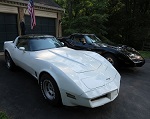
Took the '75 coupe out this AM with outside temps here in Phoenix already 90*.
Stock motor, headers, 2" aluminum radiator, 180* thermostat, no hood blanket, timing at 12* initial 35* all in.
Temp gauge right around 190*, IR gun shows 195* at the thermostat, hottest pace on the hood is closer to the radiator than right above the motor.
See pix below. All good IMHO.
Radiator looks new, as is coolant.
Motor was switched off so no fan blowing across the top of the engine...... maybe that;s the difference. Never seen it go higher than 205* even when it's 110* here.
Motor is an L48 - never pulled from the original 40K mile car. Hood paint original too.
Imo.. the 195f at thermostat housing is a little high. My 180f thermostat experience reads damn close to 180f running.
how’s radiator inside?
When running at speed, my 180F thermostat is right at 180F. When idling in my driveway, it bounces between 195F (fan on), and 185F (fan off), like clockwork.









 Engine Heat on 75 C3