



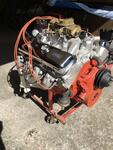





1968 427 Block numbers

Thread Starter
Advanced


Joined: Jun 2025
Posts: 86
Likes: 13
From: Will County, Illinois
 1968 427 Block numbers
Hello all.
I am new to this board, and new to the Corvette world as I just bought my 1968.
I do have a question: in front of the passenger side cylinder head are the letters/numbers : T0108IR... does anyone know what this is?
I look forward to meeting everyone and thank you all for your help!
I am new to this board, and new to the Corvette world as I just bought my 1968.
I do have a question: in front of the passenger side cylinder head are the letters/numbers : T0108IR... does anyone know what this is?
I look forward to meeting everyone and thank you all for your help!
1967 Pedal Car Champion

Joined: Mar 2020
Posts: 9,140
Likes: 4,248
From: US-PNW
There should be two series of stamps on that pad. Part of the VIN and the engine assembly plant, date, and option. The number you provided is the engine plant stamping. The other stamp should be 9 characters that begins with 18S4xxxxx where the last 5 match the last 5 of the vehicle's VIN.
T0108IR means Tonawanda, 0108 = January 8th, and IR means it was a 427 assembled as a 435 hp, triple 2-barrel carb/intake with manual transmission.
18S4xxxxx means 1=Chevrolet, 8=68, S=St. Louis, 4=just a place holder that all '68s used.
Last edited by barkingrats; Jun 27, 2025 at 11:58 PM.
Thread Starter
Advanced
Joined: Jun 2025
Posts: 86
Likes: 13
From: Will County, Illinois
Welcome!
There should be two series of stamps on that pad. Part of the VIN and the engine assembly plant, date, and option. The number you provided is the engine plant stamping. The other stamp should be 9 characters that begins with 18S4xxxxx where the last 5 match the last 5 of the vehicle's VIN.
T0108IR means Tonawanda, 0108 = January 8th, and IR means it was a 427 assembled as a 435 hp, triple 2-barrel carb/intake with manual transmission.
18S4xxxxx means 1=Chevrolet, 8=68, S=St. Louis, 4=just a place holder that all '68s used.
There should be two series of stamps on that pad. Part of the VIN and the engine assembly plant, date, and option. The number you provided is the engine plant stamping. The other stamp should be 9 characters that begins with 18S4xxxxx where the last 5 match the last 5 of the vehicle's VIN.
T0108IR means Tonawanda, 0108 = January 8th, and IR means it was a 427 assembled as a 435 hp, triple 2-barrel carb/intake with manual transmission.
18S4xxxxx means 1=Chevrolet, 8=68, S=St. Louis, 4=just a place holder that all '68s used.
I was curious as to what those numbers would mean because the previous owner told me that this was supposed to be a factory replacement block because the original owner blew up the original engine. And if it is a factory replacement, will the other stamp still show the last 5 of the VIN?
Thanks again!
Thread Starter
Advanced
Joined: Jun 2025
Posts: 86
Likes: 13
From: Will County, Illinois
1967 Pedal Car Champion
Joined: Mar 2020
Posts: 9,140
Likes: 4,248
From: US-PNW
Thank you for that information! this is very helpful because that is exactly what it is supposed to be.
I was curious as to what those numbers would mean because the previous owner told me that this was supposed to be a factory replacement block because the original owner blew up the original engine. And if it is a factory replacement, will the other stamp still show the last 5 of the VIN?
Thanks again!
I was curious as to what those numbers would mean because the previous owner told me that this was supposed to be a factory replacement block because the original owner blew up the original engine. And if it is a factory replacement, will the other stamp still show the last 5 of the VIN?
Thanks again!
An engine pad could be restamped in its entirety in order to imply that it has the original stamps. These can be very easy to very difficult to ascertain depending on the skills of deception of the person doing the stamping. Post a clear, sharp photo as PJO suggested.
Last edited by barkingrats; Jun 28, 2025 at 07:23 PM.
Thread Starter
Advanced
Joined: Jun 2025
Posts: 86
Likes: 13
From: Will County, Illinois
Those were actually called warranty replacement engines. A warranty replacement engine (block w/crank, pistons, camshaft) came from Chevrolet with a stamp only showing a CE prefix before a series of numbers (possibly a single letter A, or B, or C...) indicating where in the warranty engine sequence this one falls for the year it was made. The CE blocks did not have a VIN sequence on them - unless someone at the dealership or a machine shop added it later. These sorts of stamps are easy to spot compared to the stamps done on the assembly line at St. Louis.
An engine pad could be restamped in its entirety in order to imply that it has the original stamps. These can be very easy to very difficult to ascertain depending on the skills of deception of the person doing the stamping. Post a clear, sharp photo as PJO suggested.
An engine pad could be restamped in its entirety in order to imply that it has the original stamps. These can be very easy to very difficult to ascertain depending on the skills of deception of the person doing the stamping. Post a clear, sharp photo as PJO suggested.

Here is the one on the front of the block … I haven’t found the other stamp yet.
Corvette Stories
The Best of Corvette for Corvette Enthusiasts

Top 10 Most Expensive Corvettes Ever Sold on Bring A Trailer
Brett Foote
10 Things Every Corvette Owner Needs (2026 Edition)
Michael S. Palmer
8 Most "Only Corvette Owners Understand" Quirks and Problems
Pouria Savadkouei
10 Reasons the C6 Z06 is Still A Performance Benchmark After 20 Years
Joe Kucinski
How Much Horsepower Every Corvette Engine "LOST" in 1972
Joe Kucinski
Top 10 DOs and DON'Ts for Protecting Your Convertible Top!
Michael S. Palmer
Top 10 Most Explosive Corvettes Ever Made: Power-to-Weight Ratio Ranked!
Joe Kucinski
150 hp to 1,250 hp: Every Corvette Generation Compared by the Specs That Matter
Joe Kucinski
8 Coolest Corvette Pace Cars (and Replicas) of All Time
Verdad Gallardo
1967 Pedal Car Champion
Joined: Mar 2020
Posts: 9,140
Likes: 4,248
From: US-PNW
You can look for further clues as to what your engine is by posting the long casting number on the rear, top of the bellhousing flange on the driver's side. Then look for the casting date - it may be on the lower block wall, middle of the passenger side - in front of the starter or on the passenger flange opposite the casting number. If you pull the valve covers, you'll find the head casting numbers and dates.
Last edited by barkingrats; Jun 29, 2025 at 12:02 AM.
Thread Starter
Advanced
Joined: Jun 2025
Posts: 86
Likes: 13
From: Will County, Illinois
I hate to say this, but that's a restamped block (after it was decked by a machine shop). The character alignment and spacing is too variable for how Chevrolet engines were stamped at the engine plants. I'd say the story you were told about a replacement is likely true, but it's not a warranty replacement from Chevy. That you don't see the VIN stamping to the right of this one confirms it's not original to this car.
You can look for further clues as to what your engine is by posting the long casting number on the rear, top of the bellhousing flange on the driver's side. Then look for the casting date - it may be on the lower block wall, middle of the passenger side - in front of the starter or on the passenger flange opposite the casting number. If you pull the valve covers, you'll find the head casting numbers and dates.
You can look for further clues as to what your engine is by posting the long casting number on the rear, top of the bellhousing flange on the driver's side. Then look for the casting date - it may be on the lower block wall, middle of the passenger side - in front of the starter or on the passenger flange opposite the casting number. If you pull the valve covers, you'll find the head casting numbers and dates.
I’ll take a look at those casting numbers and let you know what I find.
He also gave me a booklet that came along with the owners manual with the word “replacement” stamped on the cover, if it means anything… I think he said it was associated with the engine.

Le Mans Master


Joined: Mar 2004
Posts: 7,502
Likes: 1,510
From: Little Rock AR
That Corvette may have had its engine replaced under warranty, but the block that is in there now does not have an original engine stamping. You still have a great car, but this replacement engine would be a bit disappointing if you previously believed it was something else.
Thread Starter
Advanced
Joined: Jun 2025
Posts: 86
Likes: 13
From: Will County, Illinois
That Corvette may have had its engine replaced under warranty, but the block that is in there now does not have an original engine stamping. You still have a great car, but this replacement engine would be a bit disappointing if you previously believed it was something else.
Thanks guys!

Thread Starter
Advanced
Joined: Jun 2025
Posts: 86
Likes: 13
From: Will County, Illinois
1967 Pedal Car Champion
Joined: Mar 2020
Posts: 9,140
Likes: 4,248
From: US-PNW
Yep, looks like the 3916321 427 2&4 bolt mains block was only used in 1968 but in quite a variety of engine horsepower options: 385hp, 390hp, 400hp, 425hp, 430hp, 435hp. For Corvettes those would have been the 390, 400, & 435 for regular optioned cars while the 430 sounds like an L-88.
Thread Starter
Advanced
Joined: Jun 2025
Posts: 86
Likes: 13
From: Will County, Illinois

Thread Starter
Advanced
Joined: Jun 2025
Posts: 86
Likes: 13
From: Will County, Illinois
[QUOTE=barkingrats;1608915582]Those were actually called warranty replacement engines. A warranty replacement engine (block w/crank, pistons, camshaft) came from Chevrolet with a stamp only showing a CE prefix before a series of numbers (possibly a single letter A, or B, or C...) indicating where in the warranty engine sequence this one falls for the year it was made. The CE blocks did not have a VIN sequence on them - unless someone at the dealership or a machine shop added it later. These sorts of stamps are easy to spot compared to the stamps done on the assembly line at St. Louis.
An engine pad could be restamped in its entirety in order to imply that it has the original stamps. These can be very easy to very difficult to ascertain depending on the skills of deception of the person doing the stamping. Post a clear, sharp photo as PJO suggested.[/QUOTE
Does anyone know if they wrote or stamped anything on the factory warranty book that came with these cars if a block was indeed replaced?
The warranty book with this car has “Replacement” stamped on the cover… I wonder if this has anything to do with it?
An engine pad could be restamped in its entirety in order to imply that it has the original stamps. These can be very easy to very difficult to ascertain depending on the skills of deception of the person doing the stamping. Post a clear, sharp photo as PJO suggested.[/QUOTE
Does anyone know if they wrote or stamped anything on the factory warranty book that came with these cars if a block was indeed replaced?
The warranty book with this car has “Replacement” stamped on the cover… I wonder if this has anything to do with it?