



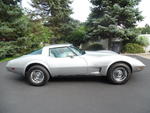


79 Corvette Weak A/C

Thread Starter
Advanced

Joined: Apr 2023
Posts: 67
Likes: 7
 79 Corvette Weak A/C
Hello all, I've been running into a interesting issue with the a/c on my car. This car was previously converted to r134a before I got it, but I've replaced the compressor (due to it leaking) and drier on the a/c system. Vacuumed out and recharged with 3-3.25 cans of r134a (36-40 oz). To maintain a decently consistent test I've ran the car at 1000 rpm with dual electric fans running constantly.
Today I tested the system and I'm getting around 70-75F air out the vents (65F when driving and that's being generous), which is cooler than the 92F it is outside, but obviously not enough to cool the inside of the car. The low side shows a pressure of about 43psi, which seems a little low to me.
I've failed to see if there is a high pressure quick connect on this car, but if there is one I do have the gauges to check it.
However every time the a/c gets turned off when the engine turns off, an audible hiss happens with the pressure equalizing in the system. Not sure how normal that is. Theory is maybe there's an internal blockage, not sure how to check for that.
Any help appreciated, I'm pretty stumped.
Today I tested the system and I'm getting around 70-75F air out the vents (65F when driving and that's being generous), which is cooler than the 92F it is outside, but obviously not enough to cool the inside of the car. The low side shows a pressure of about 43psi, which seems a little low to me.
I've failed to see if there is a high pressure quick connect on this car, but if there is one I do have the gauges to check it.
However every time the a/c gets turned off when the engine turns off, an audible hiss happens with the pressure equalizing in the system. Not sure how normal that is. Theory is maybe there's an internal blockage, not sure how to check for that.
Any help appreciated, I'm pretty stumped.

Le Mans Master


Joined: Apr 2011
Posts: 6,284
Likes: 1,171
From: Hermosa
Your 79 system has an orifice tube at least which if it comes to changing that is a lot easier vs the old systems.
First you should be at 1500 to 1800 RPM to check pressure. 43 PSI at 92* would indicate that it is low on freon. I would try charging it to an appropriate pressure level first. Google up a chart for low and high pressures for 134a.
The ford blue vs the white orifice tube will give more pressure drop and lower temps. Did you change the orifice tube when you changed the drier?
First you should be at 1500 to 1800 RPM to check pressure. 43 PSI at 92* would indicate that it is low on freon. I would try charging it to an appropriate pressure level first. Google up a chart for low and high pressures for 134a.
The ford blue vs the white orifice tube will give more pressure drop and lower temps. Did you change the orifice tube when you changed the drier?
Le Mans Master
Joined: Apr 2011
Posts: 6,284
Likes: 1,171
From: Hermosa
It gets dirty and can partially or fully clog. In addition the orifice tube originally in there was for R12 if you converted to 134a, R12 is a larger molecule. Your cooling performance will be less with the original orifice tube size. Like I said the blue would be more appropriate than the white. The blue has a smaller orifice.
Thread Starter
Advanced
Joined: Apr 2023
Posts: 67
Likes: 7
Could make sense it's clogged, as before I changed out the compressor the system did run cool, just leaked the freon out fast. I never thought the orifice tube had a filter, just thought of it more of a restrictor. The system was open for a while when the engine was rebuilt. so maybe enough junk got in there.
Le Mans Master
Joined: Apr 2011
Posts: 6,284
Likes: 1,171
From: Hermosa
Takes a lot of vacuuming down to get a system that's been open free of moisture. If you vacuum it down again let it sit for a good 30 mins after vacuuming down to both test for leaks and also allow the moisture time to evaporate off.

Melting Slicks


Joined: May 2002
Posts: 2,716
Likes: 121
From: Sulphur LA
St. Jude Donor '05-'06,'11,'13-'14,'16,'18,'19,'24, '25
vette's can be somewhat of a challenge to check the charge as the hood can partially block the condenser and radiator when open. If possible connect the service gauges and then lower the hood, if not hot air form the engine will recirculate into the condenser and radiator elevating the pressures giving misleading information.
with the engine running at around 1500 to 1800 rpm, AC on max and fan on high is the suction line cold and sweating back to the compressor?
Really need both low and high side readings to correctly evaluate the charge.
Place a fan in front of the car blowing on high into the condenser while checking the charge lvl.
Neal
with the engine running at around 1500 to 1800 rpm, AC on max and fan on high is the suction line cold and sweating back to the compressor?
Really need both low and high side readings to correctly evaluate the charge.
Place a fan in front of the car blowing on high into the condenser while checking the charge lvl.
Neal
Corvette Stories
The Best of Corvette for Corvette Enthusiasts

Top 10 Most Explosive Corvettes Ever Made: Power-to-Weight Ratio Ranked!
Joe Kucinski
150 hp to 1,250 hp: Every Corvette Generation Compared by the Specs That Matter
Joe Kucinski
8 Coolest Corvette Pace Cars (and Replicas) of All Time
Verdad Gallardo
Top 10 Corvette Engines RANKED by Peak Torque (70+ Years of Muscle!)
Joe Kucinski
Corvette ZR1X Will Be Pacing the Indy 500, And Could Probably Race, Too!
Verdad Gallardo
Top 10 Corvettes Coming to Mecum Indy 2026!
Brett Foote
Top 10 C9 Corvette MUST-HAVES to Fix These C8 Generation Flaws!
Michael S. Palmer
10 Revolutionary 'Corvette Firsts' Most People Don't Know
Joe Kucinski
5 Reasons to Upgrade to an LS6-Powered Corvette; 5 Reasons to Stay LT2
Michael S. Palmer
Thread Starter
Advanced
Joined: Apr 2023
Posts: 67
Likes: 7
I have verified the heater valve to not be an issue, I have it constantly closed with a vacuum. With the a/c turned off (Vent) and the temp is set to it's coldest I will still get outside air temp, not any hotter (with the engine at operating temperature).
I'd find it real hard to believe this thing is low on charge, I know I have a good 40 oz of r134a in the system, possibly even a little more. Which from what I've seen online would be about right, or the max. Hopefully I didn't overfill it, but it never really got too cold while charging.
I do agree with changing the orifice tube, as I'm not sure what is currently being used.
I'd find it real hard to believe this thing is low on charge, I know I have a good 40 oz of r134a in the system, possibly even a little more. Which from what I've seen online would be about right, or the max. Hopefully I didn't overfill it, but it never really got too cold while charging.
I do agree with changing the orifice tube, as I'm not sure what is currently being used.
Le Mans Master
Joined: Apr 2011
Posts: 6,284
Likes: 1,171
From: Hermosa
The only thing you know is that you put 40oz in, unless you also know the system is not leaking.
not having the right orifice tube and an old one at that will impact your temp quite a lot. If it were me I would start over,, put in the correct orifice tube, vacuum it down thoroughly, let it sit for a min of 30 mins see if the pressure changes. Then when you fill the system make sure no air is introduced through the charging line,, bleed off a bit of 134a at the connector on the car to insure this. Use a pressure chart to get the right low side at least pressure, that changes with temperature and humidity. At higher for either then the low side pressure is also higher.
You've got to start with a good known in order to troubleshoot other possible problems that can give you a high duct temp.
not having the right orifice tube and an old one at that will impact your temp quite a lot. If it were me I would start over,, put in the correct orifice tube, vacuum it down thoroughly, let it sit for a min of 30 mins see if the pressure changes. Then when you fill the system make sure no air is introduced through the charging line,, bleed off a bit of 134a at the connector on the car to insure this. Use a pressure chart to get the right low side at least pressure, that changes with temperature and humidity. At higher for either then the low side pressure is also higher.
You've got to start with a good known in order to troubleshoot other possible problems that can give you a high duct temp.
Last edited by REELAV8R; Jul 20, 2025 at 05:04 PM.

Le Mans Master
Joined: Apr 2011
Posts: 6,284
Likes: 1,171
From: Hermosa
Did the system cool well before you changed the compressor when and if the old compressor did work?
Did you add more oil to the system? If so what type oil? And if you did add oil was the system first purged of oil that was in it?
Did you add more oil to the system? If so what type oil? And if you did add oil was the system first purged of oil that was in it?

Drifting


Joined: Aug 2019
Posts: 1,334
Likes: 225
The inlet pipe and the outlet pipe to the evaporator should feel cold to the touch. Just curious, does the compressor cycle at all. Normally it will cycle at about 35psi on the low side. If it doesn't, either it's undercharged, or there's still air in the system. If the inlet pipe is not cold, then feel the line right up to the orifice tube. It should be cold right after that going into the evaporator. If not, that orifice might be the issue.
Thread Starter
Advanced
Joined: Apr 2023
Posts: 67
Likes: 7
I never stated I was a genius with a/c systems. Have to learn some how.
The inlet pipe and the outlet pipe to the evaporator should feel cold to the touch. Just curious, does the compressor cycle at all. Normally it will cycle at about 35psi on the low side. If it doesn't, either it's undercharged, or there's still air in the system. If the inlet pipe is not cold, then feel the line right up to the orifice tube. It should be cold right after that going into the evaporator. If not, that orifice might be the issue.
Following the line backwards I can feel the cool line before and after the evaporator, as well as right past the orifice tube.
Wouldn't surprise me if I need to clean the area around the evaporator, just not sure if there is a way to access it.
Le Mans Master
Joined: Apr 2011
Posts: 6,284
Likes: 1,171
From: Hermosa
Ahhh... yes I did add more oil to the system. Used PAG 150 I believe, what ever the compressor called for. The a/c got to a real low temp with the old compressor, like high 30's F. Does removing the old oil require a complete flush of the system, I thought the compressor or accumulator/drier would house most of it.
I never stated I was a genius with a/c systems. Have to learn some how.
The compressor stays constantly on. The inlet to the compressor does sweat, decently cool to the touch.
Following the line backwards I can feel the cool line before and after the evaporator, as well as right past the orifice tube.
Wouldn't surprise me if I need to clean the area around the evaporator, just not sure if there is a way to access it.
I never stated I was a genius with a/c systems. Have to learn some how.
The compressor stays constantly on. The inlet to the compressor does sweat, decently cool to the touch.
Following the line backwards I can feel the cool line before and after the evaporator, as well as right past the orifice tube.
Wouldn't surprise me if I need to clean the area around the evaporator, just not sure if there is a way to access it.
PAG is not compatible with mineral oil. So if it wasn't flushed in the conversion and ester oil was being used then you adding PAG would cause problems with residual mineral oil. Mineral mixed with PAG tends to gel. That's worst case scenario.
better case is that it was flushed and PAG or ester was used and you adding more PAG puts too much oil in the system which drastically reduces it's efficiency.
the system only holds 6 oz of oil.
So if you didn't drain it of oil and then added more, then that's likely your problem.
Or you now have a mixture of PAG and residual mineral oil with ester.
On a conversion in which you don't know what was done ALWAYS use ester oil. It is compatible with mineral oil and PAG both, and can be carried by 134a.
Drifting
Joined: Aug 2019
Posts: 1,334
Likes: 225
Ahhh... yes I did add more oil to the system. Used PAG 150 I believe, what ever the compressor called for. The a/c got to a real low temp with the old compressor, like high 30's F. Does removing the old oil require a complete flush of the system, I thought the compressor or accumulator/drier would house most of it.
I never stated I was a genius with a/c systems. Have to learn some how.
The compressor stays constantly on. The inlet to the compressor does sweat, decently cool to the touch.
Following the line backwards I can feel the cool line before and after the evaporator, as well as right past the orifice tube.
Wouldn't surprise me if I need to clean the area around the evaporator, just not sure if there is a way to access it.
I never stated I was a genius with a/c systems. Have to learn some how.
The compressor stays constantly on. The inlet to the compressor does sweat, decently cool to the touch.
Following the line backwards I can feel the cool line before and after the evaporator, as well as right past the orifice tube.
Wouldn't surprise me if I need to clean the area around the evaporator, just not sure if there is a way to access it.
Le Mans Master
Joined: Apr 2011
Posts: 6,284
Likes: 1,171
From: Hermosa
If the compressor is on constantly, either it's undercharged, or there's still air in the system. The system should pull down to about 35 psi on the low side, which will cause the compressor to stop, until the pressure rises to about 45 psi, which will cause the compressor to run again, and the cycle will restart. This is all assuming the compressor is good, and the high side pressure is good. When you evacuated, how long did you evacuate?
Actually if the compressor stays running even at 1500 to1800 rpm it is charged properly. If it were low it would cycle off when you see the pressure dropped too low, about 25 to 30psi, if it were overcharged you would see a high low side pressure and rapid cycling of the clutch as it bounced off the high side pressure switch
If it keeps running constant that's the sweet spot.
Drifting
Joined: Aug 2019
Posts: 1,334
Likes: 225
.
Actually if the compressor stays running even at 1500 to1800 rpm it is charged properly. If it were low it would cycle off when you see the pressure dropped too low, about 25 to 30psi, if it were overcharged you would see a high low side pressure and rapid cycling of the clutch as it bounced off the high side pressure switch
If it keeps running constant that's the sweet spot.
Actually if the compressor stays running even at 1500 to1800 rpm it is charged properly. If it were low it would cycle off when you see the pressure dropped too low, about 25 to 30psi, if it were overcharged you would see a high low side pressure and rapid cycling of the clutch as it bounced off the high side pressure switch
If it keeps running constant that's the sweet spot.
Le Mans Master
Joined: Apr 2011
Posts: 6,284
Likes: 1,171
From: Hermosa
If there is too much oil in the system it still will not cool properly. The oil displaces freon (134a). Oil does not add to the cooling. So for every component of freon there is too much oil limiting the cooling effect of the freon. Only the freon when changing state (liquid to vapor) contributes to the cooling.
Pressures can still be fine as far as the system is concerned and the limit switches are concerned, but still not cool adequately due to improper levels of oil.
As far as pressure is concerned, if the pump runs continuously while observing it in these old corvettes then it's running well.