When you click on links to various merchants on this site and make a purchase, this can result in this site earning a commission. Affiliate programs and affiliations include, but are not limited to, the eBay Partner Network.
What is the correct setup for the throttle return on an L88. There is a spot for a spring on the throttle cable bracket, but that seems to bind when at WOT. Any pics would be appreciated! Thank you
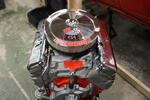
This photo shows the return spring on the wannabe ZL-1 (my opinion), but the carburetor return spring installation would be the same on a second design L-88 in any case.
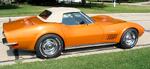
This is a photo of the 4296 for my car. The throttle bracket is a bit different, but the return spring attachment is in roughly the same location (wonder if they used a 4054 on the orange car?).
Regards,
Stan Falenski
Last edited by Rowdy Rat; Jan 5, 2026 at 10:27 PM.
Reason: Added photo.
Top photo in post above appears to be a 4054 like this one.
So now you have the return spring attachment point on the carburetor for both first and second design C3 L-88s… 1968 - early 1969 4054 cars and late 1969 4296 cars.
I have two pages from the 1969 A.I.M., first shows the air cleaner base (listed as RETAINER, #6) with a part number of 6422188.
Second page shows the carburetor, part number 3955205. This is the part number for the 4296 Holley. Both pages were drawn in late May (1969) and released June 10 (1969) which was about the time the second design L-88s started appearing (certainly the majority anyway). I think it is safe to say that the 6422188 base worked with the 3955205 carburetor.
The parts book lists the 6422188 base and has multiple applications, both big block and small block from 1965 to 1972.
I don’t see a particular application for the L-88, nor do I see a big block application for 1968 to 1972. We do know that it will fit some big blocks as it is listed for 1965 to 1967 396 and 427. The only big block, four barrel Holley air cleaner base that I KNOW was different than the others was the 1971 LS-6 version that had a very compressed tube with a sharp bend coming from the flame arrestor. Going further, the GM parts book lists different part numbers for air cleaner assemblies for 1968 to 1969 Quadrajet (most likely open element air cleaner assembly as 1970 to 1972 454 has a different part number) as it excludes 3x2 (L-68, L-71, L-71/L-89), H.D. 427 (L-88, L-88/ZL-1) and SP. H/PER 350 (the LT-1 was supposed to be released in 1969). The part numbers for 1966 to 1967 427 (1965 396 used a different cover) and 1969 to 1972 SP. H/PER. (again assumes a 1969 LT-1 was available) use the same part number (6423907), as it did for the bases which makes sense.
So what does this all mean? When I was judging heavily for NCRS and Bloomington Gold, I heard about all the hard to find parts for these cars (still do hear about it to a degree). As far as L-88 air cleaners were concerned, original filter sleeves and seals were always impossible to find… Never heard a word about bases. The parts books and A.I.M. would tend to agree that the L-88 bases should be the same as the earlier 396/427 bases and later LT-1 350 bases, all of which used four barrel Holley carburetors.
Now the big question… Does all the theory that I posted actually hold true? I’ll be honest, I’m not sure. You’re going to make me dig out my 4296 (which is safely packed away at this point) and check it out if I get curious enough! For now though, I’m inclined to believe that everything should fit according to GM. At some point though, I’m going to find out!
Regards,
Stan Falenski
Last edited by Rowdy Rat; Jan 6, 2026 at 11:24 AM.
What is the correct setup for the throttle return on an L88. There is a spot for a spring on the throttle cable bracket, but that seems to bind when at WOT. Any pics would be appreciated! Thank you
Stan:
I have no real clue what carb came on the L88s. It is an interesting puzzle.
I know that the normal drop base, fits my LS6 clone just fine, despite the short intake manifold.
And the air intake pipe clears and hooks up fine.
I have heard a lot of stories on the L88 carbs. What was stock vs what got changed out 5 min later for real racing. Maybe sticks and autos got different carbs. I have seen errors before in both the Holley books and the GM parts books, so it is hard to trust them 100% on something this rare.
These carbs were also sold over the counter and were the "hot ticket" for racers back then. Looking at dates for carbs sold online many vac sec carbs 4054, have earlier dates, pre-70. And many of the DP 4296 carbs have post 69 dates, so they are obviously over the counter carbs, despite the ridiculous "sale" prices suggested.
But what I do know, because I help out part time at a local corvette shop, is what fits and what does not. I see a lot of corvettes, and BBs are my fav.
DP Holley's do not fit the typical GM drop base air cleaner fresh air tube. It is located exactly where the secondary pump is.
This is the typical mod required when someone insists on running a DP Holley on their C3 BB. Squash the tube. This air cleaner is OEM, 69? and is the "test-fit" air cleaner at the shop.
This is the repop'd 67 L88 air cleaner base, that the shop typically uses in those applications, as it has NO air tube.
I remember seeing a pic of a 67 L88 that had a road draft tube, so it had no PCV valve, and no air cleaner pipe for fresh air.
A DP fits just fine using the 67 air cleaner base, so maybe? that is what the 67s came with?
PCV systems began in about 1968 due to the clean air act. It baffles me that GM would put a DP on a 69 L88, violate the clean air act, and it would not fit the air cleaner? Or put a air intake filter on the valve cover, or delete the PCV?
I am sure someone knows more about this than I do, and can maybe explain it.
Or maybe we will never know for sure.....
Last edited by leigh1322; Jan 6, 2026 at 07:07 PM.
I know.
And yet the drawing in the AIM above shows a vacuum secondary.
And how would the air pipe fit with a D.P.?
Those same docs show a 69 LT-1.
So it is hard to know what is 100% correct.
Like I said. It's a curiosity.
The 67 was a real race car, only 20 made, no heater, no defroster, no air tube, road vent, I could see a double pumper there easily.
GM was forced to add a heater to the L88, And kill the road tube. And add a PCV.
So I have heard proposed that the cars actually got delivered with vac secondaries, because they were forced to, and the D.P. was made an over the counter part.
Maybe all the documents did not get updated for a low volume car, with last minute changes.
That scenario works better for my logic brain than the other.
Last edited by leigh1322; Jan 6, 2026 at 09:39 PM.
If I remember correctly the L88's used a Vacuum Secondary carburetor and not a Double Pumper. The double pumper would have seemed logical to me but they chose the vacuum secondary type carburetor for the factory L88's. I know a guy who bought a L88 back in 1968 and he told me that he had the original vacuum secondary from the L88 and wanted to know if I wanted to buy it. I am not a big fan of the Vacuum secondary carburetors so I was not interested despite it being an original L88 part.
The Standard factory "single carburetor" throttle cable bracket works great for me and clears all the parts on the drop base. I have used them ever since I started running my L88 Hood and they fit just fine.
My hood is a factory unit and has the provisions for the "Draft Tube" which was the engine's primary crankcase ventilation point. The hole in my hood for the draft tube was sealed up with a metal plate that fits over the hole and keeps it sealed. I now run the standard PCV and it works just fine.
This hood is a 1968 and even in 1968 the L88's did not come with Heat. This was found online using Google" "Factory L88 Corvettes were intentionally built without heat (and radios, A/C, etc.) to save weight and discourage street use. Chevrolet wanted serious racers to buy these cars, not casual drivers; the lack of creature comforts, combined with the need for high-octane fuel and a rough-idling engine, made them impractical for the street."
I don't agree that the 1967 was a Race car and the rest of the L88's were slower cousins. "The entire production of L88's were all intended to be raced and not street driven. The primary goal was to create a pure race car, and removing non-essential items like heaters, radios, and air conditioning lowered the car's weight, improving its power-to-weight ratio."
There is one exception I found online: TheFactory Exception: While standard L88s omitted the heater, at least one documented 1967 L88 (a unique Rally Red on Red car) was built with a heater from the factory, a highly unusual occurrence.
In 1968 they only made 80 L88 Corvettes during the year. They too were race cars as were the 1969 models that followed them.
I heard the Gulf ZR1 running and knew I wanted an engine that sounds and runs like that ferocious engine.
My apology to the OP. I got a bit off track on this, but I’m really into the 1968-1972 Corvettes so this is of great interest to me… Glad to see that Mel was able to give you some good advice to solve your issue.
First design L-88s used in 1968 and early 1969 Corvettes (coded IT with M-22 in 1968-1969 and MR with M-40 in 1969) were equipped with a 4054, vacuum secondary Holley. These were used up until roughly June 1969 when the (at least the majority) second design L-88 was brought into production (coded LO with M-22 and LV with M-40; these would also include the ZL-1s coded ME and MG respectively) at that point, a 4296, double pumper Holley was used. I’ve seen my fair share of original Corvettes (L-88s included) and I can say with a great deal of certainty that is how they were delivered. There were running changes throughout the three year L-88 production run, but the major change in 1969 (from first to second design) was substantial and included more than just the change in carburetors. Everything was designed to work together… Heads, cam, carb, all of it.
Leigh, I don’t know the answer to your question, “Does it fit?” I’m curious now though so I’ll poke around my parts storage area for the 1969 and see if I can locate the carb easily. If I can, I’ll check it. I also have a call out to a buddy of mine who had a very late L-88 (4296 carb) to see if he remembered anything in particular about the air cleaner. I’ll certainly be watching out for this in the future, that’s for sure.
If I remember correctly the L88's used a Vacuum Secondary carburetor and not a Double Pumper. The double pumper would have seemed logical to me but they chose the vacuum secondary type carburetor for the factory L88's. I know a guy who bought a L88 back in 1968 and he told me that he had the original vacuum secondary from the L88 and wanted to know if I wanted to buy it. I am not a big fan of the Vacuum secondary carburetors so I was not interested despite it being an original L88 part.
As mentioned, all 1968 and early 1969 L-88s used a 4054, vacuum secondary Holley. The later (June 1969 and later) 1969 L-88s used the 4296, double pumper Holley.
My hood is a factory unit and has the provisions for the "Draft Tube" which was the engine's primary crankcase ventilation point. The hole in my hood for the draft tube was sealed up with a metal plate that fits over the hole and keeps it sealed. I now run the standard PCV and it works just fine.
Are you referring to the flame arrestor that sits on top of the air cleaner base and is connected to the vent tube that goes to the PCV? If so, that’s not the road draft tube, which was a 1967 L-88 part.
This hood is a 1968 and even in 1968 the L88's did not come with Heat. This was found online using Google" "Factory L88 Corvettes were intentionally built without heat (and radios, A/C, etc.) to save weight and discourage street use. Chevrolet wanted serious racers to buy these cars, not casual drivers; the lack of creature comforts, combined with the need for high-octane fuel and a rough-idling engine, made them impractical for the street."
Federal law for the 1968 model year required a working defroster, which meant a working heater. I’ve posted the law in its entirety in the past (not going to do it again, I’m sure you can do a search on it if interested). I’ve seen a lot of L-88 Corvettes over the 45 years I’ve been into these cars. Every real 1968-1969 L-88 Corvette I’ve had the chance to look at has had a heater.
There is one exception I found online: TheFactory Exception: While standard L88s omitted the heater, at least one documented 1967 L88 (a unique Rally Red on Red car) was built with a heater from the factory, a highly unusual occurrence..
I know of only one, real red/red 1967 L-88. I knew the previous owners, rode in the car, and have copies of the paperwork. It was a heater delete car… Just like all of the other 1967 L-88s.
If I remember correctly the L88's used a Vacuum Secondary carburetor and not a Double Pumper. The double pumper would have seemed logical to me but they chose the vacuum secondary type carburetor for the factory L88's. I know a guy who bought a L88 back in 1968 and he told me that he had the original vacuum secondary from the L88 and wanted to know if I wanted to buy it. I am not a big fan of the Vacuum secondary carburetors so I was not interested despite it being an original L88 part.
The Standard factory "single carburetor" throttle cable bracket works great for me and clears all the parts on the drop base. I have used them ever since I started running my L88 Hood and they fit just fine.
My hood is a factory unit and has the provisions for the "Draft Tube" which was the engine's primary crankcase ventilation point. The hole in my hood for the draft tube was sealed up with a metal plate that fits over the hole and keeps it sealed. I now run the standard PCV and it works just fine.
This hood is a 1968 and even in 1968 the L88's did not come with Heat. This was found online using Google" "Factory L88 Corvettes were intentionally built without heat (and radios, A/C, etc.) to save weight and discourage street use. Chevrolet wanted serious racers to buy these cars, not casual drivers; the lack of creature comforts, combined with the need for high-octane fuel and a rough-idling engine, made them impractical for the street."
I don't agree that the 1967 was a Race car and the rest of the L88's were slower cousins. "The entire production of L88's were all intended to be raced and not street driven. The primary goal was to create a pure race car, and removing non-essential items like heaters, radios, and air conditioning lowered the car's weight, improving its power-to-weight ratio."
There is one exception I found online: TheFactory Exception: While standard L88s omitted the heater, at least one documented 1967 L88 (a unique Rally Red on Red car) was built with a heater from the factory, a highly unusual occurrence.
In 1968 they only made 80 L88 Corvettes during the year. They too were race cars as were the 1969 models that followed them.
I heard the Gulf ZR1 running and knew I wanted an engine that sounds and runs like that ferocious engine.
You mention the standard PCV, is that the 736C or the 746C? Parts catalog shows the 746C for HD 427 and LT1 which currently goes on the secondary market for a crazy $300. I can only guess that the spring inside is designed for engines with low vacuum at idle, externally the same
Are you guys using the factory filter element or is there a better option that works without modifying the factory hood?
I intend to use the original L-88 set up with the actual filter element in the hood.
Originally Posted by leigh1322
Stan:
I have no real clue what carb came on the L88s. It is an interesting puzzle.
I know that the normal drop base, fits my LS6 clone just fine, despite the short intake manifold.
And the air intake pipe clears and hooks up fine.
Leigh,
I can tell you from experience that the LS-6 air cleaner base is different than anything else. The tube that goes to the flame arrestor bends up very close to the bottom of the base and extends past the base 2”-3”… If I still had my LS-6, I’d post a photo of it. Will a regular Holley base work? Probably, but that isn’t what was originally installed.
I have heard a lot of stories on the L88 carbs. What was stock vs what got changed out 5 min later for real racing. Maybe sticks and autos got different carbs. I have seen errors before in both the Holley books and the GM parts books, so it is hard to trust them 100% on something this rare.
These carbs were also sold over the counter and were the "hot ticket" for racers back then. Looking at dates for carbs sold online many vac sec carbs 4054, have earlier dates, pre-70. And many of the DP 4296 carbs have post 69 dates, so they are obviously over the counter carbs, despite the ridiculous "sale" prices suggested.
I don’t know… From what I have seen over the years, I’m reasonably sure of what carburetors were used on the L-88s. As far as prices, yeah, they’re expensive! The 4054s are rarely seen and the last one that I saw sold went for almost $5,000 and that one needed restored which probably ran another $500 to $1,000. The 4296s were sold in larger numbers, but as you mentioned, production dated carbs bring a lot more money than service dated carbs… You just have to know which is which.
DP Holley's do not fit the typical GM drop base air cleaner fresh air tube. It is located exactly where the secondary pump is.
This is the typical mod required when someone insists on running a DP Holley on their C3 BB. Squash the tube. This air cleaner is OEM, 69? and is the "test-fit" air cleaner at the shop.
OK… I had to know!
Never heard of any issues with air cleaner bases and 4296s. Called a buddy who had a very late build L-88 with a second design (4296 equipped) engine. He used a reproduction (he purchased) 6422188 base with no issues. Asked him if he had to massage it or modify it in any way… “No.”
So I had to find out for myself. Dug out my 6422188 base and my 4296 carb and put them together… While close, there is no interference between the pump arm and the flame arrestor tube. I neglected to install a carb to base gasket when I did this which adds another 3/64” of clearance. In any case, it fits. I’m not sure what base your shop is using Leigh, but I suspect it isn’t the correct part for the application.
Base installed, sits flat and installed correctly on carburetor.
Close, but there is clearance (this without the gasket).
Thanks much Stan!
I am glad the stock DP fits!
That clears up a little mystery for me.
To me, it looks like the difference between the 30cc Holley pump and the 50cc Holley pump would be more than enough to cause the problem.
The 50cc one looks much taller.
I guess that is the one that has the problem.
The shop gets a lot of cars in that have been severely modified over the years, and have to un-do many of those modifications, to get them to run right. 30cc pump arm











 L88 Throttle return setup