When you click on links to various merchants on this site and make a purchase, this can result in this site earning a commission. Affiliate programs and affiliations include, but are not limited to, the eBay Partner Network.
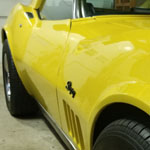
I have a 1969 Corvette, small block with auto and A/C. My A/C was not working so I replaced most parts, like the dryer, POA valve, etc. I purchased a R134a ready compressor and reinstalled all components. I had cold A/C - what a joy!
Any way, driving on the highway one day my belt suddenly made a heck of a noise and I had to immediately shut off the A/C. This is the carnage I found:
Here is a close up.
It looks like my manifold lines (that I did not replace) had somehow failed. It looks like a stress related failure. By the way, all parts were reinstalled in stock location so I am not sure how the line was stressed. But my main pain point is that my brand new compressor seized.
I don't have a lot of A/C experience with old Chevy's, but most other systems have a low pressure switch that will shut off the compressor if there is no freon pressure in the system. My question is this: It doesn't seem that the stock 69 system has a safety low pressure switch. Is this correct?
If it is correct, have folks added one to help protect the compressor?
Thanks in advance for the help - I don't want to replace my next compressor AGAIN!!!
When you finished your rebuild work what were the high side and low side pressures reading on your manifold gauges while the engine was running with the A/C switched on? What engine speed (rpm) were these readings taken at? What was the ambient air temperature in the area? How many ounces of refrigerant (R-134A) did you put in the system?
Did you reverse flush the lines, evaporator, high side muffler, and condenser with A/C flush solvent before installing all of the new parts to the system?
The fact that the high side muffler blew up isn't necessarily because of some sort of mechanical vibration or movement breaking the liquid line. Over-pressure conditions are very suspect. Changing the chemistry from R-12 to R-134A requires proper technique. You did a lot of work to what is basically a big chemistry experiment and it blew up. You need to figure out why.
When you finished your rebuild work what were the high side and low side pressures reading on your manifold gauges while the engine was running with the A/C switched on? What engine speed (rpm) were these readings taken at? What was the ambient air temperature in the area? How many ounces of refrigerant (R-134A) did you put in the system?
Did you reverse flush the lines, evaporator, high side muffler, and condenser with A/C flush solvent before installing all of the new parts to the system?
The fact that the high side muffler blew up isn't necessarily because of some sort of mechanical vibration or movement breaking the liquid line. Over-pressure conditions are very suspect. Changing the chemistry from R-12 to R-134A requires proper technique. You did a lot of work to what is basically a big chemistry experiment and it blew up. You need to figure out why.
Sorry for the slow reply - I was out of town for a couple of days...
First, I am not an A/C guy, so if I did something wrong, I certainly want to learn!
Starting point was a factory A/C system that was 100% complete and assembled, but not working. Power to the compressor had been removed and the system had not been used for many years, although I do not know for how long - this was before I owned the car.
When I disassembled the system, I found a crack in a high side hose to the expansion valve that was the likely culprit for the demise of the original system.
I replaced every component in the A/C system except the condenser, evaporator and the manifold lines I showed in my initial picture. The POA was replaced with a modern replacement type POA that cycles the compressor on and off via pressure. All O rings were replaced and the new R134a compressor was purchased. No debris was found in the system, but I blew low pressure compressed air backwards through the parts I did not replace. In no case did I see any debris, so luckily the system appeared to be very clean and nice.
When I charged the system, I first pulled a vacuum that held for several hours. I then charged it with R134a from a 30 pound tank that was mounted on a scale so I could see how much I put in. I put in 70% of the R12 spec (which I read off the original compressor but don't have the value in front of me). Again, I don't have my paperwork in front of me but low side pressures were in the 30s and high side was 170 - 180 range. These pressures were measured at the manifold connection to the compressor.
The anomaly here was that the system didn't cycle properly. When I manually cycled the system (by looking at my manifold gauges) it ran like a champ, but the switch (mounted to the POA replacement) would not turn off. Long story short, I contacted the supplier and ended up mounting a temperature switch which they insisted would work better and more reliably than the pressure switch. After mounting this it appeared the system was working properly, so I broke my arm patting myself on the back and started using the A/C.
I used it for a couple of days without issue. On the day when it broke, I was on my way home on the highway with the A/C on. All of the sudden I heard a tremendous squealing from the belt under the hood. I shut the A/C off and the noise stopped. When I arrived home, I found the damage as described.
What didn't strike me until after I found that my new compressor was destroyed was that the system does not appear to have a low pressure safety switch in it to protect the compressor. Regardless of what caused the hose to break, a low pressure safety switch would have protected the compressor and kept it from running and damaging itself. I'm wondering if I should add a low pressure switch?
Again, I am not an A/C guy, but I certainly tried to do everything right to make sure the system worked well. It is disappointing to have to go back to square 1 again
sounds like you did everything right except I question the type of poa valve used. What type of compressor? Was it an A6 clone? I rebuilt my 1969 system using existing poa and resealed my original A6 compressor. I think it has a high pressure relief valve only.
If you were low on refrigerant you would have felt cooling diminish while driving.
VS
The compressor was a Four Seasons A6 style compressor made for use with R134a.
The replacement POA is a new design - the original function POA which was supposedly problematic. I installed this one from Corvette Central but made by Old Air Products.:
I do still have my original R-12 compressor and it seems to move freely. I wonder if I should attempt to try and convert that unit? I'm not sure what needs to be done to convert the original R-12 compressor to R134a. I know the oils are not compatible, but I don't know how to get all the oil out of it. If it is easy to take apart, I might try that. No matter what, I need to buy a new receiver/ dryer, but if I can safely save $320 for yet another compressor I would be willing to try to flush/ rebuild the one I have!
Just my two cents...a R12 compressor operates at a lower pressure than a R134a compressor. So you could use it in an R134a system, but it would not cool as well as R134a in a system operating at the intended pressure. Some of my car buddies have done the R134a conversion where you change the necessary components but kept the R12 compressor. It was certainly better than nothing, but they were underwhelmed. I have rebuilt a couple of A6 compressors, and I haven't seen a "conversion kit" that will change the operating pressure. Based on what's inside them, don't think you can do anything to change their operational pressure. That said, you can certainly use the one you have, but I would replace the shaft seal. The old ceramic seals leaked mineral oil and refrigerant. They are fairly easy to take apart, but require special tools. You can get them all on E-Bay or aftermarket vendors. I would replace all the o-rings and make sure you get a double lip shaft seal. It's a newer design that doesn't leak. While it's open, you can clean all the old mineral oil out. If you decide to do this, I would recommend you get the holding fixture that goes in a bench vise. It makes the job 10 times easier. Check the clutch gap and shim if necessary. I hope this helps.
Just my two cents...a R12 compressor operates at a lower pressure than a R134a compressor. So you could use it in an R134a system, but it would not cool as well as R134a in a system operating at the intended pressure. Some of my car buddies have done the R134a conversion where you change the necessary components but kept the R12 compressor. It was certainly better than nothing, but they were underwhelmed. I have rebuilt a couple of A6 compressors, and I haven't seen a "conversion kit" that will change the operating pressure. Based on what's inside them, don't think you can do anything to change their operational pressure. That said, you can certainly use the one you have, but I would replace the shaft seal. The old ceramic seals leaked mineral oil and refrigerant. They are fairly easy to take apart, but require special tools. You can get them all on E-Bay or aftermarket vendors. I would replace all the o-rings and make sure you get a double lip shaft seal. It's a newer design that doesn't leak. While it's open, you can clean all the old mineral oil out. If you decide to do this, I would recommend you get the holding fixture that goes in a bench vise. It makes the job 10 times easier. Check the clutch gap and shim if necessary. I hope this helps.
MajD
Thank you very much for the details and information - much appreciated!
Based on what you say, I guess it is best for me to just swallow the bitter pill and buy another R134a built and designed compressor. The fan speed on these cars is bad enough, so as it is the overall system performance is marginal at best. I don't want to reduce that even further.
Am I correct that there is no low pressure compressor protection in these systems? I feel like I'd like to add a low pressure safety switch if there isn't.
There is an over pressure sensor on the back of the A6 compressor. It looks like a small cylinder. There may have been one on your new unit as well. In my experience, the compressor is protected by the low pressure sensor located on the low pressure inlet line to the compressor. It looks exactly like the two prong plug in your POA valve picture. When the pressure is too low, the current flowing through the sensor is interrupted, which breaks the circuit to the compressor clutch coil to prevent it from running. Somewhere on your low pressure line there should be a plug with two prongs on it.
... In my experience, the compressor is protected by the low pressure sensor located on the low pressure inlet line to the compressor. It looks exactly like the two prong plug in your POA valve picture...
I wonder if that was added in later years? My 69 does not have this - you can see it by looking at the manifold hoses I showed in my first post.
Hawk
There is no low pressure switch on the 69 system.
I resealed my A6 using the dual lip seal about 9 years ago and I am still cool. I stuck with R12. The system is not designed to cycle. It's either on or off. The expansion valve controls the amount of refrigerant passing. That is why I questioned your choice of poa valve.
Call the guys at Old Air and tell them you have their poa and see what they think about using it with the a6.
Lots of vids showing you how to reseal the a6.
vs
Hawk
There is no low pressure switch on the 69 system.
I resealed my A6 using the dual lip seal about 9 years ago and I am still cool. I stuck with R12. The system is not designed to cycle. It's either on or off. The expansion valve controls the amount of refrigerant passing. That is why I questioned your choice of poa valve.
Call the guys at Old Air and tell them you have their poa and see what they think about using it with the a6.
Lots of vids showing you how to reseal the a6.
vs
Thank you. This is what seemed to be the case but I wanted to verify just in case.
R-12 now is exceedingly expensive, in many cases over $100 a pound. So I want to stick with R134a since it is (for now) readily available and I have a large tank of it.
It's good advice to call the guys from Old Air and see what they say. The next time I put this A/C back together and charge it I REALLY would like it to be my last time doing it. Loosing a $300+ compressor stings. I tried quite hard to do everything right, but I ended up getting burned anyway. Next time I want to have a low pressure switch in the system to save my compressor if I lose refrigerant.
I feel your pain, especially with a blk/blk car here in florida... My 69's ac is not working as well as I would like, but I'd like to keep R12 if I can... finding someone here in central florida is the issue for me tho... In NY i'd have it fixed in a NY minute... I don't really want to go with 134 and some people I know have gone with vintage air... I hope it all works out for you tho..
I feel your pain, especially with a blk/blk car here in florida... My 69's ac is not working as well as I would like, but I'd like to keep R12 if I can... finding someone here in central florida is the issue for me tho... In NY i'd have it fixed in a NY minute... I don't really want to go with 134 and some people I know have gone with vintage air... I hope it all works out for you tho..
/jc
The problem with Vintage Air or Classic Air is that their systems require gutting and changing the factory heater box. I spent a lot of time tearing apart the dash/ console to restore the operation of all the vacuum hoses and doors and make sure everything under the dash worked as designed. Also, the controls get replaced too so it becomes a very noticeable change. Since my car is a factory A/C car, I want to keep the original parts if I can.
As I said in a few earlier posts, I am no A/C expert, but I'm learning fast from the school of hard knocks! I'll get this solved eventually, also with thanks to help from the forum here!
Good plan. I understand you lose your factory radio with vintage also!!!
A mistake I made when first repairing my factory ac was not replacing the expansion valve. Caused very low pressure on low side, high on high side. If you still have your old poa it might work fine. There are companies that rebuild them. Mine worked fine with r12. I understand there is an adjustment that can be made on them internally for increased pressure, but that's above my pay grade.
Keep at it. You will get it.VS
My local Corvette shop will no longer rebuild or use rebuilt A6 or R4 compressors any longer. The original 40 year old cores are just worn out and the rebuilds just do not last. They got tired of multiple replacements in a row.
They convert these systems over to a modern Sanden style compressor, with either R12 or R134, customer preference. That compressor seems to be very reliable. Sanden brackets are available for a C3.
You appear to have an aftermarket replacement for an A6 compressor. No idea on that one but I would check country of origin and then decide. If you are going non-original anyway, just go Sanden.
Yes the POA and VIR conversions change the system to a cycle switch system and work very well, with fewer failure points. If the cycle system will not pull a low enough pressure to trip off and cycle, you likely have a charge issue or a partially blocked orifice tube, etc. etc. I recommend the smart variable orifice tube, they make R134 work better and do cool better at idle, it is a two step.
So your reliable choice seems to be to rebuild your original and not-too-worn out A6 or go with a Sanden compressor.
Running the system non-stop should not hurt the compressor as long as it has a charge, no debris and it is cooling, which means it is circulating oil.
OTOH if the charge leaks out, it will not cool, it will not recirculate oil, and that will kill the compressor. The cycle switch will protect it, the psi has to over ~40-45 psi for the cycle switch to trigger the compressor on. A low psi switch on the compressor is redundant, but may give extra protection. A high pressure protection switch makes some sense, but if you charge it carefully, using the two gauge manifold method, it should not be necessary. If you stop running it when it stops cooling well, you should not need any safety switches other than the cycle switch. The safety switches are there to protect the system from the non-thinking public.
IWU I would check your current orifice tube and see if it is clogged with debris, to determine cause of failure. Wipe inside the compressor output tube with a q-tip. I did not see where you flushed the entire system to remove small debris particles, but I would certainly do that now. Air flushing is not enough. Liquid flush kits are available, or you can use mineral spirits, or R134. Inspect the flush liquid for small debris. Flush until clean. Hoses can be effectively flushed. On a badly contaminated system it is almost impossible to effectively flush the evaporator or condensor. If you confirm debris, add a large system filter. But regardless you must throroughly remove all the flushing liquid with a long air purge, or some R134, and then change the dessicant. A friend of mine will charge a blow-up system twice after a rebuild, and only run the first charge for a short time, as an extra flush.
It is not rocket science, but the interior should be surgically clean. An old large odd-shaped muffler like you have is notoriously difficult to flush clean, and should be replaced. My suspect cause would be debris that stayed in there, and killed the compressor. Some people prefer just adding large debris filters as a safety precaution. I prefer, as a DIY'r, to just over-flush until I am 100% sure it is surgically clean.
There is some chemistry involved, but sounds like you mailed that part.
My local Corvette shop will no longer rebuild or use rebuilt A6 or R4 compressors any longer. The original 40 year old cores are just worn out and the rebuilds just do not last. They got tired of multiple replacements in a row.
They convert these systems over to a modern Sanden style compressor, with either R12 or R134, customer preference. That compressor seems to be very reliable. Sanden brackets are available for a C3.
You appear to have an aftermarket replacement for an A6 compressor. No idea on that one but I would check country of origin and then decide. If you are going non-original anyway, just go Sanden.
Yes the POA and VIR conversions change the system to a cycle switch system and work very well, with fewer failure points. If the cycle system will not pull a low enough pressure to trip off and cycle, you likely have a charge issue or a partially blocked orifice tube, etc. etc. I recommend the smart variable orifice tube, they make R134 work better and do cool better at idle, it is a two step.
So your reliable choice seems to be to rebuild your original and not-too-worn out A6 or go with a Sanden compressor.
Running the system non-stop should not hurt the compressor as long as it has a charge, no debris and it is cooling, which means it is circulating oil.
OTOH if the charge leaks out, it will not cool, it will not recirculate oil, and that will kill the compressor. The cycle switch will protect it, the psi has to over ~40-45 psi for the cycle switch to trigger the compressor on. A low psi switch on the compressor is redundant, but may give extra protection. A high pressure protection switch makes some sense, but if you charge it carefully, using the two gauge manifold method, it should not be necessary. If you stop running it when it stops cooling well, you should not need any safety switches other than the cycle switch. The safety switches are there to protect the system from the non-thinking public.
IWU I would check your current orifice tube and see if it is clogged with debris, to determine cause of failure. Wipe inside the compressor output tube with a q-tip. I did not see where you flushed the entire system to remove small debris particles, but I would certainly do that now. Air flushing is not enough. Liquid flush kits are available, or you can use mineral spirits, or R134. Inspect the flush liquid for small debris. Flush until clean. Hoses can be effectively flushed. On a badly contaminated system it is almost impossible to effectively flush the evaporator or condensor. If you confirm debris, add a large system filter. But regardless you must throroughly remove all the flushing liquid with a long air purge, or some R134, and then change the dessicant. A friend of mine will charge a blow-up system twice after a rebuild, and only run the first charge for a short time, as an extra flush.
It is not rocket science, but the interior should be surgically clean. An old large odd-shaped muffler like you have is notoriously difficult to flush clean, and should be replaced. My suspect cause would be debris that stayed in there, and killed the compressor. Some people prefer just adding large debris filters as a safety precaution. I prefer, as a DIY'r, to just over-flush until I am 100% sure it is surgically clean.
There is some chemistry involved, but sounds like you mailed that part.
Thanks for the details and explanation - these are helpful.
A couple of notes though:
I initially called Classic Air and Vintage Air because I thought they had "engine bay" kits for factory air cars. It turns out that they do not. When I inquired about using a Sanden compressor, both stated that it would not work well with the factory style system. They both basically had an "all or none" approach to the A/C systems. Due to this feedback from them, I chose to purchase a new A6 style compressor made for R134a. I think without the failure it would have continued to work well. I have a new manifold hose set and I don't want to change that over now. I do not want to try and use my original R12 compressor so my plan is to source another A6 compressor made for R134a like I purchased initially.
From a debris perspective: My original A/C system was still fully in place, so that had protected the system from outside dust and dirt. I replaced EVERYTHING in my A/C system except the condenser, evaporator and manifold hose assembly (the one that failed). All the parts that I took off showed ZERO evidence of any debris. You are correct that I did not perform a fluid flush of my remaining components. All I did was use compressed air to blow out my remaining parts. In doing so, I again saw zero evidence of any debris. The bottom line here is I do not believe that debris caused my system to fail. (Having said that, I might very well NOW have debris in the system from my compressor failing. I plan to inspect carefully again AND flush as you described.)
You stated: "I recommend the smart variable orifice tube, they make R134 work better and do cool better at idle, it is a two step.". This sounds like a good plan, so I should look these up. I was unaware this type of thing existed. I simply purchased a replacement orifice tube and installed it.
You discussed the cycle switch, and I just had a "DUH" moment. The cycle switch turns the compressor on at high pressure and turns it off at low pressure, so yes, it will protect the compressor. I just had a brain fart and got focused on a low pressure switch, but I agree I don't need it. Note, however, that based on Old Air's recommendation, I installed a temperature switch and negated the use of the pressure switch so it was not active in my system when it failed. I think I will go back to having one.
I am confused by the discussion of orifice tube in your 1969 system. There is no orifice tube in the original 69 system. The expansion valve does that job. (I know Leigh knows a lot about ac.)
VS
There is a replacement kit available that the PO showed in post #5.
It gets rid of the very clog-prone POA valve and you can see the cycle switch in the pic, that now controls the complressor.
I know nothing about thw replacement aluminum A6 compressors.
I would go a google search looking for owner reviews on them before going that way.
I know the OEM A6 compressors have not been made in decades, and most have been rebuilt too many times, and the current rebuilt ones just do not last.
I tore apart a compressor one time, just for fun, and the pistons inside were cool. But they have zero sealing rings. Just a 1" piston riding in an aluminum bore. Once the bore gets worn or scratched, you are out of luck trying to get it to build pressure.
The later R4s are round, and have a huge O-ring sealing ring, and have always had leak problems.
The Sandens are new and obviously built well because they are reliable, based on numerous installs.






 1969 Factory A/C Question