When you click on links to various merchants on this site and make a purchase, this can result in this site earning a commission. Affiliate programs and affiliations include, but are not limited to, the eBay Partner Network.
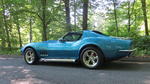
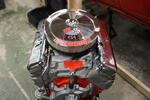
I have stock bottem end 350 with a 425HP trickflow top end kit, headers and 750DP on a victor JR intake.
I think I probally should of went smaller carb but Im learning and having fun wrenching on this 77 as much as I like driving it.
To start, the car smelled very rich, (burned eyes rich). I should say timming is set at 16 Intial, 38 Total, vacumn adv hooked up to manifold. I get around 10in vac at idle. 700rpm.
I learned my transfer slots were open way to far after reading some online info. That helped alot. I purchased some holley kit to be able to adjust secondaires for idle speed instead of taking carb off or trying to get a tool under the base plate to adjust the seconday butterflys. I also installed a 3.5 powervavle since I had low man vacumn.
I installed a wideband and it confrimed I was running too rich. 10.5 - 11.0 rich. I changed stock jets from 73s to 69s and I am now around 13:8-14:0 cruise.
Im using Burton Machines guide I found somewhere online and now I got some questions before I start drilling my new holley.
From his guide this is a bit rich. 13:5 - 14:0 seemed where the engine was happy. Its a pretty flat curve which Im guessing is good.
Would my next step be to drill/tap IFR and make them smaller and go bigger with the IABs or am I alreadying in the ball park and I should I leave it alone?
I am also now getting a lean stumble when I press down on throttle under load. Maybe the transion from idle cirtuit to main. I am gussing larger number squirters and maybe go up on the power valve?
Wide Open performance is good. 12.5. Still have factory secondary jets in. Not sure what number they are.
Any tips would be great. I sure wish I had a wideband when I was youngers. I remember turning car off at 3000rpm pulling over to check plugs haha. Times have changed. This is my first holley.
From: At my Bar drinking and wrenching in Lafayette Colorado
Air/fuel numbers rev'ing the engine in park under no load are completely irrelevant. Do not attempt to "tune" the carb to 14.0:1 at no-load 2500 rpm. You are running on the transition circuit only at 2500 rpm no-load, which will be, and should be, rich.
2020 Corvette of the Year Finalist (performance mods)
2019 C3 of Year Winner (performance mods)
2016 C3 of Year Finalist
The power valve has no effect at idle, only under load. You need to be at cruise on a flat section of road that eventually climbs a hill. When your car climbes the hill, do not move the accelerator. As the engine sees the laod watch your AFR gauge, it should go.lean ,then rich when you hit the power valve. It helps to have a vacuum gauge visible so you can see the vacuum gauge reflect the load.
When you start to play with pressed in IAB jets, its easier to take a strand of wire and stick one end in the air bleed and wrap the other end around the venturi or fliter stud so it doesnt fall into the carb. Increasing the number of strands will decrease the oriface size and tell you if its the correct path to take.
As for drilling holes, you may want to change your metering block to an aftermarket one that has changeable idle fuel restrictors. You can drill and add them as well since its aftermarket and not hurt the value of an original carb for those purists reading. Changing the idle fuel restrictor will lean your idle mixture while not affecting the transition circuit.
If you do drill holes in your butterflies, read as many legitmate articles as you can find on placement. If they are to close to the transition holes you will pull fuel which is opposite of what you are trying to accomplish. If you screw it up, solder it closed
Do not ask AI....it just grabs any opinion it can find on the internet and averages them....and every knuckle head can post an opinion. I can just make a stupid statement about placement and AI would use that info....
Thanks guys! I ordered an aftermarket metering block today. I went out today with a vacumn gauge hooked up and I learned a few things. First my power valve is coming in to late. It goes very lean, hesitates then PV comes in to rescue it. I also noticed when that happens my A/F gauge is at 15 all the way until secondaries open then it went to 17 until I lifted. Im going to wait until I get the new metering block as I am sure that will change things as well. I went down a jet size (68) to get the primaires set. Im about 13.8-14.3 at 3000rpm. So now Im lean when the PV comes in. If it stays that way with the new metering block Ill be able to open the PCVR easily. Then on to increasing secondary jets Im sure.
I was able to get idle at 700 rpm with primaries set to square transfer slot and opening the secondaries just a pinch. All four of my A/F screws are about 1/8 turn out only. Still a bit rich at 12.5 on the A/F gauge.
If there is a next time, I would of started with a smaller carb but sure am learning these Holleys. Im stuborn and on a mission to get his one to work.
Thanks guys! I ordered an aftermarket metering block today. I went out today with a vacumn gauge hooked up and I learned a few things. First my power valve is coming in to late. It goes very lean, hesitates then PV comes in to rescue it. I also noticed when that happens my A/F gauge is at 15 all the way until secondaries open then it went to 17 until I lifted. Im going to wait until I get the new metering block as I am sure that will change things as well. I went down a jet size (68) to get the primaires set. Im about 13.8-14.3 at 3000rpm. So now Im lean when the PV comes in. If it stays that way with the new metering block Ill be able to open the PCVR easily. Then on to increasing secondary jets Im sure.
I was able to get idle at 700 rpm with primaries set to square transfer slot and opening the secondaries just a pinch. All four of my A/F screws are about 1/8 turn out only. Still a bit rich at 12.5 on the A/F gauge.
If there is a next time, I would of started with a smaller carb but sure am learning these Holleys. Im stuborn and on a mission to get his one to work.
Champion # RC9YC. These were what the Trick Flow instructions called for, for their Super 23 heads.
That's a cold plug. What do they look like after a hard run?
Was there an alternate number from a different manufacturer.
If you use Google a number of posts state the plug fouls due to being cold which will throw off your AF reading.
Autolite # 3924 is the other the instructions list. Last plug I checed they looked dark but not fouled.
That bears out the contradiction in the plug recommended. The RC9YC cross references to 3923 which is colder than the 3924. Try a warmer plug and then do your testing.
I went out and looked. I actually am running the autolites with no gap. They don't look black anymore.
Originally Posted by MelWff
That bears out the contradiction in the plug recommended. The RC9YC cross references to 3923 which is colder than the 3924. Try a warmer plug and then do your testing.
OK you are getting deep into carb re-engineering.
First all DPs are jetted very rich in the transition circuit. They just are.
They are competition carbs.
They are designed not to go too lean, even on big cams with very low idle vac, like 1/2 of yours. So on yours they just pull too much fuel.
They work better with cams a lot bigger than your 225* duration.
Your 1/8 turn out confirms that.
That means the entire idle/transition circuit is far too rich for your application.
You will need to lean out the IFR to start with, quite a bit.
Yours should be in the 12"+ idle vac range. DPs still work well at 7"
A street oriented vac secondary carb would fine tune a lot easier, they are factory set leaner in the transition circuit, for milder cam vac, but you already have this one.
Get yourself a good tuning book, and read David Vizard too.
All the carb tuning is done by rpm, vacuum gauge, along with AFR.
The DP will fight you there because the mechanically opened secondaries don't give a hoot about vacuum, or engine load.
Once they kick in you have lost fine-tuning control.
If you can fine-tune the AFR in the first 50-75% of the throttle, it will run great. Then just let it go rich at WOT.
You should be able to fine tune the primaries, and then will just have to live with the overly rich secondary transition.
As long as it stays at 12.5 at WOT you can't really hurt it.
You will need fully adjustable metering blocks, with screw in IFRs and PVCRs, and screw in air bleeds in the main body.
I had those added to my factory original 4803 Holley. It was really good at WOT, but even it was pretty rich otherwise, even being a vac sec, and even tho it is a factory carb and factory calibrated for my motor.
One of the best tips I have is to go up 4 sizes on the primary jets, (too rich) temporarily, and then creep up on it with the rpm and lower vacuum, until you figure out where the pri main jets come in. It is probably higher than you think. Even disconnect the secondary linkage during this. Could be 2400 or 3000 rpm. It is all transition until then. And that is likely where you are cruising. Check the PV kick in point this way also. Set it maybe 3-4" below your cruise vac level.
I attached a great article on the Holley fine-tuning process.
Just be prepared for a LOT of experimenting, and keep a tuning notebook.
Tune them in order, idle, transition, pri main jets, pri PV, sec transition, sec jets, PV, acc pumps. The circuits kick-in sequentially.
This carb has very small hex wrench style removeable air bleeds. If I did not tell you they were there, would you even notice them?
Last edited by leigh1322; Feb 16, 2026 at 09:38 AM.
some of the old-school Holley tuning books mention inserting a V-shaped small piece of thin-gage wire into the Idle Feed Restrictor in the Primary Metering Block. There's pics if you can find one of those books. They were usually printed before all these adjustable air bleeds were invented. I don't recall if it was a HP Book, or a SA book. Nobody does books anymore.
I used a 0.012" piece of stainless wire on my double pumper (McMaster-Carr). This calculated out to 4% less fuel, after measuring the size of the orifice, the pi-squared-R thing. Got my O2 sensor to 14.1 at idle, using that. it was very rich before that, no I don't have the "before" number. A thicker wire gage will reduce fuel flow more in the idle mixture.
you could use pin gauges, or the shanks of wire-gauge drill bits to figure out your Idle Feed Restrictor orifice, and then do some maths. yeah, real old-school. I don't think anybody does this any more. Now they just drop the teeny-tiny air bleeds down into the carb plenum, geez, I hope not.
the V-shape prevents it from falling out, after the carb is reassembled. maybe it's actually J-shaped. anyways, one end sort of hooks around.
the ancient Holley carb tuning DVD had some introductory-level guidelines for beginners on tuning the carb, useful for the squirters and pumps, power valve, etc. It's probably on YouTube nowadays. Very introductory level, just barely scratches the surface, but points in the right direction.
I think for your 350, you'd be really happy with a 650DP. maybe even a 600DP if you're not racing. gives good "seat-of-the-pants" feedback.









 Holley tunning questions