




Need help identifying this car
Thread Starter
Racer


Joined: Jul 2003
Posts: 282
Likes: 52
From: Lima Oh
 Need help identifying this car
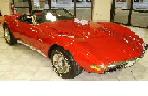
I just purchased a 68 coupe for a resto project. Car is completely disassembled, has the original trans but not the original motor. When previous owner bought it, it had a 350 c.i. and he was rebuilding a 327 to put in it. I think the car may have been a 427 c.i. car. It has a high rev tach and high rise hood like the one pictured below. Any other clues I can look for to determine what engine and h.p. were originally in the car?
http://www.usedcorvettesforsale.com/files/3a_1.jpg
Ken
http://www.usedcorvettesforsale.com/files/3a_1.jpg
Ken

Burning Brakes

Joined: Mar 2004
Posts: 816
Likes: 1
From: Finland
That hood does not look original to me...
One is to look at the swaybars - do they look old enough to be original and after that you might have hint more - you should go check the 1968 database to see what options vere available that year for small and big blocks.
AND what is the VIN?
One is to look at the swaybars - do they look old enough to be original
and after that you might have hint more - you should go check the 1968 database to see what options vere available that year for small and big blocks.AND what is the VIN?

Safety Car


Joined: Oct 1999
Posts: 4,101
Likes: 10
From: NorCal
That original transmission my help. If it's an M-22 it would point to a BB, I believe. The hood is for an L-88 (427 4 bbl w/ aluminum heads) if it is OEM and would be worth a bundle. Does it have the air filter setup for an L-88? Some pictures would help (like the inside of the hood),
Aren't puzzles fun? I'm squeezing a guy to sell me a base '68 coupe thats partially dis-assembled. Can't wait!
Hans
Aren't puzzles fun? I'm squeezing a guy to sell me a base '68 coupe thats partially dis-assembled. Can't wait!
Hans
Thread Starter
Racer
Joined: Jul 2003
Posts: 282
Likes: 52
From: Lima Oh
I'm going to pick up tonight and will try to get some pictures. This could be an unbelievable find. The body is in great shape, no indication that it was ever hit or damaged. Originally British green, now black. Power windows, steering and brakes. Frame is completely stripped and repairs appear to have been done correctly. Will need new interior, but everything is there (but completely disassembled). I'll check tonight to see if it has a rear sway bar in the pile, also try to figure out gear ratio. May have to open up the trans. to determine m20, 21, or 22. Unfortunately, it's not the original gas tank, so no build sheet. If there is any way to prove L88, I may start to feel bad. I only paid $2900 for the whole thing.
Ken
Ken

Safety Car


Joined: Jun 2002
Posts: 4,756
Likes: 2,506
From: Buckeye, AZ
St. Jude Donor '12-'13
I'm with the guy above. They hood appears to be aftermarket, that is way higher than a stock big block hood. If it was an L88 car, it will only be valuable with a proper serial number L88, which you will pay through the nose for if you can find one. If the original drivetrain components are gone my advice woudl be build it the ay you want it. If you want hanlding and performance, you would probably be better off staying small block. The big blocks were fast and "torquey" but could not handle or brake very well do to the unbalanced nature of the car. I have read a few articles which claimed that the hi-perf 327 models available in the late sixties were in many cases a better choice for an all around sports car. The were 20hp less, but coudl also handle peropely. The big block was the choice for street racing/quarter mile runs. for some reason certain setups get the most attention...like big blocks or hemis. At shows everyone wants to see 426 hemis, but many articles state that the 440 magnum was a much better set up for the average hobbyist or street racer. They hemis were rather touchy and had more potential for strip racing, but for the street the 440 was much more user friendly. Lately it seems every show I go to there is a low mileage hemi or a rash of big blocks. I think right now there are a lot of fakes, especially on options not tracked in the serial number. 70 RS Camaros seem to all of the sudden becom so common. The reason....no serial number tracking and aftermarket parts availble to "make" RSs. Seems to be a lot of Yenko cars showing up these days too.

Team Owner

Joined: Jul 1999
Posts: 26,545
Likes: 46
From: Huntersville NC
ok... the red vette in the pic is not your vette, just an example of what your hood looks like. 99.999% sure it is aftermarket. What exactly is the redline? Best guess is your original engine was 327/350 - redline was 6000. On the 435 hp (tripower) and 430 hp (L88) biglblock the redline was 6500. If you have a fuel return line running along the passenger side frame (ie 2 fuel lines right next to each other )that would rule out either of those 2 bigblocks. Again, 99.99% you do NOT have an M-22. That trans would have a drain plug, M-20/M-21 would not, but someone could have tapped one in. Original trans will have your vin dervative (last few numbers) stamped on the case. I think 327/350 hp cars came with M21 and a higher rear gear, but can't recall if they all came that way. Pretty sure auto trans was not an option with 350 hp. If it comes down to M20 or M21 you can easily distinguish once you get the car on the road and drive it, if you can wait for that. 
Corvette Stories
The Best of Corvette for Corvette Enthusiasts

Top 10 Most Expensive Corvettes Ever Sold on Bring A Trailer
Brett Foote
10 Things Every Corvette Owner Needs (2026 Edition)
Michael S. Palmer
8 Most "Only Corvette Owners Understand" Quirks and Problems
Pouria Savadkouei
10 Reasons the C6 Z06 is Still A Performance Benchmark After 20 Years
Joe Kucinski
How Much Horsepower Every Corvette Engine "LOST" in 1972
Joe Kucinski
Top 10 DOs and DON'Ts for Protecting Your Convertible Top!
Michael S. Palmer
Top 10 Most Explosive Corvettes Ever Made: Power-to-Weight Ratio Ranked!
Joe Kucinski
150 hp to 1,250 hp: Every Corvette Generation Compared by the Specs That Matter
Joe Kucinski
8 Coolest Corvette Pace Cars (and Replicas) of All Time
Verdad Gallardo
Advanced
Joined: May 2004
Posts: 96
Likes: 0
From: Chippewa Lake Ohio
Also check the rear leaf spring, if it is origional count the leaves.
7 leaves would be a BB
9 leaves would be the 327.
Not all 350/327s came with the M-21 it was optioned. Mine was origionaly equiped with the 350/327 and the M-20 according to the Build sheet.
Also if it has the origional inner fenders up front and it has 9 leaves. You can check out if it was the base 300hp or the 350hp by looking for the mounting holes for a TI unit on the front of the drivers inner fender, all 350/327s had TI.
Regards,
Heli
7 leaves would be a BB
9 leaves would be the 327.
Not all 350/327s came with the M-21 it was optioned. Mine was origionaly equiped with the 350/327 and the M-20 according to the Build sheet.
Also if it has the origional inner fenders up front and it has 9 leaves. You can check out if it was the base 300hp or the 350hp by looking for the mounting holes for a TI unit on the front of the drivers inner fender, all 350/327s had TI.
Regards,
Heli
Advanced
Joined: May 2004
Posts: 96
Likes: 0
From: Chippewa Lake Ohio
TI = Transistorized Ignition.
Here is a pic of one on Ebay
http://cgi.ebay.com/ebaymotors/ws/eB...RK%3AMEWA%3AIT
Regards,
Heli
Here is a pic of one on Ebay
http://cgi.ebay.com/ebaymotors/ws/eB...RK%3AMEWA%3AIT
Regards,
Heli
Thread Starter
Racer
Joined: Jul 2003
Posts: 282
Likes: 52
From: Lima Oh
Mystery solved, at least for now. Thanks to all the clues provided, I have determined that the car was originally a 327. Nine springs instead of seven, holes in firewall for TI, one piece fan shroud, 6000 rpm tach. The hood appears to be a correct aftermarket 427.
Still going to be a great project.
The serial number is 194378S417714, which would indicate early April of 1968. If anyone has a correct dated block for sale, let me know.
Hans, here's some of the numbers from the trans:
18S417714
P8D19
3857584
392?660
Thanks again for all of the help. I learned a great deal in a short period of time. This place rocks.
Ken
Still going to be a great project.
The serial number is 194378S417714, which would indicate early April of 1968. If anyone has a correct dated block for sale, let me know.
Hans, here's some of the numbers from the trans:
18S417714
P8D19
3857584
392?660
Thanks again for all of the help. I learned a great deal in a short period of time. This place rocks.
Ken

Melting Slicks


Joined: Oct 2003
Posts: 2,300
Likes: 2
St. Jude Donor '08
"The serial number is 194378S417714"
1=Chevrolet
94=Corvette
37=coupe
8=1968
S=St. Louis
Thats all I can get from the VIN, do you have the PROTECT-O-PLATE
It tells the rest of the information about the car.
P8D19
P=4spd Muncie
8=1968
D=April
19= 19th of April(build date)
1=Chevrolet
94=Corvette
37=coupe
8=1968
S=St. Louis
Thats all I can get from the VIN, do you have the PROTECT-O-PLATE
It tells the rest of the information about the car.
P8D19
P=4spd Muncie
8=1968
D=April
19= 19th of April(build date)

Melting Slicks

Joined: Feb 2004
Posts: 2,435
Likes: 0
From: largo florida
To find out if the trans is a m20, m21, or m22, look at the build date code on the trans. It will either end in a A, B, or C.
A - M20
B - M21
C - M22
I think the build date code runs up an down along the edge of the casing somewhere.
A - M20
B - M21
C - M22
I think the build date code runs up an down along the edge of the casing somewhere.
