





 Ew!
Ew!




Restoring Rotors

Pro

Joined: Oct 2009
Posts: 730
Likes: 0
From: LaGrange Highlands IL

Joe
Corvette Stories
The Best of Corvette for Corvette Enthusiasts

Top 10 Most Expensive Corvettes Ever Sold on Bring A Trailer
Brett Foote
10 Things Every Corvette Owner Needs (2026 Edition)
Michael S. Palmer
8 Most "Only Corvette Owners Understand" Quirks and Problems
Pouria Savadkouei
10 Reasons the C6 Z06 is Still A Performance Benchmark After 20 Years
Joe Kucinski
How Much Horsepower Every Corvette Engine "LOST" in 1972
Joe Kucinski
Top 10 DOs and DON'Ts for Protecting Your Convertible Top!
Michael S. Palmer
Top 10 Most Explosive Corvettes Ever Made: Power-to-Weight Ratio Ranked!
Joe Kucinski
150 hp to 1,250 hp: Every Corvette Generation Compared by the Specs That Matter
Joe Kucinski
8 Coolest Corvette Pace Cars (and Replicas) of All Time
Verdad Gallardo





Thread Starter
Race Director


Joined: May 2002
Posts: 10,306
Likes: 15
Thread Starter
Race Director
Joined: May 2002
Posts: 10,306
Likes: 15
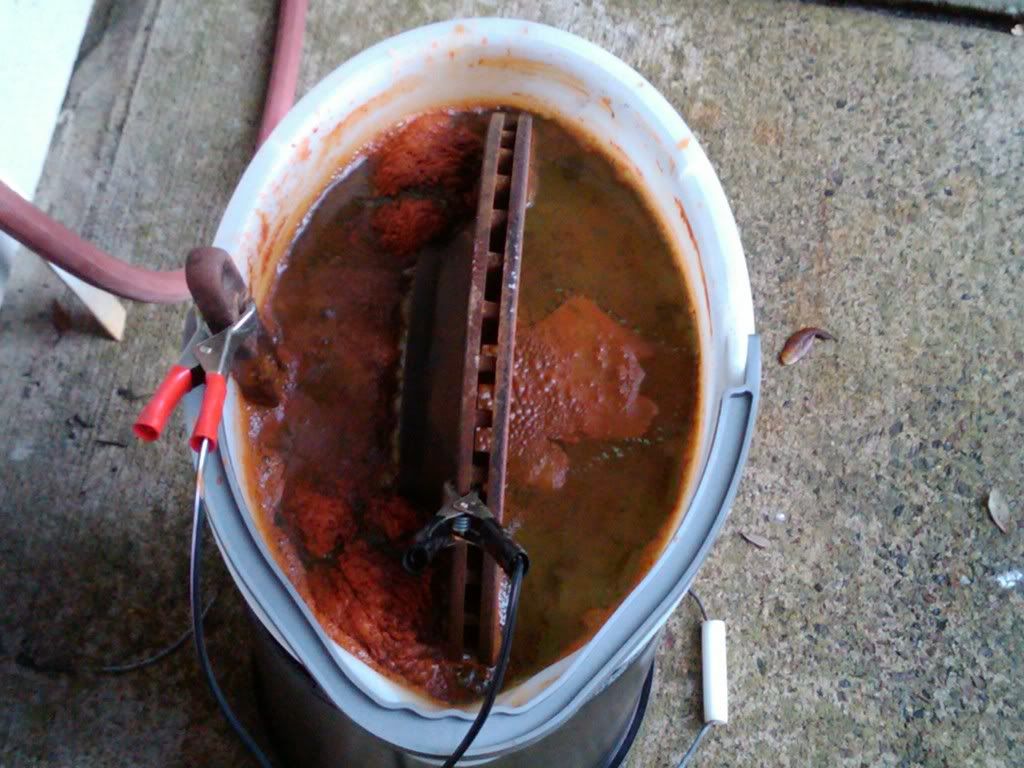
I actually changed my setup from the original picture.
I used a tall kitchen garbage can and some big pieces of Rebar as my Anode - worked great!
I use sodium carbonate to be safe and I use 1 tablespoon per 1 gallon. The process puts off small amounts of hydrogen which is combustible so I do it outside in a well ventilated area. Also I don't want the Anode and the rotor to touch, I want them at least a few inches apart from one another. IF I mess with any of the setup, I always want to make sure its UNPLUGGED from the wall first. The more anodes I connect around the perimeter of the rotor, the better the results or I can just flip the rotor etc but its a longer process.
I also use latex gloves during the process and I wear a mask when using the Scotchbrite to finish the rotor. I only use a Steel Anode because Stainless Steel, galvanized and other materials will result in a toxic batch of water.
I use 3M type Scotch Bright Finishing Pad product #10144NA to finish off the job.
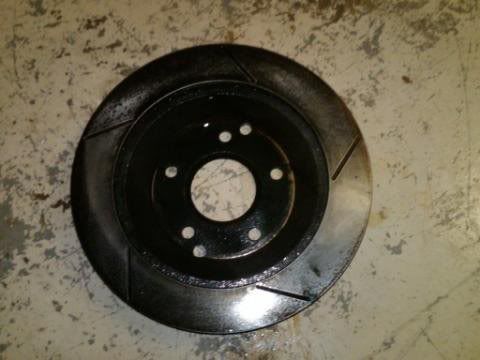
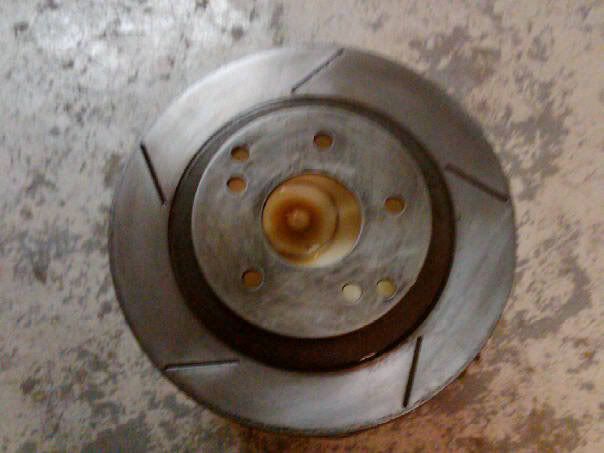
I chose not to paint them this time around, just protected them with oil.
If the current is too high and is taxing my battery charger, I check these items:
1. Increase the distance between the anode and the rotor being cleaned.
2. Reduce the amount of anode in the vat. Lift it out slightly.
3. Reduce the operating voltage or increase the current range of the battery charger setting.
If I don't see an immediate reaction beginning in the vat when I plug in the battery charger, I check all of my connections carefully. It can be difficult to get a good electrical connection on a heavily rusted tool. This is where the ammeter on my battery charger comes in handy. I can tell at a glance if I have a good connection to the rotor. The bubbling action starts immediately after power is applied.
If the rotor in my vat appears to be eroding instead of de-rusting, I verify that I have the battery charger polarity correct. The rotor must always be connected to the "negative" black terminal.
**Caution** Hydrogen gas reacts explosively with oxygen (in the presence of heat) to produce water vapor. I always shut down the power before adjusting/removing the electrodes.
If I am using electrolysis to remove rust...and have a considerable broth of bubbles...I am very cautious. That broth is not the place I discard a glowing cigarette ember, lit match...or any other spark. Be warned...!!
I used a tall kitchen garbage can and some big pieces of Rebar as my Anode - worked great!
I use sodium carbonate to be safe and I use 1 tablespoon per 1 gallon. The process puts off small amounts of hydrogen which is combustible so I do it outside in a well ventilated area. Also I don't want the Anode and the rotor to touch, I want them at least a few inches apart from one another. IF I mess with any of the setup, I always want to make sure its UNPLUGGED from the wall first. The more anodes I connect around the perimeter of the rotor, the better the results or I can just flip the rotor etc but its a longer process.
I also use latex gloves during the process and I wear a mask when using the Scotchbrite to finish the rotor. I only use a Steel Anode because Stainless Steel, galvanized and other materials will result in a toxic batch of water.
I use 3M type Scotch Bright Finishing Pad product #10144NA to finish off the job.
I chose not to paint them this time around, just protected them with oil.
If the current is too high and is taxing my battery charger, I check these items:
1. Increase the distance between the anode and the rotor being cleaned.
2. Reduce the amount of anode in the vat. Lift it out slightly.
3. Reduce the operating voltage or increase the current range of the battery charger setting.
If I don't see an immediate reaction beginning in the vat when I plug in the battery charger, I check all of my connections carefully. It can be difficult to get a good electrical connection on a heavily rusted tool. This is where the ammeter on my battery charger comes in handy. I can tell at a glance if I have a good connection to the rotor. The bubbling action starts immediately after power is applied.
If the rotor in my vat appears to be eroding instead of de-rusting, I verify that I have the battery charger polarity correct. The rotor must always be connected to the "negative" black terminal.
**Caution** Hydrogen gas reacts explosively with oxygen (in the presence of heat) to produce water vapor. I always shut down the power before adjusting/removing the electrodes.
If I am using electrolysis to remove rust...and have a considerable broth of bubbles...I am very cautious. That broth is not the place I discard a glowing cigarette ember, lit match...or any other spark. Be warned...!!
Last edited by xlr8nflorida; Dec 16, 2009 at 08:29 PM.
Thread Starter
Race Director
Joined: May 2002
Posts: 10,306
Likes: 15
Just search for a spray that is anti-corrosion etc.
I then put them in a big Ziplock Bag.
You probably don't even need to spray them as long as you don't get a hole in the bag.
I just apply the oil on the rotor as extra protection.
Last edited by xlr8nflorida; Dec 16, 2009 at 08:09 PM.
Thread Starter
Race Director
Joined: May 2002
Posts: 10,306
Likes: 15
I used to use WD40 too and it worked fine. However, 50% of WD40 is mineral spirits so now I use other brands.