
Brake Bleeding

Thread Starter
Burning Brakes

Joined: Jul 2014
Posts: 801
Likes: 31
 Brake Bleeding
What is the best way to bleed the brakes on the C4 ZR1? My pedal doesn't feel very firm and doesn't exactly inspire confidence. I know the car has ABS and it seems to work from a panic stop I did. I would like to bleed/flush the brake fluid, but want to make sure I do it correctly. I know ABS can sometimes complicate things. On my Jeep you need a special tool to activate the ABS pump to properly bleed the brakes.
Le Mans Master


Joined: Mar 2004
Posts: 5,107
Likes: 171
From: Dublin CA
Start by siphoning off most of the brake fluid from the master reservoir leaving a little fluid over the two outlets at the bottom of the reservoir. Full the reservoir with new fluid. Jack up the passenger side read and remove the tire. Use a jack stand to support the car for safety. Place a piece of clear tubing about 3 feet long snugly over the bleeder screw. Place the end of the tube into a clear jar. Open the bleeder screw and with the help of a second person, have them slowly pump the brake. Watch for new clear fluid to come out the tube into the jar. Carefully check the reservoir to be sure that it NEVER runs dry, keep it full. Once you have new clear fluid coming from the right rear, close the bleeder screw and remove the tube. Replace the tire (torque nuts to 100 pounds). Jack up driver's rear and repeat above.
Then jack up passenger front and repeat bleeding. Proceed to driver's front and bleed.
If you keep the reservoir full and don't let the system suck air you will be fine.
I replaced my standard bleeder screws with speed bleeders from Rock Auto. Come in a package of two. Make the bleeding much easier. You can do it yourself without the need of a second person. But the additional help does make it easier.
Then jack up passenger front and repeat bleeding. Proceed to driver's front and bleed.
If you keep the reservoir full and don't let the system suck air you will be fine.
I replaced my standard bleeder screws with speed bleeders from Rock Auto. Come in a package of two. Make the bleeding much easier. You can do it yourself without the need of a second person. But the additional help does make it easier.

Melting Slicks

Joined: May 2010
Posts: 2,082
Likes: 3
From: Conowingo Maryland
I like to gradevely bleed mine. i do as John said take a good amount of fluid out of the resivour and top it off. then I go to one of the rear wheels place a container under the tire open the bleed screw and let the fluid run till the res is a little over half empty tighten the bleeder then go to the next side top up the resivour and bleed just like before then continue with the outer wheels untill you are done
Le Mans Master
Joined: Mar 2004
Posts: 5,107
Likes: 171
From: Dublin CA
You always start with the farthest wheel from the reservoir first and work your way to the closest. I use the clear plastic tube for two reasons, it keeps the fluid contained from splashing or dripping all over. You can also see if you have air in the system. Important to know if you replace the brake lines to the calipers. And you can see the new clear fluid better.
Melting Slicks
Joined: May 2010
Posts: 2,082
Likes: 3
From: Conowingo Maryland
You always start with the farthest wheel from the reservoir first and work your way to the closest. I use the clear plastic tube for two reasons, it keeps the fluid contained from splashing or dripping all over. You can also see if you have air in the system. Important to know if you replace the brake lines to the calipers. And you can see the new clear fluid better.


Team Owner


Joined: Aug 2004
Posts: 21,543
Likes: 3,216
From: Park City Utah
I like to gradevely bleed mine. i do as John said take a good amount of fluid out of the resivour and top it off. then I go to one of the rear wheels place a container under the tire open the bleed screw and let the fluid run till the res is a little over half empty tighten the bleeder then go to the next side top up the resivour and bleed just like before then continue with the outer wheels untill you are done
Except I do it the fast, fast way.
Suck out the old fluid from teh reservoir w/a syringe, wipe clean.
Fill w/new fluid
Open all 4 bleeders at the same time. When fluid comes from any given caliper clear/clean, you know the new fluid has made it to and through that caliper, close it.
If one isn't flowing, or is too slow, pump the pedal w/the bleeder open. after releasing the pedal, resume gravity bleeding of that caliper. When fluid begins flowing from bleeder of that caliper (presumably the "last one"), it's bled. Tap it lightly w/a hammer a couple times, let drip for another couple seconds, close bleeder and your done.
You can do the whole vehicle by yourself this way, in <10 minutes.
Last edited by Tom400CFI; Aug 5, 2014 at 10:47 AM.
Team Owner
Joined: Aug 2004
Posts: 21,543
Likes: 3,216
From: Park City Utah
Brakes are great. If you don't like the performance they provide, upgrade the PADS to something better. I use Hawk HP_ right now, but will likely try forum vendor Carbotech next time.
Corvette Stories
The Best of Corvette for Corvette Enthusiasts

Top 10 Corvette Engines RANKED by Peak Torque (70+ Years of Muscle!)
Joe Kucinski
Corvette ZR1X Will Be Pacing the Indy 500, And Could Probably Race, Too!
Verdad Gallardo
Top 10 Corvettes Coming to Mecum Indy 2026!
Brett Foote
Top 10 C9 Corvette MUST-HAVES to Fix These C8 Generation Flaws!
Michael S. Palmer
10 Revolutionary 'Corvette Firsts' Most People Don't Know
Joe Kucinski
5 Reasons to Upgrade to an LS6-Powered Corvette; 5 Reasons to Stay LT2
Michael S. Palmer
2027 Corvette vs The World: Every C8 vs Its Closest Competitor
Joe Kucinski
10 Most Common Corvette Problems of the Last 20 Years!
Joe Kucinski
5 MOST and 5 LEAST Popular Corvette Model Years in History!
Joe Kucinski
Safety Car


Joined: Aug 2008
Posts: 4,344
Likes: 48
From: San Marcos CA
I have the factory scanner, but the abs software module doesn't seem to work anymore so I can't cycle the solenoids in the abs unit. not really a problem,- just bleed the other 97% of the brake fluid out in the convention manner and then go find some gravel or water and activate the abs on the road to cycle in new dot 3 juice.
I own a power bleeder now, but you have to collect the adapters for each master cyl reservoir you need. The old fashioned way with a helper pumping the brakes always works fine too. The car itself is really a run-of-the-mill C4... only the engine and wide body panels are really model specific- all the service information is pretty generic C4.
I own a power bleeder now, but you have to collect the adapters for each master cyl reservoir you need. The old fashioned way with a helper pumping the brakes always works fine too. The car itself is really a run-of-the-mill C4... only the engine and wide body panels are really model specific- all the service information is pretty generic C4.

Intermediate

Joined: Jul 2014
Posts: 35
Likes: 3
From: SC
New to the Corvette community and forums. This video is one that I've watched and seems to do a good job in explaining how to do the bleed and flush by ChrisFix (I believe he's a member on these forums too, aka dogfish246).
Last edited by drinkoj; Aug 5, 2014 at 12:28 AM. Reason: added forum user name

Melting Slicks


Joined: Apr 2011
Posts: 3,491
Likes: 475
From: New Jersey
Start by siphoning off most of the brake fluid from the master reservoir leaving a little fluid over the two outlets at the bottom of the reservoir. Full the reservoir with new fluid. Jack up the passenger side read and remove the tire. Use a jack stand to support the car for safety. Place a piece of clear tubing about 3 feet long snugly over the bleeder screw. Place the end of the tube into a clear jar. Open the bleeder screw and with the help of a second person, have them slowly pump the brake. Watch for new clear fluid to come out the tube into the jar. Carefully check the reservoir to be sure that it NEVER runs dry, keep it full. Once you have new clear fluid coming from the right rear, close the bleeder screw and remove the tube. Replace the tire (torque nuts to 100 pounds). Jack up driver's rear and repeat above.
Then jack up passenger front and repeat bleeding. Proceed to driver's front and bleed.
If you keep the reservoir full and don't let the system suck air you will be fine.
I replaced my standard bleeder screws with speed bleeders from Rock Auto. Come in a package of two. Make the bleeding much easier. You can do it yourself without the need of a second person. But the additional help does make it easier.
Then jack up passenger front and repeat bleeding. Proceed to driver's front and bleed.
If you keep the reservoir full and don't let the system suck air you will be fine.
I replaced my standard bleeder screws with speed bleeders from Rock Auto. Come in a package of two. Make the bleeding much easier. You can do it yourself without the need of a second person. But the additional help does make it easier.
I have not done brakes like this in years, I use a vacuum bleeder. Cheap and oh so easy.
Safety Car

Joined: Aug 2009
Posts: 3,745
Likes: 275
From: Melbourne, Victoria, Australia
I recommend you gravity bleed the brakes, that is what i do now unless a master cylinder or brake hoses have been replaced.
The brake booster diaphragm tends to fail when bleeding the brakes the old fashion way, pumping the pedal further than normal and stretching the diaphragm as someone opens the bleeder while pushing the brake pedal to the floor.
I just remove the bleeder screws on the rear brakes, while topping up the master cylinder with new high quality brake fluid.
Then refit the bleeder screws and do the front.
I do not have any problems with boosters failing since, i have replaced 2 boosters with torn diaphragms both failed when bleeding the brakes the old fashion way.
For brake effectiveness it depends on your use, get some hawk street pads for street use. The Hawk HP Plus are fantastic on a racetrack as long as you use good brake fluid. They do squeal but FRICTION is how brakes work, if you have basic road car brake pads with little friction compound you can stand on the brake pedal and barely slow the car.
If you want brakes that make you swear holy $*@T these brakes are great when you hit the pedal, get some high friction brake pads. Most brake pads "protect" the discs, expect to replace your discs ever third brake pad swap. the penalty for great brakes.
The J55 brakes you have use 13 inch diameter thick discs, they are only limited by brake pad choice. fitting basic road car brake pads with very limited friction compound will degrade the cars braking capability's.
I have used my vette on club track days and have no stopping problems with Hawk HP plus brake pads, lap after lap after lap.
This is where standard brake pads will just disintegrate and turn to powder.
Street/Track brake pads.
http://www.parts123.com/parts123/yb....5Z50000050F~~~
http://www.parts123.com/parts123/yb....5Z50000050F~~~
Street brake pads.
http://www.parts123.com/parts123/yb....5Z50000050F~~~
http://www.parts123.com/parts123/yb....5Z50000050F~~~
The brake booster diaphragm tends to fail when bleeding the brakes the old fashion way, pumping the pedal further than normal and stretching the diaphragm as someone opens the bleeder while pushing the brake pedal to the floor.
I just remove the bleeder screws on the rear brakes, while topping up the master cylinder with new high quality brake fluid.
Then refit the bleeder screws and do the front.
I do not have any problems with boosters failing since, i have replaced 2 boosters with torn diaphragms both failed when bleeding the brakes the old fashion way.
For brake effectiveness it depends on your use, get some hawk street pads for street use. The Hawk HP Plus are fantastic on a racetrack as long as you use good brake fluid. They do squeal but FRICTION is how brakes work, if you have basic road car brake pads with little friction compound you can stand on the brake pedal and barely slow the car.
If you want brakes that make you swear holy $*@T these brakes are great when you hit the pedal, get some high friction brake pads. Most brake pads "protect" the discs, expect to replace your discs ever third brake pad swap. the penalty for great brakes.
The J55 brakes you have use 13 inch diameter thick discs, they are only limited by brake pad choice. fitting basic road car brake pads with very limited friction compound will degrade the cars braking capability's.
I have used my vette on club track days and have no stopping problems with Hawk HP plus brake pads, lap after lap after lap.
This is where standard brake pads will just disintegrate and turn to powder.
Street/Track brake pads.
http://www.parts123.com/parts123/yb....5Z50000050F~~~
http://www.parts123.com/parts123/yb....5Z50000050F~~~
Street brake pads.
http://www.parts123.com/parts123/yb....5Z50000050F~~~
http://www.parts123.com/parts123/yb....5Z50000050F~~~

Le Mans Master
Joined: Mar 2004
Posts: 5,107
Likes: 171
From: Dublin CA
Note: With the plastic hose over the bleeder it will not suck air into the line. If you put a little fluid in the jar, if the line starts to suck back it only will pull fluid. The use of speed bleeders is even better because the small ball valve closes when you let up on the brake. Watch the video posted by drinkoj above. The plastic hose that I use fits tight and has to be forced onto the bleeder.
If you don't put on the plastic hose then you need two people to bleed the brake system. One to slowly pump the brake while the other open and closes the bleeder valve.
If you don't put on the plastic hose then you need two people to bleed the brake system. One to slowly pump the brake while the other open and closes the bleeder valve.
Last edited by John A. Marker; Aug 5, 2014 at 10:44 AM.
Team Owner
Joined: Aug 2004
Posts: 21,543
Likes: 3,216
From: Park City Utah
Yes, you COULD, since you're bleeding anyway. But really, you could do the lines and re-bleed anytime, IMO.
Be careful with the corrections then! I do this all the time -literally, 100's of times on all sorts of brands/models... and it works. If it didn't work I wouldn't have posted it.
You are right that when you release the pedal w/the bleeder open some air is drawn into the caliper body.
I didn't clarify what makes it work above well; since I was talking about gravity bleeding, I left that next "step" up for assumption, but after you pump the pedal to get things moving in a stubborn caliper, you then continue to gravity bleed that caliper (which eliminates air from the caliper). Then, as per my last post, When fluid begins flowing from bleeder of that caliper (presumably the "last one", it's bled. Tap it lightly w/a hammer a couple times, let drip for another couple seconds, close bleeder and your done.
Why does this work, or why doesn't it "fill the system with air"? The MC is much smaller volume than a caliper. Also, not all of the back stroke on the MC is replenished by fluid being drawn from the caliper; some can/does refill the bore via the replenishing port. Anyway, the point is, the volume of air drawn back into the caliper is such a small percentage that it is is ultimately a minuscule amount of air in the caliper...and it is readily displaced by fluid gravity feeding back into the caliper immediately following the pedal release....no different than hooking up a new/empty caliper (full of air) to a corner, and letting it gravity fill.
The "pedal pumping" is only a recommendation for when we run into a caliper that doesn't want to flow via gravity bleeding. You could wait forever....you could go buy a pressure bleeder....OR you could pump the pedal once to physically clear passages and get fluid moving, then finish off w/gravity and be done.
This works, and it is FAST. I've done it 100's of times.
One clarification; you do not pump the brakes with the bleeder open. Doing this would suck air right back into the system. You pump and hold, THEN open the bleeder. Then when the pedal drops to the floor, the pedal operator signals you to close the screw.
I have not done brakes like this in years,
I have not done brakes like this in years,
You are right that when you release the pedal w/the bleeder open some air is drawn into the caliper body.
I didn't clarify what makes it work above well; since I was talking about gravity bleeding, I left that next "step" up for assumption, but after you pump the pedal to get things moving in a stubborn caliper, you then continue to gravity bleed that caliper (which eliminates air from the caliper). Then, as per my last post, When fluid begins flowing from bleeder of that caliper (presumably the "last one", it's bled. Tap it lightly w/a hammer a couple times, let drip for another couple seconds, close bleeder and your done.
Why does this work, or why doesn't it "fill the system with air"? The MC is much smaller volume than a caliper. Also, not all of the back stroke on the MC is replenished by fluid being drawn from the caliper; some can/does refill the bore via the replenishing port. Anyway, the point is, the volume of air drawn back into the caliper is such a small percentage that it is is ultimately a minuscule amount of air in the caliper...and it is readily displaced by fluid gravity feeding back into the caliper immediately following the pedal release....no different than hooking up a new/empty caliper (full of air) to a corner, and letting it gravity fill.
The "pedal pumping" is only a recommendation for when we run into a caliper that doesn't want to flow via gravity bleeding. You could wait forever....you could go buy a pressure bleeder....OR you could pump the pedal once to physically clear passages and get fluid moving, then finish off w/gravity and be done.
This works, and it is FAST. I've done it 100's of times.
Last edited by Tom400CFI; Aug 5, 2014 at 12:08 PM.

Safety Car
Joined: Jan 2004
Posts: 3,783
Likes: 15
From: Northern California
I replaced all four bleeder screws with the Earl's Solo Bleeds!...
Just open the bleeder screw and pump the brake pedal about 5 times, making sure the master cylinder is topped off with clean fluid. No need to open and close the bleeder screw. Bleed one caliper at a time.
EASIEST, way I've ever used!!!...
Best $20 I've ever spent. Part #280022ERL available anywhere.
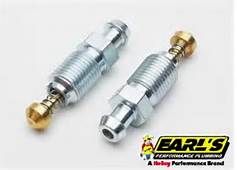
Just open the bleeder screw and pump the brake pedal about 5 times, making sure the master cylinder is topped off with clean fluid. No need to open and close the bleeder screw. Bleed one caliper at a time.
EASIEST, way I've ever used!!!...
Best $20 I've ever spent. Part #280022ERL available anywhere.
Last edited by GKK; Aug 5, 2014 at 07:39 PM.
Melting Slicks
Joined: Aug 2008
Posts: 2,082
Likes: 50
From: Palmdale CA
One clarification; you do not pump the brakes with the bleeder open. Doing this would suck air right back into the system. You pump and hold, THEN open the bleeder. Then when the pedal drops to the floor, the pedal operator signals you to close the screw.
I have not done brakes like this in years, I use a vacuum bleeder. Cheap and oh so easy.
I have not done brakes like this in years, I use a vacuum bleeder. Cheap and oh so easy.
No peddle "Pumping" required, all air is drawn to the source of Vacuum.