



HELP!!! 383 still smoking.....

Thread Starter
Racer

Joined: Jan 2005
Posts: 315
Likes: 0
From: tomahawk wisconsin

yes it is a 1 peice gasket... I have 5 plugs that are all black..2,4,6,8 and 7...number 7 seems to be the worst..on sunday when I pull the intake off again if I dont find any sighns of oil passing by the gaskets(oil dye) I will start going deeper into the motor. if and when I pull the pistons back out what exactly should I be lookin for besides the obviouse???how can I tell if the rings are mixed up?

Le Mans Master


Joined: Feb 2000
Posts: 9,715
Likes: 27
From: Kempner Texas
Each ring will have a manufacturer's identification mark on one side of the ring. It's usually positioned near the gap. That mark must be positioned 'UP" when installed on the piston.
If you're using single moly rings, the face of the top ring, the part that rides against the cylinder wall, will look more shiny than the second ring. For the single moly ring set, the top ring has a moly inlay while the second ring is cast iron. So the top ring will look shiny and the second ring dark.
You should also run your finger-tip across the ends to make sure there is no burr or raised metal right at the end of the rings. If the rings were bought +.005 and custom gapped, sometimes that mechanic will not file off the raised metal that results for the grinding. Failing to do this will not allow the ring to seat and seal properly.
The ring gaps should also be properly positioned on the piston for best oil control. The diagram of how they should be positioned is in many of the better manuals. The ring gaps should NOT be just installed on the piston in any ole' position and DEFINITELY, the gaps should not align vertically.
The oil ring package - consisting of three pieces, should be the Speed-Pro SS-50U STANDARD TENSION stainless steel type which has the weavy rail separator. It's considered to be the BEST oil ring package on the market.
The ends of the separator SHOULD NOT BE OVER-LAPPED, but, instead butted together. You'll usually see little colored plastic squares installed at the ends of the separator to help the installer insure that the ends are NOT over-lapped.
The is a difference of about 5 psi in tension between the LOW TENSION oil ring set and the STANDARD TENSION. Low tension sets usually call for an aftermarket vacuum assist unit for best oil control. They're good for racing, but not for street operation.
If all those checks test "good" I'd remove each ring from the piston, then install it in the bore it came from, square it up and check the end gaps. Depending on the intended use of the engine, the actual gaps will vary. For a N/A street engine .018/.020 is in the ball park for the top ring.
In the past, the 2nd ring gap was always set tighter than the top (.012/.014), but the latest tests show that a wider 2nd end gap is better; something in the range of .024/.026. I verified this through both Speed-Pro and TRW a few years back. Many reference sources still show the older recommended gap though.
This wider 2nd ring gap allows residual combustion gasses to vent which reduces internal pressure and results in the top ring remaining sealed at higher RPMs. Otherwise, the tests have shown that the pressure build up will unseat the top ring, hurting power.
Hope this helps.
Jake
If you're using single moly rings, the face of the top ring, the part that rides against the cylinder wall, will look more shiny than the second ring. For the single moly ring set, the top ring has a moly inlay while the second ring is cast iron. So the top ring will look shiny and the second ring dark.
You should also run your finger-tip across the ends to make sure there is no burr or raised metal right at the end of the rings. If the rings were bought +.005 and custom gapped, sometimes that mechanic will not file off the raised metal that results for the grinding. Failing to do this will not allow the ring to seat and seal properly.
The ring gaps should also be properly positioned on the piston for best oil control. The diagram of how they should be positioned is in many of the better manuals. The ring gaps should NOT be just installed on the piston in any ole' position and DEFINITELY, the gaps should not align vertically.
The oil ring package - consisting of three pieces, should be the Speed-Pro SS-50U STANDARD TENSION stainless steel type which has the weavy rail separator. It's considered to be the BEST oil ring package on the market.
The ends of the separator SHOULD NOT BE OVER-LAPPED, but, instead butted together. You'll usually see little colored plastic squares installed at the ends of the separator to help the installer insure that the ends are NOT over-lapped.
The is a difference of about 5 psi in tension between the LOW TENSION oil ring set and the STANDARD TENSION. Low tension sets usually call for an aftermarket vacuum assist unit for best oil control. They're good for racing, but not for street operation.
If all those checks test "good" I'd remove each ring from the piston, then install it in the bore it came from, square it up and check the end gaps. Depending on the intended use of the engine, the actual gaps will vary. For a N/A street engine .018/.020 is in the ball park for the top ring.
In the past, the 2nd ring gap was always set tighter than the top (.012/.014), but the latest tests show that a wider 2nd end gap is better; something in the range of .024/.026. I verified this through both Speed-Pro and TRW a few years back. Many reference sources still show the older recommended gap though.
This wider 2nd ring gap allows residual combustion gasses to vent which reduces internal pressure and results in the top ring remaining sealed at higher RPMs. Otherwise, the tests have shown that the pressure build up will unseat the top ring, hurting power.
Hope this helps.
Jake
Last edited by JAKE; May 24, 2005 at 04:27 PM.
Thread Starter
Racer
Joined: Jan 2005
Posts: 315
Likes: 0
From: tomahawk wisconsin
Originally Posted by JAKE
Each ring will have a manufacturer's identification mark on one side of the ring. It's usually positioned near the gap. That mark must be positioned 'UP" when installed on the piston.
If you're using single moly rings, the face of the top ring, the part that rides against the cylinder wall, will look more shiny than the second ring. For the single moly ring set, the top ring has a moly inlay while the second ring is cast iron. So the top ring will look shiny and the second ring dark.
You should also run your finger-tip across the ends to make sure there is no burr or raised metal right at the end of the rings. If the rings were bought +.005 and custom gapped, sometimes that mechanic will not file off the raised metal that results for the grinding. Failing to do this will not allow the ring to seat and seal properly.
The ring gaps should also be properly positioned on the piston for best oil control. The diagram of how they should be positioned is in many of the better manuals. The ring gaps should NOT be just installed on the piston in any ole' position and DEFINITELY, the gaps should not align vertically.
The oil ring package - consisting of three pieces, should be the Speed-Pro SS-50U STANDARD TENSION stainless steel type which has the weavy rail separator. It's considered to be the BEST oil ring package on the market.
The ends of the separator SHOULD NOT BE OVER-LAPPED, but, instead butted together. You'll usually see little colored plastic squares installed at the ends of the separator to help the installer insure that the ends are NOT over-lapped.
The is a difference of about 5 psi in tension between the LOW TENSION oil ring set and the STANDARD TENSION. Low tension sets usually call for an aftermarket vacuum assist unit for best oil control. They're good for racing, but not for street operation.
If all those checks test "good" I'd remove each ring from the piston, then install it in the bore it came from, square it up and check the end gaps. Depending on the intended use of the engine, the actual gaps will vary. For a N/A street engine .018/.020 is in the ball park for the top ring.
In the past, the 2nd ring gap was always set tighter than the top (.012/.014), but the latest tests show that a wider 2nd end gap is better; something in the range of .024/.026. I verified this through both Speed-Pro and TRW a few years back. Many reference sources still show the older recommended gap though.
This wider 2nd ring gap allows residual combustion gasses to vent which reduces internal pressure and results in the top ring remaining sealed at higher RPMs. Otherwise, the tests have shown that the pressure build up will unseat the top ring, hurting power.
Hope this helps.
Jake
If you're using single moly rings, the face of the top ring, the part that rides against the cylinder wall, will look more shiny than the second ring. For the single moly ring set, the top ring has a moly inlay while the second ring is cast iron. So the top ring will look shiny and the second ring dark.
You should also run your finger-tip across the ends to make sure there is no burr or raised metal right at the end of the rings. If the rings were bought +.005 and custom gapped, sometimes that mechanic will not file off the raised metal that results for the grinding. Failing to do this will not allow the ring to seat and seal properly.
The ring gaps should also be properly positioned on the piston for best oil control. The diagram of how they should be positioned is in many of the better manuals. The ring gaps should NOT be just installed on the piston in any ole' position and DEFINITELY, the gaps should not align vertically.
The oil ring package - consisting of three pieces, should be the Speed-Pro SS-50U STANDARD TENSION stainless steel type which has the weavy rail separator. It's considered to be the BEST oil ring package on the market.
The ends of the separator SHOULD NOT BE OVER-LAPPED, but, instead butted together. You'll usually see little colored plastic squares installed at the ends of the separator to help the installer insure that the ends are NOT over-lapped.
The is a difference of about 5 psi in tension between the LOW TENSION oil ring set and the STANDARD TENSION. Low tension sets usually call for an aftermarket vacuum assist unit for best oil control. They're good for racing, but not for street operation.
If all those checks test "good" I'd remove each ring from the piston, then install it in the bore it came from, square it up and check the end gaps. Depending on the intended use of the engine, the actual gaps will vary. For a N/A street engine .018/.020 is in the ball park for the top ring.
In the past, the 2nd ring gap was always set tighter than the top (.012/.014), but the latest tests show that a wider 2nd end gap is better; something in the range of .024/.026. I verified this through both Speed-Pro and TRW a few years back. Many reference sources still show the older recommended gap though.
This wider 2nd ring gap allows residual combustion gasses to vent which reduces internal pressure and results in the top ring remaining sealed at higher RPMs. Otherwise, the tests have shown that the pressure build up will unseat the top ring, hurting power.
Hope this helps.
Jake
Le Mans Master
Joined: Feb 2000
Posts: 9,715
Likes: 27
From: Kempner Texas
Originally Posted by ar91c4
yup it sure did.So what do you suggest I do if they all check out fine?do I need to buy a new set or can I re-use the ones in there?
If you get to the point of pulling pistons, you should also check the ring to land clearance too. Won't be the first time a builder installed 1/16ths rings in a 5/64th piston.
Keep us posted on what you do and what you find.
Jake
Thread Starter
Racer
Joined: Jan 2005
Posts: 315
Likes: 0
From: tomahawk wisconsin
I deffinaly wiil and I realy do appreciate all the help guys.There is one other thing I noticed and I dont know if its relevent or not but everytime I start the car it revs to about 1500 rpms and stays there for a minute or two then drops down to about 800..It also hunts for idle at stop lights.

Instructor
Joined: Jan 2003
Posts: 233
Likes: 0
From: IL
old smoky
what could be done is to check the area where the intake bolts to the head set the intake down on the engine with out gaskets and look at the area where the intake and head bolt together a good autmotive machine shop will know what the measurements should be.
Le Mans Master
Joined: Feb 2000
Posts: 9,715
Likes: 27
From: Kempner Texas
Originally Posted by black85vette
what could be done is to check the area where the intake bolts to the head set the intake down on the engine with out gaskets and look at the area where the intake and head bolt together a good autmotive machine shop will know what the measurements should be.
Jake
Thread Starter
Racer
Joined: Jan 2005
Posts: 315
Likes: 0
From: tomahawk wisconsin
Update!!!
Originally Posted by JAKE
Right; I already recommended that, a few posts back.
Jake
Jake

Corvette Stories
The Best of Corvette for Corvette Enthusiasts

Top 10 Most Expensive Corvettes Ever Sold on Bring A Trailer
Brett Foote
10 Things Every Corvette Owner Needs (2026 Edition)
Michael S. Palmer
8 Most "Only Corvette Owners Understand" Quirks and Problems
Pouria Savadkouei
10 Reasons the C6 Z06 is Still A Performance Benchmark After 20 Years
Joe Kucinski
How Much Horsepower Every Corvette Engine "LOST" in 1972
Joe Kucinski
Top 10 DOs and DON'Ts for Protecting Your Convertible Top!
Michael S. Palmer
Top 10 Most Explosive Corvettes Ever Made: Power-to-Weight Ratio Ranked!
Joe Kucinski
150 hp to 1,250 hp: Every Corvette Generation Compared by the Specs That Matter
Joe Kucinski
8 Coolest Corvette Pace Cars (and Replicas) of All Time
Verdad Gallardo
Team Owner

Joined: Aug 2000
Posts: 24,125
Likes: 3
St. Jude Donor '14
Originally Posted by ar91c4
well heres something new.....I sprayed some starting fluid around the ports,under the injectors, and the car had a noticable change in idle...
Le Mans Master
Joined: Feb 2000
Posts: 9,715
Likes: 27
From: Kempner Texas
Originally Posted by ar91c4
hey jake,
where you at in texas???
where you at in texas???
Okay, seems that you're on to something here.
If you had the heads flat cut and/or the block deck cut, this could change the angles so that the intake won't seal properly.
So your going to have to follow the recommendation that I made earlier, and the same one that someone else just recently made, to:
Remove the intake (yea, again).
Scrape off all the gasket material from both the intake and the heads.
Set the intake on the heads with NO gasket.
Check to see how much gap there is between the intake and the heads; use feeler gauges.
Check to see if the gap is the same top to bottom or if it's greater at one end than the other, sort of like a tiny "V" shape. You can probably get a good view from standing directly in front of the engine and looking at the end of the head/intake mating area.
Measure the gap at the front and rear of the intake to block (what we refer to as the "China Walls".)
Be sure to write down all the measurements.
Check was a machine shop to see how much material has to be removed from the intake manifold to square everything up again. There's a formula they use to calculate the amount, but your feeler gauge readings will him the the shop too.
Sometimes just moving to a thicker intake gasket can cure the problem, but at this point I wouldn't take a chance. My thinking is: Fix This Sucka Once And For All!
Jake
Thread Starter
Racer
Joined: Jan 2005
Posts: 315
Likes: 0
From: tomahawk wisconsin
Originally Posted by JAKE
I'm at Dallas.
Okay, seems that you're on to something here.
If you had the heads flat cut and/or the block deck cut, this could change the angles so that the intake won't seal properly.
So your going to have to follow the recommendation that I made earlier, and the same one that someone else just recently made, to:
Remove the intake (yea, again).
Scrape off all the gasket material from both the intake and the heads.
Set the intake on the heads with NO gasket.
Check to see how much gap there is between the intake and the heads; use feeler gauges.
Check to see if the gap is the same top to bottom or if it's greater at one end than the other, sort of like a tiny "V" shape. You can probably get a good view from standing directly in front of the engine and looking at the end of the head/intake mating area.
Measure the gap at the front and rear of the intake to block (what we refer to as the "China Walls".)
Be sure to write down all the measurements.
Check was a machine shop to see how much material has to be removed from the intake manifold to square everything up again. There's a formula they use to calculate the amount, but your feeler gauge readings will him the the shop too.
Sometimes just moving to a thicker intake gasket can cure the problem, but at this point I wouldn't take a chance. My thinking is: Fix This Sucka Once And For All!
Jake
Okay, seems that you're on to something here.
If you had the heads flat cut and/or the block deck cut, this could change the angles so that the intake won't seal properly.
So your going to have to follow the recommendation that I made earlier, and the same one that someone else just recently made, to:
Remove the intake (yea, again).
Scrape off all the gasket material from both the intake and the heads.
Set the intake on the heads with NO gasket.
Check to see how much gap there is between the intake and the heads; use feeler gauges.
Check to see if the gap is the same top to bottom or if it's greater at one end than the other, sort of like a tiny "V" shape. You can probably get a good view from standing directly in front of the engine and looking at the end of the head/intake mating area.
Measure the gap at the front and rear of the intake to block (what we refer to as the "China Walls".)
Be sure to write down all the measurements.
Check was a machine shop to see how much material has to be removed from the intake manifold to square everything up again. There's a formula they use to calculate the amount, but your feeler gauge readings will him the the shop too.
Sometimes just moving to a thicker intake gasket can cure the problem, but at this point I wouldn't take a chance. My thinking is: Fix This Sucka Once And For All!
Jake

anyway yes I will check everything twice (or 3 times) and make SURE I FIX THIS SUCKA ONCE AND FOR ALL!!!!!!LOL

do you have any recomendations on a thicker gasket?How about maybe a part number?
Le Mans Master
Joined: Feb 2000
Posts: 9,715
Likes: 27
From: Kempner Texas
Originally Posted by ar91c4
well Jake on the fourth of july when I come to dallas I am going to have to buy you a drink or two...
anyway yes I will check everything twice (or 3 times) and make SURE I FIX THIS SUCKA ONCE AND FOR ALL!!!!!!LOL
do you have any recomendations on a thicker gasket?How about maybe a part number?
anyway yes I will check everything twice (or 3 times) and make SURE I FIX THIS SUCKA ONCE AND FOR ALL!!!!!!LOL
do you have any recomendations on a thicker gasket?How about maybe a part number?
Thanks for the offer, but I won't be in town then. I've got to take my son up to the United States Military Academy at West Point so he can begin his college/military training.
As far as the gasket thickness, it depends on the gaps you're dealing with.
The preferred way is to have the intake machined in order to fit the heads properly. But if you're set on trying the thicker gasket route, post the gaps and I'll look through some of the catalogs I have to get the make and part numbers.
Jake
Thread Starter
Racer
Joined: Jan 2005
Posts: 315
Likes: 0
From: tomahawk wisconsin
Originally Posted by JAKE
Thanks for the offer, but I won't be in town then. I've got to take my son up to the United States Military Academy at West Point so he can begin his college/military training.
As far as the gasket thickness, it depends on the gaps you're dealing with.
The preferred way is to have the intake machined in order to fit the heads properly. But if you're set on trying the thicker gasket route, post the gaps and I'll look through some of the catalogs I have to get the make and part numbers.
Jake
As far as the gasket thickness, it depends on the gaps you're dealing with.
The preferred way is to have the intake machined in order to fit the heads properly. But if you're set on trying the thicker gasket route, post the gaps and I'll look through some of the catalogs I have to get the make and part numbers.
Jake
Le Mans Master
Joined: Feb 2000
Posts: 9,715
Likes: 27
From: Kempner Texas
Originally Posted by ar91c4
ok well this weekend I will tear into it again and see what i find....thanks for all the help guys.
A standard intake manifold gasket, like the FelPro 1206 or Mr. Gasket Ultra Seals, are about .060 thick.
You "can" silicone two together (using sensor safe silicone) that's give you twice that thickness, or about .120".
I don't know what your gaps will measure when you slide the feeler gauges in the gaps, but FelPro makes a single intake gasket that's .060, and I believe they can be gotten with in-between sizes of .090 and even .120 and maybe even thicker. So if you use one of those, you won't have to silicone two gaskets together.
In years past, I've run doubled intake gaskets that I siliconed together with no problem at all. Due to the compression of the gasket material, you'll just have to go over the bolt torque several times until the torque value takes a set.
I've even run doubled HEAD gaskets (no silicone though) to get .080 thickness and NO problem with those either.
But as I said before, the preferred way is to have the intake manifold milled.
Be sure to let us know what you come up with.
Jake
Team Owner
Joined: Aug 2000
Posts: 24,125
Likes: 3
St. Jude Donor '14
If you think that the intake and heads are off geometry due to the milling, you might want to put some clay down between the intake and the heads and bolt the intake down (without a gasket) and compare the crush thickness at all 4 corners. Compare the thickness from the top of the runner to the bottom of the runner.
When you remove the intake, look for signs of oil crossing the seal of the intake gasket, at the base of the runners. If you can get an adjustable protractor and start comparing the wedge angles at the corners.
When you remove the intake, look for signs of oil crossing the seal of the intake gasket, at the base of the runners. If you can get an adjustable protractor and start comparing the wedge angles at the corners.
Team Owner


Joined: Mar 2001
Posts: 30,856
Likes: 293
From: Boston, Dallas, Detroit, SoCal, back to Boston MA
Originally Posted by ar91c4
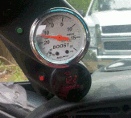
well at idle the motor pulls 15 inches..I think I might need a boost sensitive pcv valve. like the ones that came in the grand nationals.
Thread Starter
Racer
Joined: Jan 2005
Posts: 315
Likes: 0
From: tomahawk wisconsin
Originally Posted by BrianCunningham
If your running a blower you need to reroute the PVC system. You trying to run it pressurized. Ask over in the forced-induction section. What kit are you running?

also thanks guys and I will spend some serious time looking everything over this time...also where do I get one of those adjustable protractors from?I have never used one but I am sure I will be able to figure it out..
thanks again guys..

Drifting

Joined: May 2003
Posts: 1,730
Likes: 1
From: Charlotte NC
St. Jude Donor '05
Chad Golen at Golen engines has been able to help me and some guys of mine with intakes not properly cut after heads have been milled down. The only thing he needs is your intake and a fresh gasket crushed down.
I sent one guy over to him and they actually cut a otherwize good LT1 intake before touching my buddies just to make sure they had everything setup right.. SO basically they ruined one just to make sure they where going to do the best job for the other guy.
Tell him alvin sent you if you decide to talk to him
I sent one guy over to him and they actually cut a otherwize good LT1 intake before touching my buddies just to make sure they had everything setup right.. SO basically they ruined one just to make sure they where going to do the best job for the other guy.
Tell him alvin sent you if you decide to talk to him