



Fuel Requirement

Thread Starter
Drifting


Joined: Oct 2005
Posts: 1,257
Likes: 4
From: North Carolina
 Fuel Requirement
Hello,
Been driving my 89 vette for about a month now and have been filling it up with 93 Octane every time I go to the gas station. Its not listed anywhere in or on the car, and I can't seem to find out what it should run on online. Whats the fuel requirment for this engine... L98 with the Aluminum Heads. If it will run better and cheaper on something else,... then I want to know about it!
DG
Been driving my 89 vette for about a month now and have been filling it up with 93 Octane every time I go to the gas station. Its not listed anywhere in or on the car, and I can't seem to find out what it should run on online. Whats the fuel requirment for this engine... L98 with the Aluminum Heads. If it will run better and cheaper on something else,... then I want to know about it!
DG

Team Owner

Joined: Dec 2000
Posts: 90,675
Likes: 304
From: SE NY
Cruise-In II Veteran
If you are running stock ignition timing of 6deg BTDC you can run 87 octane with no problem.
The reason for running higher octane (i.e. slower burning) on a stock L98 is so that you can advance base timing for improved acceleration.
The reason for running higher octane (i.e. slower burning) on a stock L98 is so that you can advance base timing for improved acceleration.
Thread Starter
Drifting
Joined: Oct 2005
Posts: 1,257
Likes: 4
From: North Carolina
Yea,
I asked for a few reasons. I figured why now save the extra $$$ if I could, not to mention whats more important,... power and I know the 93 burns slower then the 87 which means if its intended timing is for the 87 I am loosing a little something and paying more to do it...
Meanwhile, I would love to turn up the timing a little and Ill still use the 93,... but isn't the timing completely computer controlled,... how do I go about doing that? PCM tune... this is something I haven't looked into yet..
Let me know,
Dan
I asked for a few reasons. I figured why now save the extra $$$ if I could, not to mention whats more important,... power and I know the 93 burns slower then the 87 which means if its intended timing is for the 87 I am loosing a little something and paying more to do it...
Meanwhile, I would love to turn up the timing a little and Ill still use the 93,... but isn't the timing completely computer controlled,... how do I go about doing that? PCM tune... this is something I haven't looked into yet..
Let me know,
Dan

Safety Car

Joined: Dec 2004
Posts: 4,088
Likes: 0
From: Poop land
93 octane is just about $5 more per fill up. I'd set base timing to 10 degrees and run with that. Throttle response with more timing just feels much better on acceleration as well. To advance timing, you would turn the distributer counter clockwise just a notch..

Le Mans Master


Joined: Oct 2003
Posts: 6,130
Likes: 2
From: seattle WA
I've advanced the timing to 8* on my 87 and still burn 87 octane without pinging. To advance your timing you'll of course need a timing light and you have to unplug the EST, very simple job.
Thread Starter
Drifting
Joined: Oct 2005
Posts: 1,257
Likes: 4
From: North Carolina
I am getting my 96 OBDII Impala tuned at the end of the month. (PCM4LESS) I was headed in the direction of asking the same tuning questions about the vette. Maybe you guys would like to give me a little advice while the topic is still hot...
What controls can be changed or improved on this OBDI System??? I know its basic and I'm not sure EXACTLY what the PCM (ECU?) controls on this car.
Dan
Last edited by Danspeed1; Feb 12, 2007 at 10:59 AM.
Safety Car
Joined: Dec 2004
Posts: 4,088
Likes: 0
From: Poop land
Well, the ECM controls timing to a certain point, the limits of what the spark advance look up tables vs rpms vs load in your chip. GM says to prevent tampering with the timing so they can save their butt. Also more spark advance causes your car to be more prone to pinging under engine load, especially when the coolant temps are 200 and above as well as having more emissions, primarily NOx emissions. I have run my timing as high as 14 degrees in cool days where my coolant temps were consistently less than 170 degrees.
In summary, you sure can benefit from more timing. The ECM doesn't know what you set your base timing to. It only adds (or subtracts) to/from it.
In summary, you sure can benefit from more timing. The ECM doesn't know what you set your base timing to. It only adds (or subtracts) to/from it.
Corvette Stories
The Best of Corvette for Corvette Enthusiasts

Top 10 Most Expensive Corvettes Ever Sold on Bring A Trailer
Brett Foote
10 Things Every Corvette Owner Needs (2026 Edition)
Michael S. Palmer
8 Most "Only Corvette Owners Understand" Quirks and Problems
Pouria Savadkouei
10 Reasons the C6 Z06 is Still A Performance Benchmark After 20 Years
Joe Kucinski
How Much Horsepower Every Corvette Engine "LOST" in 1972
Joe Kucinski
Top 10 DOs and DON'Ts for Protecting Your Convertible Top!
Michael S. Palmer
Top 10 Most Explosive Corvettes Ever Made: Power-to-Weight Ratio Ranked!
Joe Kucinski
150 hp to 1,250 hp: Every Corvette Generation Compared by the Specs That Matter
Joe Kucinski
8 Coolest Corvette Pace Cars (and Replicas) of All Time
Verdad Gallardo
Le Mans Master

Joined: Feb 2006
Posts: 8,753
Likes: 9
From: Louisiana
If you would like to advace base timing, you will need a timing light and a 9/16" distrubitor bolt wrench. Loosen the hold down bolt a little, disconnect the EST connector and start the engine. Hook up the timing light and point at the mark on the balancer. Note where the timing is and to advance timing turn the dist cap to the desired mark. Once you have it were you want it, tighten the hold down bolt and recheck the timing to make sure it didn't move. Turn the engine off and disconnect the battery. Connect the EST connector and reconnect the battery and start the engine. If you check the timing, the mark will be at about 12 o'clock or 22*-24*.
EST connector
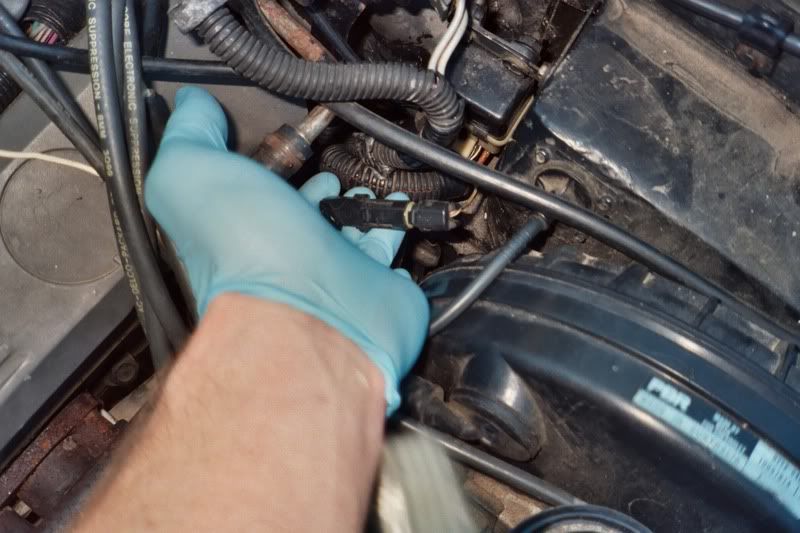
Timing mark [pic done by forum member Ray Quayle]

EST connector
Timing mark [pic done by forum member Ray Quayle]
Thread Starter
Drifting
Joined: Oct 2005
Posts: 1,257
Likes: 4
From: North Carolina
Hey thanks for the info and pics guys... what the heck, I'll give it a try!
Now what about the ECU??? I see on the PCM 4 LESS site that they do the L98 Engine.... is it worth the $$??
Dan
P.S. I have the 180*F Stat in and I am going to get the secondary 200*F Switch in the spring,... I will have to look into getting the ECU to turn the primary on at 185*F
Now what about the ECU??? I see on the PCM 4 LESS site that they do the L98 Engine.... is it worth the $$??
Dan
P.S. I have the 180*F Stat in and I am going to get the secondary 200*F Switch in the spring,... I will have to look into getting the ECU to turn the primary on at 185*F
Last edited by Danspeed1; Feb 12, 2007 at 05:40 PM.
Le Mans Master
Joined: Feb 2006
Posts: 8,753
Likes: 9
From: Louisiana
What modifications do you have on the Corvette?
Edit: I have the chip programmed to turn the fan on at 200* and off at 180*. If you have the fan on at 180* it might run too much. I also have a 180* t-stat.
Edit: I have the chip programmed to turn the fan on at 200* and off at 180*. If you have the fan on at 180* it might run too much. I also have a 180* t-stat.
Last edited by RRT vette; Feb 12, 2007 at 06:34 PM.

Racer

Joined: May 2006
Posts: 293
Likes: 0
To put it simply and in terms for a guy that is "no stranger to timing the 60's and 70's cars", all the ECM does is change the timing based on the engine speed and load. In other words the ECM takes the place of the centrifugal and vacuum advances. As in the olden days when you change the "base timing" on a computer car, all you are changing is the "initial timing". The total timing and all the in between timing points are changed too. When you start messing with the chip, the tune, THAT is the same as re-curving the distributor. Maybe that will take some of the mystery out if it. Just as back in the olden days, the best way to find the optimum initial timing for an existing curve is to make back to back 1/4 runs and keep advancing the timing 2* at a time until the 1/4 mile MPH quits improving. See? There really isn't anything new with these cars.
Thread Starter
Drifting
Joined: Oct 2005
Posts: 1,257
Likes: 4
From: North Carolina
To put it simply and in terms for a guy that is "no stranger to timing the 60's and 70's cars", all the ECM does is change the timing based on the engine speed and load. In other words the ECM takes the place of the centrifugal and vacuum advances. As in the olden days when you change the "base timing" on a computer car, all you are changing is the "initial timing". The total timing and all the in between timing points are changed too. When you start messing with the chip, the tune, THAT is the same as re-curving the distributor. Maybe that will take some of the mystery out if it. Just as back in the olden days, the best way to find the optimum initial timing for an existing curve is to make back to back 1/4 runs and keep advancing the timing 2* at a time until the 1/4 mile MPH quits improving. See? There really isn't anything new with these cars.


Le Mans Master
Joined: Feb 2006
Posts: 8,753
Likes: 9
From: Louisiana
You will recieve a piggyback adapter that fits between your ECM chip. It is removable incase you want to go back to stock.
Thread Starter
Drifting
Joined: Oct 2005
Posts: 1,257
Likes: 4
From: North Carolina
Thanks RRT,
More then likely what I will do is wait and see how he does with my Impala, then I will look into getting the vette done next. For now the timing advance should keep me busy
DG
More then likely what I will do is wait and see how he does with my Impala, then I will look into getting the vette done next. For now the timing advance should keep me busy
DG
Safety Car
Joined: Dec 2004
Posts: 4,088
Likes: 0
From: Poop land
Yeah man, all tuning is just playing with the fuel enrichment tables at different rpms and spark advance at different rpms. That is what has been done to mine. You could get going faster if you advance spark at higher rpms, as well as enriching the A/F mixture enough so you don't detonate. Basically with performance WOT tuning, your motor is on the edge. Now tuning for daily drivabilty, light to mid throttle is a different story... much harder to mess with because of closed loop A/F ratio variance.

Safety Car
Joined: Jan 2004
Posts: 3,783
Likes: 15
From: Northern California
My last Vette was an "89" and it said in the owners manual to use premium fuel of at least 91 octane for best engine performance. I used 87 for awhile but, I noticed it would knock a little during part throttle. I've been using 91 ever since.
On my current "91" Vette, I use 91 octane per the user manual because of the higher compression engine.
My wifes 2002 Mitsubishi Diamante VR-X says to use Premium fuel but, we've been using regular. One day I explained to her how different fuels burn and we decided to use Chevron 91 octane. A few weeks later she told me she noticed she went further on a tank of gas and it took less to fill up.
She's been using 91 ever since.
On my current "91" Vette, I use 91 octane per the user manual because of the higher compression engine.
My wifes 2002 Mitsubishi Diamante VR-X says to use Premium fuel but, we've been using regular. One day I explained to her how different fuels burn and we decided to use Chevron 91 octane. A few weeks later she told me she noticed she went further on a tank of gas and it took less to fill up.
She's been using 91 ever since.
