



A question about trans. temp. sending unit.

Thread Starter
Race Director


Joined: Jun 2004
Posts: 13,961
Likes: 707
From: WI
 A question about trans. temp. sending unit.
I have a drain plug install kit for my trans. pan, and a trans. temp. gauge. The sender for the gauge screws into the drain plug but the end of the probe does not stick out past the end of the nut. Now the question is, should I grind down the nut to allow the sender to stick into the ATF? Right now there would be contact with the ATF through the tube of the drain. Part of me thinks that it would read fine the way it is, any idea? I can take pictures if need be.
The kit looks similar to this:
http://www.jegs.com/webapp/wcs/store...0002_752949_-1
You can see how the plug screws in, the sender is much longer but still is not past the end nut that is inside the pan.
The kit looks similar to this:
http://www.jegs.com/webapp/wcs/store...0002_752949_-1
You can see how the plug screws in, the sender is much longer but still is not past the end nut that is inside the pan.
Thread Starter
Race Director
Joined: Jun 2004
Posts: 13,961
Likes: 707
From: WI
That was my thought also. I was thinking to put it in the pan, that way I could measure the trans. temp. and also use it as a drain plug. Is there a decent way to plumb it in, in a better spot? I do have a trans. cooler to install as well, so will be getting some fittings for the radiator and ATF line. I was thinking to use a tee fitting off the ATF return from the radiator and plumb the cooler into that.

Le Mans Master


Joined: Jan 2002
Posts: 9,036
Likes: 13
From: Edmonton AB
That was my thought also. I was thinking to put it in the pan, that
way I could measure the trans. temp. and also use it as a drain plug.
Is there a decent way to plumb it in, in a better spot?
I do have a trans. cooler to install as well, so will be getting some
fittings for the radiator and ATF line. I was thinking to use a tee fitting
off the ATF return from the radiator and plumb the cooler into that.
way I could measure the trans. temp. and also use it as a drain plug.
Is there a decent way to plumb it in, in a better spot?
I do have a trans. cooler to install as well, so will be getting some
fittings for the radiator and ATF line. I was thinking to use a tee fitting
off the ATF return from the radiator and plumb the cooler into that.
plumbing a sender and/or an external cooler. (The cooler isn't necessary,
the sender could be installed alone with the hoses just there to
adapt the tee fitting into the OEM line.)
Looking for Transmission Cooling Pans
I expect that temperatures will vary according to where the sensor is
mounted. I have not sampled temps at different locations but my
vote is that the supply line to the cooler will register higher than the
fluid in the return line and the pan.
With the gauge in place, average temperatures for the location will
become apparent. When the gauge starts indicating higher temperatures,
this will be the sign to consider taking appropriate action.
Regarding the adapter/drain mentioned earlier. Is it really feasible to
mount this vertically in the bottom of the pan on a C4? I do not know
but I suspect the plug and sender would extend down and be vulnerable.
I think it could work as a sender adapter if mounted in a wall of the
pan (but it would not be completely useful as a drain.) Some thought
as to which wall (front/rear/side?) would ensure the least vulnerability
and best wire routing.
Incidently, there is a plug in the transmission case on the driver's
side above the shifter linkage. I believe it is 1/8" NPT and my
understanding is that it is a port for reading pressures.
I have seen sender installation tips online that suggest using this
port for the sender (and may have mentioned it in posts here in the
past). HOWEVER, THIS PORT TURNS 90º INSDE THE CASE AND
THERE IS ONLY A THIN WALL AT THE BEND. The depth of the port
is shallow enough that A SENDER COULD BOTTOM AT THE TURN AND
IF FORCED, CRACK THE CASE.
I considered a hose in the port and mounting the sender to a fitting
at the end of the short hose before I elected to tap into the cooler
lines.
.
Thread Starter
Race Director
Joined: Jun 2004
Posts: 13,961
Likes: 707
From: WI
The stock radiator is flare? I was thinking to run a 90° fitting off the radiator at the return to the pan line, run that to the cooler with hose, then back to the stock return line with a flare to hose barb fitting. I have not looked at all the routing yet. I just have the pan dropped for now. It got to cold to keep going. Is there a nice place to run the cooler lines? What temp. have you been running at? I suspect I'll need to cover the cooler in winter.
Le Mans Master
Joined: Jan 2002
Posts: 9,036
Likes: 13
From: Edmonton AB
It is on my '89. FBM2111 is the p/n for the 1/2" Inverted Flare to -6 AN Male.
I vote against 90° fittings in favor of straight(er) fittings and a bit
more hose. Barb ends, clamps and hose will work for cooler plumbing.
I only have the sensor, there is no cooler. Because of other car
priorities in 2006, I have no sensor results from events yet.
Perhaps plumbing so that the oil passes through the external cooler
first and then through the exchanger in the radiator might help during
colder periods?
.
Originally Posted by Aardwolf
I was thinking to run a 90° fitting off the radiator at the return to the
pan line, run that to the cooler with hose, then back to the stock
return line with a flare to hose barb fitting.
pan line, run that to the cooler with hose, then back to the stock
return line with a flare to hose barb fitting.
more hose. Barb ends, clamps and hose will work for cooler plumbing.
Originally Posted by Aardwolf
Is there a nice place to run the cooler lines? What temp. have you
been running at? I suspect I'll need to cover the cooler in winter.
been running at? I suspect I'll need to cover the cooler in winter.
priorities in 2006, I have no sensor results from events yet.
Perhaps plumbing so that the oil passes through the external cooler
first and then through the exchanger in the radiator might help during
colder periods?
.

Melting Slicks

Joined: Oct 2004
Posts: 2,662
Likes: 8
From: Knoxville Tennessee
Let me suggest getting a Derale trans pan. It already has a drain pulg in it, provides for more fluid and has cooling tubes running thru the fluid. You could install the temp probe in the drain plug provided, monitor the temp and determine if you need the additional trans cooler. Just a thought. Also, what temp kit did you get?
Bernie
Bernie
Le Mans Master
Joined: Jan 2002
Posts: 9,036
Likes: 13
From: Edmonton AB
I elected to tap into the cooler lines using the approach mentioned
earlier because it seemed to be the least intrusive manner of collecting
trans temperature data.
The fittings have a cost but they can either be used for a cooler if one
proves necessary or moved to another more needy project in minutes,
leaving no trace on the current car.
Aside from cost and issues entailed in swapping, consider that a deeper
pan like the Derale also requires thought about whether it can coexist
with an OEM convertible X-brace or an after-market part like the
R-D Cross-Frame.
.
Corvette Stories
The Best of Corvette for Corvette Enthusiasts

Top 10 Most Expensive Corvettes Ever Sold on Bring A Trailer
Brett Foote
10 Things Every Corvette Owner Needs (2026 Edition)
Michael S. Palmer
8 Most "Only Corvette Owners Understand" Quirks and Problems
Pouria Savadkouei
10 Reasons the C6 Z06 is Still A Performance Benchmark After 20 Years
Joe Kucinski
How Much Horsepower Every Corvette Engine "LOST" in 1972
Joe Kucinski
Top 10 DOs and DON'Ts for Protecting Your Convertible Top!
Michael S. Palmer
Top 10 Most Explosive Corvettes Ever Made: Power-to-Weight Ratio Ranked!
Joe Kucinski
150 hp to 1,250 hp: Every Corvette Generation Compared by the Specs That Matter
Joe Kucinski
8 Coolest Corvette Pace Cars (and Replicas) of All Time
Verdad Gallardo
Thread Starter
Race Director
Joined: Jun 2004
Posts: 13,961
Likes: 707
From: WI
I thought of the Derale pan to but don't want to have to try plugging the tubes if the trans. runs cold in the winter. It's been -20° here at night with some days only getting to 1°. I think we averaged a temp. of 8.6° so far in Feb.
I got this gauge:
http://www.egauges.com/vdo_ind.asp?T...d&PN=A021E061Y
I plan to install it in the center air vent above the radio, and another gauge as well. I haven't decide yet witch other gauge would be best.
I run some HPDE days and also drag, I may need a fan on the cooler but am not sure yet.
I got this gauge:
http://www.egauges.com/vdo_ind.asp?T...d&PN=A021E061Y
I plan to install it in the center air vent above the radio, and another gauge as well. I haven't decide yet witch other gauge would be best.
I run some HPDE days and also drag, I may need a fan on the cooler but am not sure yet.

Le Mans Master


Joined: Jul 1999
Posts: 5,005
Likes: 38
From: jackson nj
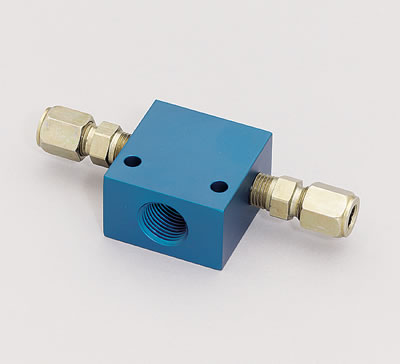
It would be better for you if you used the Auto Meter manifold for this. They make them for 3/8 or 5/16" lines and are specifically designed for the sending units of the trans temp gauges. You can also get it from Jegs like the drain plug.
Le Mans Master
Joined: Jan 2002
Posts: 9,036
Likes: 13
From: Edmonton AB
- 2287 for 5/16" fittings and 1/2" NPT female sensor port
- 2286 for 3/8" fittings and 1/2" NPT female sensor port
However, the fittings supplied appear to be compression-type units.
These fittings together with the solid block adapter seem to mean that
the OEM lines need to be cut up.
.


Le Mans Master
Joined: Jul 1999
Posts: 5,005
Likes: 38
From: jackson nj
Slalom4me..you are correct with the compression fitting that come with the manifold, however cutting the line is not the only way of installing it. You can put fittings in each end and the OEM trans line fitting will go into one, then make a line for the other side, all without cutting. Also if an aftermarket cooler is in the picture (it sure better be) then the fittings they supply in most cases will install into the OEM cooler fitting on the radiator, and then into one side of the manifold while still using the autostore (Advance, Napa, Part Rite, etc) going into the other end with the OEM trans line going into it. All of those don't require any cutting of the original line. I use those procedures on line locs, trans lines, oil pressure/temp and so on with my cars.