


Intercooling

Thread Starter
Safety Car


Joined: May 2006
Posts: 4,290
Likes: 140
From: Salem NH
 Intercooling
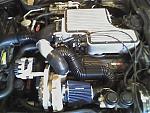
Cheap intercooling. This should be plug and play over the valve cover on curved discharge Powerdyne or Procharger, maybe even vortech.
http://members.cisdi.com/~anesthes/p...s/intercooler/
-- Joe
http://members.cisdi.com/~anesthes/p...s/intercooler/
-- Joe
Melting Slicks

Joined: Aug 2003
Posts: 3,394
Likes: 393
From: Lakeville MI
Nice find Joe,
Be sure to let us know the pressure drop once you can test it. I read that ATI used to quote a 3 psi drop for their air to air intercoolers, so their head units were pullied to produce an extra 3 lbs.
A 3 psi pressure drop could really cripple a 6 lb. Powerdyne, so I hope its not that bad. Since its much smaller than a typical air to air intercooler, hopefully it will be much better in this regard.
Be sure to let us know the pressure drop once you can test it. I read that ATI used to quote a 3 psi drop for their air to air intercoolers, so their head units were pullied to produce an extra 3 lbs.
A 3 psi pressure drop could really cripple a 6 lb. Powerdyne, so I hope its not that bad. Since its much smaller than a typical air to air intercooler, hopefully it will be much better in this regard.
Thread Starter
Safety Car
Joined: May 2006
Posts: 4,290
Likes: 140
From: Salem NH
Nice find Joe,
Be sure to let us know the pressure drop once you can test it. I read that ATI used to quote a 3 psi drop for their air to air intercoolers, so their head units were pullied to produce an extra 3 lbs.
A 3 psi pressure drop could really cripple a 6 lb. Powerdyne, so I hope its not that bad. Since its much smaller than a typical air to air intercooler, hopefully it will be much better in this regard.
Be sure to let us know the pressure drop once you can test it. I read that ATI used to quote a 3 psi drop for their air to air intercoolers, so their head units were pullied to produce an extra 3 lbs.
A 3 psi pressure drop could really cripple a 6 lb. Powerdyne, so I hope its not that bad. Since its much smaller than a typical air to air intercooler, hopefully it will be much better in this regard.
Coupled with some MAT vs spark advance tables, it should be pretty straight forward to build a calibration that runs fine on the street, and even better at the track with ice water.
Vortech's air to water intercooler:
http://www.vortechsuperchargers.com/...p=19&cat_key=3
-- Joe
Thread Starter
Safety Car
Joined: May 2006
Posts: 4,290
Likes: 140
From: Salem NH
Check this out regarding pressure drop:
"s Water to Air for me?
A Water to Air Intercooler setup is similar in principle to a traditional air to air setup, except that there is water passing through the core of the intercooler instead of air which is responsible for drawing the heat out of the intake air. There are many benefits of using a water to air intercooler setup.
Water to air means incredibly low pressure drop.
Pressure drop on a standard water to air intercooler core is only .05 PSI. That's not a typo, pressure drop on a water to air intercooler setup is up to 20 times less than a comparably performing air to air setup.
Water to air means better engine cooling.
Many people who try to road race with a front mount intercooler have overheating problems because the air going to the radiator has to pass through the hot intercooler first. With a water to air setup, you have far more flexible options. The core will probably be in the engine bay, and the radiator can be mounted in the trunk, under the car, or in some applications a radiator is not even needed.
Water to air means better throttle response.
Instead of the horrible mess of pipes that is normally associated with an air to air intercooler, a water to air intercooler can be mounted in the engine bay, directly between the turbo outlet and the throttle body. A shorter intake route with fewer bends is beneficial in every way.
Water to air means no heat soak.
A water to air intercooler setup circulates water through the core even when the car is not moving. This is especially useful during drag racing, when the core temperature raises significantly during a pass, and then the car sits still for several minutes waiting for the next pass.
Water to air means extreme drag racing advantage.
You can add ice to your reservoir, if so equipped, which will drop your intake temperature BELOW ambient. Of course, the ice melts, which is why this is so good for drag racing.
Water to air means Mid Engine No Problem.
Every modified mid or rear engine turbo vehicle should have a water to air intercooler setup. It is not practical to have a front mounted air to air setup in these applications, but you can have a water to air intercooler in the back of the vehicle and the radiator in the front, providing greater cooling than an air to air setup.
Bugatti Veyron.
The Bugatti Veyron is equipped with a water to air intercooler. 1,001 horsepower, 250 MPH cars might be somewhat common at the drag strip, but that's not what the Veyron is about. The Veyron is an all-around car, not just a top-speed monster. That's the reason it is the most expensive car in the world and they still lose money on every one. Bugatti chose a water to air intercooler for this car because it is absolutely the best system available. The Ford GT and Ariel Atom also use water to air, for a more real-world example.
Why does it work?
Water does a better job of drawing the heat out of metal than air. Look at engine cooling - how many air-cooled engines are there? Not many, because water does a much more effective job at cooling. So much more, in fact, that it is impossible to engineer a solution for a modern high performance engine that is air cooled.
How does it work?
Now that you have a place to buy all of the components, water to air intercooler setups are easier to implement than air to air. The reason it is easier is because you have extreme flexibility as to where to mount all of the components. Mount the core in the engine bay. The air inlet/outlet should, of course, be piped in between your turbo and throttle body. The water inlet should come from the pump, and the outlet should lead to the radiator, then the reservoir (if equipped)."
"s Water to Air for me?
A Water to Air Intercooler setup is similar in principle to a traditional air to air setup, except that there is water passing through the core of the intercooler instead of air which is responsible for drawing the heat out of the intake air. There are many benefits of using a water to air intercooler setup.
Water to air means incredibly low pressure drop.
Pressure drop on a standard water to air intercooler core is only .05 PSI. That's not a typo, pressure drop on a water to air intercooler setup is up to 20 times less than a comparably performing air to air setup.
Water to air means better engine cooling.
Many people who try to road race with a front mount intercooler have overheating problems because the air going to the radiator has to pass through the hot intercooler first. With a water to air setup, you have far more flexible options. The core will probably be in the engine bay, and the radiator can be mounted in the trunk, under the car, or in some applications a radiator is not even needed.
Water to air means better throttle response.
Instead of the horrible mess of pipes that is normally associated with an air to air intercooler, a water to air intercooler can be mounted in the engine bay, directly between the turbo outlet and the throttle body. A shorter intake route with fewer bends is beneficial in every way.
Water to air means no heat soak.
A water to air intercooler setup circulates water through the core even when the car is not moving. This is especially useful during drag racing, when the core temperature raises significantly during a pass, and then the car sits still for several minutes waiting for the next pass.
Water to air means extreme drag racing advantage.
You can add ice to your reservoir, if so equipped, which will drop your intake temperature BELOW ambient. Of course, the ice melts, which is why this is so good for drag racing.
Water to air means Mid Engine No Problem.
Every modified mid or rear engine turbo vehicle should have a water to air intercooler setup. It is not practical to have a front mounted air to air setup in these applications, but you can have a water to air intercooler in the back of the vehicle and the radiator in the front, providing greater cooling than an air to air setup.
Bugatti Veyron.
The Bugatti Veyron is equipped with a water to air intercooler. 1,001 horsepower, 250 MPH cars might be somewhat common at the drag strip, but that's not what the Veyron is about. The Veyron is an all-around car, not just a top-speed monster. That's the reason it is the most expensive car in the world and they still lose money on every one. Bugatti chose a water to air intercooler for this car because it is absolutely the best system available. The Ford GT and Ariel Atom also use water to air, for a more real-world example.
Why does it work?
Water does a better job of drawing the heat out of metal than air. Look at engine cooling - how many air-cooled engines are there? Not many, because water does a much more effective job at cooling. So much more, in fact, that it is impossible to engineer a solution for a modern high performance engine that is air cooled.
How does it work?
Now that you have a place to buy all of the components, water to air intercooler setups are easier to implement than air to air. The reason it is easier is because you have extreme flexibility as to where to mount all of the components. Mount the core in the engine bay. The air inlet/outlet should, of course, be piped in between your turbo and throttle body. The water inlet should come from the pump, and the outlet should lead to the radiator, then the reservoir (if equipped)."
Thread Starter
Safety Car
Joined: May 2006
Posts: 4,290
Likes: 140
From: Salem NH
I wanted to upgrade to a ysi when I had the s-trim on the firechicken, but could never fork the $2500 for the head unit. Thats a lot of dough.
These IC's support '1000' hp on paper, but thats chinese mfg math, so multiply that by .55 and thats probably the real number. I'd think you'd need a bigger core, as suggested for the ysi.
-- Joe

Melting Slicks
Joined: Jul 2004
Posts: 3,277
Likes: 32
From: Mission Viejo California
Totally... I'm somewhat suspicious of their hp #'s. i called bell intercoolers and they said that I wanted about 75 square inches of hot side surface area. They ysi flows about 1500 cfm although I'm using about 1200 or so....
For smaller s and t trim systems that you're spinning hard, an intercooler like this may be the ticket.
For smaller s and t trim systems that you're spinning hard, an intercooler like this may be the ticket.
Thread Starter
Safety Car
Joined: May 2006
Posts: 4,290
Likes: 140
From: Salem NH
Totally... I'm somewhat suspicious of their hp #'s. i called bell intercoolers and they said that I wanted about 75 square inches of hot side surface area. They ysi flows about 1500 cfm although I'm using about 1200 or so....
For smaller s and t trim systems that you're spinning hard, an intercooler like this may be the ticket.
For smaller s and t trim systems that you're spinning hard, an intercooler like this may be the ticket.
Single Inlet/Single Outlet
When compared to an Air/Air intercooler, a Liquid/Air system can handle more heat transfer and, therefore, more power for a given core size. This is due to the use of liquid as the charge cooling medium, which provides better heat transfer properties than air. The trade off for this increase in cooling capacity is the need for additional components not required with an Air/Air system (coolant reservoir, pump and heat exchanger). Liquid/Air systems are well suited for applications where there may not be direct access to a cooling air stream, for instance in a rear or mid engine vehicle. Liquid/Air systems are also able to increase intercooler efficiencies beyond 100% through the use of chilled or ice water as a cooling medium.
Core Dimensions: 12 x 6 x 6
Horsepower Rating: 400 hp (max) (for core shown)
So, for about the same core size (and shape based on picture)
we go from 1,000 hp to 400 hp..
IMO, I think it's probably good for around 500 to 550hp. Not good for you, but probably fine for me, tb, and some of the other guys with smaller blowers. (<10psi).
Bell also says max 1psi drop over the air to water ICs with 10psi boost. I think if I end up upgrading my impeller on the powerdyne, and it can push 10psi w/out overspinning I'll go with one of these cheap IC's.
I checked out this website too: http://www.frozenboost.com/
who sells the ebay intercoolers, along with accessories. They have a $299 setup w/ everything needed, and you can upgrade to the bosch pump (mustang cobra) for $69 more.
-- Joe
Corvette Stories
The Best of Corvette for Corvette Enthusiasts

150 hp to 1,250 hp: Every Corvette Generation Compared by the Specs That Matter
Joe Kucinski
8 Coolest Corvette Pace Cars (and Replicas) of All Time
Verdad Gallardo
Top 10 Corvette Engines RANKED by Peak Torque (70+ Years of Muscle!)
Joe Kucinski
Corvette ZR1X Will Be Pacing the Indy 500, And Could Probably Race, Too!
Verdad Gallardo
Top 10 Corvettes Coming to Mecum Indy 2026!
Brett Foote
Top 10 C9 Corvette MUST-HAVES to Fix These C8 Generation Flaws!
Michael S. Palmer
10 Revolutionary 'Corvette Firsts' Most People Don't Know
Joe Kucinski
5 Reasons to Upgrade to an LS6-Powered Corvette; 5 Reasons to Stay LT2
Michael S. Palmer
2027 Corvette vs The World: Every C8 vs Its Closest Competitor
Joe Kucinski
Melting Slicks
Joined: Jul 2004
Posts: 3,277
Likes: 32
From: Mission Viejo California
So are those the same as the intercoolers on ebay?
They mention that the pressure drop at the rated cfm is super low. I bet you could stretch this unit to work on a powerdyne or s trim car. I found it interesting how they mention that there is a difference between the air to air and air to water cores(which makes sense).
I like their type 5 one. I could fit that thing in between the hood mounting points on the dog house. I'd only have to trim a bit. It's almost similar in size to the spearco 2-231 except the whole package is half the price of the spearco intercooler.
Their packages seem pretty well prices. Give it a try and let us know how it works. Run some tests!
Here's a link for liquid to air intercoolers of similar dimensions:
http://www.racetep.com/atoliq.html
They're high dollar cores so I'm not sure how much difference there is. Maybe someone will chime in like BTF who is a garrett dealer.
They mention that the pressure drop at the rated cfm is super low. I bet you could stretch this unit to work on a powerdyne or s trim car. I found it interesting how they mention that there is a difference between the air to air and air to water cores(which makes sense).
I like their type 5 one. I could fit that thing in between the hood mounting points on the dog house. I'd only have to trim a bit. It's almost similar in size to the spearco 2-231 except the whole package is half the price of the spearco intercooler.
Their packages seem pretty well prices. Give it a try and let us know how it works. Run some tests!
Here's a link for liquid to air intercoolers of similar dimensions:
http://www.racetep.com/atoliq.html
They're high dollar cores so I'm not sure how much difference there is. Maybe someone will chime in like BTF who is a garrett dealer.
Last edited by qwiketz; Apr 3, 2008 at 04:00 PM.
Thread Starter
Safety Car
Joined: May 2006
Posts: 4,290
Likes: 140
From: Salem NH
So are those the same as the intercoolers on ebay?
They mention that the pressure drop at the rated cfm is super low. I bet you could stretch this unit to work on a powerdyne or s trim car. I found it interesting how they mention that there is a difference between the air to air and air to water cores(which makes sense).
I like their type 5 one. I could fit that thing in between the hood mounting points on the dog house. I'd only have to trim a bit. It's almost similar in size to the spearco 2-231 except the whole package is half the price of the spearco intercooler.
Their packages seem pretty well prices. Give it a try and let us know how it works. Run some tests!
Here's a link for liquid to air intercoolers of similar dimensions:
http://www.racetep.com/atoliq.html
They're high dollar cores so I'm not sure how much difference there is. Maybe someone will chime in like BTF who is a garrett dealer.
They mention that the pressure drop at the rated cfm is super low. I bet you could stretch this unit to work on a powerdyne or s trim car. I found it interesting how they mention that there is a difference between the air to air and air to water cores(which makes sense).
I like their type 5 one. I could fit that thing in between the hood mounting points on the dog house. I'd only have to trim a bit. It's almost similar in size to the spearco 2-231 except the whole package is half the price of the spearco intercooler.
Their packages seem pretty well prices. Give it a try and let us know how it works. Run some tests!
Here's a link for liquid to air intercoolers of similar dimensions:
http://www.racetep.com/atoliq.html
They're high dollar cores so I'm not sure how much difference there is. Maybe someone will chime in like BTF who is a garrett dealer.
I'll try it out eventually. I wanna get a baseline of how the car is with the stock powerdyne, then maybe try the upgraded impeller with the intercooler.
-- Joe

Safety Car

Joined: Apr 2001
Posts: 3,525
Likes: 2
From: Houston TX
www.extremeintercoolers.com
JR Parrot owns this facility and is extremely competitive on A2A and A2W ICs. He has built multiple ICs for me for my cars and for other cars that I built. Even one for a 3 lobe Mazda rotary in an airplace (cool project). That is his '90 300ZX street car with the SBC and T88.
I just realized how many of my custom set-ups are displayed on his website.
http://www.extremeintercoolers.com/customs.html
The water to air (1st one) for another car, the crossflow custom (2nd) was for the rotary airplane, and the complete custom (4th one) is for my '87. The 4th one completely wraps around the "suitcase" in a C4, with 3.5" inlet, 4" outlet and 5.5" thick core. The core dimensions exactly match the factory radiator core.
I have a nice A2W that is good for 2500CFM at <1 psi pressure drop. I just have not gotten around to installing on the car. 4" inlet and outlet, w/ 1" NPT wetside fittings.
Aaron
JR Parrot owns this facility and is extremely competitive on A2A and A2W ICs. He has built multiple ICs for me for my cars and for other cars that I built. Even one for a 3 lobe Mazda rotary in an airplace (cool project). That is his '90 300ZX street car with the SBC and T88.
I just realized how many of my custom set-ups are displayed on his website.
http://www.extremeintercoolers.com/customs.html
The water to air (1st one) for another car, the crossflow custom (2nd) was for the rotary airplane, and the complete custom (4th one) is for my '87. The 4th one completely wraps around the "suitcase" in a C4, with 3.5" inlet, 4" outlet and 5.5" thick core. The core dimensions exactly match the factory radiator core.
I have a nice A2W that is good for 2500CFM at <1 psi pressure drop. I just have not gotten around to installing on the car. 4" inlet and outlet, w/ 1" NPT wetside fittings.
Aaron
Last edited by AKS Racing; Apr 3, 2008 at 09:16 PM.
Thread Starter
Safety Car
Joined: May 2006
Posts: 4,290
Likes: 140
From: Salem NH
Here is Vortechs install diagram. Is this the routing you would do?
I'd think, that you would want the HOT return water from the IC to pass through the heat exchanger first, before returning to the tank. Especially if your adding ice to your storage tank.
Why do you think it would be beneficial to run the hot return direct to the tank, and have the feed pass through the heat exchanger before the intercooler?
-- Joe

I'd think, that you would want the HOT return water from the IC to pass through the heat exchanger first, before returning to the tank. Especially if your adding ice to your storage tank.
Why do you think it would be beneficial to run the hot return direct to the tank, and have the feed pass through the heat exchanger before the intercooler?
-- Joe
928, code, coupon, diagrams, exchanger, flow, frozenboost, frozenboostcom, heat, ic, impeller, intercooler, motorsports, nitrous, routing, work
