



 what where the dyno #'s ?
 keep us updated

Parallel Plumbing 84 TBs

Thread Starter
Pro


Joined: Dec 2002
Posts: 603
Likes: 0
From: 84 383 XFire Chandler, AZ
 Parallel Plumbing 84 TBs
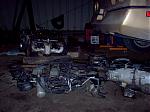
I thought there would be interest in this. I have been struggling with feeding a 383 in my 84. On the dyno we noticed a fuel pressure drop from 20psi to 15psi with a TPI pump. Pressure started to drop off from 4000rpm to 5500rpm the pressure was at 15psi. Needless to say this indicated a severe fuel delivery issue - the TPI pump should be able to supply enough fuel - I have a LT1 pump in the wings just in case the motor needs more fule. One way to cure this is to parallel plumbing the TBs. The regulator is a bypass regulator hooked up to the return side. I am also removing both regulators and will have a plate welded in place. The injector tops are at the weld shop and should be done in a couple days. Hopefully this setup will supply enough fuel to feed the motor so it can be all it can be.
I also plan on redoing the fuel lines to use hardlines once I get stuff setup. This was a exercise in getting it plumbed and working. The airpump at this point is nothing more than a pulley - it is gutted. I may fab up a airpump delete for the 84 sometime in the future.

"To boldly go where not many are willing to tread.."
I also plan on redoing the fuel lines to use hardlines once I get stuff setup. This was a exercise in getting it plumbed and working. The airpump at this point is nothing more than a pulley - it is gutted. I may fab up a airpump delete for the 84 sometime in the future.
"To boldly go where not many are willing to tread.."
Last edited by elkabong; Apr 11, 2008 at 09:32 AM.

Race Director

Joined: Sep 2000
Posts: 17,298
Likes: 33
From: The Top of Utah
Originally Posted by elkabong
I thought there would be interest in this. I have been struggling with feeding a 383 in my 84. On the dyno we noticed a fuel pressure drop from 20psi to 15psi with a TPI pump. Pressure started to drop off at 4000rpm and at 5500rpm the pressure was at 15psi. Needless to say this indicated a severe fuel delivery issue - the TPI pump should be able to supply enough fuel
Originally Posted by elkabong
One way to cure this is to parallel plumbing the TBs. The regulator is a bypass regulator hooked up to the return side. I am also removing both regulators and will have a plate welded in place.
This doesn't add up. Possibly your fuel filter or sock are clogged and can't handle the volume. A, supposedly freer flowing fuel system, after the pressure gauge, should show up as an even greater pressure drop. There is no way you have increased the fuel needs of the engine to require such a drastic overhaul of the delivery system. It should, however, cause no harm, so maybe such a diversion will keep your "tinkeritis" from doing any real damage.
RACE ON!!!
Last edited by CFI-EFI; Apr 8, 2008 at 11:05 AM.
Thread Starter
Pro
Joined: Dec 2002
Posts: 603
Likes: 0
From: 84 383 XFire Chandler, AZ
The calculated numbers show two injectors need to flow 114.29lb/hr to support a hp target 413. The way to do that is increase the fuel pressure. I am also using 80lb injectors. The flowrate of the injectors have been validated on a flow bench.
Yes I can program the injector pulse width. The trick is keeping them to a 80%-85% duty cycle - hence the higher fuel pressure to support the flow requirements and duty cycle requirements. Headroom is factored in as well. Running them static or close to static is not a good thing.
I mis-stated the "regulators". My humble apologies. The front TB is the accumulator and the rear is the pressure regulator. Needless to say they will both be blocked off.
As far as pressure drop is concerned I have no doubt you do not experience the same things that I am. There is a big difference between a stock motor (205hp, yours is stock right?) and mine which should be capable of 375hp-400hp. Needless to say the fueling requirements are extremely different. All I know is what was seen while on the dyno and what the data logs show.
No "tinkeritis" here. Just being rational about the whole thing based on data - not supposition or inference.
Yes I can program the injector pulse width. The trick is keeping them to a 80%-85% duty cycle - hence the higher fuel pressure to support the flow requirements and duty cycle requirements. Headroom is factored in as well. Running them static or close to static is not a good thing.
I mis-stated the "regulators". My humble apologies. The front TB is the accumulator and the rear is the pressure regulator. Needless to say they will both be blocked off.
As far as pressure drop is concerned I have no doubt you do not experience the same things that I am. There is a big difference between a stock motor (205hp, yours is stock right?) and mine which should be capable of 375hp-400hp. Needless to say the fueling requirements are extremely different. All I know is what was seen while on the dyno and what the data logs show.
No "tinkeritis" here. Just being rational about the whole thing based on data - not supposition or inference.
Last edited by elkabong; Apr 8, 2008 at 11:39 AM.
Race Director
Joined: Sep 2000
Posts: 17,298
Likes: 33
From: The Top of Utah
Originally Posted by elkabong
The calculated numbers show two injectors need to flow 114.29lb/hr to support a hp target 413. The way to do that is increase the fuel pressure. I am also using 80lb injectors. The flowrate of the injectors have been validated on a flow bench.
Originally Posted by elkabong
I mis-stated the "regulators". My humble apologies. The front TB is the accumulator and the rear is the pressure regulator. Needless to say they will both be blocked off.
Originally Posted by elkabong
As far as pressure drop is concerned I have no doubt you do not experience the same things that I am. There is a big difference between a stock motor (205hp, yours is stock right?) and mine which should be capable of 375hp-400hp.
I guess before I can comment further, I would have to know where you are taking your fuel pressure measurement from. I have been assuming, picturing, one thing, which I can see now, may not be the case.
RACE ON!!!

Race Director


Joined: Sep 2003
Posts: 16,837
Likes: 338
From: Database Error Indiana
Makes sense to me. Stock tpi pump has its limits. A few years ago, on the dyno my tpi car was making nearly the same HP (lots of torque though) while datalogging and watching the pressure guage I noticed a pressure drop at the same time the wideband said "lean" and HP dropped off. Time for a Walbro.
Corvette Stories
The Best of Corvette for Corvette Enthusiasts

How Much Horsepower Every Corvette Engine "LOST" in 1972
Joe Kucinski
Top 10 DOs and DON'Ts for Protecting Your Convertible Top!
Michael S. Palmer
Top 10 Most Explosive Corvettes Ever Made: Power-to-Weight Ratio Ranked!
Joe Kucinski
150 hp to 1,250 hp: Every Corvette Generation Compared by the Specs That Matter
Joe Kucinski
8 Coolest Corvette Pace Cars (and Replicas) of All Time
Verdad Gallardo
Top 10 Corvette Engines RANKED by Peak Torque (70+ Years of Muscle!)
Joe Kucinski
Corvette ZR1X Will Be Pacing the Indy 500, And Could Probably Race, Too!
Verdad Gallardo
Top 10 Corvettes Coming to Mecum Indy 2026!
Brett Foote
Top 10 C9 Corvette MUST-HAVES to Fix These C8 Generation Flaws!
Michael S. Palmer
Race Director
Joined: Sep 2000
Posts: 17,298
Likes: 33
From: The Top of Utah
Originally Posted by Spankyellow
Makes sense to me. Stock tpi pump has its limits.
RACE ON!!!
Burning Brakes


Joined: Sep 2006
Posts: 1,202
Likes: 3
From: MD
It may be he's experienced a drop in the pressure BETWEEN the TB's as referenced from the input pressure at the regulator. Parallel plumbing would help that.
Glad you've got the new motor in Elkabong.
Glad you've got the new motor in Elkabong.


Race Director
Joined: Sep 2000
Posts: 17,298
Likes: 33
From: The Top of Utah
Originally Posted by JLeatherman
It may be he's experienced a drop in the pressure BETWEEN the TB's as referenced from the input pressure at the regulator. Parallel plumbing would help that.
RACE ON!!!
Race Director
Joined: Sep 2000
Posts: 17,298
Likes: 33
From: The Top of Utah
Originally Posted by elkabong
The pressure is measured on the input side at the Y block and regulated going back to the tank. Regulation still takes place on the return side.
RACE ON!!!
Thread Starter
Pro
Joined: Dec 2002
Posts: 603
Likes: 0
From: 84 383 XFire Chandler, AZ
The pressure drop was in the stock configuration measured at the line between both TBs. I will let you know whether or not parallel plumbing solves the problem once it is back on the dyno. Also, data logs will also show whether or not it is working because the duty cycle of the injectors should not spike if enough fuel is being supplied.
Race Director
Joined: Sep 2003
Posts: 16,837
Likes: 338
From: Database Error Indiana
Indeed, the TPI pump does have it's limitations, as all pumps do. A drop in pressure is an indication of an insufficient fuel supply, as you experienced. However, parallel plumbing of the TBs neither increases the pump output, nor reduces the fuel demands of the engine.
RACE ON!!!
RACE ON!!!
 I wonder if 280 rwhp is past the limit of the pump? I am not familiar with the CFI system or its requirements so I don't know about the delivery needs. I ended my story with, "time for a Walbro" as a suggestion to Mr. kabong. I would like to hear updates on this motor, because I like to see guys do something different. Even more when they have success.
Thread Starter
Pro
Joined: Dec 2002
Posts: 603
Likes: 0
From: 84 383 XFire Chandler, AZ
Mr. Spanky  ,
,
I have a high flow pump in the wings just in case. The assertion that the TPI pump can't handle the fuel requirements may be correct but I would like to find out. I have a buddy with the same TPI pump on a MPFI equipped motor putting out 400+ at the crank. So who knows..... The other thought is the TPI pump just may be toast and not up the challenge.
FWIW - Parallel plumbing both TBs has been used since '02 so it is not new in the Crossfire world. All one needs to do is go to http://www.crossfire.homeip.net/ and search for "parallel plumbing". Also, it is all an experiment anyway especially with the 'ol Crossfire.
,I have a high flow pump in the wings just in case. The assertion that the TPI pump can't handle the fuel requirements may be correct but I would like to find out. I have a buddy with the same TPI pump on a MPFI equipped motor putting out 400+ at the crank. So who knows..... The other thought is the TPI pump just may be toast and not up the challenge.
FWIW - Parallel plumbing both TBs has been used since '02 so it is not new in the Crossfire world. All one needs to do is go to http://www.crossfire.homeip.net/ and search for "parallel plumbing". Also, it is all an experiment anyway especially with the 'ol Crossfire.

Team Owner

Joined: Feb 2006
Posts: 24,460
Likes: 7
From: sw Ohio