



Going Carb on C-4

Burning Brakes

Joined: Sep 2006
Posts: 1,142
Likes: 0
From: Spring Grove Illinois

 You realy lose nothing beside the TC lockup(easy fix) and a few MPG functions on the dash

Le Mans Master


Joined: May 2004
Posts: 5,386
Likes: 534


Race Director


Joined: Jan 2008
Posts: 16,028
Likes: 170
From: oregon
i think you either spend a lot on EFI or go carb if you want to really move some air. i was lucky & bought a car with a miniram. that little manifold supports enough air for my modest goals, road racing & low 12's at the strip.

Drifting

Joined: May 2005
Posts: 1,302
Likes: 1
From: Tomahawk WI
I enjoy tinkering on my carbed vette but EFI does have some significant advantages. Cold starts for one. EFI will start a car in the cold better, no question. EFI cars ar more fuel efficient, all other factors being equal. I'm not trying discourage you from giong carb, but there are things EFI does better.

Pro

Joined: Jan 2008
Posts: 584
Likes: 1
From: Near Lockport NY Black 1986 Coupe
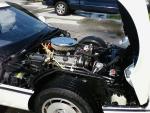
I'm in the process of switching to a carb, and was wondering where you guys found these low profile air cleaners. Do you have any numbers of cfm flow-through for them? I really don't want to cut my hood for it, as I'd prefer a sleeper look, but I don't want to limit performance either.
Instructor

Joined: Mar 2005
Posts: 216
Likes: 3
yea the first thing you do is start cutting wires. hehe, its really staight forward,just go back to the old musle cars cut all you efi wires except for temp, coil and ing hot, for electric choke, you will have to cut I believe a red wire going to the computer box so your engine light stays off. and as far as mpg. i really cant tell a difference in city driving as long as i keep my foot out of it
Last edited by davenbocafl; Jun 17, 2008 at 09:40 PM.
Drifting
Joined: May 2005
Posts: 1,302
Likes: 1
From: Tomahawk WI
yea the first thing you do is start cutting wires. hehe, its really staight forward,just go back to the old musle cars cut all you efi wires except for temp, coil and ing hot, for electric choke, you will have to cut I believe a red wire going to the computer box so your engine light stays off. and as far as mpg. i really cant tell a difference in city driving as long as i keep my foot out of it
You can fold the efi wires back on top of the bell housing if you are considering ever putting the EFI on. Unless you are really going to make it a hod rod, putting a carb on will lower resale value so having the stock parts on hand when you sel it wouldn't be a bad thing. I removed all the excess wiring on my own car... and don'r regret it.
I don't know about any step by step manual ekess but I'd be willing to help you with any questions/problems you had and I bet several other dark siders would be too./
Corvette Stories
The Best of Corvette for Corvette Enthusiasts

Top 10 Most Expensive Corvettes Ever Sold on Bring A Trailer
Brett Foote
10 Things Every Corvette Owner Needs (2026 Edition)
Michael S. Palmer
8 Most "Only Corvette Owners Understand" Quirks and Problems
Pouria Savadkouei
10 Reasons the C6 Z06 is Still A Performance Benchmark After 20 Years
Joe Kucinski
How Much Horsepower Every Corvette Engine "LOST" in 1972
Joe Kucinski
Top 10 DOs and DON'Ts for Protecting Your Convertible Top!
Michael S. Palmer
Top 10 Most Explosive Corvettes Ever Made: Power-to-Weight Ratio Ranked!
Joe Kucinski
150 hp to 1,250 hp: Every Corvette Generation Compared by the Specs That Matter
Joe Kucinski
8 Coolest Corvette Pace Cars (and Replicas) of All Time
Verdad Gallardo
Pro

Joined: Mar 2008
Posts: 702
Likes: 0
You can fold the efi wires back on top of the bell housing if you are considering ever putting the EFI on. Unless you are really going to make it a hod rod, putting a carb on will lower resale value so having the stock parts on hand when you sel it wouldn't be a bad thing. I removed all the excess wiring on my own car... and don'r regret it.
I don't know about any step by step manual ekess but I'd be willing to help you with any questions/problems you had and I bet several other dark siders would be too./
I don't know about any step by step manual ekess but I'd be willing to help you with any questions/problems you had and I bet several other dark siders would be too./
Drifting
Joined: May 2005
Posts: 1,302
Likes: 1
From: Tomahawk WI
Pro
Joined: Mar 2008
Posts: 702
Likes: 0
If my jobs makes it through the winter, the motor swap should happen in sometime after january. its hard to just come up with 4.5-7k while doing lots of other things to the car at the same time. Paint, slicks and shocks are all coming in the next 30 days!

Le Mans Master
Joined: Sep 2006
Posts: 6,050
Likes: 147
From: Phoenix AZ
2021 C4 of the Year - Modified Finalist
Efi
AZC4guy, wow, I haven't heard you let up on the F.I. benefits, ever!! cool.
I like carbs and I like Fuel Injection.
What I like the most is being able to troubleshoot a fuel injected car for someone that spent waaaay too much money on his setup, and knows nothing except how to write checks.
It's kind of a kick that my 25 year old car is injected, and gets over 30 mpg, spins the tires, and rumbles ondown the road.
I can't tell you how many people haave commented at the gas stations lately how terrible it must be to be constantly be filling up my car since it probably gets such poor gas mileage.
When I tell them it gets over 30 mpg, suddenly I must be a genius to be able to tune a sportscar to get that kind of mileage. it's funny.
I stop every couple days and put 4 gallons or so in it because the gas prices change daily.
I drive 50 miles a day through 25 miles of heavy traffic, and 25 of kind of open road.
That's the benefits of fuel injection, even if it is the preimitive batch fire style.
Anyway, since these cars have the technology, it would probably be a good thing to improve on it instead of removing it.
Think of it this way,
These must have been kick-*** cars before the bean counters cheapened everything.
Soooo it's up to us to restore them to kick -*** status.
In my book, the real benefits of the F.I. is the ability of the system to compensate for altitude, and temperature changes.
Sure it's a pain to disassemble and reassemble, modify, and work on especially when the car is hot, but it's a dream to drive when everything is working as it should.
usually if it's not working right, (and you discount distributor, wires, plugs, thermostat, water pump, and the engine long block) it's a sensor, vacuum leak, or fuel delivery problem such as a fuel pump, regulator, or injector.
usually only one thing fails at any time.
With a carburetor, the fuel metering, regulation, delivery, pump shot, mixture, etc. is in the carb.
It's smaller, less laid out, and usually simple to fix. but when it doesn't work right, you have to consider every system in a carb.
idle circuit, enrichment, acceleration, choke, idle bleeds, auxiliary annular boosters, secondary circuits, metering rods, jets, power valves, accelerator cams, throttle shaft wear, throttle blade timing, etc.
in reality, even it is in a smaller package, you still have to remove the entire underhood fuel metering device to deal with it.
In addition, the fuel will evaporate from the bowls when you let it sit for a few weeks.
There are trade -offs on both ends, but the intuitive tuner will be adept at both systems.
I like carbs and I like Fuel Injection.
What I like the most is being able to troubleshoot a fuel injected car for someone that spent waaaay too much money on his setup, and knows nothing except how to write checks.
It's kind of a kick that my 25 year old car is injected, and gets over 30 mpg, spins the tires, and rumbles ondown the road.
I can't tell you how many people haave commented at the gas stations lately how terrible it must be to be constantly be filling up my car since it probably gets such poor gas mileage.
When I tell them it gets over 30 mpg, suddenly I must be a genius to be able to tune a sportscar to get that kind of mileage. it's funny.
I stop every couple days and put 4 gallons or so in it because the gas prices change daily.
I drive 50 miles a day through 25 miles of heavy traffic, and 25 of kind of open road.
That's the benefits of fuel injection, even if it is the preimitive batch fire style.
Anyway, since these cars have the technology, it would probably be a good thing to improve on it instead of removing it.
Think of it this way,
These must have been kick-*** cars before the bean counters cheapened everything.
Soooo it's up to us to restore them to kick -*** status.
In my book, the real benefits of the F.I. is the ability of the system to compensate for altitude, and temperature changes.
Sure it's a pain to disassemble and reassemble, modify, and work on especially when the car is hot, but it's a dream to drive when everything is working as it should.
usually if it's not working right, (and you discount distributor, wires, plugs, thermostat, water pump, and the engine long block) it's a sensor, vacuum leak, or fuel delivery problem such as a fuel pump, regulator, or injector.
usually only one thing fails at any time.
With a carburetor, the fuel metering, regulation, delivery, pump shot, mixture, etc. is in the carb.
It's smaller, less laid out, and usually simple to fix. but when it doesn't work right, you have to consider every system in a carb.
idle circuit, enrichment, acceleration, choke, idle bleeds, auxiliary annular boosters, secondary circuits, metering rods, jets, power valves, accelerator cams, throttle shaft wear, throttle blade timing, etc.
in reality, even it is in a smaller package, you still have to remove the entire underhood fuel metering device to deal with it.
In addition, the fuel will evaporate from the bowls when you let it sit for a few weeks.
There are trade -offs on both ends, but the intuitive tuner will be adept at both systems.
Instructor
Joined: Mar 2005
Posts: 216
Likes: 3
I agree with most you said except for the fact that carbs you can fix in your driveway, and these engines run on a specific fuel to air ratio regardless weather its on a carb or FI,in other words if you wanted to restrick a carb unit on air flow the same as your FI ,the fuel to air mixture would be exactely the same(if tuned right). FI DOES NOT run the engine leaner to increase MPG. it resrticks the air flow to increase MPG. thats why there rated at such low HP. Give me the air and let my foot regulate how much I want to feed my car. I use to get 630HP out of a 283/288, 30 over running F/G in NHRA and the fuel to air ratio was exactley the same, except we ran them lean almost to the point of burning a piston for more heat, not recommended for street use.I watched Bod Glidden who use to run Pro stock in NHRA, just for the fun of it, while he was tire testing at indy, take his 2- 1050 dominators off his Pinto and put 2- 660 Holley's on it with the same jets I ran in the 283 and he ran within .02 hundreds in the quarter mile, we couldn't believe it, but it taught us alot, problably could have made a little jet change and run just as fast as the dominators,but it was on Firestones nickel.
Last edited by davenbocafl; Jun 18, 2008 at 09:05 PM.
