



Max hood clearance

Thread Starter
Safety Car


Joined: May 2006
Posts: 4,290
Likes: 140
From: Salem NH
 Max hood clearance
Anyone know what the hood clearance #s are ? I'm thinking of putting a singleplane on and a 90* box with an LS1 throttle body. I'm not 100% sure it will fit under the hood. What have you carb guys got away with for heights?
-- Joe
-- Joe

Le Mans Master


Joined: Aug 2000
Posts: 8,838
Likes: 31
From: Australia
Joe ,
numbers I recall are TPI at 9 1/2 from china rail , Vette max 10".
Mike Davis may have some stuff of interest to you regarding SP conversion.
http://www.eecis.udel.edu/~davis/z28...leplane-elbow/
http://www.eecis.udel.edu/~davis/z28...30629_SP_misc/
http://www.eecis.udel.edu/~davis/z28/fall01/
numbers I recall are TPI at 9 1/2 from china rail , Vette max 10".
Mike Davis may have some stuff of interest to you regarding SP conversion.
http://www.eecis.udel.edu/~davis/z28...leplane-elbow/
http://www.eecis.udel.edu/~davis/z28...30629_SP_misc/
http://www.eecis.udel.edu/~davis/z28/fall01/
Thread Starter
Safety Car
Joined: May 2006
Posts: 4,290
Likes: 140
From: Salem NH
Joe ,
numbers I recall are TPI at 9 1/2 from china rail , Vette max 10".
Mike Davis may have some stuff of interest to you regarding SP conversion.
http://www.eecis.udel.edu/~davis/z28...leplane-elbow/
http://www.eecis.udel.edu/~davis/z28...30629_SP_misc/
http://www.eecis.udel.edu/~davis/z28/fall01/
numbers I recall are TPI at 9 1/2 from china rail , Vette max 10".
Mike Davis may have some stuff of interest to you regarding SP conversion.
http://www.eecis.udel.edu/~davis/z28...leplane-elbow/
http://www.eecis.udel.edu/~davis/z28...30629_SP_misc/
http://www.eecis.udel.edu/~davis/z28/fall01/
I was measuring from the top of my miniram until I smashed into the hood and I got like 4" in the rear, and 3" in the front. Is that 10" the rear height? I would think my miniram is no more than 6" total?
Thanks!
edit: that's the same intake I'm using. I noticed between the first and second link, he milled like a half inch off the intake.
That gives me hope of forcing clearances!
Edelbrock makes an 80mm LS1 box that mounts to the singleplane manifold. They said good for '400hp na'. I imagine with
forced induction, it's probably good until 500hp or so eh? Your thoughts?
-- Joe
Last edited by anesthes; Aug 14, 2008 at 06:40 AM.

Pro


Joined: Mar 2008
Posts: 702
Likes: 0
10" huh? That sounds a ton higher than I'd imagine.
I was measuring from the top of my miniram until I smashed into the hood and I got like 4" in the rear, and 3" in the front. Is that 10" the rear height? I would think my miniram is no more than 6" total?
Thanks!
edit: that's the same intake I'm using. I noticed between the first and second link, he milled like a half inch off the intake.
That gives me hope of forcing clearances!
Edelbrock makes an 80mm LS1 box that mounts to the singleplane manifold. They said good for '400hp na'. I imagine with
forced induction, it's probably good until 500hp or so eh? Your thoughts?
-- Joe
I was measuring from the top of my miniram until I smashed into the hood and I got like 4" in the rear, and 3" in the front. Is that 10" the rear height? I would think my miniram is no more than 6" total?
Thanks!
edit: that's the same intake I'm using. I noticed between the first and second link, he milled like a half inch off the intake.
That gives me hope of forcing clearances!
Edelbrock makes an 80mm LS1 box that mounts to the singleplane manifold. They said good for '400hp na'. I imagine with
forced induction, it's probably good until 500hp or so eh? Your thoughts?
-- Joe
Sounds freakin awesome, I hope you do it!
Drifting


Joined: Feb 2003
Posts: 1,978
Likes: 2
From: San Antonio Texas
Someone posted a while back 9" front & 10" rear. I don't know for sure and can't measure mine right now (apart for painting). That should be close; +/- 1/2", I'd guess. The Edlebrock Victor Jr. is 4.58" tall from China wall to Carb base.

Corvette Stories
The Best of Corvette for Corvette Enthusiasts

Top 10 Most Expensive Corvettes Ever Sold on Bring A Trailer
Brett Foote
10 Things Every Corvette Owner Needs (2026 Edition)
Michael S. Palmer
8 Most "Only Corvette Owners Understand" Quirks and Problems
Pouria Savadkouei
10 Reasons the C6 Z06 is Still A Performance Benchmark After 20 Years
Joe Kucinski
How Much Horsepower Every Corvette Engine "LOST" in 1972
Joe Kucinski
Top 10 DOs and DON'Ts for Protecting Your Convertible Top!
Michael S. Palmer
Top 10 Most Explosive Corvettes Ever Made: Power-to-Weight Ratio Ranked!
Joe Kucinski
150 hp to 1,250 hp: Every Corvette Generation Compared by the Specs That Matter
Joe Kucinski
8 Coolest Corvette Pace Cars (and Replicas) of All Time
Verdad Gallardo
Thread Starter
Safety Car
Joined: May 2006
Posts: 4,290
Likes: 140
From: Salem NH
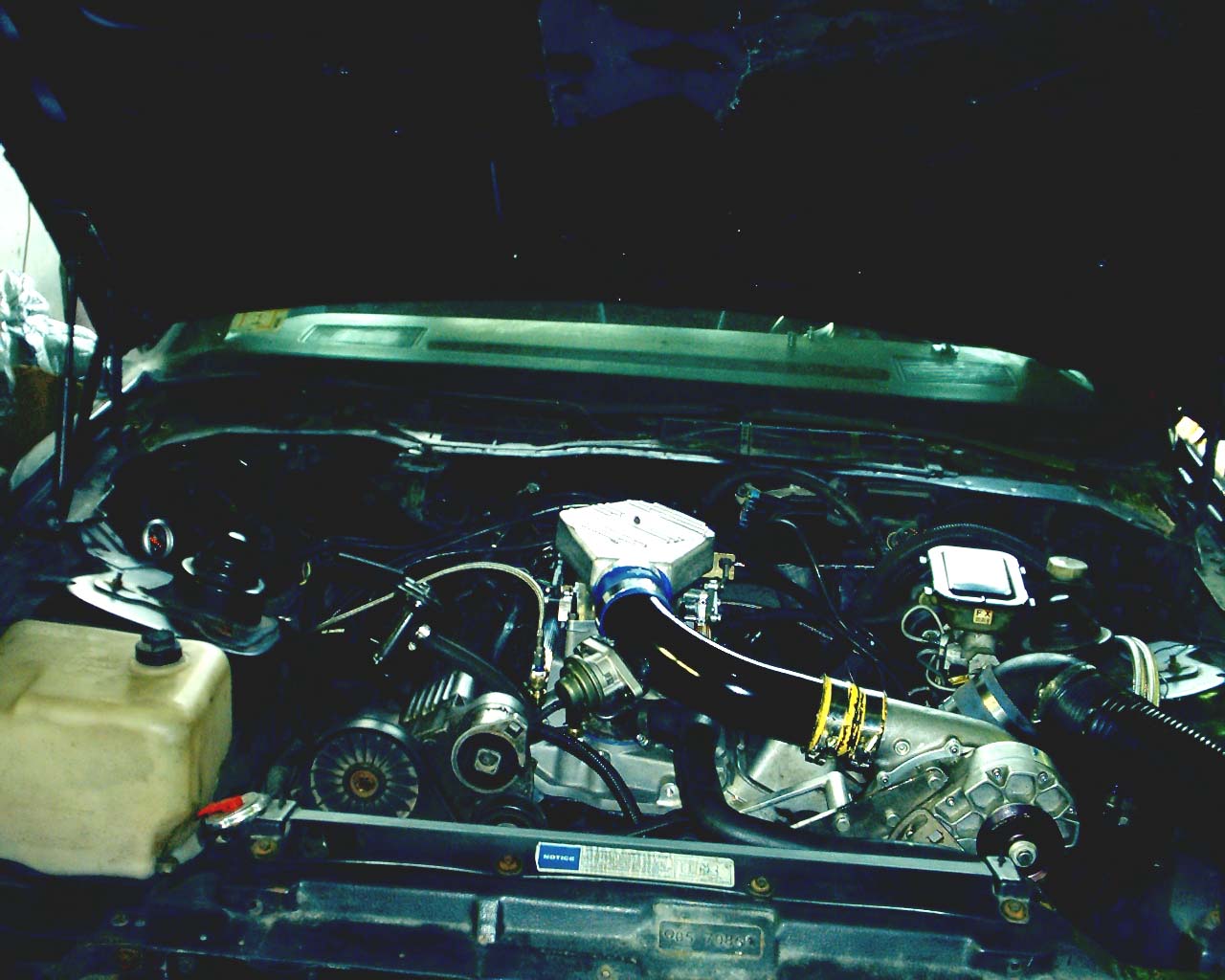
And that was my second singleplane. I made the first one out of a converted carb intake. Very fast. Singleplane is the way to go. I foolishly sold the intake thinking I wouldn't get it to it under the vette hood. I have the miniram right now with 5 90* bends from the blower to the throttle body. Talk about pressure drop.
With a singleplane and a dog house with an 80MM LS1 throttle body aiming at the driver side, I'll only have two 90* bends.
Melting Slicks

Joined: Jan 2008
Posts: 2,065
Likes: 1
From: Jasper Texas
Good point there Joe. More boost psi=more power. And you could recoup most of the money by selling the miniram too.
Gotta question for ya', is there any intercooler setups for the c4 on the market, or do they have to be custom made?
Gotta question for ya', is there any intercooler setups for the c4 on the market, or do they have to be custom made?
Thread Starter
Safety Car
Joined: May 2006
Posts: 4,290
Likes: 140
From: Salem NH
Raid sent me a bunch of pix of his procharger setup. Kinda crazy plumbing and the IC doesn't look to pick up much air.
-- Joe
Melting Slicks
Joined: Aug 2003
Posts: 3,401
Likes: 397
From: Lakeville MI
Hey Joe,
For our somewhat flow limited set-ups, perhaps spraying a water/methanol, water/ethanol mix or even 100% methanol into the compressor inlet will offer some gains and help cool the compressor components.
Of course, the possility of corrosion and erosion of the impeller could be an issue. Apparently, this method increases the overall mass flow and could potentially increase boost and lower inlet temperatures as a result.
I'm still not conviced that conventional water/methanol will do much for us, since we can only increase spark advance in an attempt to build more power. Increasing boost isn't really an option. I think it could actually decrease the overall mass flow due to the density increase downsteam of the compressor.
I'm still on the fence on this one.
For our somewhat flow limited set-ups, perhaps spraying a water/methanol, water/ethanol mix or even 100% methanol into the compressor inlet will offer some gains and help cool the compressor components.
Of course, the possility of corrosion and erosion of the impeller could be an issue. Apparently, this method increases the overall mass flow and could potentially increase boost and lower inlet temperatures as a result.
I'm still not conviced that conventional water/methanol will do much for us, since we can only increase spark advance in an attempt to build more power. Increasing boost isn't really an option. I think it could actually decrease the overall mass flow due to the density increase downsteam of the compressor.
I'm still on the fence on this one.

Safety Car
Joined: Apr 2001
Posts: 3,525
Likes: 2
From: Houston TX
Joe / Tequila,
I have spent a bit of time working with the A2A systems and the xxOH injection. The big con of xxOH injection (and conversely the pro for A2A) is the fact that the xxOH does not inject untill you hit a preset boost level, so around town, the IATs run in the 165°F range, and will spike to ~210 until the xxOH takes affect, then I will finish a run at ~180°F). A2A kept the temps near ambient (~+10-15°F), then rapidly builds to the 240+ area by the end of the run (my combo at 11 psi; no idea what IATs would be with the A2A at 26+ psi).
Now the plus for xxOH is the increased boost (due to less restriction in the intake tract), and the ability to add additional timing without encroaching upon detonation. This would be a con for A2A.
As for the intake, to give you some ideas of what can be fabbed between the blower and the TB in an afternoon.
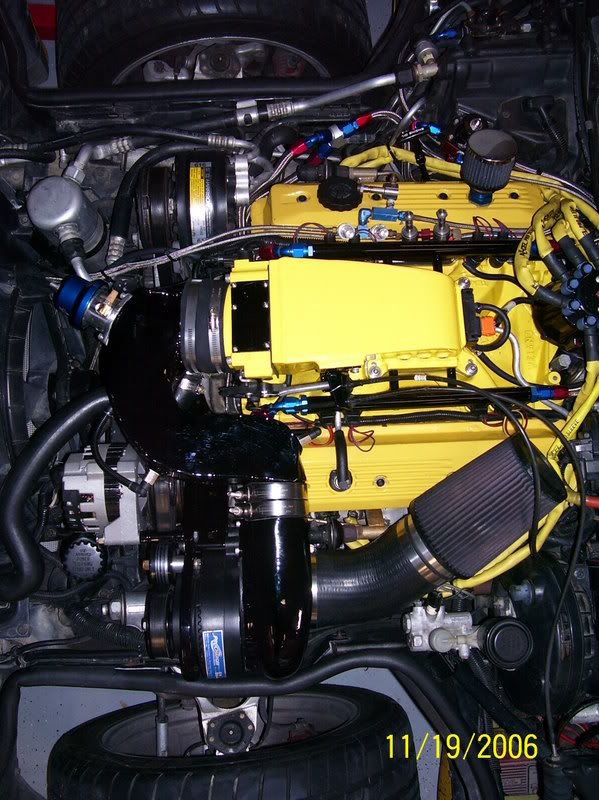
I hope this helps,
Aaron
I have spent a bit of time working with the A2A systems and the xxOH injection. The big con of xxOH injection (and conversely the pro for A2A) is the fact that the xxOH does not inject untill you hit a preset boost level, so around town, the IATs run in the 165°F range, and will spike to ~210 until the xxOH takes affect, then I will finish a run at ~180°F). A2A kept the temps near ambient (~+10-15°F), then rapidly builds to the 240+ area by the end of the run (my combo at 11 psi; no idea what IATs would be with the A2A at 26+ psi).
Now the plus for xxOH is the increased boost (due to less restriction in the intake tract), and the ability to add additional timing without encroaching upon detonation. This would be a con for A2A.
As for the intake, to give you some ideas of what can be fabbed between the blower and the TB in an afternoon.
I hope this helps,
Aaron
Last edited by AKS Racing; Aug 15, 2008 at 02:48 PM.
Thread Starter
Safety Car
Joined: May 2006
Posts: 4,290
Likes: 140
From: Salem NH
Joe / Tequila,
I have spent a bit of time working with the A2A systems and the xxOH injection. The big con of xxOH injection (and conversely the pro for A2A) is the fact that the xxOH does not inject untill you hit a preset boost level, so around town, the IATs run in the 165°F range, and will spike to ~210 until the xxOH takes affect, then I will finish a run at ~180°F). A2A kept the temps near ambient (~+10-15°F), then rapidly builds to the 240+ area by the end of the run (my combo at 11 psi; no idea what IATs would be with the A2A at 26+ psi).
Now the plus for xxOH is the increased boost (due to less restriction in the intake tract), and the ability to add additional timing without encroaching upon detonation. This would be a con for A2A.
As for the intake, to give you some ideas of what can be fabbed between the blower and the TB in an afternoon.
I hope this helps,
Aaron
I have spent a bit of time working with the A2A systems and the xxOH injection. The big con of xxOH injection (and conversely the pro for A2A) is the fact that the xxOH does not inject untill you hit a preset boost level, so around town, the IATs run in the 165°F range, and will spike to ~210 until the xxOH takes affect, then I will finish a run at ~180°F). A2A kept the temps near ambient (~+10-15°F), then rapidly builds to the 240+ area by the end of the run (my combo at 11 psi; no idea what IATs would be with the A2A at 26+ psi).
Now the plus for xxOH is the increased boost (due to less restriction in the intake tract), and the ability to add additional timing without encroaching upon detonation. This would be a con for A2A.
As for the intake, to give you some ideas of what can be fabbed between the blower and the TB in an afternoon.
I hope this helps,
Aaron
Also, the header on the driver side is making the fuel feed line around 180f-195f as well.. Hot fuel, hot air.. ugg.
I noticed in your pic your air filter is located over the valve cover. What kind of difference did you see if any bu moving it up there?
-- Joe
Safety Car
Joined: Apr 2001
Posts: 3,525
Likes: 2
From: Houston TX
I was just playing with my IR gun and the temps entering my air filter are nothing short of scary.. 180f
Also, the header on the driver side is making the fuel feed line around 180f-195f as well.. Hot fuel, hot air.. ugg.
I noticed in your pic your air filter is located over the valve cover. What kind of difference did you see if any bu moving it up there?
-- Joe
Also, the header on the driver side is making the fuel feed line around 180f-195f as well.. Hot fuel, hot air.. ugg.
I noticed in your pic your air filter is located over the valve cover. What kind of difference did you see if any bu moving it up there?
-- Joe
 compared to what could fit between the blower inlet and the master cylinder), which gave me an extra 1psi boost (back in the day when I was trying desperately to get to 10 psi). I have done similar to others cars with the same "non-results" on the temp. BTW, pulled the air filter for a final dyno run (back when I was pushing 10.8 psi boost with the IC) and picked up 1WHP, which is well within the test measurement variability, so the filter is flowing enough.
I would encourage you to datalog your IATs and see if there is really cause for concern. At 10.8 psi, I would be at ~240°F at the end of a run, but I was trying to shove 2300CFM through a lot of piping and a custom 4" IC. You may not have the same issues.
Aaron
Melting Slicks
Joined: Aug 2003
Posts: 3,401
Likes: 397
From: Lakeville MI
From discussions with Joe, I think our IATs are pretty similar.
During cruise, I'll see somewhere between 130 and 150 F depending how heat soaked the blower is, and about 250 F at peak boost at the top of a gear (6,000-6,200 rpm).
My peak boost is something over 7 psi, but I need a better gauge to be sure, it could be as high as 9 psi based on the impeller rpm (about 42,000).
I'm measuring the IAT with my Ford MAF's integrated sensor which is located just downstream of the blower's discharge. The air is roughly being heated 100 degrees above the pre-boost temperature at the peak, which seems reasonable to me.
Aaron: Any thoughts on spraying into the compressor inlet?
During cruise, I'll see somewhere between 130 and 150 F depending how heat soaked the blower is, and about 250 F at peak boost at the top of a gear (6,000-6,200 rpm).
My peak boost is something over 7 psi, but I need a better gauge to be sure, it could be as high as 9 psi based on the impeller rpm (about 42,000).
I'm measuring the IAT with my Ford MAF's integrated sensor which is located just downstream of the blower's discharge. The air is roughly being heated 100 degrees above the pre-boost temperature at the peak, which seems reasonable to me.
Aaron: Any thoughts on spraying into the compressor inlet?
Safety Car
Joined: Apr 2001
Posts: 3,525
Likes: 2
From: Houston TX
Those are pretty good IATs for cruising with no IC. 250°F with 7psi seems a bit off, but if you start from 130-160°F, maybe that is accurate. I typically look for ~12-18° / psi at boost psi approaching 1 bar, and most ICs can pull that temp by 10° / psi if the ambiant is in the less than 80°F range. It sucks when you live in South TX and ambiant is over 100°F.
I'm not really sure that spraying methanol directly into the impellor would really hurt anything, but I question why you would. You can spray directly after the discharge and let the latent heat of vaporization of the H2O (mixed with the methanol) and the methanol itself work to pull the heat out of the air stream as the xxOH/water goes from a liquid to a gas.
The effect of the cooling occurs not only in the ducting from the blower discharge, but also in the intake tract and the intake port of the cylinder heads. Once all of the liquid has gone to a vapor, the cooling ceases, but the alcohol still helps to deter detonation by the fact of the 116 RON/MON rating. As an added bonus, the water will serve to keep the combustion chambers extremely clean. They look new when / if you disassemble.
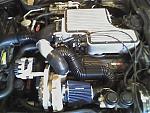
If you look closely at the pic I posted, you can see the twin Snow nozzles mounted in the duct from the blower to the TB.
Am I missing something that makes you think it might be advantageous to spray into the impellor. Also keep in mind that the finely vaporized alcohol is extremely flammable and this would be directly above the headers and the spark plugs. I would think that you might be approaching the flash point of the alcohol, so you would have to blend heavily with H2O.
Aaron
I'm not really sure that spraying methanol directly into the impellor would really hurt anything, but I question why you would. You can spray directly after the discharge and let the latent heat of vaporization of the H2O (mixed with the methanol) and the methanol itself work to pull the heat out of the air stream as the xxOH/water goes from a liquid to a gas.
The effect of the cooling occurs not only in the ducting from the blower discharge, but also in the intake tract and the intake port of the cylinder heads. Once all of the liquid has gone to a vapor, the cooling ceases, but the alcohol still helps to deter detonation by the fact of the 116 RON/MON rating. As an added bonus, the water will serve to keep the combustion chambers extremely clean. They look new when / if you disassemble.
If you look closely at the pic I posted, you can see the twin Snow nozzles mounted in the duct from the blower to the TB.
Am I missing something that makes you think it might be advantageous to spray into the impellor. Also keep in mind that the finely vaporized alcohol is extremely flammable and this would be directly above the headers and the spark plugs. I would think that you might be approaching the flash point of the alcohol, so you would have to blend heavily with H2O.
Aaron
Melting Slicks
Joined: Aug 2003
Posts: 3,401
Likes: 397
From: Lakeville MI
There's an ongoing discussion over on TGO.
Frow what I've gathered, spraying into the impeller (pre-compression) increases the inlet air density and should increase the overall mass air flow of the system. In this regard, it should behave somewhat like a larger impeller with increased mass air flow/rev.
I can imagine that some of the vaporation also occurs post compression helping to cool the charge air.
By injecting downsteam of the compressor, the overall mass air flow will not be increased, but the charge will be cooler and denser than before. I suspect that this may result in somewhat reduced mass flow through the system. I'm assuming that the denser charge would behave somewhate like an additional air flow restriction.
Since our powerdyne bearings are rather temperature sensitive, it would appear that this may offer some benefit in this regard also.
I was playing around with this calculator which includes options on where the injection occurs:
http://www.not2fast.com/turbo/glossa...orDutyCycle=90
This calculator suggests that for a non-intercooled application injection before the compressor or turbocharger is preferred.
Frow what I've gathered, spraying into the impeller (pre-compression) increases the inlet air density and should increase the overall mass air flow of the system. In this regard, it should behave somewhat like a larger impeller with increased mass air flow/rev.
I can imagine that some of the vaporation also occurs post compression helping to cool the charge air.
By injecting downsteam of the compressor, the overall mass air flow will not be increased, but the charge will be cooler and denser than before. I suspect that this may result in somewhat reduced mass flow through the system. I'm assuming that the denser charge would behave somewhate like an additional air flow restriction.
Since our powerdyne bearings are rather temperature sensitive, it would appear that this may offer some benefit in this regard also.
I was playing around with this calculator which includes options on where the injection occurs:
http://www.not2fast.com/turbo/glossa...orDutyCycle=90
This calculator suggests that for a non-intercooled application injection before the compressor or turbocharger is preferred.
Last edited by tequilaboy; Aug 15, 2008 at 05:38 PM.
