




383 6" or 5.7" rods

Thread Starter
Race Director

Joined: Apr 2000
Posts: 15,344
Likes: 4,009
From: Texas
 383 6" or 5.7" rods
Heading down the 383 path and wrestling with what length rods to use. To bad the damn search doesn't work since this has no doubt been beaten to death.
Plan is to build an engine with a 6300rpm hp peak so it will need to survive to 6500/6600. Goal is ~420hp-430hp at the wheels (on a Dynojet). Primary use is on a road course for track days and HPDEs...ie I'll use the low end grunt of a 383 to get out of the corners and need the hp for the straights
Cam is tbd, but figure in the 230/236 range for duration and high 5xx for lift with 112 LC. I do drive the car on the street on occasion so it will need some civility.
Probably going with Lloyd Elliot heads (LE2) since AFRs are beyond what I want to spend. (I'll be in touch Lloyd )
Internal balance SCAT or Eagle forged 4340 crank, SPEC lightweight flywheel and ATI damper.
Current engine has 11.3:1 static CR with no issues and the 383 will be about the same.
Keep in mind that on a road course the engine will spend a LOT more than just a few seconds above 5000rpm. During some track days I've logged the better part of 4 hours on the course.
Looking at the SCAT 4340 H-beam Q-lite rods just need to decide on length.
I have concerns regarding the 6" rods in the areas of high rpm piston stability and having the pin in the oil ring land. Less weight (due to lighter piston) is goodness as is a better rod/stroke ratio. Reverse of all the above is true for the 5.7 rod.
Thoughts?
Plan is to build an engine with a 6300rpm hp peak so it will need to survive to 6500/6600. Goal is ~420hp-430hp at the wheels (on a Dynojet). Primary use is on a road course for track days and HPDEs...ie I'll use the low end grunt of a 383 to get out of the corners and need the hp for the straights
Cam is tbd, but figure in the 230/236 range for duration and high 5xx for lift with 112 LC. I do drive the car on the street on occasion so it will need some civility.
Probably going with Lloyd Elliot heads (LE2) since AFRs are beyond what I want to spend. (I'll be in touch Lloyd
)Internal balance SCAT or Eagle forged 4340 crank, SPEC lightweight flywheel and ATI damper.
Current engine has 11.3:1 static CR with no issues and the 383 will be about the same.
Keep in mind that on a road course the engine will spend a LOT more than just a few seconds above 5000rpm. During some track days I've logged the better part of 4 hours on the course.
Looking at the SCAT 4340 H-beam Q-lite rods just need to decide on length.
I have concerns regarding the 6" rods in the areas of high rpm piston stability and having the pin in the oil ring land. Less weight (due to lighter piston) is goodness as is a better rod/stroke ratio. Reverse of all the above is true for the 5.7 rod.
Thoughts?

Le Mans Master


Joined: Aug 2000
Posts: 8,838
Likes: 31
From: Australia

Drifting


Joined: Jun 2001
Posts: 1,625
Likes: 1
From: Zagreb, Croatia
I'm also in this (deciding what rods/pistons to get for my 383 build)
right now, but I plan to rev my engine to 7500.
Link that rodj posted, makes me wonder!
I was almost sure that I'll go with 6" rods!
right now, but I plan to rev my engine to 7500.
Link that rodj posted, makes me wonder!
I was almost sure that I'll go with 6" rods!
Burning Brakes


Joined: Nov 2006
Posts: 1,102
Likes: 1
From: Portsmouth Virginia 396LT4 435RWHP/400RWTQ Best so far 11.26 @ 123mph
#007
Don't rule out 5.85" or 5.875 rods also as an option.I run a 396 3.875 stroke crank with 5.875 rods and the wrist pin does not enter the oil ring boundary. A 383/3.750 with a 5.875 rod I would think would work fine for that application with sustained high rpm and wanting to stay out of the oil groove.
Rick
Don't rule out 5.85" or 5.875 rods also as an option.I run a 396 3.875 stroke crank with 5.875 rods and the wrist pin does not enter the oil ring boundary. A 383/3.750 with a 5.875 rod I would think would work fine for that application with sustained high rpm and wanting to stay out of the oil groove.
Rick
Safety Car


Joined: Apr 2005
Posts: 3,624
Likes: 431
From: Dale City VA
The difference in performance and durability in your application is virtually a draw. Espc using off the shelf componets.
At <6500RPM (sustained) a good quality 5.7" rod will be fine. I have turned 400SBC's with GM 5.7 "X rods" more RPM back when we didn't know any better and aftermarket rod availibility wasn't what it is today....
On the other hand piston stability and the wrist pin intersecting the oil ring should not be a concern with the 6" rod. It's a well proven combination in the SBC and very few people ever have any problems.
Don't ge too wrapped around the axel about it. With something as insignifigant in an engine as Rod Length, it takes a real big change to make a noticeable difference. Going from a 1.52 stroke to rod ratio to a 1.6 stroke to rod ration is not a big change. The actual difference in HP and TQ peaks between the 2 is about 200-300rpm.
If you want to get wrapped around the axel about it and do some real research. Jerry Stahl (the Super Stock racer and header mfg) has a good synopsis on his web site about rod length.
http://www.stahlheaders.com/Lit_Rod%20Length.htm
Considering your planning to run it on a road course - I would suggest you spend time finding the lightest weight crank, rods and pistons you can afford. The Scat Q Lite rod is a good peice for little $$$. If you like I could make some recommendations for the other parts.
Will
At <6500RPM (sustained) a good quality 5.7" rod will be fine. I have turned 400SBC's with GM 5.7 "X rods" more RPM back when we didn't know any better and aftermarket rod availibility wasn't what it is today....
On the other hand piston stability and the wrist pin intersecting the oil ring should not be a concern with the 6" rod. It's a well proven combination in the SBC and very few people ever have any problems.
Don't ge too wrapped around the axel about it. With something as insignifigant in an engine as Rod Length, it takes a real big change to make a noticeable difference. Going from a 1.52 stroke to rod ratio to a 1.6 stroke to rod ration is not a big change. The actual difference in HP and TQ peaks between the 2 is about 200-300rpm.
If you want to get wrapped around the axel about it and do some real research. Jerry Stahl (the Super Stock racer and header mfg) has a good synopsis on his web site about rod length.
http://www.stahlheaders.com/Lit_Rod%20Length.htm
Considering your planning to run it on a road course - I would suggest you spend time finding the lightest weight crank, rods and pistons you can afford. The Scat Q Lite rod is a good peice for little $$$. If you like I could make some recommendations for the other parts.
Will
Thread Starter
Race Director
Joined: Apr 2000
Posts: 15,344
Likes: 4,009
From: Texas
Considering your planning to run it on a road course - I would suggest you spend time finding the lightest weight crank, rods and pistons you can afford. The Scat Q Lite rod is a good peice for little $$$. If you like I could make some recommendations for the other parts.
Will

Advanced

Joined: Feb 2006
Posts: 54
Likes: 0
From: Reading Pa
RKLESSDRIVER is right, rod length in a 383 is close to irrelevant. 5.7 or 6.0 at 6500 rpm's has alot more to do with balance than rod length. Go with whatever the builder of the rotating asm is happy with, you will not know the diff if it's well balanced. I built a few 302's for a 5.0 class and we put 6.25" rods in one of them compared to the 5.7 we normally used and it did'nt make enough difference to make it worth doing on purpose. The engine was a little more playful and reved easier, it wanted more compression, but the total power under the curve was not significantly changed only the throttle response seemed to change a little snappier. Have fun
Corvette Stories
The Best of Corvette for Corvette Enthusiasts

Every 2027 Corvette Engine Explained
Joe Kucinski
Designer Imagines A Corvette That Looks More Like a Corvette Than the Corvette
Verdad Gallardo
10 Ugly Corvettes That We Still Kinda Love
Joe Kucinski
Top 10 Most Expensive Corvettes Ever Sold on Bring A Trailer
Brett Foote
10 Things Every Corvette Owner Needs (2026 Edition)
Michael S. Palmer
8 Most "Only Corvette Owners Understand" Quirks and Problems
Pouria Savadkouei
10 Reasons the C6 Z06 is Still A Performance Benchmark After 20 Years
Joe Kucinski
How Much Horsepower Every Corvette Engine "LOST" in 1972
Joe Kucinski
Top 10 DOs and DON'Ts for Protecting Your Convertible Top!
Michael S. Palmer


 GS POWAR!


Burning Brakes


Joined: Nov 2004
Posts: 781
Likes: 0
I built a very similar engine a few years ago. 7,000 plus RPM, LT4 383 stroker for street and occasional road course.
45lb crank, compatable with 5.7" rod, internal balance.
To keep my piston speed within reasonable limits at elevated RPMs, I went with the 'middle' choice of the 5.85" rod (Manley's I-beam, 580-590 grams, considered lightweight). A 6.00" H-beam is going to be rather heavy, even if it calls itself "LW". A 5.7" would have been my second choice.
This, of course, required a custom piston (Diamond, 480 grams, a tad heavy for my liking). The wrist pin barely poked into the oil ring groove, just enough to require the additional rail support.
Got it together, barely broken-in, two weeks later took it to an open track day. Spent most of the day above 5,000 RPM, lots of 6,000+plus RPM up and down shifting. Plenty of 3rd gear 7,000 RPM corner entrys, to avoid using 4th (4.10 rear gear, a bit much for this course). A little over 300 degree oil temps (stock C4 6 speed radiator, no oil cooler).
My brakes took a beating, but the engine never gave me a hint of trouble.
Drove the car home (well over 100 mile trip) with the A/C on!
45lb crank, compatable with 5.7" rod, internal balance.
To keep my piston speed within reasonable limits at elevated RPMs, I went with the 'middle' choice of the 5.85" rod (Manley's I-beam, 580-590 grams, considered lightweight). A 6.00" H-beam is going to be rather heavy, even if it calls itself "LW". A 5.7" would have been my second choice.
This, of course, required a custom piston (Diamond, 480 grams, a tad heavy for my liking). The wrist pin barely poked into the oil ring groove, just enough to require the additional rail support.
Got it together, barely broken-in, two weeks later took it to an open track day. Spent most of the day above 5,000 RPM, lots of 6,000+plus RPM up and down shifting. Plenty of 3rd gear 7,000 RPM corner entrys, to avoid using 4th (4.10 rear gear, a bit much for this course). A little over 300 degree oil temps (stock C4 6 speed radiator, no oil cooler).
My brakes took a beating, but the engine never gave me a hint of trouble.
Drove the car home (well over 100 mile trip) with the A/C on!

Thread Starter
Race Director
Joined: Apr 2000
Posts: 15,344
Likes: 4,009
From: Texas
Lot's of good info, thank to all. Gives me lots to think about.
This is going to be my winter project since rainy season starts here in the Pacific Northwest shortly...although this week is making me think it's arrived early

This is going to be my winter project since rainy season starts here in the Pacific Northwest shortly...although this week is making me think it's arrived early
Pro

Joined: Nov 2005
Posts: 536
Likes: 0
From: Bardstown Kentucky
Heading down the 383 path and wrestling with what length rods to use. To bad the damn search doesn't work since this has no doubt been beaten to death.
Plan is to build an engine with a 6300rpm hp peak so it will need to survive to 6500/6600. Goal is ~420hp-430hp at the wheels (on a Dynojet). Primary use is on a road course for track days and HPDEs...ie I'll use the low end grunt of a 383 to get out of the corners and need the hp for the straights
Cam is tbd, but figure in the 230/236 range for duration and high 5xx for lift with 112 LC. I do drive the car on the street on occasion so it will need some civility.
Probably going with Lloyd Elliot heads (LE2) since AFRs are beyond what I want to spend. (I'll be in touch Lloyd )
Internal balance SCAT or Eagle forged 4340 crank, SPEC lightweight flywheel and ATI damper.
Current engine has 11.3:1 static CR with no issues and the 383 will be about the same.
Keep in mind that on a road course the engine will spend a LOT more than just a few seconds above 5000rpm. During some track days I've logged the better part of 4 hours on the course.
Looking at the SCAT 4340 H-beam Q-lite rods just need to decide on length.
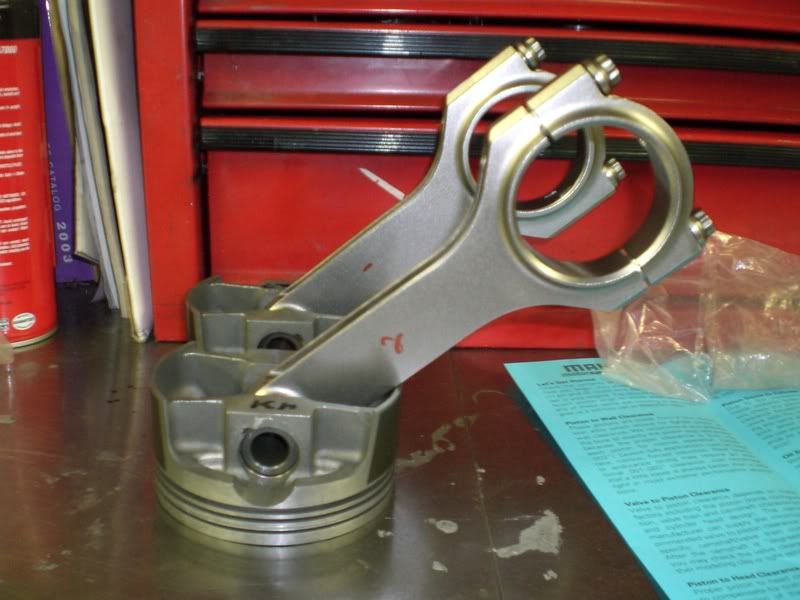
I have concerns regarding the 6" rods in the areas of high rpm piston stability and having the pin in the oil ring land. Less weight (due to lighter piston) is goodness as is a better rod/stroke ratio. Reverse of all the above is true for the 5.7 rod.
Thoughts?
Plan is to build an engine with a 6300rpm hp peak so it will need to survive to 6500/6600. Goal is ~420hp-430hp at the wheels (on a Dynojet). Primary use is on a road course for track days and HPDEs...ie I'll use the low end grunt of a 383 to get out of the corners and need the hp for the straights
Cam is tbd, but figure in the 230/236 range for duration and high 5xx for lift with 112 LC. I do drive the car on the street on occasion so it will need some civility.
Probably going with Lloyd Elliot heads (LE2) since AFRs are beyond what I want to spend. (I'll be in touch Lloyd
)Internal balance SCAT or Eagle forged 4340 crank, SPEC lightweight flywheel and ATI damper.
Current engine has 11.3:1 static CR with no issues and the 383 will be about the same.
Keep in mind that on a road course the engine will spend a LOT more than just a few seconds above 5000rpm. During some track days I've logged the better part of 4 hours on the course.
Looking at the SCAT 4340 H-beam Q-lite rods just need to decide on length.
I have concerns regarding the 6" rods in the areas of high rpm piston stability and having the pin in the oil ring land. Less weight (due to lighter piston) is goodness as is a better rod/stroke ratio. Reverse of all the above is true for the 5.7 rod.
Thoughts?

Drifting
Joined: Dec 2005
Posts: 1,360
Likes: 3
From: NORTHEAST
On the 383's we have been building we have used 6 inch rods as it does free up some unwanted friction in the engine and the pistons are a lot lighter compared to pistons that are used in a 5.7 or 5.850 rod.
The rods are either the 6 inch Compstar rods or the Scat I beams with 7/16 bolts.
The Callies Compstar crank is the best quality crank out there as far as sizing, roundness, straightness and journals that are right on from journal to jouranl.
we get 595.00 for those cranks.
Here is a link to one we dynoed a few weeks ago.
http://www.chevelles.com/forums/showthread.php?t=236517
The rods are either the 6 inch Compstar rods or the Scat I beams with 7/16 bolts.
The Callies Compstar crank is the best quality crank out there as far as sizing, roundness, straightness and journals that are right on from journal to jouranl.
we get 595.00 for those cranks.
Here is a link to one we dynoed a few weeks ago.
http://www.chevelles.com/forums/showthread.php?t=236517
Last edited by BLOCKMAN; Aug 28, 2008 at 08:47 AM.

Burning Brakes
Joined: Sep 2005
Posts: 993
Likes: 3
From: Iowa
I would run a 6 inch rod or longer in this application. I would not change the ring sizing though since it needs to go longer between rebuilds. Going with a smaller ring size decreases the longevity of the package; ok for an outlaw sprint car engine but not so much for someone a little less serious. Just my .02
Last edited by Deakins; Aug 28, 2008 at 12:07 PM.
Safety Car
Joined: Apr 2005
Posts: 3,624
Likes: 431
From: Dale City VA
There is not much difference in the rings. 1.5mm=.059" 1/16=.062" but the 1.5, 1.5, 3.0mm ring pack severly limits your ring choices as compared to the conventional 1/16, 1/16, 3/16 ring pack. For the life of me I don't know why Mahle offers their pistons with this stupid crap... then again maybe its just a maketing gimick to sell more rings.
You really need to go to a .043 or 1.2mm (.047) ring to get any weight or friction advantage over the tried and true 1/16 ring. Here you run into the same problems of limited ring choices and more money. None of which fly in a dual puprose - street car.
Also the oil ring eats more HP and causes more friction than the compression rings. You almost HAVE to run std tension oil rings for oil control so any advantage the .043 compression rings gave you is going to be nill on the street.
Carl:
That's a good price (over the counter retail) on a Compstar crank. I wish they would offer the 1pc rear seal ones in their Comet LW line.
Will
You really need to go to a .043 or 1.2mm (.047) ring to get any weight or friction advantage over the tried and true 1/16 ring. Here you run into the same problems of limited ring choices and more money. None of which fly in a dual puprose - street car.
Also the oil ring eats more HP and causes more friction than the compression rings. You almost HAVE to run std tension oil rings for oil control so any advantage the .043 compression rings gave you is going to be nill on the street.
Carl:
That's a good price (over the counter retail) on a Compstar crank. I wish they would offer the 1pc rear seal ones in their Comet LW line.
Will
Drifting
Joined: Dec 2005
Posts: 1,360
Likes: 3
From: NORTHEAST
There is not much difference in the rings. 1.5mm=.059" 1/16=.062" but the 1.5, 1.5, 3.0mm ring pack severly limits your ring choices as compared to the conventional 1/16, 1/16, 3/16 ring pack. For the life of me I don't know why Mahle offers their pistons with this stupid crap... then again maybe its just a maketing gimick to sell more rings.
You really need to go to a .043 or 1.2mm (.047) ring to get any weight or friction advantage over the tried and true 1/16 ring. Here you run into the same problems of limited ring choices and more money. None of which fly in a dual puprose - street car.
Also the oil ring eats more HP and causes more friction than the compression rings. You almost HAVE to run std tension oil rings for oil control so any advantage the .043 compression rings gave you is going to be nill on the street.
Carl:
That's a good price (over the counter retail) on a Compstar crank. I wish they would offer the 1pc rear seal ones in their Comet LW line.
Will
You really need to go to a .043 or 1.2mm (.047) ring to get any weight or friction advantage over the tried and true 1/16 ring. Here you run into the same problems of limited ring choices and more money. None of which fly in a dual puprose - street car.
Also the oil ring eats more HP and causes more friction than the compression rings. You almost HAVE to run std tension oil rings for oil control so any advantage the .043 compression rings gave you is going to be nill on the street.
Carl:
That's a good price (over the counter retail) on a Compstar crank. I wish they would offer the 1pc rear seal ones in their Comet LW line.
Will
Metric rings are very common in some of our high end builds.
Those cranks are what we sell them for, If we wated to get cheap we can buy 4340 cranks for 375.00 but they don't compare to a Callies.