


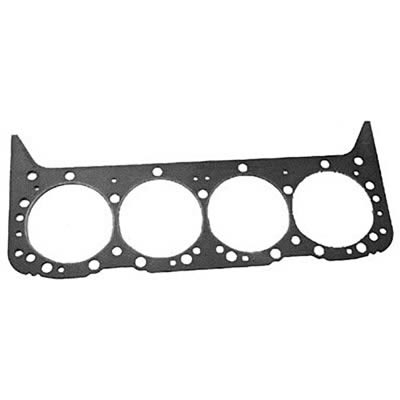

View Poll Results: What gasket would you install
Stock thickness for longevity


6
27.27%
.029" gasket for performance (but wouldn't bet on leak-free results)


3
13.64%
.029" gasket because you've seen thinner gaskets last years (w/o leaks)


6
27.27%
Larger bore .039"/.041" FelPro just because it's FelPro


7
31.82%
Voters: 22. You may not vote on this poll
Head gasket thickness poll

Thread Starter
Race Director


Joined: Nov 2003
Posts: 12,221
Likes: 446
From: Overland Park Kansas
2020 Corvette of the Year Finalist (appearance mods)
C4 of Year Winner (appearance mods) 2019

Don't know if the block has been honed yet but if it has it will be critical to use the same style gaskets the block was honed with (if your machinist used honing plates which he should have). Otherwise bore distortion will occur near the tops of the bores adjacent to each head bolt. The bores can be pulled as much as .0015 -.002 out of round when cylinder head installation does not duplicate conditions the bolck saw during the honing operation. Studs versus bolts will make a huge difference as well. You will develop more clamp load with a stud torqued to the same value as a bolt which again means bore distortion if something different is used during assembly than was used during honing. Bore distortion will hurt power due to increased blow-by possibly more that you will gain by a small bump up in compression with a thinner gasket. MLS gaskets are superior to anything else on the market right now, especially for aluminum heads on iron blocks.
The mechanic with check the deck for flatness. If a problem exists, then the story will be different.
So, if the block is O.K., I assume this post does not apply. And, to be honest, I don't understand parts of this post.
Don't know if the block has been honed yet but if it has it will be critical to use the same style gaskets the block was honed with (if your machinist used honing plates which he should have). Otherwise bore distortion will occur near the tops of the bores adjacent to each head bolt. The bores can be pulled as much as .0015 -.002 out of round when cylinder head installation does not duplicate conditions the bolck saw during the honing operation.

Studs versus bolts will make a huge difference as well. You will develop more clamp load with a stud torqued to the same value as a bolt which again means bore distortion if something different is used during assembly than was used during honing. Bore distortion will hurt power due to increased blow-by possibly more that you will gain by a small bump up in compression with a thinner gasket. MLS gaskets are superior to anything else on the market right now, especially for aluminum heads on iron blocks.
That's part of the argument.
Another part is wanting to keep it lively with street response. And, to pull well in 6th gear on the hwy. I have to assume compression helps acheive that.
I'm also hearing good quench controls knock. Squeezing combustion up into the head chamber decreases detonation. My first choice is to use an intake w/o EGR. So, won't the extra quench help compensate for loss of EGR (by reducing possibility of detonation)?

Team Owner

Joined: Aug 2005
Posts: 34,988
Likes: 515
From: Riverside County Southern California
Co-winner 2020 C4 of the Year - Modified
2018 Corvette of Year Finalist
2017 C4 of Year
2016 C7 of Year Finalist
St. Jude Donor '09 thru '20

Melting Slicks


Joined: Jun 2002
Posts: 2,705
Likes: 30
From: Chesapeake Beach Maryland
2015 C5 of Year Finalist
I know that ratios around 11.1 to 11.7 are doable. When I asked Lloyd Elliot about head gaskets this is one of the responses I got back regarding head gasket thickness and compression. I was initially concerned about the using the thinner Impala SS gasket, but on my setup he recomended and this raises factory compression a bit.
"Don
The .029 thickness is what we want.
We are wanting all the compression we can get.
No worries about detonation.
The heads and cam is designed for that extra compression.
We should end up about 11.3 to 1
Lloyd"
The .029 thickness is what we want.
We are wanting all the compression we can get.
No worries about detonation.
The heads and cam is designed for that extra compression.
We should end up about 11.3 to 1
Lloyd"

Le Mans Master


Joined: Oct 2004
Posts: 5,841
Likes: 19
From: CLT, North Carolina
GREGGPENN: "When I say I'm reusing the same block, I mean as-is. I was not intending on pulling pistons, etc... It has 55k miles."
Since you are obviously not rehoning the block and fitting new pistons and rings it will be important to put the same head gasket back on or you could easily cause the tops of the cylinders to distort when you torque the heads back on. Anything that creates different stresses in a used engine during re-assembly where these parts are mated and seated is inviting bore distortion and increased cylinder leakage. This is especially true in the case of the Small Block Chevy.
Below is a picture of a SBC being honed with honing plates torqued in place and the machine is a Sunnen Products Company model CV-616 Automatic Cylinder Honing Machine.
Engine builders discovered long ago the importance of good block preparation by simulating distributed stresses around the tops of the cylinder bores that result from torquing on the heads. These bolt stresses pull on the bores about 1/2" down from the top adjacent to each of the five head bolts causing around .0015 - .002 out of round which will allow a lot of blow-by and this hurts power. Using a different style head gasket than the one the engine broke-in with causes distributed stresses at the top of the block to be different as well and introduces unwanted bore distortion. Changing to studs when you broke in with bolts will too. If you plan to change something in this area you want to simulate those conditions the block will see in the honing process so you have good straight round cylinders when the heads are installed.

Performance Honing- copied from the Internet
Maximizing Torque Plate Performance
While just bolting on a torque plate is enough to put you ahead of a standard production machine shop's bore quality, paying attention to the fine points can increase the degree of accuracy substantially. Fastener loads and type, as well as the lubricants and thread engagement, torque plate stiffness and surface finish, and even gasket type can all vary the bore distortion replicated by the torque plate. It is important to mimic the final engine assembly as closely as possible. Sunnen has done extensive research in this regard, with precision bore measurements showing that these factors can materially affect the final bore quality.
True bore distortion cannot be measured with a dial bore gauge since it only measures length without considering an axis. The Inner Contour Meter is a precision device that can map the actual bore shape. This is an important tool at Sunnen in developing tooling and techniques, which closely replicate an ideal cylindrical shape. With it isometric and radial plots of the bore are generated under various conditions, allowing comparative evaluation of the cylinder bores. This is useful in solving complex distortion simulation problems, and allows compensation or correction that can lead to a better finished product.

...In the isometric above notice how dramatically the bore distortion changes at the upper portion of the bore with the variation in clamping loads imposed by the two different gasket types.
Last edited by Greg Gore; Nov 8, 2008 at 08:37 AM.

Race Director
Joined: Jan 2005
Posts: 10,641
Likes: 13
From: Slidell Louisiana
(caveat this is with aluminum heads)
Thread Starter
Race Director
Joined: Nov 2003
Posts: 12,221
Likes: 446
From: Overland Park Kansas
2020 Corvette of the Year Finalist (appearance mods)
C4 of Year Winner (appearance mods) 2019
Since you are obviously not rehoning the block and fitting new pistons and rings it will be important to put the same head gasket back on or you could easily cause the tops of the cylinders to distort when you torque the heads back on. Anything that creates different stresses in a used engine during re-assembly where these parts are mated and seated is inviting bore distortion and increased cylinder leakage. This is especially true in the case of the Small Block Chevy.
Engine builders discovered long ago the importance of good block preparation by simulating distributed stresses around the tops of the cylinder bores that result from torquing on the heads. These bolt stresses pull on the bores about 1/2" down from the top adjacent to each of the five head bolts causing around .0015 - .002 out of round which will allow a lot of blow-by and this hurts power. Using a different style head gasket than the one the engine broke-in with causes distributed stresses at the top of the block to be different as well and introduces unwanted bore distortion. Changing to studs when you broke in with bolts will too. If you plan to change something in this area you want to simulate those conditions the block will see in the honing process so you have good straight round cylinders when the heads are installed.
Engine builders discovered long ago the importance of good block preparation by simulating distributed stresses around the tops of the cylinder bores that result from torquing on the heads. These bolt stresses pull on the bores about 1/2" down from the top adjacent to each of the five head bolts causing around .0015 - .002 out of round which will allow a lot of blow-by and this hurts power. Using a different style head gasket than the one the engine broke-in with causes distributed stresses at the top of the block to be different as well and introduces unwanted bore distortion. Changing to studs when you broke in with bolts will too. If you plan to change something in this area you want to simulate those conditions the block will see in the honing process so you have good straight round cylinders when the heads are installed.
Using different types of gaskets magnifies distortion by pulling the deck in multiple directions/ways. Therefore changing gasket types increases the chance for gasket failure and other "failures".
The question I have is what constitutes a different gasket type. Strickly speaking, I have to assume different thickness(es) of the same type could be considered different types. That means using the SAME stock gasket minimizes chance of problem.
OTOH. If sticking with a composite gasket that still has a stainless fire ring may be reasonably similar -- and therefore low-risk. (Especially if it also has a lock wire (as does stock). I feel some latitude has to exist -- otherwise modifying a motor would always require the use of a new block and new heads!
So, going from a composite to a shim is what's really risky. (Because it's a totally different type of gasket). Another company makes a solid copper gasket as well. Though considered reusable, it may be better if used on a new motor from the outset.
There are several types of gaskets listed on any retail site. From what's being said here, it seems sticking with a composite gasket is best. There are a decent number of responders who say a .029" gasket has worked for years. I wonder if that was on a new block or reused factory block.

Pro

Joined: Feb 2005
Posts: 658
Likes: 1
From: Centerville OH
Gregg -- Sorry for the minor hijack, but it is on topic .......
I'm finalizing the choice of head gasket for my 383 Gen 1 build. I have 65 cc heads, and 5 cc flat tops .005 in the hole. I was originally planning on a FelPro 1010 (.039 thickness) which puts me at 10.8 static, 8.05 dynamic with .043 quench. If I move to a .028 gasket, I will have .033 quench distance with 11.15 SCR, 8.30 DCR. My question is this -- will the tighter quench offset the increased compression from a detonation resistance perspective?
I'm finalizing the choice of head gasket for my 383 Gen 1 build. I have 65 cc heads, and 5 cc flat tops .005 in the hole. I was originally planning on a FelPro 1010 (.039 thickness) which puts me at 10.8 static, 8.05 dynamic with .043 quench. If I move to a .028 gasket, I will have .033 quench distance with 11.15 SCR, 8.30 DCR. My question is this -- will the tighter quench offset the increased compression from a detonation resistance perspective?
Le Mans Master
Joined: Oct 2004
Posts: 5,841
Likes: 19
From: CLT, North Carolina
My comments were not suggesting that your choices might be inviting possible head gasket failure. I was trying point out installing a different gasket type than the engine has run with this long would be inviting likely bore distortion by disturbing the piston ring to cylinder wall seal.
Examples of different gasket types would be FelPro MLS, FelPro composition with stainless steel wire inside the armor, preflattened stainless steel wire inside the armor, copper wire inside the armor, Cometic MLS, and thin shim type gasket. Testing bore distortion with different head gasket types using special equipment points out each gasket style caused different stress distribution at the tops of the bores. This is why the better engine shops hone blocks using honing plates torqued to the block decks with the same style gasket the engine is to be assembled with. If the engine work does not include a complete teardown for rehoning, new pistons and rings the the same style gaskets should be installed again.
For best results and to prevent introducing unwanted bore distortion.
Examples of different gasket types would be FelPro MLS, FelPro composition with stainless steel wire inside the armor, preflattened stainless steel wire inside the armor, copper wire inside the armor, Cometic MLS, and thin shim type gasket. Testing bore distortion with different head gasket types using special equipment points out each gasket style caused different stress distribution at the tops of the bores. This is why the better engine shops hone blocks using honing plates torqued to the block decks with the same style gasket the engine is to be assembled with. If the engine work does not include a complete teardown for rehoning, new pistons and rings the the same style gaskets should be installed again.
For best results and to prevent introducing unwanted bore distortion.
Corvette Stories
The Best of Corvette for Corvette Enthusiasts

Top 10 Most Explosive Corvettes Ever Made: Power-to-Weight Ratio Ranked!
Joe Kucinski
150 hp to 1,250 hp: Every Corvette Generation Compared by the Specs That Matter
Joe Kucinski
8 Coolest Corvette Pace Cars (and Replicas) of All Time
Verdad Gallardo
Top 10 Corvette Engines RANKED by Peak Torque (70+ Years of Muscle!)
Joe Kucinski
Corvette ZR1X Will Be Pacing the Indy 500, And Could Probably Race, Too!
Verdad Gallardo
Top 10 Corvettes Coming to Mecum Indy 2026!
Brett Foote
Top 10 C9 Corvette MUST-HAVES to Fix These C8 Generation Flaws!
Michael S. Palmer
10 Revolutionary 'Corvette Firsts' Most People Don't Know
Joe Kucinski
5 Reasons to Upgrade to an LS6-Powered Corvette; 5 Reasons to Stay LT2
Michael S. Palmer
Thread Starter
Race Director
Joined: Nov 2003
Posts: 12,221
Likes: 446
From: Overland Park Kansas
2020 Corvette of the Year Finalist (appearance mods)
C4 of Year Winner (appearance mods) 2019
So, what type did they use? I would have assumed composite with a wire inside the firing ring. And, I've read (inconsistently), that it is a .051" gasket. (Chevy Performance parts makes this thickness/configuration, but maybe it's not stock. Hell, I don't know.)
I would assume any composite gasket would be similar (and minimize) the risk of gasket failure. I'd also assume a .051" with a wire would be better -- but this is all a GUESS. Knowing what to use/why vs. what not to use would be helpful.
Todd,
FWIW, Tony recommended I shoot for 10.8-11.0 compression on my build. Assuming he read my plan correctly, I have to assume a new build could easily tolerate another couple of tenths. And, since racing/power is your goal, why not? From the threads I've read on the subject, I'll predict feedback will support the higher number...
A poster earlier in this thread uses more quench successfully too. But, maybe the reverse cooling of the LT1 makes higher compression w/o knock easier?
Thread Starter
Race Director
Joined: Nov 2003
Posts: 12,221
Likes: 446
From: Overland Park Kansas
2020 Corvette of the Year Finalist (appearance mods)
C4 of Year Winner (appearance mods) 2019
My comments were not suggesting that your choices might be inviting possible head gasket failure. I was trying point out installing a different gasket type than the engine has run with this long would be inviting likely bore distortion by disturbing the piston ring to cylinder wall seal.
Le Mans Master
Joined: Oct 2004
Posts: 5,841
Likes: 19
From: CLT, North Carolina
Absolutely no danger of a broken ring. Concern is only for increased blowby which will negate any small increase you sought with the thinner head gasket. Any gains you are trying to get by swapping to thinner or smaller volume head gaskets will probably be more than offset by screwing up the ring to cylinder wall seal regardless what the wizard behind the local parts counter thinks.
Thread Starter
Race Director
Joined: Nov 2003
Posts: 12,221
Likes: 446
From: Overland Park Kansas
2020 Corvette of the Year Finalist (appearance mods)
C4 of Year Winner (appearance mods) 2019
Absolutely no danger of a broken ring. Concern is only for increased blowby which will negate any small increase you sought with the thinner head gasket. Any gains you are trying to get by swapping to thinner or smaller volume head gaskets will probably be more than offset by screwing up the ring to cylinder wall seal regardless what the wizard behind the local parts counter thinks.
The idea is getting to the ideal burn configuration within the cylinder. What I don't get is how real this quench issue really is. Since you're technically versed, maybe you can help.
TPiS describes it as a "secret making HP". Others describe quench as being necessary to avoid detonation. And, we all know detonation can be very harmful to a motor!
Practically though, we're talking about a minute sliver of space. For example, getting L98 factory quench from .076 to .040 is a change of .035". That's 35 thousanths of an inch!! That's only 1/3rd of 1/10th of an inch.
From what I understand, a stock L98 piston sits .025" down in the hole. With the factory gasket, it's face is .076" away from the head deck. But, some magic, somewhere, has determined that .040" is "THE" distance where power is maximized. And, people seem to associate this with a more complete burn.
There are also characteristics of intake runners, piston tops, and chamber designs that promote swirling of AFmix for more complete burns. What I find odd is this aspect has typically been ignored in discussions about "the" best cylinders heads. I've even seen the topic brushed aside (maybe because head designers have all dealt with that issue equally well????)
Todd asks the question about higher compression ratio. I ask it about lower numbers.
The question is whether quench is important (and effective) enough to consider taking risks. It may not be to add power (though a side-effect). More specifically, it's to acheive optimal burn. This can avoid detonation in high-compression applications. For me, I'm also hoping it would help alleviate the need for an EGR valve. Most aftermarket intakes don't have EGR provisions, so from that aspect, I believe this issue to be very important. Unless it's total B.S.....

Burning Brakes


Joined: Nov 2008
Posts: 995
Likes: 1
From: Naples Campania
i put .029 on mine when i installed Edelbrock heads. I did have a slight leak and i had to have it re-done, but i'm pretty sure that was more about attaching aluminum heads to a cast iron block. I don't know how those guys did it, but the seal is solid as a rock now.
As for the compression, I've heard of it gaining a decent amount with the thinner gasket. More compression is good compression as long as you don't end up launching anything through your valve covers....
As for the compression, I've heard of it gaining a decent amount with the thinner gasket. More compression is good compression as long as you don't end up launching anything through your valve covers....

Burning Brakes
Joined: Jul 2006
Posts: 1,080
Likes: 2
From: Pittsburgh PA
I will have .033 quench distance with 11.15 SCR, 8.30 DCR. My question is this -- will the tighter quench offset the increased compression from a detonation resistance perspective?
As for the gasket thing, i dont think you'll beable to use the stock gasket again
 good luck trying to do that and it be dumb to try to reuse a factory 10+ year old gasket. I think the gain in compression will be greater than any blow by losses with different gaskets, with your intended goals/power levels
Le Mans Master
Joined: Oct 2004
Posts: 5,841
Likes: 19
From: CLT, North Carolina
It's not total BS, just not at the top of the list for what you are trying to accomplish. The .040 figure you are being quoted as gospel is because someone heard most performance engine builders strive for a zero deck and since the gasket typically measures .040 compressed they guess this must be the secret to optimal quench when this is actually not true. Quench is not really what you design on purpose first, it is what is left over after you have designed the ideal combustion chamber. A good combustion chamber wants to occupy as little real estate as possible but this is counter productive to good port flow because a tight small chamber shrouds the valve. So an acceptable compromise must be reached by spreading out the chamber walls which promotes mid-lift flow without presenting more surface area to the combustion process to burn across than is absolutely necessary. Actually the correct figure for quench is whatever it takes to run the piston close to the head without hitting it. There are several things that decide this; one being piston to wall clearance, another being piston skirt design and yet another being peak operating RPM of the engine. Potential for gain no doubt does exist for a piston .076 away from the head but in your example more gain will come from the boost in compression as you move the head closer to the piston. I would have to recommend changing to better pistons machined to run closer to the deck as the right approach and you could also incorporate some of the better 1mm rings while you are at it. There is no question a better choice would be to upgrade to a good head which will improve performance far more than monkeying with head gasket thickness. When it comes to planning your engine build start with a clean sheet of paper and draw a vertical line down through the middle. Title the left side of your list "It's a Big Thing" and title the right side "It's a Little Thing." Spend your money on the big things first.
Burning Brakes
Joined: Jul 2006
Posts: 1,080
Likes: 2
From: Pittsburgh PA
There are several things that decide this; one being piston to wall clearance, another being piston skirt design and yet another being peak operating RPM of the engine.
Thread Starter
Race Director
Joined: Nov 2003
Posts: 12,221
Likes: 446
From: Overland Park Kansas
2020 Corvette of the Year Finalist (appearance mods)
C4 of Year Winner (appearance mods) 2019
It's not total BS, just not at the top of the list for what you are trying to accomplish. The .040 figure you are being quoted as gospel is because someone heard most performance engine builders strive for a zero deck and since the gasket typically measures .040 compressed they guess this must be the secret to optimal quench when this is actually not true. Quench is not really what you design on purpose first, it is what is left over after you have designed the ideal combustion chamber. A good combustion chamber wants to occupy as little real estate as possible but this is counter productive to good port flow because a tight small chamber shrouds the valve. So an acceptable compromise must be reached by spreading out the chamber walls which promotes mid-lift flow without presenting more surface area to the combustion process to burn across than is absolutely necessary. Actually the correct figure for quench is whatever it takes to run the piston close to the head without hitting it. There are several things that decide this; one being piston to wall clearance, another being piston skirt design and yet another being peak operating RPM of the engine. Potential for gain no doubt does exist for a piston .076 away from the head but in your example more gain will come from the boost in compression as you move the head closer to the piston. I would have to recommend changing to better pistons machined to run closer to the deck as the right approach and you could also incorporate some of the better 1mm rings while you are at it. There is no question a better choice would be to upgrade to a good head which will improve performance far more than monkeying with head gasket thickness. When it comes to planning your engine build start with a clean sheet of paper and draw a vertical line down through the middle. Title the left side of your list "It's a Big Thing" and title the right side "It's a Little Thing." Spend your money on the big things first.
Knowing there's a lot of hype in sales-prose, please comment on this...
From TPiS website: "This (.029") head gasket is designed to raise the compression ratio 1/2 point (vs. the stock .051" gasket). But more importantly, it tightens up the quench area which is one of the major secrets to making horsepower without being octane sensitive. "
So, is there any truth to the advertisement shown above? If tightening up quench is synonomous with increasing compression, doesn't this statement really say increased compression avoids octane sensitivity!? Where's the logic in that?
Note: The gasket being advertised is designed (from my understanding) as a replacement for an L98 stock small block.
And, could you rephrase the statement above? I'm unsure of your point. More gain than what?... knock suppression? I don't get it.
Le Mans Master
Joined: Oct 2004
Posts: 5,841
Likes: 19
From: CLT, North Carolina
Their advertising is correct in that it does tighten up the quench and increase compression ratio at the same time but the power increase will be more attributal to the compression ratio increase than the change in quench. It is impossible to quantify changes relating to how quench affects knock without special equipment. Knock comes about when some adverse condition forms or is present which interferes with the otherwise controlled rate of burn in a properly operating combustion cycle. Oxygen count in the exhaust is worth looking at. Oxygen count will always increase when an engine is knocking because oxygen is not uniting with carbon and hydrogen to form Co, Co2, and h2o (and others) because of the disruption in the combustion process.
Causes of knock is a tough parameter to nail down. The usual remedy is to retard spark advance but the usual culprit is combustion chamber design and layout and of course fuel quality.
Causes of knock is a tough parameter to nail down. The usual remedy is to retard spark advance but the usual culprit is combustion chamber design and layout and of course fuel quality.
Last edited by Greg Gore; Nov 12, 2008 at 12:58 PM.
