


View Poll Results: What gasket would you install
Stock thickness for longevity


6
27.27%
.029" gasket for performance (but wouldn't bet on leak-free results)


3
13.64%
.029" gasket because you've seen thinner gaskets last years (w/o leaks)


6
27.27%
Larger bore .039"/.041" FelPro just because it's FelPro


7
31.82%
Voters: 22. You may not vote on this poll
Head gasket thickness poll
Thread Starter
Race Director


Joined: Nov 2003
Posts: 12,222
Likes: 446
From: Overland Park Kansas
2020 Corvette of the Year Finalist (appearance mods)
C4 of Year Winner (appearance mods) 2019
 Head gasket thickness poll
Apparently, you can gain almost a 1/2 point in compression going from a stock gasket (.051" in 1989) to something thinner like .029".
Both TPiS and GM Performance Parts offer the .029" thickness gasket for a stock 4" bore.
Felpro offer .039 & .041 in a 4.166" bore. These are most commonly suggested but the bore is larger and they aren't much thinner. Granted FelPro is a well-known brand.
My shop thinks I should avoid using a thinner gasket because of common leak issues due to the conversion. For best results, he recommends the .051" stock version with block studs installed. I'm wondering how much of this forum agrees/disagrees.
The shop will install whatever I pick. They just don't think thinner is worth the risk. OTOH, thinner will maintain dynamic compression when installing a longer duration cam. I assume this will translate to better low-end response and better mpg.
Thanks!
gp
P.S. I know I can gain 2pts via 56cc chamber too.
Both TPiS and GM Performance Parts offer the .029" thickness gasket for a stock 4" bore.
Felpro offer .039 & .041 in a 4.166" bore. These are most commonly suggested but the bore is larger and they aren't much thinner. Granted FelPro is a well-known brand.
My shop thinks I should avoid using a thinner gasket because of common leak issues due to the conversion. For best results, he recommends the .051" stock version with block studs installed. I'm wondering how much of this forum agrees/disagrees.
The shop will install whatever I pick. They just don't think thinner is worth the risk. OTOH, thinner will maintain dynamic compression when installing a longer duration cam. I assume this will translate to better low-end response and better mpg.
Thanks!
gp
P.S. I know I can gain 2pts via 56cc chamber too.

Burning Brakes

Joined: Jul 2006
Posts: 1,080
Likes: 2
From: Pittsburgh PA
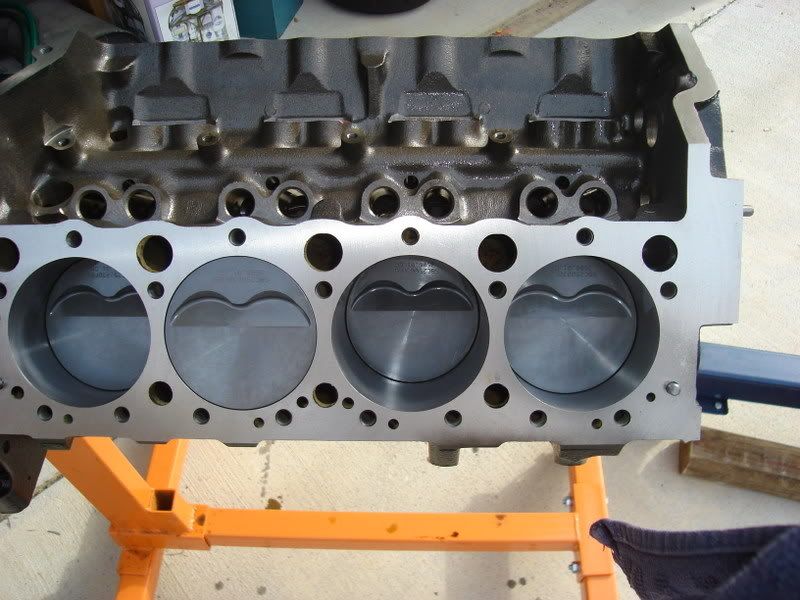
if it is indeed .051 stock, then by all means go the thinnest gasket you can get that still seals well. Your quench with that gasket is off alot and i'm surprised GM would allow this. Pistons sit in the bore about .02-.025" and combine that with a .051 gasket, that leaves a nasty .071-.076 quench height! That is absolutely horrible
going to .028-.029" will get you a better but still far from optimal .048-.053" quench.
Optimal is .035-.045 with .040 being where you want to be. Not only will the gain in compression help, the more efficient quench height will lead to more efficient combustion and that will help power and mileage
going to .028-.029" will get you a better but still far from optimal .048-.053" quench.
Optimal is .035-.045 with .040 being where you want to be. Not only will the gain in compression help, the more efficient quench height will lead to more efficient combustion and that will help power and mileage

Race Director

Joined: Jan 2005
Posts: 10,641
Likes: 13
From: Slidell Louisiana
I didn't answer your poll since you didn't have thinner choices.
I know that you have a GEN 1 and I have a Gen 2 but every SBC need decent quench for optimal performance.
So go thin for good quench, my shortblock was set up for piston depth of .005 and I'm running a .027 cometics for a .032 quench on my DD LT1.
I would not use MLS gaskets on a stock short block, but I would definately use them on a rebuild (mls needs proper deck surfacing for reliable sealing.)
Even with the compression a little higher than 12 to 1 it runs on pump gas in traffic in the Mississippi/Louisiana summer hit with the AC on and does it without detonation.
Mike
I know that you have a GEN 1 and I have a Gen 2 but every SBC need decent quench for optimal performance.
So go thin for good quench, my shortblock was set up for piston depth of .005 and I'm running a .027 cometics for a .032 quench on my DD LT1.
I would not use MLS gaskets on a stock short block, but I would definately use them on a rebuild (mls needs proper deck surfacing for reliable sealing.)
Even with the compression a little higher than 12 to 1 it runs on pump gas in traffic in the Mississippi/Louisiana summer hit with the AC on and does it without detonation.
Mike
Last edited by aboatguy; Nov 5, 2008 at 08:30 PM. Reason: mine doesn't leak
Thread Starter
Race Director
Joined: Nov 2003
Posts: 12,222
Likes: 446
From: Overland Park Kansas
2020 Corvette of the Year Finalist (appearance mods)
C4 of Year Winner (appearance mods) 2019
I was convinced 1989 used .051 (from other posts). Now, I notice TPiS says there .029" gasket is like milling .010". Could the stock gasket be an .039"?
My mechanic says studs help make it easier to torque the head correctly. Is that B.S.? (I was going to reuse stock bolts until he said that).
He also said he's seen lots of coolant leaks on cars where thinner gaskets where installed. Stated it as pretty much a guaranteed coolant seepage. He said "How do you like the smell of coolant in the morning?
Regarding material, I take it MLS = multi-layered steel. What are the best materials? If you select 4" bore for a 1989 Chevy 350 on Summit, the options returned are GM performance and SCE. SCE is a $100 copper gasket. The GM is composite (w/o fire ring or lock wire).
I even saw someone else recommending a .015" shim gasket but holy bajeezus that's thin! Yeah it would hit the desired .040" quench. (Edit... Oh yeah, the 1094 is the one I've seen recommended before. You're kidding me, right? It's listed a rubber-coated!!!)
This is going to be a touch choice!!! Keep the feedback/poll coming. I wouldn't mind hearing more about gasket materials/specific choices too.
BTW: I should say my priority would be sealing first. Second would be having no detonation (w/o an EGR too). Let's not forget responsive low-end performance (via high compression).
gp
My mechanic says studs help make it easier to torque the head correctly. Is that B.S.? (I was going to reuse stock bolts until he said that).
He also said he's seen lots of coolant leaks on cars where thinner gaskets where installed. Stated it as pretty much a guaranteed coolant seepage. He said "How do you like the smell of coolant in the morning?
Regarding material, I take it MLS = multi-layered steel. What are the best materials? If you select 4" bore for a 1989 Chevy 350 on Summit, the options returned are GM performance and SCE. SCE is a $100 copper gasket. The GM is composite (w/o fire ring or lock wire).
I even saw someone else recommending a .015" shim gasket but holy bajeezus that's thin! Yeah it would hit the desired .040" quench. (Edit... Oh yeah, the 1094 is the one I've seen recommended before. You're kidding me, right? It's listed a rubber-coated!!!)
This is going to be a touch choice!!! Keep the feedback/poll coming. I wouldn't mind hearing more about gasket materials/specific choices too.
BTW: I should say my priority would be sealing first. Second would be having no detonation (w/o an EGR too). Let's not forget responsive low-end performance (via high compression).
gp
Last edited by GREGGPENN; Nov 5, 2008 at 10:44 PM.
Thread Starter
Race Director
Joined: Nov 2003
Posts: 12,222
Likes: 446
From: Overland Park Kansas
2020 Corvette of the Year Finalist (appearance mods)
C4 of Year Winner (appearance mods) 2019
Corvette Stories
The Best of Corvette for Corvette Enthusiasts

5 Best & 5 Worst Corvette Daily Drivers
Joe Kucinski
The Headlights of Every Corvette Generation Explained
Joe Kucinski
5 Best & 5 Most Overrated Corvette Track Packages of All Time!
Joe Kucinski
Every 2027 Corvette Engine Explained
Joe Kucinski
Designer Imagines A Corvette That Looks More Like a Corvette Than the Corvette
Verdad Gallardo
10 Ugly Corvettes That We Still Kinda Love
Joe Kucinski
Top 10 Most Expensive Corvettes Ever Sold on Bring A Trailer
Brett Foote
10 Things Every Corvette Owner Needs (2026 Edition)
Michael S. Palmer
8 Most "Only Corvette Owners Understand" Quirks and Problems
Pouria Savadkouei
Race Director
Joined: Jan 2005
Posts: 10,641
Likes: 13
From: Slidell Louisiana
Regarding material, I take it MLS = multi-layered steel. What are the best materials? If you select 4" bore for a 1989 Chevy 350 on Summit, the options returned are GM performance and SCE. SCE is a $100 copper gasket. The GM is composite (w/o fire ring or lock wire).
I even saw someone else recommending a .015" shim gasket but holy bajeezus that's thin! Yeah it would hit the desired .040" quench.
I even saw someone else recommending a .015" shim gasket but holy bajeezus that's thin! Yeah it would hit the desired .040" quench.
Last edited by aboatguy; Nov 5, 2008 at 10:40 PM.

Team Owner

Joined: Oct 2004
Posts: 81,241
Likes: 3,063
From: altered state
St. Jude Donor '05

Burning Brakes
Joined: Jul 2006
Posts: 1,080
Likes: 2
From: Pittsburgh PA
even tho the 1094 is paper thin, its rubber coated and works with aluminum heads. I've heard many ppl running it with out problems but must make sure your surfaces are pretty flat and very clean. Also have heard people using copper spray to coat it before they put it on. Helps with the sealing
I'd run the mr gasket .028 or the GM version which is .028 i believe
you dont have to use a 4" bore gasket. you can get 4.060-4.166's and still be fine. gives more options that way
I'd run the mr gasket .028 or the GM version which is .028 i believe
you dont have to use a 4" bore gasket. you can get 4.060-4.166's and still be fine. gives more options that way

Drifting

Joined: Dec 2005
Posts: 1,313
Likes: 2
From: High Ridge Missouri
Here is the Mr Gasket head gasket I believe you're talking about. I've actually been considering this one myself and was curious if anyone else has run it.
http://store.summitracing.com/partde...4&autoview=sku
http://store.summitracing.com/partde...4&autoview=sku

Burning Brakes
Joined: Dec 2006
Posts: 936
Likes: 2
From: Tyrone PA
Ok, here goes my experience...........
Stock shortblock never out of car so it isn't decked for flatness or anything. Bought used 113 heads that were run before and had some brinnelling (could see and slightly feel a thin ring around the combustion chambers). I was tight on money last winter (couldn't spend money on machining the heads to clean them up), and I wanted compression. I went with the .015 thickness steel shim gasket (1094). As per CFI's threads I found while searching, I copper coat sprayed both sides of the gasket before I installed it. All is fine. Spraying a 175 shot of nitrous, just ran a 11.43 @ 121 at the track last weekend. No signs of headgasket problems at all. I think the copper coat spray helps with imperfections a little. I plan on using the 1094's again.
Stock shortblock never out of car so it isn't decked for flatness or anything. Bought used 113 heads that were run before and had some brinnelling (could see and slightly feel a thin ring around the combustion chambers). I was tight on money last winter (couldn't spend money on machining the heads to clean them up), and I wanted compression. I went with the .015 thickness steel shim gasket (1094). As per CFI's threads I found while searching, I copper coat sprayed both sides of the gasket before I installed it. All is fine. Spraying a 175 shot of nitrous, just ran a 11.43 @ 121 at the track last weekend. No signs of headgasket problems at all. I think the copper coat spray helps with imperfections a little. I plan on using the 1094's again.



Safety Car


Joined: Sep 2001
Posts: 4,163
Likes: 555
From: Glenbeulah Wi
Ok, here goes my experience...........
Stock shortblock never out of car so it isn't decked for flatness or anything. Bought used 113 heads that were run before and had some brinnelling (could see and slightly feel a thin ring around the combustion chambers). I was tight on money last winter (couldn't spend money on machining the heads to clean them up), and I wanted compression. I went with the .015 thickness steel shim gasket (1094). As per CFI's threads I found while searching, I copper coat sprayed both sides of the gasket before I installed it. All is fine. Spraying a 175 shot of nitrous, just ran a 11.43 @ 121 at the track last weekend. No signs of headgasket problems at all. I think the copper coat spray helps with imperfections a little. I plan on using the 1094's again.
Stock shortblock never out of car so it isn't decked for flatness or anything. Bought used 113 heads that were run before and had some brinnelling (could see and slightly feel a thin ring around the combustion chambers). I was tight on money last winter (couldn't spend money on machining the heads to clean them up), and I wanted compression. I went with the .015 thickness steel shim gasket (1094). As per CFI's threads I found while searching, I copper coat sprayed both sides of the gasket before I installed it. All is fine. Spraying a 175 shot of nitrous, just ran a 11.43 @ 121 at the track last weekend. No signs of headgasket problems at all. I think the copper coat spray helps with imperfections a little. I plan on using the 1094's again.
 Use this gasket! It works well.

Racer


Joined: Feb 2006
Posts: 460
Likes: 0
From: MN
http://http://www.tpis.com/index.php...y=Head+Gaskets
Last edited by Razor89; Nov 6, 2008 at 05:05 PM.
Thread Starter
Race Director
Joined: Nov 2003
Posts: 12,222
Likes: 446
From: Overland Park Kansas
2020 Corvette of the Year Finalist (appearance mods)
C4 of Year Winner (appearance mods) 2019
So, I called TPiS for their opinion....
They believe the .029" (link above) would be reliable for long-term installation. Their gasket is made by Victor. They believe the GM performance gaskets are also made by Victor. Though surmising they might even be the SAME gasket, TPiS thought their version was a 4.080" bore. Summit's .029" GM version is a 4" bore.
TPiS recommended staying away from the .015" shim for long-term applications -- though indicating it was a great gasket for power-making applications. Adding, it was a gasket they've used with great success. They just wouldn't count on it sealing for years (like I'd want).
I also asked about studs. Interestingly enough, they said not to use them as well. Reason was higher likely-hood of breaking into the water jacket.
They believe the .029" (link above) would be reliable for long-term installation. Their gasket is made by Victor. They believe the GM performance gaskets are also made by Victor. Though surmising they might even be the SAME gasket, TPiS thought their version was a 4.080" bore. Summit's .029" GM version is a 4" bore.
TPiS recommended staying away from the .015" shim for long-term applications -- though indicating it was a great gasket for power-making applications. Adding, it was a gasket they've used with great success. They just wouldn't count on it sealing for years (like I'd want).
I also asked about studs. Interestingly enough, they said not to use them as well. Reason was higher likely-hood of breaking into the water jacket.

Race Director

Joined: Jun 1999
Posts: 14,924
Likes: 9
From: Merritt Ils Fl
Kinda funny. You guys are trying to pick up CR with a thinner gasket, I am trying to shed some with a thicker gasket. Thicker than stock gaskets scare me but I an not comfortable with 11:1 CR.


Le Mans Master


Joined: Oct 2004
Posts: 5,841
Likes: 19
From: CLT, North Carolina
Don't know if the block has been honed yet but if it has it will be critical to use the same style gaskets the block was honed with (if your machinist used honing plates which he should have). Otherwise bore distortion will occur near the tops of the bores adjacent to each head bolt. The bores can be pulled as much as .0015 -.002 out of round when cylinder head installation does not duplicate conditions the bolck saw during the honing operation. Studs versus bolts will make a huge difference as well. You will develop more clamp load with a stud torqued to the same value as a bolt which again means bore distortion if something different is used during assembly than was used during honing. Bore distortion will hurt power due to increased blow-by possibly more that you will gain by a small bump up in compression with a thinner gasket. MLS gaskets are superior to anything else on the market right now, especially for aluminum heads on iron blocks.