



Throttle Body Coolant Bypass
Thread Starter
Instructor

Joined: Jun 2008
Posts: 122
Likes: 1
From: Turnersville New Jersey
 Throttle Body Coolant Bypass
I have an 89 coupe and was wondering what is the purpose of bypassing the coolant from the Throttle Body. What are the pros and cons.
Thanks !!!
Thanks !!!
Burning Brakes


Joined: Feb 2008
Posts: 988
Likes: 7
From: Sarasota Fl
1. No coolant spills everywhere if you need to remove the TB (for cleaning, painting, etc).
2. Plenum is cooler to the touch after running the car.
3. Cooler air enters the engine without hot coolant to heat it up. (supposedly)
4. Removes clutter from the engine bay with 2 less hoses.
Cons:
1. Takes 20 min to do.

Pro

Joined: Jun 2007
Posts: 626
Likes: 2
From: Coquitlam British Columbia
Pros:
1. No coolant spills everywhere if you need to remove the TB (for cleaning, painting, etc).
2. Plenum is cooler to the touch after running the car.
3. Cooler air enters the engine without hot coolant to heat it up. (supposedly)
4. Removes clutter from the engine bay with 2 less hoses.
Cons:
1. Takes 20 min to do.
1. No coolant spills everywhere if you need to remove the TB (for cleaning, painting, etc).
2. Plenum is cooler to the touch after running the car.
3. Cooler air enters the engine without hot coolant to heat it up. (supposedly)
4. Removes clutter from the engine bay with 2 less hoses.
Cons:
1. Takes 20 min to do.


Instructor
Joined: Jul 2007
Posts: 132
Likes: 0
From: Austin Texas
No cons....except if you live in sub freezing climate. The main purpose for running coolent through the TB was too keep condensation from icing up when car is not running for long periods. The icing in the TB could potentially keep the TB blade from moving.
Even back in the day, GM was preparing for "The Day After Tomorrow" with this TB heating technique....

Even back in the day, GM was preparing for "The Day After Tomorrow" with this TB heating technique....

Pro


Joined: Oct 2008
Posts: 706
Likes: 265
From: Jyväskylä, FINLAND
Even if the car isn't running, but the engine is, the heat transferred from block through intake etc. (the metals in contact with each other) will be enough.
I've road tested my car with TB coolant bypass thousands of miles in various different situations (temperatures near water freezing point - just above, just below - way below freezing point, in freezing rain, snowing, ... you name it) during this and last winter and there has been no problems whatsoever.
If the time 'lost' in this procedure is not considered, there are no cons.
Instructor
Joined: Jul 2007
Posts: 132
Likes: 0
From: Austin Texas
How would it prevent TB from icing, if the car is not running? If the car isn't running, there is no heat, no water circulation.
Even if the car isn't running, but the engine is, the heat transferred from block through intake etc. (the metals in contact with each other) will be enough.
I've road tested my car with TB coolant bypass thousands of miles in various different situations (temperatures near water freezing point - just above, just below - way below freezing point, in freezing rain, snowing, ... you name it) during this and last winter and there has been no problems whatsoever.
If the time 'lost' in this procedure is not considered, there are no cons.
Even if the car isn't running, but the engine is, the heat transferred from block through intake etc. (the metals in contact with each other) will be enough.
I've road tested my car with TB coolant bypass thousands of miles in various different situations (temperatures near water freezing point - just above, just below - way below freezing point, in freezing rain, snowing, ... you name it) during this and last winter and there has been no problems whatsoever.
If the time 'lost' in this procedure is not considered, there are no cons.
Why do you think GM incorporated this system....just for fun ?
Last edited by joecarter85; Jan 11, 2009 at 12:17 PM.
Corvette Stories
The Best of Corvette for Corvette Enthusiasts

Top 10 Most Expensive Corvettes Ever Sold on Bring A Trailer
Brett Foote
10 Things Every Corvette Owner Needs (2026 Edition)
Michael S. Palmer
8 Most "Only Corvette Owners Understand" Quirks and Problems
Pouria Savadkouei
10 Reasons the C6 Z06 is Still A Performance Benchmark After 20 Years
Joe Kucinski
How Much Horsepower Every Corvette Engine "LOST" in 1972
Joe Kucinski
Top 10 DOs and DON'Ts for Protecting Your Convertible Top!
Michael S. Palmer
Top 10 Most Explosive Corvettes Ever Made: Power-to-Weight Ratio Ranked!
Joe Kucinski
150 hp to 1,250 hp: Every Corvette Generation Compared by the Specs That Matter
Joe Kucinski
8 Coolest Corvette Pace Cars (and Replicas) of All Time
Verdad Gallardo
Le Mans Master


Joined: Aug 2000
Posts: 8,838
Likes: 31
From: Australia
At idle (hi manifold vac) ,the pressure drop across the butterflies causes the air to cool allowing ice to form if the incoming air is cold enough and has enough moisture content.
Gas going from hi to low pressure cools.
Pro
Joined: Oct 2008
Posts: 706
Likes: 265
From: Jyväskylä, FINLAND
When has this really happened to anyone?
As I stated above, I have tested this in practise, in all kinds of weather (in which water even could freeze and form ice) and I've had no problems. None. During last winter and this winter so far I have driven ca. 7 000 miles with TB coolant bypass.
As I stated above, I have tested this in practise, in all kinds of weather (in which water even could freeze and form ice) and I've had no problems. None. During last winter and this winter so far I have driven ca. 7 000 miles with TB coolant bypass.


Instructor

Joined: Sep 2008
Posts: 136
Likes: 0
From: DFW TX
Granted this may not mean much in comparrison but it's still a design/event that may have some relativity to the subject.
On the F-15's I used to work on, we had heating elements along the leading edge of the wings and each sensor or probe. This was due to the high flow of air, cooler temps and humidity caused condensation on all leading surfaces and at altitude the water would freeze and weigh down the jet. Or even at our location the ice would build up on landing and take-off causing engine damaged from uice breaking off and being sucked down the intake.
If any one is familiar with Top-Fuel engine they know that Nitromethane is nearly a solid when it is ignited. Thus when there is improper ignition, the motors often grenades because of the fuel solidifying into ice.
This may be one reason... to keep throttle operational nominal or to keep ice from being injested.
On the F-15's I used to work on, we had heating elements along the leading edge of the wings and each sensor or probe. This was due to the high flow of air, cooler temps and humidity caused condensation on all leading surfaces and at altitude the water would freeze and weigh down the jet. Or even at our location the ice would build up on landing and take-off causing engine damaged from uice breaking off and being sucked down the intake.
If any one is familiar with Top-Fuel engine they know that Nitromethane is nearly a solid when it is ignited. Thus when there is improper ignition, the motors often grenades because of the fuel solidifying into ice.
This may be one reason... to keep throttle operational nominal or to keep ice from being injested.
Advanced

Joined: Jun 2008
Posts: 63
Likes: 1
From: Pittsburgh PA
Recognize that GM designs cars to work, and work without problems, in a wide range of environmental conditions. Most of use never expose our cars to anywhere near the designed range. To use a sample size of 1, and say your car always works, is not conclusive at all.
Until we drive out cars in Death Valley, and then in Alaska (and test in on dozens of cars) all we can do is guess.
That being said, if your car is only driven in the summer, it would seem it is safe to bypass the throttle body.
Dale
Until we drive out cars in Death Valley, and then in Alaska (and test in on dozens of cars) all we can do is guess.
That being said, if your car is only driven in the summer, it would seem it is safe to bypass the throttle body.
Dale

Intermediate
Joined: Jan 2009
Posts: 34
Likes: 0
From: Las Vegas Nevada
throttle body coolant bypass
I kinda got lost on the article on this I have an 85 and the one hose on the drivers side comes out below the throttle body then down to the intake,the other one on the passenger side goes to my heater core, so what I would need to do is run the one coming from my heater core to the intake and then run the hose from under the throttle to the passenger side where I took off the one from the heater core. Is this correct? I live in the dessert any heat savings would help alot.
Burning Brakes
Joined: Feb 2008
Posts: 988
Likes: 7
From: Sarasota Fl
This is what it looks like on a '91 L98. Toss the water pump frisbee while you have the air duct off (if anything, it makes putting the serpentine belt on SOOO much easier). How I did it:
1. Bought about 5 feet of 5/8" heater hose, two 5/8" caps (available in TB bypass kits sold at AutoZone) some hose clamps, and an e-z bend hose spring.
2. Drain coolant.
3. Remove hoses from TB, bottom heater core inlet, and TB to intake "U" hose.
U hose:

4. Place radiator hose grease on both ends of new hose with e-z bend spring over it.
5. Place end of heater hose over intake outlet. Bend hose spring to ~ 90*.
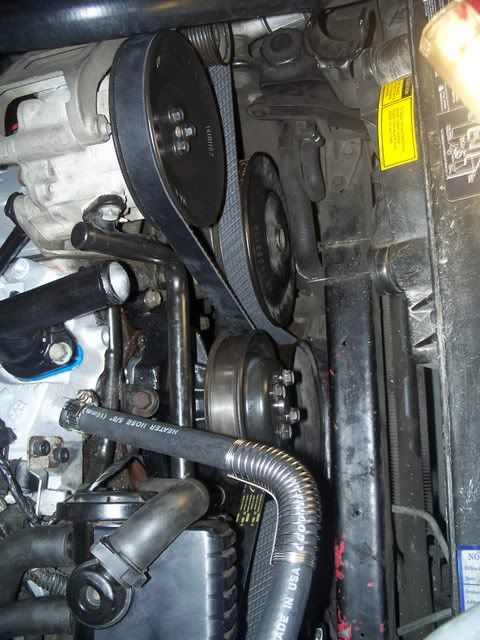
6. Route hose away from AC and tensioner pulleys. I used zip-ties and attached it to the AC line.
7. Insert into heater core LOWER inlet. You don't need to remove the high-fill reservoir - mine was off for cleaning and it was easier to access and snap a picture.

End result:

If you want more pics, just say the word,
-Jonathan
Last edited by janarvae; Jan 12, 2009 at 11:30 PM.

Intermediate
Joined: Jan 2009
Posts: 34
Likes: 0
From: Las Vegas Nevada
Jonathan, great job looks clean, in the last picture on your TB you have two hose's the top one goes to the vent on the valve cover the bottom one with the writing on goes to what ? I cant see in the pic. on mine thats the hose that goes to the heater core.
Le Mans Master
Joined: Aug 2000
Posts: 8,838
Likes: 31
From: Australia
On TB;
Top hose on TB goes to rocker cover
Bottom hose on TB goes to charcoal canister by drv headlight



Burning Brakes
Joined: Feb 2008
Posts: 988
Likes: 7
From: Sarasota Fl
On mine, the top passenger side hose goes to the breather in the valve cover. The lower hose goes to the fuel vapor purge solenoid.


See the SILVER (just beneath the green one) hose clamp? That is for the hose that goes to the heater core.
