


LT4 Timing Chain decision

Thread Starter
Race Director

Joined: Apr 2000
Posts: 15,344
Likes: 4,009
From: Texas

 You've contributed a boat load of information to this forum. Your contributions are always welcome in my book
Btw #1...
A replacement Cloyes LT4 ED chain can be bought for less than $50 from Summit
Btw #2...
I'm meeting tomorrow morning with a friend and fellow road course/road racing junky who also happens to own a large metal fabrication facility. He's going to hardness test my stock LT4 and LT4 ED cam gears and my water pump driveshaft gear. Stay tuned...

Le Mans Master


Joined: Jan 2002
Posts: 9,036
Likes: 13
From: Edmonton AB
My vote is that this is a high-stakes decision with respects to
the time and money riding on the outcome.
It will be interesting to hear what hardness readings are reported.
sothpaw2 wrote that his cam gear was RC 28-29 and the water
pump gear registered RC 42. He felt this relationship was wrong
but in industrial applications, the hardness of a pinion & spur are
different. The practice of running a relatively harder material
against a relatively softer one is common where materials are
contacting one another. In the case of pinon & spur gears, the
pinion is designated as the harder member of the pair because it
has fewer teeth than the spur.
Regarding Tom Piper's suggestion that increased TQ/HP/RPM leads
crankshaft torsional action to shorten gear tooth life. I feel the
cam chain may serve as a dampener.
Also, wouldn't the stronger ocillations result in a failure mode of
fracture formation at the root of the teeth, rather than severe, but
uniform wear on both faces of each tooth around the full circumference
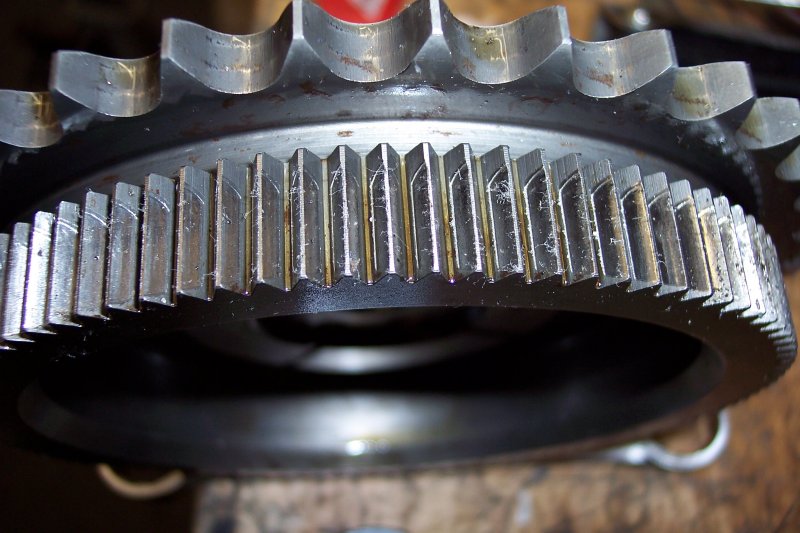
of the water pump (spur) gear as occured on RichS' gear?
More later.
.
the time and money riding on the outcome.
It will be interesting to hear what hardness readings are reported.
sothpaw2 wrote that his cam gear was RC 28-29 and the water
pump gear registered RC 42. He felt this relationship was wrong
but in industrial applications, the hardness of a pinion & spur are
different. The practice of running a relatively harder material
against a relatively softer one is common where materials are
contacting one another. In the case of pinon & spur gears, the
pinion is designated as the harder member of the pair because it
has fewer teeth than the spur.
Regarding Tom Piper's suggestion that increased TQ/HP/RPM leads
crankshaft torsional action to shorten gear tooth life. I feel the
cam chain may serve as a dampener.
Also, wouldn't the stronger ocillations result in a failure mode of
fracture formation at the root of the teeth, rather than severe, but
uniform wear on both faces of each tooth around the full circumference
of the water pump (spur) gear as occured on RichS' gear?
More later.
.

Team Owner

Joined: Aug 2005
Posts: 34,988
Likes: 515
From: Riverside County Southern California
Co-winner 2020 C4 of the Year - Modified
2018 Corvette of Year Finalist
2017 C4 of Year
2016 C7 of Year Finalist
St. Jude Donor '09 thru '20
I purchased and installed the GM Performance Roller Chain. I hope I get no issues with this set up.
Safety Car

Joined: Feb 1999
Posts: 3,504
Likes: 4
From: Mexico Beach FL
And, if my memory serves me correctly, the stock LT4 and the ED timing set both have a cam sprocket without holes in it like the LT1 -- the reason for the absence of holes was to add mass to the cam to help eliminate torsional vibration there.
To me, this is evidence that GM knew the LT4 had more of a problem with torsional vibration because of the extended hp and rpm.
I also believe this is a problem that occurs more readily on the LT1 and LT4 because of the water pump drive gears that add to the "whipping" action.
The earlier small blocks don't have that.
Keep in mind, once torsional vibration occurs, it tends to be amplified if the harmonics are at the resonant frequency of the mass of the components, and this can be devastating. And, the water pump gear running off the cam sprocket tends to start whipping back-and-forth at a high rate (some what like a swing that is pushed only at one position maintains the motion throughout the entire path).
I believe that most Opti-Spark rotors that come apart are also due to this.
In addition, I don't know the links anymore, but there were at least two incidents where individuals on the Z28 forum had completely stock engines and put on under drive pulleys without ANY damper at all (don't ask me how they did that). The result was broken cam bolts and water pump teeth that were sheared.
Remember these were supposed to be completely stock LT1 engines rev limited at 5K, minus a damper.
And, I submit as evidence my ED timing set that was bought in about 1998 is still pristine (I've had it apart and checked) at 45K miles, and I don't baby it.
Torsional vibration is the "silent killer" of engines -- you will never feel it.
Tom Piper
Last edited by Tom Piper; Jan 17, 2009 at 01:04 PM.
Thread Starter
Race Director
Joined: Apr 2000
Posts: 15,344
Likes: 4,009
From: Texas
Tested the hardness of the two cam gears this morning.
The first gear is my original LT4 cam gear that was on my car when it left the plant in BG. It has ~70k miles on it. The hardness is 28
The second gear tested was my LT4 Extreme Duty cam gear. I bought it in the 2003 timeframe. Most of that time I had an electric waterpump. Before pulling the engine, I ran ~1k miles with the OEM pump. The hardness is 28 on this gear as well.
Unfortunately the original LT4 waterpump drive gear is still on the shaft which prevented us from testing it, so no results for that gear.
My conclusion is that I'll be fine with the ED setup.
- The cam gears are the same hardness
- I'll be using the stock LT4 waterpump driveshaft gear. That gear was fine for 70k miles on the original cam gear
- I'm using an ATI Super Damper
If I see metal in my oil, I'll be pulling things apart in a hurry!
The first gear is my original LT4 cam gear that was on my car when it left the plant in BG. It has ~70k miles on it. The hardness is 28
The second gear tested was my LT4 Extreme Duty cam gear. I bought it in the 2003 timeframe. Most of that time I had an electric waterpump. Before pulling the engine, I ran ~1k miles with the OEM pump. The hardness is 28 on this gear as well.
Unfortunately the original LT4 waterpump drive gear is still on the shaft which prevented us from testing it, so no results for that gear.
My conclusion is that I'll be fine with the ED setup.
- The cam gears are the same hardness
- I'll be using the stock LT4 waterpump driveshaft gear. That gear was fine for 70k miles on the original cam gear
- I'm using an ATI Super Damper
If I see metal in my oil, I'll be pulling things apart in a hurry!

Race Director
Joined: Aug 2006
Posts: 18,346
Likes: 1
From: D / FW
I went with the ED timing chain and a crank trigger LS timing chain cover for future mods and a much thinner Harmonic Balancer [ Dedenbar ] .
I fixing to go with electric water pump and I was going to start another thread to debate GPM to go with. More ain't always better .
Oh yeah I have a 450 HP LT 4 used and abused on road track and strip.
I fixing to go with electric water pump and I was going to start another thread to debate GPM to go with. More ain't always better .
Oh yeah I have a 450 HP LT 4 used and abused on road track and strip.
Corvette Stories
The Best of Corvette for Corvette Enthusiasts

150 hp to 1,250 hp: Every Corvette Generation Compared by the Specs That Matter
Joe Kucinski
8 Coolest Corvette Pace Cars (and Replicas) of All Time
Verdad Gallardo
Top 10 Corvette Engines RANKED by Peak Torque (70+ Years of Muscle!)
Joe Kucinski
Corvette ZR1X Will Be Pacing the Indy 500, And Could Probably Race, Too!
Verdad Gallardo
Top 10 Corvettes Coming to Mecum Indy 2026!
Brett Foote
Top 10 C9 Corvette MUST-HAVES to Fix These C8 Generation Flaws!
Michael S. Palmer
10 Revolutionary 'Corvette Firsts' Most People Don't Know
Joe Kucinski
5 Reasons to Upgrade to an LS6-Powered Corvette; 5 Reasons to Stay LT2
Michael S. Palmer
2027 Corvette vs The World: Every C8 vs Its Closest Competitor
Joe Kucinski
Le Mans Master


Joined: Jan 2003
Posts: 8,596
Likes: 19
From: Portland Oregon
I have used several ED sets from Cloyes and knock on wood so far no problems at all, these installs includes one in my personal C4. I would not have any problems with using it again, in fact I just installed another Cloyes ED set into a 95 TA, in that combo with LT headers, AFR 195 LT4 Eliminator heads, Edelbrock LT4 intake, custom cam and tuning, yielded 405HP to the wheels. Needless to say the customer was ecstatic with the results.
Le Mans Master
Joined: Jan 2002
Posts: 9,036
Likes: 13
From: Edmonton AB
Sorry to take so long to follow up.
Tom Piper. Thank you for a reasoned rebuttal.
Gear tooth failure takes three general forms, tooth fracture, pitting
and scoring. Of these, scoring is described as a problem associated
commonly with high speed and high loads.
reports testing 48 gear sets and determining the following probabilities
for occurance of gear scoring:
22 yrs earlier.
So, where does this leave us? To reduce the likelyhood of tooth
scoring in high speed/high load gear sets, consider steps to lower
the tooth temperature of the gears.
Harmon Blok's Critical-Temperature Theory is based on criteria like
gear material, hardness, surface finish, type of lubrication, additives
and so on.
Of these criteria, my vote is that an end-user like 96GS#007 can
have some influence over the following:
Tom Piper. Thank you for a reasoned rebuttal.
In addition to your points about torsional vibration, another
consideration is that of water pump cavitation. Unlike the crank,
which is separated by the chain from the spur gear on the cam,
my vote is that cavitation at the pump would transmit nearly
directly to the driven pinion. Increased valve-train loads from
higher lift and stronger springs might also be a factor. So might
the oil pump.
Still, no matter which direction it comes from, above, below or
behind, my vote is that the failure mode of vibration-induced tooth
chatter would be by fatigue fractures occuring at the root of one
or more teeth. Catastrophic failure would seem likely to follow in
short order.
Yet, the image of RichS' gear appears to show deep wear evenly
distributed across both sides of all the visible teeth? Various
degrees of pitting is evident on several of the teeth, too.
I don't dispute that torsional vibration might be a consideration in
some situations, but I do not think that it is the culprit in RichS'
instance. (In the event that TV DOES play a part in ED cam gear
failure, then since 96GS#007 already has the ATI Super Damper,
his bets are hedged in this regard.)
Moving on.consideration is that of water pump cavitation. Unlike the crank,
which is separated by the chain from the spur gear on the cam,
my vote is that cavitation at the pump would transmit nearly
directly to the driven pinion. Increased valve-train loads from
higher lift and stronger springs might also be a factor. So might
the oil pump.
Still, no matter which direction it comes from, above, below or
behind, my vote is that the failure mode of vibration-induced tooth
chatter would be by fatigue fractures occuring at the root of one
or more teeth. Catastrophic failure would seem likely to follow in
short order.
Yet, the image of RichS' gear appears to show deep wear evenly
distributed across both sides of all the visible teeth? Various
degrees of pitting is evident on several of the teeth, too.
I don't dispute that torsional vibration might be a consideration in
some situations, but I do not think that it is the culprit in RichS'
instance. (In the event that TV DOES play a part in ED cam gear
failure, then since 96GS#007 already has the ATI Super Damper,
his bets are hedged in this regard.)
Gear tooth failure takes three general forms, tooth fracture, pitting
and scoring. Of these, scoring is described as a problem associated
commonly with high speed and high loads.
Standard Handbook of Machine Design
Shigley, Joseph E.; Mischke, Charles R.
McGraw-Hill 1986
Raymond J. Drago
Under high speed conditions, the sliding motion of one gear on
another may create instantaneous conditions of temperature and
pressure which destroy the film of oil separating the tooth flanks.
... scoring is generally progressively destructive. Though never a
catastrophic failure itself, scoring destroys the tooth surface,
which leads to accelerated wear, pitting and spalling. If scoring is
allowed to progress unchecked, tooth fracture may ultimately occur."
Mr Drago goes on to discuss Harmon Blok's Critical-Temperature Theory
and the method of determining Tooth Flash Temperature which
is based on criteria like gear material, hardness, surface finish, type of
lubrication, additives and so on.
"When the flash temperature reaches its critical value, failure by
scoring will occur. Note that the flash temperature referred to
here is not related in any way to the flash point of the oil ... "
Mr Drago concludes with a chart showing allowable Flash Temperatures
for two grade of alloy steel (at 60 Rc) with three kinds of mil-spec
lubricants. The resulting values range from 295ºF to 375ºF.
In a 2008 paper, A Study in Spur Gear Scoring, author Armando AmadorShigley, Joseph E.; Mischke, Charles R.
McGraw-Hill 1986
Raymond J. Drago
Under high speed conditions, the sliding motion of one gear on
another may create instantaneous conditions of temperature and
pressure which destroy the film of oil separating the tooth flanks.
... scoring is generally progressively destructive. Though never a
catastrophic failure itself, scoring destroys the tooth surface,
which leads to accelerated wear, pitting and spalling. If scoring is
allowed to progress unchecked, tooth fracture may ultimately occur."
Mr Drago goes on to discuss Harmon Blok's Critical-Temperature Theory
and the method of determining Tooth Flash Temperature which
is based on criteria like gear material, hardness, surface finish, type of
lubrication, additives and so on.
"When the flash temperature reaches its critical value, failure by
scoring will occur. Note that the flash temperature referred to
here is not related in any way to the flash point of the oil ... "
Mr Drago concludes with a chart showing allowable Flash Temperatures
for two grade of alloy steel (at 60 Rc) with three kinds of mil-spec
lubricants. The resulting values range from 295ºF to 375ºF.
reports testing 48 gear sets and determining the following probabilities
for occurance of gear scoring:
- 5.5 % where ≤ 275ºF
- 10% where ≤ 293ºF
- 10-30% where 293ºF - 388ºF
- 30% where ≥ 338ºF
22 yrs earlier.
So, where does this leave us? To reduce the likelyhood of tooth
scoring in high speed/high load gear sets, consider steps to lower
the tooth temperature of the gears.
Harmon Blok's Critical-Temperature Theory is based on criteria like
gear material, hardness, surface finish, type of lubrication, additives
and so on.
Of these criteria, my vote is that an end-user like 96GS#007 can
have some influence over the following:
- [*]
- [*]
- [*]
- [*]
- [*]
- [*]
- [*]
- [*]
Safety Car
Joined: Feb 1999
Posts: 3,504
Likes: 4
From: Mexico Beach FL
...Tom Piper. Thank you for a reasoned rebuttal.
In addition to your points about torsional vibration, another
consideration is that of water pump cavitation. Unlike the crank,
which is separated by the chain from the spur gear on the cam,
my vote is that cavitation at the pump would transmit nearly
directly to the driven pinion. Increased valve-train loads from
higher lift and stronger springs might also be a factor. So might
the oil pump.....
In addition to your points about torsional vibration, another
consideration is that of water pump cavitation. Unlike the crank,
which is separated by the chain from the spur gear on the cam,
my vote is that cavitation at the pump would transmit nearly
directly to the driven pinion. Increased valve-train loads from
higher lift and stronger springs might also be a factor. So might
the oil pump.....
My pristine ED timing set with 45K miles on it has seen three different water pumps.
The reason I added this is because of a discussion on a previous thread about water pump drive stiffness being the problem.
And, as I mentioned above, I think the fact that two different people, after putting on underdrive pulleys without any damper, on the Z28 forum with completely stock LT1 engines (including the stock LT1 timing set, not the ED timing set) saw catostrophic failure (broken cam bolts) and water pump drive teeth that were shreaded the same way as I have seen in threads on this forum goes a long way in providing evidence that the problem is not the ED timing set.
These preople had no problem with the stock damper, the problem happened only after putting on the underdrive pulley with no damper at all.
Tom Piper
Last edited by Tom Piper; Jan 20, 2009 at 07:13 AM.

Melting Slicks


Joined: Jun 2004
Posts: 3,253
Likes: 2
From: Castro Valley CA
Of these criteria, my vote is that an end-user like 96GS#007 can
have some influence over the following:
[*]Surface finish. Liberal application of assembly lube &/or EOS to
the gear tooth faces, followed by light loads during a break-in period
of low speeds and cool operating temperatures will help burnish and
cold work the rough tooth faces.
Take note of the condition of the unworn tooth surface of RichS'
cam gear - there are prominent marks left from the gear cutter.
.[*]Amount of lubrication. Ensure that the correct number of
bleed holes are present and adequately sized. Investigate whether
it is possible modify the enclosure to deflect oil windage in the
direction of the gear tooth engagement. Direct pressure spray?
.[*]Type of lubrication. Ensure that engine oil has appropriate
properties for the application. Monitor through oil analysis to
determine the rate at which lubrication breaks down in operation
and adjust the expected oil service life acccordingly.
.[*]Lubrication additives. Determine whether aftermarket additives
are available to bolster traditional additives that have been reduced
or removed from oil in recent years.
[*]Oil Analysis[/list].
I glanced thru Amador's paper and unquestionably it correlates to the wear patterns observed on the gears. I have condensed the easiest recommendations that I would follow to minimize this issue. Any breakdown of eslasto-hydrodynamic lubrication on the gear tooth surface to the boundry layer regime will increase the gear tooth flash temperatures. The reduced levels of ZDDP may very well be a factor in my unprofessional opinion.
Le Mans Master
Joined: Jan 2003
Posts: 8,596
Likes: 19
From: Portland Oregon
First of all, if I do a rebuild, a torsional damper will be on my build list.
I glanced thru Amador's paper and unquestionably it correlates to the wear patterns observed on the gears. I have condensed the easiest recommendations that I would follow to minimize this issue. Any breakdown of eslasto-hydrodynamic lubrication on the gear tooth surface to the boundry layer regime will increase the gear tooth flash temperatures. The reduced levels of ZDDP may very well be a factor in my unprofessional opinion.
I glanced thru Amador's paper and unquestionably it correlates to the wear patterns observed on the gears. I have condensed the easiest recommendations that I would follow to minimize this issue. Any breakdown of eslasto-hydrodynamic lubrication on the gear tooth surface to the boundry layer regime will increase the gear tooth flash temperatures. The reduced levels of ZDDP may very well be a factor in my unprofessional opinion.
Le Mans Master
Joined: Jan 2002
Posts: 9,036
Likes: 13
From: Edmonton AB
How many teeth are there on the cam gear and on the water
pump pinion? What are their diameters of the two gears, measured
across the center axis from mid-tooth depth to mid-tooth depth?
Thanks,
Ken R.
.
pump pinion? What are their diameters of the two gears, measured
across the center axis from mid-tooth depth to mid-tooth depth?
Thanks,
Ken R.
.
Thread Starter
Race Director
Joined: Apr 2000
Posts: 15,344
Likes: 4,009
From: Texas
Teeth.....
wp gear: 39
cam gear: 97
diameter...
wp gear: 1.86"
cam gear: 4.95"
The measurements are +/- .02" The shape of the mic made it difficult to be exactly correct.
Le Mans Master
Joined: Jan 2002
Posts: 9,036
Likes: 13
From: Edmonton AB
Thank you.
I had wondered about a couple of factors and these values will
help satisfy my curiosity
Water Pump Speed when engine RPM @ 7,000.
guessing that the reason they are not identical may be due to my
rounding of the results. Perhaps there are also minor variations in
the physical measurement.
Close enough for this exercise.
.
I had wondered about a couple of factors and these values will
help satisfy my curiosity
- the speed of the water pump
- the Pitch Line Velocity of LTx gears
Water Pump Speed when engine RPM @ 7,000.
Cam RPM = Crank RPM ÷ 2
Cam RPM = 7000 RPM ÷ 2
Cam RPM = 3500 RPM
WP RPM = Cam RPM · (Cam gear teeth ÷ Water pump teeth)
WP RPM = 3500 RPM · (97 ÷ 39)
WP RPM = 3500 RPM · 2.4872
WP RPM = 8705 RPM
Pitch Line VelocityCam RPM = 7000 RPM ÷ 2
Cam RPM = 3500 RPM
WP RPM = Cam RPM · (Cam gear teeth ÷ Water pump teeth)
WP RPM = 3500 RPM · (97 ÷ 39)
WP RPM = 3500 RPM · 2.4872
WP RPM = 8705 RPM
Speed in FPM at Pitch Diameter of gear and pinion
π ≈ 3.14159
Circumference = π · d
Cam Gear:
Incidently, regarding the difference in PLV between the two gears:π ≈ 3.14159
Circumference = π · d
Cam Gear:
Dia: d = 4.95"
C = π · d
C = 3.14159 · 4.95
C = 15.5508705"
PLV = Cam RPM · Cam Gear circumference (in ft)
PLV = 3500 · (15.5508705" ÷ 12"/ft)
PLV = 3500 · (1.29591 ft)
PLV = 4535.7'
WP GearC = π · d
C = 3.14159 · 4.95
C = 15.5508705"
PLV = Cam RPM · Cam Gear circumference (in ft)
PLV = 3500 · (15.5508705" ÷ 12"/ft)
PLV = 3500 · (1.29591 ft)
PLV = 4535.7'
Dia: d = 1.86"
C = π · d
C = 3.14159 · 1.86
C = 5.8433574"
PLV = WP RPM · Cam Gear circumference (in ft)
PLV = 8705 · (5.8433574 ÷ 12"/ft)
PLV = 8705 · (0.48695 ft)
PLV = 4238.9'
C = π · d
C = 3.14159 · 1.86
C = 5.8433574"
PLV = WP RPM · Cam Gear circumference (in ft)
PLV = 8705 · (5.8433574 ÷ 12"/ft)
PLV = 8705 · (0.48695 ft)
PLV = 4238.9'
4238.9 ÷ 4535.7 = 6.54%
My vote is that the numbers should be the same for both. I am guessing that the reason they are not identical may be due to my
rounding of the results. Perhaps there are also minor variations in
the physical measurement.
Close enough for this exercise.
.
Le Mans Master
Joined: Jan 2002
Posts: 9,036
Likes: 13
From: Edmonton AB
8705 - is that right? Seems a bit steep for water pump speed.
For the Gen I SBC, WP RPM is generally adjusted to be somewhere
in the range of 70 - 80 % of crank speed for motorsports use. Pump
vane efficiency charts commonly level off in the 5-6k range (pump
speed).
At least one company claims their pumps can be run up to 10k before
experiencing cavitation. However, one would want a first hand
demonstration.
.
For the Gen I SBC, WP RPM is generally adjusted to be somewhere
in the range of 70 - 80 % of crank speed for motorsports use. Pump
vane efficiency charts commonly level off in the 5-6k range (pump
speed).
At least one company claims their pumps can be run up to 10k before
experiencing cavitation. However, one would want a first hand
demonstration.
.
