


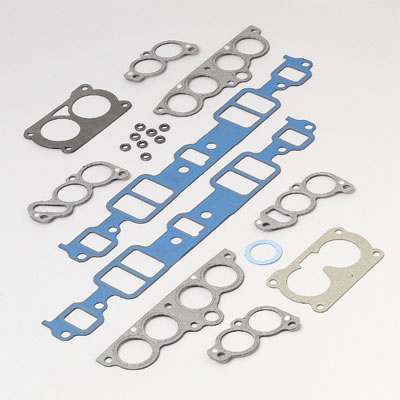

Are these the correct gaskets??

Thread Starter
Racer

Joined: Sep 2005
Posts: 449
Likes: 1
From: Victoria
 Are these the correct gaskets??
I have purchased a Small Block Chevy Intake Manifold set for TPI online and after reading the information contained in google search 'choosing TPI unit' It states that the intake manifold gaskets for the corvette are different than for other tpi's'?"
Can anyone confirm that this set is ok for my 89?
Purchased from Ebay seller bigsail720 (read feedback to view items as he has none listed at present)
Can anyone confirm that this set is ok for my 89?
Purchased from Ebay seller bigsail720 (read feedback to view items as he has none listed at present)

Safety Car


Joined: Jan 2004
Posts: 3,783
Likes: 15
From: Northern California
I bought this TPI Gasket set from Summit which had the Rear intake coolant passages blocked off like the Stock TPI gaskets.
Part #QMS93318 For Corvette 5.7 TPI

Part #QMS93318 For Corvette 5.7 TPI
Last edited by GKK; Feb 1, 2009 at 01:42 PM.

Le Mans Master


Joined: Dec 2000
Posts: 7,839
Likes: 22
From: San Diego, Ca
The Vette L98 uses restrictors on the rear of the manifold gaskets to provide additional cooling at the rear of the heads. The F-Body's do not. No problems have been posted when using the F-Body gaskets. The '91 L98 and current production 113 heads have counterbored bolt holes for gasket retainers to maintain intake gasket alignment. GM made this change to stop recurrent intake gasket leaks which led to glavanic corrosion and head gasket failure. Intake gaskets are offered for these heads with and without the restrictors, though finding the '91 Vette (with the restrictors) is getting more difficult since that production was a relatively small number. The rubber pieces for the rear and front of the manifold are strictly aftermarket pieces and there have been quite a few posts showing that they don't work - recommend you use silcone as outlined in the Shop Manual instead. Also, pitted surfaces on the coolant passageways may require a thin coating of silicon to keep them from leaking and if you've got signs of galvanic corrosion, you might want to check out the entire cooling system, cylinder #7 for head gasket leakage.

Race Director


Joined: Nov 2003
Posts: 12,221
Likes: 446
From: Overland Park Kansas
2020 Corvette of the Year Finalist (appearance mods)
C4 of Year Winner (appearance mods) 2019
You will find some Vette owners PREFER to install the non-Corvette gaskets. This thread provides add'l background. (Though it's not really needed after SunCr's thorough explanation.)
Thread Starter
Racer
Joined: Sep 2005
Posts: 449
Likes: 1
From: Victoria
The Vette L98 uses restrictors on the rear of the manifold gaskets to provide additional cooling at the rear of the heads. The F-Body's do not. No problems have been posted when using the F-Body gaskets. The '91 L98 and current production 113 heads have counterbored bolt holes for gasket retainers to maintain intake gasket alignment. GM made this change to stop recurrent intake gasket leaks which led to glavanic corrosion and head gasket failure. Intake gaskets are offered for these heads with and without the restrictors, though finding the '91 Vette (with the restrictors) is getting more difficult since that production was a relatively small number. The rubber pieces for the rear and front of the manifold are strictly aftermarket pieces and there have been quite a few posts showing that they don't work - recommend you use silcone as outlined in the Shop Manual instead. Also, pitted surfaces on the coolant passageways may require a thin coating of silicon to keep them from leaking and if you've got signs of galvanic corrosion, you might want to check out the entire cooling system, cylinder #7 for head gasket leakage.
Thanks All,and to SunCr for pointing out the useless rubber pieces,as I would have fitted these without thinking.

Last edited by Qiken; Feb 2, 2009 at 01:54 AM.

Safety Car
Joined: Oct 2008
Posts: 4,689
Likes: 4
From: Yucaipa CA
I have purchased a Small Block Chevy Intake Manifold set for TPI online and after reading the information contained in google search 'choosing TPI unit' It states that the intake manifold gaskets for the corvette are different than for other tpi's'?"
Can anyone confirm that this set is ok for my 89?
Purchased from Ebay seller bigsail720 (read feedback to view items as he has none listed at present)
Can anyone confirm that this set is ok for my 89?
Purchased from Ebay seller bigsail720 (read feedback to view items as he has none listed at present)
Corvette Stories
The Best of Corvette for Corvette Enthusiasts

Top 10 Most Explosive Corvettes Ever Made: Power-to-Weight Ratio Ranked!
Joe Kucinski
150 hp to 1,250 hp: Every Corvette Generation Compared by the Specs That Matter
Joe Kucinski
8 Coolest Corvette Pace Cars (and Replicas) of All Time
Verdad Gallardo
Top 10 Corvette Engines RANKED by Peak Torque (70+ Years of Muscle!)
Joe Kucinski
Corvette ZR1X Will Be Pacing the Indy 500, And Could Probably Race, Too!
Verdad Gallardo
Top 10 Corvettes Coming to Mecum Indy 2026!
Brett Foote
Top 10 C9 Corvette MUST-HAVES to Fix These C8 Generation Flaws!
Michael S. Palmer
10 Revolutionary 'Corvette Firsts' Most People Don't Know
Joe Kucinski
