






Cold Air Intake Test Results
Thread Starter
Melting Slicks

Joined: Aug 2003
Posts: 3,401
Likes: 397
From: Lakeville MI
 Cold Air Intake Test Results
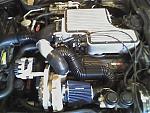
I finally had a chance to try out my Bf-109 inspired cold air intake/supercharger inlet.
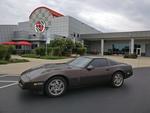
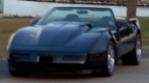
Here are a couple quick pics:


Results for 72 F ambient temperature:
Under cruise:
Blower discharge air temperature dropped by approx. 30 degrees F. From a typical value of 130F to 93-96F. .
.
Under Boost:
Blower discharge air temperature dropped by about 65 degrees F under boost. From typical peak value of 270 F to 205 F at 10 psi in 2nd gear. No knock retard or knock counts present with 26 degrees advance.
Stationary idle/low speed running:
Blower discharge air temperature stablized at approx. 100F. Typically this would approach 160-170 f for a sustained idle with the air cleaner mounted to the blower inlet.
The air cleaner will be relocated internally. This is only the first test, to determine feasibility and the impact on the charge air temperature.
Note: This was done with a $12 used ebay fender.
Here are a couple quick pics:
Results for 72 F ambient temperature:
Under cruise:
Blower discharge air temperature dropped by approx. 30 degrees F. From a typical value of 130F to 93-96F.
.Under Boost:
Blower discharge air temperature dropped by about 65 degrees F under boost. From typical peak value of 270 F to 205 F at 10 psi in 2nd gear. No knock retard or knock counts present with 26 degrees advance.
Stationary idle/low speed running:
Blower discharge air temperature stablized at approx. 100F. Typically this would approach 160-170 f for a sustained idle with the air cleaner mounted to the blower inlet.
The air cleaner will be relocated internally. This is only the first test, to determine feasibility and the impact on the charge air temperature.
Note: This was done with a $12 used ebay fender.

Le Mans Master

Joined: Feb 2005
Posts: 5,146
Likes: 3
From: The Motor City
Pat, the gain in lowered temps in huge!! My only critique would be trying to hide it a bit more. Can you get a 180* from the inlet to go out underneath the blower/power steering and then out in front of the tire where the c. canister is located (lower portion of the front bumper cover where it connects to inner fender)?
Le Mans Master

Joined: Sep 2006
Posts: 6,050
Likes: 147
From: Phoenix AZ
2021 C4 of the Year - Modified Finalist
I have been trying to figure out what car came with turn signals that are the same height as the corvettes' without the running lights part. That way, you can free up some space where the running lights go to make a dual inlet from both sides. an aluminum sheetmetal "funnel" on both sides painted black would look symmetrical, and would need a baffle to lose any rocks or leaves, etc. when the car is shut down. maybe even a screen with a small wire that has a finger ring to pull it out and shake it clear occasionally then slide it back in.....The screen could be left out for HP runs, then reinserted for normal driving. Using the holes for the turn signals/running lights would allow you to use the existing factory holes, and give you the option to go back to stock if the need arises.
um, that air filter would indicate too much tequila if you left it that way.
after studying your pics for a sec, If I had those holes cut in MY hood, I would find a K&N filter tht would fit in the square inlet under the hood, and on the top of the hood, make a low profile air inlet, and use teflon or soft seal, and bolt it through the louvers with long screws through the gaps of the louvers maybe with either many small diameter screws (for strength) or sheet metal "straps" that go through the louver slots and release with Zeuss fasteners (quick release) on the bottom of the hood.
um, that air filter would indicate too much tequila if you left it that way.
after studying your pics for a sec, If I had those holes cut in MY hood, I would find a K&N filter tht would fit in the square inlet under the hood, and on the top of the hood, make a low profile air inlet, and use teflon or soft seal, and bolt it through the louvers with long screws through the gaps of the louvers maybe with either many small diameter screws (for strength) or sheet metal "straps" that go through the louver slots and release with Zeuss fasteners (quick release) on the bottom of the hood.
Last edited by coupeguy2001; May 31, 2009 at 10:31 AM.

Racer

Joined: May 2009
Posts: 421
Likes: 2
From: van buren ar
i live in arkansas and one trip @ night and that filter would be plugged solid with insects.that has to be a track only car is the onlything i can figure.looks crazy as hell but those results speak for themself.GO GO SNORKLE CHARGER!!!!
Thread Starter
Melting Slicks
Joined: Aug 2003
Posts: 3,401
Likes: 397
From: Lakeville MI
SNORKLE CHARGER! I like it.
Thanks for the feedback.
Of course, the point of this exercise was to determine how much there is to be gained by feeding the supercharger with cooler air, and if the gains would justify a more sophisticated/practical/aestheticly pleasing/permanent solution.
With the blower in the picture, it was never clear to me how much air heating was actually due to the compressor vs drawing hot under hood air near the exhaust header.
Now I'm motivated to make something work, but I'm not yet willing to modify the hood.
I was going to run without a filter for the first test, but since I have about a mile of dirt road to negotiate before hitting the pavement, I needed some kind of filter.
Since my original filter was easy to fit and cleared the tire, I just left it on for the test drive, since I wasn't really concerned about building any ram pressure at this stage. I was also concerned about sucking in birds/bugs or other debris, so I figured the filter was a good thing to have, despite the appearance.
Its an easy swap to revert back to the normal fender arrangement, so this may wind up being reserved for track days.
I'll work on packaging the filter inside a housing just inside the fender and ducting to the blower. I have a coffee can that should do the trick. This should result in some ram pressure from the snorkel and hopefully minimize heat soak to the filter element and housing since they will be a good distance from the header.
Thanks for the feedback.
Of course, the point of this exercise was to determine how much there is to be gained by feeding the supercharger with cooler air, and if the gains would justify a more sophisticated/practical/aestheticly pleasing/permanent solution.
With the blower in the picture, it was never clear to me how much air heating was actually due to the compressor vs drawing hot under hood air near the exhaust header.
Now I'm motivated to make something work, but I'm not yet willing to modify the hood.
I was going to run without a filter for the first test, but since I have about a mile of dirt road to negotiate before hitting the pavement, I needed some kind of filter.
Since my original filter was easy to fit and cleared the tire, I just left it on for the test drive, since I wasn't really concerned about building any ram pressure at this stage. I was also concerned about sucking in birds/bugs or other debris, so I figured the filter was a good thing to have, despite the appearance.
Its an easy swap to revert back to the normal fender arrangement, so this may wind up being reserved for track days.
I'll work on packaging the filter inside a housing just inside the fender and ducting to the blower. I have a coffee can that should do the trick. This should result in some ram pressure from the snorkel and hopefully minimize heat soak to the filter element and housing since they will be a good distance from the header.

Race Director


Joined: Jun 2004
Posts: 13,963
Likes: 708
From: WI
Very nice drop in temps!
Could this work for air intake? Intake air instead of brake cooling:

The make different size and shape NACA ducts, they are around $20 and can be riveted in. glassed in, etc.
Could this work for air intake? Intake air instead of brake cooling:
The make different size and shape NACA ducts, they are around $20 and can be riveted in. glassed in, etc.
Corvette Stories
The Best of Corvette for Corvette Enthusiasts

Top 10 Most Expensive Corvettes Ever Sold on Bring A Trailer
Brett Foote
10 Things Every Corvette Owner Needs (2026 Edition)
Michael S. Palmer
8 Most "Only Corvette Owners Understand" Quirks and Problems
Pouria Savadkouei
10 Reasons the C6 Z06 is Still A Performance Benchmark After 20 Years
Joe Kucinski
How Much Horsepower Every Corvette Engine "LOST" in 1972
Joe Kucinski
Top 10 DOs and DON'Ts for Protecting Your Convertible Top!
Michael S. Palmer
Top 10 Most Explosive Corvettes Ever Made: Power-to-Weight Ratio Ranked!
Joe Kucinski
150 hp to 1,250 hp: Every Corvette Generation Compared by the Specs That Matter
Joe Kucinski
8 Coolest Corvette Pace Cars (and Replicas) of All Time
Verdad Gallardo
Racer
Joined: May 2009
Posts: 421
Likes: 2
From: van buren ar
I know there is a formula for intake charge temp drop vs horsepower gain,but i dont know what it is.maybe someone will chime in on that.i know that some forced induction guys use two iat's one before and one after the s/c to help maximize fuel and spark maps.my guess they use stand alone cpu set ups.ill be watching to see what you come up with for a final set up.i like to race and for the track id use it the way you got it now,and then swap back to street mode set up the rest of the time.


Pro

Joined: Jan 2009
Posts: 686
Likes: 4
From: Austin Texas
Nice work.
My 93 fenders are louvered and I've pondered cutting out the depressions and installing a tapezoidal funnel duct / collector over them on the inside of the fender for an air intake, but is remains only a thought.
My 93 fenders are louvered and I've pondered cutting out the depressions and installing a tapezoidal funnel duct / collector over them on the inside of the fender for an air intake, but is remains only a thought.
Thread Starter
Melting Slicks
Joined: Aug 2003
Posts: 3,401
Likes: 397
From: Lakeville MI
I pulled out the battery tray and the filter now fits inside the fender, just inward of the snorkel.
I Just have to work on the housing to enclose the filter and attach to the snorkel now for the full effect.
Update:
Filter is now enclosed internally and is isolated to the snorkel. An old golf bag cover with a 3 inch hole cut for the snorkel, a 3-4" pvc adaptor to form the coupling to the snorkel and prevent collapse of the bag and some zip ties to seal up around the duct with the air cleaner inside, a little like the improvised Apollo 13 CO2 scrubbers...
Went for a quick drive at tonight's 60 F ambient temp. Blower discharge air temps hovered between a cool 80 F and 86 F with the internal filter and bag arrangement. So it looks like a 20-25 degree rise over ambient is repeatable.
I Just have to work on the housing to enclose the filter and attach to the snorkel now for the full effect.
Update:
Filter is now enclosed internally and is isolated to the snorkel. An old golf bag cover with a 3 inch hole cut for the snorkel, a 3-4" pvc adaptor to form the coupling to the snorkel and prevent collapse of the bag and some zip ties to seal up around the duct with the air cleaner inside, a little like the improvised Apollo 13 CO2 scrubbers...
Went for a quick drive at tonight's 60 F ambient temp. Blower discharge air temps hovered between a cool 80 F and 86 F with the internal filter and bag arrangement. So it looks like a 20-25 degree rise over ambient is repeatable.
Last edited by tequilaboy; May 31, 2009 at 09:12 PM.
Pro
Joined: Jan 2009
Posts: 686
Likes: 4
From: Austin Texas
I pulled out the battery tray and the filter now fits inside the fender, just inward of the snorkel.
I Just have to work on the housing to enclose the filter and attach to the snorkel now for the full effect.
Update:
Filter is now enclosed internally and is isolated to the snorkel. An old golf bag cover with a 3 inch hole cut for the snorkel, a 3-4" pvc adaptor to form the coupling to the snorkel and prevent collapse of the bag and some zip ties to seal up around the duct with the air cleaner inside, a little like the improvised Apollo 13 CO2 scrubbers...
I Just have to work on the housing to enclose the filter and attach to the snorkel now for the full effect.
Update:
Filter is now enclosed internally and is isolated to the snorkel. An old golf bag cover with a 3 inch hole cut for the snorkel, a 3-4" pvc adaptor to form the coupling to the snorkel and prevent collapse of the bag and some zip ties to seal up around the duct with the air cleaner inside, a little like the improvised Apollo 13 CO2 scrubbers...
Did you relocate the battery ?
Thread Starter
Melting Slicks
Joined: Aug 2003
Posts: 3,401
Likes: 397
From: Lakeville MI
Yes,
The battery was relocated several years ago to the passenger side storage compartment to improve weight distribution.
Since this had already been done, it made this experiment much easier.
The battery was relocated several years ago to the passenger side storage compartment to improve weight distribution.
Since this had already been done, it made this experiment much easier.