




Dyno numbers

Former Vendor
Joined: Mar 2004
Posts: 1,518
Likes: 7
From: Valencia CA

Jonnymac,
I keep meaning to ask if the current dyno data is from the same facility you baselined it at 309 RWHP with all your bolt on mods??
If so, that lends alot of credibility to your current figures because those numbers certainly seem inline for a car with bolt ons if the engine was in good shape.
Also, the net gains from the H/C swap (over 100 HP) are more impressive knowing the before and after data was collected using the same dyno/test facility for both (the best/only way to really learn anything).
Thanks,
Tony
I keep meaning to ask if the current dyno data is from the same facility you baselined it at 309 RWHP with all your bolt on mods??
If so, that lends alot of credibility to your current figures because those numbers certainly seem inline for a car with bolt ons if the engine was in good shape.
Also, the net gains from the H/C swap (over 100 HP) are more impressive knowing the before and after data was collected using the same dyno/test facility for both (the best/only way to really learn anything).
Thanks,
Tony
Thread Starter
Melting Slicks


Joined: Oct 2005
Posts: 3,178
Likes: 5
From: Daleville Indiana
St. Jude Donor '08
Yes they are from the same dyno. I also found an old Dynojet run I did two months before that first run. I made 294hp and 309tq on an outdoor dyno (Back Street Performance)on a hot day 90+. The 309/339 run was done on a cold day with almost no humidity. Between runs I added "918" springs, TB coolant bypass, new plugs, wires and fuel filter.


Last edited by Jonnymac; Jun 8, 2009 at 08:43 PM. Reason: pics added
Former Vendor
Joined: Mar 2004
Posts: 1,518
Likes: 7
From: Valencia CA
Thanks for all that info...
Looking at your older dyno runs its pretty clear the biggest difference in power output was likely all due to air fuel ratio.....you're lower power pulls were clearly waay to lean to be optimal with the best run you made closer to the 12.3-13.0 these EFI cars typically like.
Glad to hear the recent test was on the same dyno....that backs my thoughts that your torque numbers are in line for a good heads cam package and all your horsepower is completely legit based on a function of much better breathing allowing the torque curve to hang on much farther before slowy dropping away. Look at all your pre-heads/cam runs.....the torque curve starts dropping much sooner and then falls off a cliff ultimately killing power. Similar to some of the weaker H/C cars as well....but those typically dont fall off quite as quickly.
Peak torque represents the RPM at which your engine has the ability to process the greatest amount of air (effected by everything from the aircleaner to the exhaust tips and everything in between). Cylinder heads represent the largest restriction in the pipeline (a fact most people overlook or simply dont realize).....hence the big power gains when you install a very high flowing efficient set of heads. Efficiency, btw, (mostly related to airspeed and CSA) just slightly less important than peak flow....both have a big role in the end results. The 1-2-3 punch of the Eliminator line is big flow at every liftpoint, lots of airspeed thru a conservative cross sectional area, and above average valve control with lightweight parts and premium lightweight springs and retainers.
Perhaps with more positive dyno and track results coming more people will think a little harder about some of the technical merits of these heads I have been trying to drive home (for the better part of 12 months), and not be as quick to dismiss what I have to say as "marketing" or "hype".
We might just be on to something here....
-Tony
Looking at your older dyno runs its pretty clear the biggest difference in power output was likely all due to air fuel ratio.....you're lower power pulls were clearly waay to lean to be optimal with the best run you made closer to the 12.3-13.0 these EFI cars typically like.
Glad to hear the recent test was on the same dyno....that backs my thoughts that your torque numbers are in line for a good heads cam package and all your horsepower is completely legit based on a function of much better breathing allowing the torque curve to hang on much farther before slowy dropping away. Look at all your pre-heads/cam runs.....the torque curve starts dropping much sooner and then falls off a cliff ultimately killing power. Similar to some of the weaker H/C cars as well....but those typically dont fall off quite as quickly.
Peak torque represents the RPM at which your engine has the ability to process the greatest amount of air (effected by everything from the aircleaner to the exhaust tips and everything in between). Cylinder heads represent the largest restriction in the pipeline (a fact most people overlook or simply dont realize).....hence the big power gains when you install a very high flowing efficient set of heads. Efficiency, btw, (mostly related to airspeed and CSA) just slightly less important than peak flow....both have a big role in the end results. The 1-2-3 punch of the Eliminator line is big flow at every liftpoint, lots of airspeed thru a conservative cross sectional area, and above average valve control with lightweight parts and premium lightweight springs and retainers.
Perhaps with more positive dyno and track results coming more people will think a little harder about some of the technical merits of these heads I have been trying to drive home (for the better part of 12 months), and not be as quick to dismiss what I have to say as "marketing" or "hype".
We might just be on to something here....
-Tony
Last edited by Tony Mamo @ AFR; Jun 9, 2009 at 12:00 AM.
Thread Starter
Melting Slicks
Joined: Oct 2005
Posts: 3,178
Likes: 5
From: Daleville Indiana
St. Jude Donor '08
Not to be a suck-azz but I just got my copy of GM high-tech. Congrats to Tony and AFR on winning the LT1 head shootout.
PS This free advertisement should be worth a set of 8019 springs.
PS This free advertisement should be worth a set of 8019 springs.
Former Vendor
Joined: Mar 2004
Posts: 1,518
Likes: 7
From: Valencia CA

Gotta love the automotive performance message boards....its the male soap opera of this millenium.....LOL
Seriously, sometimes its really entertaining and picking up a few things here and there never hurts as well.
I appreciate the heads up (on the test) and to be perfectly honest, we sent them those heads so long ago I completely forgot about the test and what it involved (these types of things generally take a long time to actually really pan out....especially with all the budget cuts in the automotive publishing industry).
Anyway, I need to pick up a copy to see the results for myself
Get the bigger fuel pump installed and swap those springs (or shim your standard versions) and go rock a bigger number on the dyno.
If your contemplating swapping to the 8019's, call me and let me see what I can work out for you....but getting back to the dyno is a must!
Later,
Tony

Safety Car


Joined: Sep 2000
Posts: 3,524
Likes: 4
From: Hinckley Ohio
 Very interesting statement I never heard before...got me thinking
The engine would certainly flow more air at higher rpms, but you say process not flow.......but then you say the greatest amount of air which sounds like flow????
So are you saying the peak torque rpm is when the engine reaches its maximum efficiency??
Trying to understand the full significance of what you are saying??

Former Vendor
Joined: Mar 2004
Posts: 1,518
Likes: 7
From: Valencia CA
Very interesting statement I never heard before...got me thinkingThe engine would certainly flow more air at higher rpms, but you say process not flow.......but then you say the greatest amount of air which sounds like flow????
So are you saying the peak torque rpm is when the engine reaches its maximum efficiency??
Trying to understand the full significance of what you are saying??
At peak TQ an engine is at its most efficient RPM which is usually noted on dyno sheets as "VE" for volumetric efficiency. That number should be the highest right at peak TQ although occasionally I have seen it the highest 100 or so RPM's away (with a torque figure within a single digit or two away from peak). That could be just the way the dyno is datalogging/processing the info because in theory, peak torque will always represent the engine's highest level of efficiency and it's ability to best fill (and evacuate) it's cylinders at that particular RPM based on the combination.
A good cylinder head/combination that enables alot of HP (which simply means the engines ability to maintain good torque figures at higher RPM's) is one that can better feed that engine past peak torque and keep its cylinder filling abilities high in spite of the fact there is much less time to do so. At higher RPM every intake and exhaust event happens much faster making it more difficult to get air into and out of the engine. As your torque curve starts rolling over, even though your pistons and valves are moving faster, less air is actually entering and exiting the engine on every cycle and on top of that internal friction losses and losses from windage (internal oil control) are moving much higher as well. Better management of both of those situations (via trick oil pans, dry sumps, custom pistons with thinner ring packs) can help and make a big difference on power because the torque curve wont plummet as fast from those mounting losses which are not just increasing in a linear fashion with RPM....more of a square of RPM.
Dont forget guys.....engines only make torque and torque is what the dyno is measuring. Horsepower doesnt really exist.....its only a mathematical derivative of torque and RPM. Thats why I felt the OP's numbers were inline....his torque figures were not so out of place, the key to his success in the power department is his engine now has much better breathing abilities with the new heads and cam so his torque curve didnt roll over as fast (bringing in the bigger power figures) as other dyno results you might be accustomed to seeing.
Look for continued results with these new heads that set the bar a few wrungs higher. I have flowed a handful of the cylinder heads you guys have been swearing by and using and trust me there is a bigger gap here in flow performance and efficiency than most of you realize. The frustrating thing for me is I have known this all along but have been labeled by some as just a guy trying to peddle another product (that might provide you with potentially similar results to what you were accustomed to seeing or marginally better). I guess the reality is alot of performance products dont quite deliver on what they promise and its easier to shoot first and ask questions later....LOL
Anyway...looking forward to more results. Perhaps some of you guys might have a glass half full approach to seeing them now.

-Tony
PS....When flowing some of these ported stockers (and ported aftermarket castings as well), while the intake numbers are obviously softer than a similar sized clean sheet design AFR Elim head, I have noticed the exhaust flow is really down a bunch (20-30 CFM's as early as .300 lift). Exhaust flow is critical to high RPM power and can really have an effect on how quickly the torque curve rolls over. One of the reasons the AFR dyno data looks so good upstairs is the exhaust port of the new Elims is especially good (better actually than we even advertise). Once you cant properly evacuate the cylinder and make room for another fresh intake charge your going nowhere fast and power will start falling off quickly. To quote an accurate cliche, an engine is simply an air pump and an efficient air pump capable of processing more air in and more air out will generate alot more power.
Last edited by Tony Mamo @ AFR; Jun 9, 2009 at 03:25 PM.
Corvette Stories
The Best of Corvette for Corvette Enthusiasts

Every 2027 Corvette Engine Explained
Joe Kucinski
Designer Imagines A Corvette That Looks More Like a Corvette Than the Corvette
Verdad Gallardo
10 Ugly Corvettes That We Still Kinda Love
Joe Kucinski
Top 10 Most Expensive Corvettes Ever Sold on Bring A Trailer
Brett Foote
10 Things Every Corvette Owner Needs (2026 Edition)
Michael S. Palmer
8 Most "Only Corvette Owners Understand" Quirks and Problems
Pouria Savadkouei
10 Reasons the C6 Z06 is Still A Performance Benchmark After 20 Years
Joe Kucinski
How Much Horsepower Every Corvette Engine "LOST" in 1972
Joe Kucinski
Top 10 DOs and DON'Ts for Protecting Your Convertible Top!
Michael S. Palmer
Drifting


Joined: Oct 2006
Posts: 1,328
Likes: 14
From: Stafford Connecticut
I would be very interested in your dyno comparisons of your AFR'S and the Dart Pro 1 Platinums.I am in the market for a set of 195 cfm heads for a 400 small block build.I am on a budget but also don't want to be penny wise pound foolish.When can we expect your results?Thanks

Former Vendor
Joined: Mar 2004
Posts: 1,518
Likes: 7
From: Valencia CA
I would be very interested in your dyno comparisons of your AFR'S and the Dart Pro 1 Platinums.I am in the market for a set of 195 cfm heads for a 400 small block build.I am on a budget but also don't want to be penny wise pound foolish.When can we expect your results?Thanks
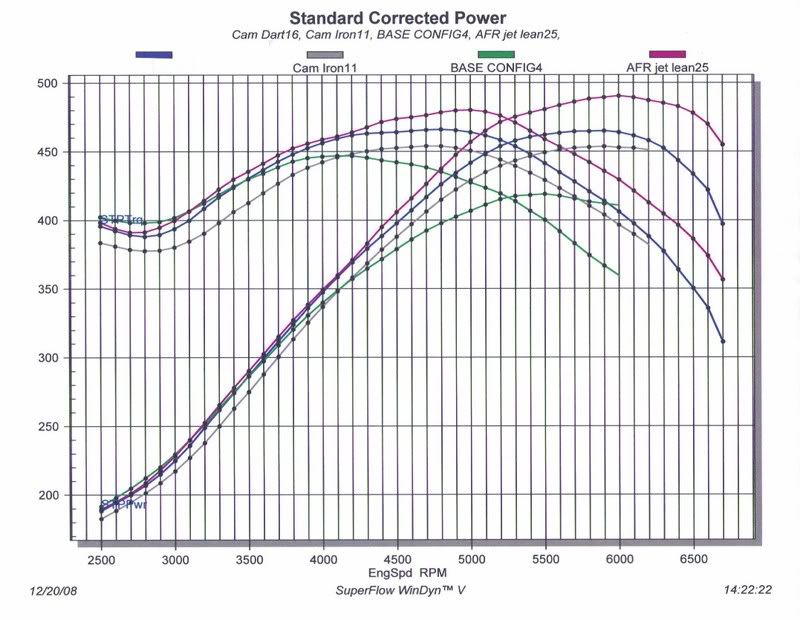
Tested along with a heavily ported set of OEM camel humps as well (which also produced respectable results). The customer was local in the So Cal area and I flowed all three heads and attended the dyno as well. The compression was the same on all three btw....actually tell a lie, the camel humps had a half a point or so more so a slight advantage there.
The platinum series 200 cc Darts were 10 better than the ported GM heads....the 195 cc AFR street heads (not the Comp's) 25HP better than the Darts
http://www.corvette-guru.com/modules...d=6558&start=0
For those too lazy to do alot of reading here is the overlays below (engine dyno numbers btw). The lowest results displayed in the gragh (green line) represent the camel hump head with an old school flat tappet solid. The next best run (gray line) is just from swapping to a modern extreme energy hyd roller cam which surprised everyone quite a bit (big jump in power). The Dart swap next (blue line) and the AFR swap (purple) representing the best results seen here. Note the huge area under the curve gains from the AFR curve as well....not just a little more peak power....the entire curve was enhanced with the 195 AFR's. Also, note the power gains past peak....60 HP delta where you would be shifting the AFR headed combination. That makes for a huge increase in average power....one that would have a big impact on street and track performance out in the real world.
-Tony
Last edited by Tony Mamo @ AFR; Jun 9, 2009 at 05:34 PM.




Team Owner


Joined: Nov 1999
Posts: 32,782
Likes: 11
From: Former NCM Drag Racing coordinator, National director Corvette Challenge Spring Hill, Tennessee: Whiting, New Jersey
Cruise-In VI Veteran
Cruise-In VII Veteran
Thread Starter
Melting Slicks
Joined: Oct 2005
Posts: 3,178
Likes: 5
From: Daleville Indiana
St. Jude Donor '08
Le Mans Master

Joined: Jul 2000
Posts: 5,012
Likes: 5
From: OKC OK
Actually, you (we) should look at MPH instead of ET. But, really some SAE corrected dynojet #s would be best to compare. Also, just to clear the air, I'm a big AFR fan, and I hope that these numbers jive with other mainstream dynos. I have just seen larger numbers come from this type dyno, and from my many years of looking at LTx heads/cam setups these #s don't really coincide with what I've seen.


