


1984 Corvette Crossfire Problems. Need help!

Thread Starter
Instructor


Joined: Aug 2009
Posts: 149
Likes: 1
 1984 Corvette Crossfire Problems. Need help!
I have a 1984 Corvette that I just bought about 3 weeks ago for a daily driver. The car has 88000 and is in decent shape. The problem with it is it gets too much gas. Once you get up over 30 mph it smooths out and when you are doing 60 mph or more it runs great. The worst time is at a cold start. You can watch the injectors and, what I am told is the gas should be coming out as a mist, but mine just dumps the gas out. I thought it might be the injectors and spent nearly $300 on two new ones, put them in and everything is exactly the same. Still dumping the gas out.
Does anyone out there have a remedy for this? I realize the crossfire is sort of a mystery to most people, and I really don't want to cover the expense of converting it over to a carb. I like to just keep the crossfire, but have to figure out how to make it run correctly. Open to any ideas from people that may have suffered the same problems. I have owned an 84 before and never had any problems with it, and it actually got good gas mileage too. Want this one to run the same. Hope somebody out there can help me out!
Does anyone out there have a remedy for this? I realize the crossfire is sort of a mystery to most people, and I really don't want to cover the expense of converting it over to a carb. I like to just keep the crossfire, but have to figure out how to make it run correctly. Open to any ideas from people that may have suffered the same problems. I have owned an 84 before and never had any problems with it, and it actually got good gas mileage too. Want this one to run the same. Hope somebody out there can help me out!

Race Director


Joined: Dec 2000
Posts: 17,551
Likes: 26
From: El Paso Texas
Hi Hugh, and welcome to the forum. The Crossfire is just a simple twin TBI system....nothing mysterious about it.
First question....are you getting a check engine light, and if so, have you checked for DTC's (diagnostic trouble codes) stored in the computer? There are a couple of things that will cause what you're experiencing.
The first thing I would like you to check for is a vacuum leak. This will introduce "false air" into the engine, which the ECM will compensate for with....you guessed it, additional fuel. Check all of your rubber lines and if in question, replace. Next, mount a vacuum gauge on an intake port and post how many inches of vacuum you have at idle.
Secondarily, we need to know if your Throttle position sensor is adjusted and functioning correctly, and if the O2 sensor is doing the same. Do you have the factory service manual for your car? The procedure for setting the TPS is in there, and if you don't have the manual, we can walk you through the procedure. Your MAP sensor needs to be tested as well.
Do you have a high idle as well? A malfunctioning IAC motor can cause too much air to enter the engine at low RPM as well.
I'm also curious what your fuel pressure is. The crossfire should have between 9-13 psi....if it's too much higher than 13, it can cause a rich condition at low rpm. A clogged regulator or pinched return line could cause this. Checking fuel pressure on a CFI isn't fun....I took my crossover tube between the TBI's to a hose and tube shop and had them mount a port on it to test pressure with. You can also run a T fitting just past the fuel filter to test with, but it's a PITA.
Soooo....time to start troubleshooting. If tuned correctly, the Crossfire should get you about 26 mpg on the highway and around 19 in town. Let us know what you find out.
First question....are you getting a check engine light, and if so, have you checked for DTC's (diagnostic trouble codes) stored in the computer? There are a couple of things that will cause what you're experiencing.
The first thing I would like you to check for is a vacuum leak. This will introduce "false air" into the engine, which the ECM will compensate for with....you guessed it, additional fuel. Check all of your rubber lines and if in question, replace. Next, mount a vacuum gauge on an intake port and post how many inches of vacuum you have at idle.
Secondarily, we need to know if your Throttle position sensor is adjusted and functioning correctly, and if the O2 sensor is doing the same. Do you have the factory service manual for your car? The procedure for setting the TPS is in there, and if you don't have the manual, we can walk you through the procedure. Your MAP sensor needs to be tested as well.
Do you have a high idle as well? A malfunctioning IAC motor can cause too much air to enter the engine at low RPM as well.
I'm also curious what your fuel pressure is. The crossfire should have between 9-13 psi....if it's too much higher than 13, it can cause a rich condition at low rpm. A clogged regulator or pinched return line could cause this. Checking fuel pressure on a CFI isn't fun....I took my crossover tube between the TBI's to a hose and tube shop and had them mount a port on it to test pressure with. You can also run a T fitting just past the fuel filter to test with, but it's a PITA.
Soooo....time to start troubleshooting. If tuned correctly, the Crossfire should get you about 26 mpg on the highway and around 19 in town. Let us know what you find out.
Thread Starter
Instructor
Joined: Aug 2009
Posts: 149
Likes: 1
I do not have a check engine light coming on.
How do you go about checking the DTCs?
It doesn't idle high, sometimes it actually dies from flooding out.
I guess the easiest thing to do at this point is to check the vacuum lines. I did notice that there was a plastic tube coming off the back of each port with a screw in it, as if they were cut off and plugged up. Not sure what that was all about but it appears that someone cut off and plugged the smog control.
How do you go about checking the DTCs?
It doesn't idle high, sometimes it actually dies from flooding out.
I guess the easiest thing to do at this point is to check the vacuum lines. I did notice that there was a plastic tube coming off the back of each port with a screw in it, as if they were cut off and plugged up. Not sure what that was all about but it appears that someone cut off and plugged the smog control.
Race Director
Joined: Dec 2000
Posts: 17,551
Likes: 26
From: El Paso Texas
On the ALDL, with the key OFF you can insert a jumper wire or paper clip between terminals A and B. Now turn the key to the ON position but do not start the car.
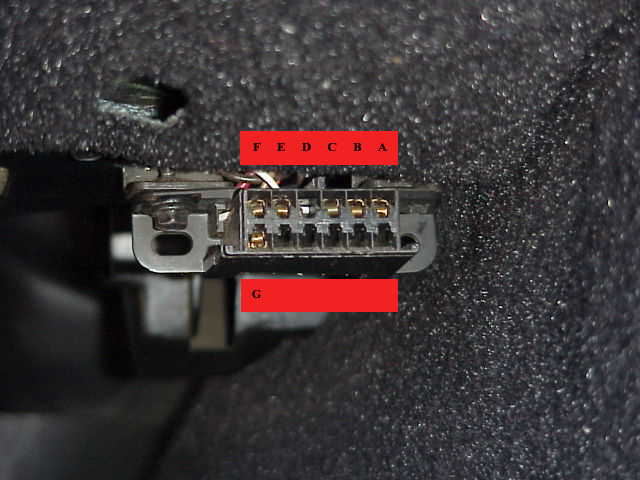
The check engine light should flash out three "12" codes to let you know the system is operational.
A "12" code is a single flash, pause, followed by two flashes....ie....flash, pause, flash flash. There will be a long pause between each "12" code.
If any codes are stored, the system will flash out the three initial "12" codes followed by whatever code(s) is/are stored, and then three more 12 codes. Let's say for example you had a "32" code stored. When you retrieved your codes, you would get the following;
Your three "12" codes, followed by flash flash flash, pause, flash flash. This 32 code would happen 3 times, followed by three more "12" codes. If additional codes are stored, they would flash out between the "12" sequences.
Here's a web site that spells it out a lot better than I do...
http://www.freeautomechanic.com/diag...blecodes5.html
Hope this helps....
I strongly suspect you have a substantial vacuum leak somewhere which is causing your overly rich condition at low rpm. This is tricking the MAP sensor to richen things up....or the MAP sensor itself may be faulty. Let's see what the ECM thinks, and then do some more troubleshooting.
The check engine light should flash out three "12" codes to let you know the system is operational.
A "12" code is a single flash, pause, followed by two flashes....ie....flash, pause, flash flash. There will be a long pause between each "12" code.
If any codes are stored, the system will flash out the three initial "12" codes followed by whatever code(s) is/are stored, and then three more 12 codes. Let's say for example you had a "32" code stored. When you retrieved your codes, you would get the following;
Your three "12" codes, followed by flash flash flash, pause, flash flash. This 32 code would happen 3 times, followed by three more "12" codes. If additional codes are stored, they would flash out between the "12" sequences.
Here's a web site that spells it out a lot better than I do...
http://www.freeautomechanic.com/diag...blecodes5.html
Hope this helps....
I strongly suspect you have a substantial vacuum leak somewhere which is causing your overly rich condition at low rpm. This is tricking the MAP sensor to richen things up....or the MAP sensor itself may be faulty. Let's see what the ECM thinks, and then do some more troubleshooting.
Thread Starter
Instructor
Joined: Aug 2009
Posts: 149
Likes: 1
Okay, I think I did find one leak. The hose looked good but if I sprayed carb cleaner around it the engine would rev up. I replaced that hose and the stream looks better. The problem I have is on the back of each throttle body there is one vacuum line that someone obviously plugged off. Not sure where they would have gone. On the rear one I have a main vacuum, a capped vacuum and then one someone plugged off with a screw. On the front one I have one going to what I believe is the cruise control, one capped on and another plugged off by someone with a screw. Do you know where I can get a vacuum diagram for an 84? I can't find one anywhere.
Also, I did the test you suggested and the computer only flashed 12 over and over. I did have the battery unhooked when I replaced the injectors the day before so I probably cleared out any codes (if there were any) since it was unhooked for a couple hours.
I have tightened down the throttle bodies and I don't see any other leaks, although the line going to the cruise control is a series of small lines linked into bigger ones... looks kind of problematic but I don't see any leaking from it.
If you have access to a vacuum diagram that would be great. I have no vacuum lines going to the air cleaner, and I know at least one should be going to it, but I don't know where it would be coming from.
Thanks for your help. It is already better than it was.
Also, I did the test you suggested and the computer only flashed 12 over and over. I did have the battery unhooked when I replaced the injectors the day before so I probably cleared out any codes (if there were any) since it was unhooked for a couple hours.
I have tightened down the throttle bodies and I don't see any other leaks, although the line going to the cruise control is a series of small lines linked into bigger ones... looks kind of problematic but I don't see any leaking from it.
If you have access to a vacuum diagram that would be great. I have no vacuum lines going to the air cleaner, and I know at least one should be going to it, but I don't know where it would be coming from.
Thanks for your help. It is already better than it was.
Race Director
Joined: Dec 2000
Posts: 17,551
Likes: 26
From: El Paso Texas
I have the factory service manual and will get them for you....but it will be Tuesday afternoon before I get a chance to post it (weird work schedule). Someone else may chime in before then.
You're onto something with the vacuum lines. Have you put a vacuum gauge on it yet to see how much vacuum you have at idle? I suspect it's going to be low. If you have one leaky line, I'm betting there are others.
You're onto something with the vacuum lines. Have you put a vacuum gauge on it yet to see how much vacuum you have at idle? I suspect it's going to be low. If you have one leaky line, I'm betting there are others.
Thread Starter
Instructor
Joined: Aug 2009
Posts: 149
Likes: 1
Took it for a drive and it is better but still getting too much gas at low speeds. Not bogging down as much as it did but still not right. If I have the vacuum diagram I might just replace all the lines and (hopefully) rehook up the ones that are not going where they are supposed to go.
There is definitely a difference in the way the fuel is coming out the injectors. It originally came out in gushes and now it is more of a spray. I think it it is supposed to be more of a mist... but not sure. But I know it is getting too much gas by just the way it running and smells.
I have the service manual on PDF, but I can't find a vacuum diagram in it anywhere. It might not be complete.
There is definitely a difference in the way the fuel is coming out the injectors. It originally came out in gushes and now it is more of a spray. I think it it is supposed to be more of a mist... but not sure. But I know it is getting too much gas by just the way it running and smells.
I have the service manual on PDF, but I can't find a vacuum diagram in it anywhere. It might not be complete.

Le Mans Master

Joined: May 2006
Posts: 9,226
Likes: 9
From: Irvine Ca
hugh, The First thing.....the very first thing would be to buy a $20 O2 Sensor and pop it on.
Incorrect feedback from that one single sensor would account for a lot of things that could go wrong with the CPU. The CPU can only react to what feedback it is getting. Trash in, Trash out........Good O2 sensor = Good input.
The '84 only has one O2 sensor on the Driver side...it may even have come unplugged.
Incorrect feedback from that one single sensor would account for a lot of things that could go wrong with the CPU. The CPU can only react to what feedback it is getting. Trash in, Trash out........Good O2 sensor = Good input.
The '84 only has one O2 sensor on the Driver side...it may even have come unplugged.
Last edited by jhammons01; Sep 1, 2009 at 09:54 AM.
Corvette Stories
The Best of Corvette for Corvette Enthusiasts

Every 2027 Corvette Engine Explained
Joe Kucinski
Designer Imagines A Corvette That Looks More Like a Corvette Than the Corvette
Verdad Gallardo
10 Ugly Corvettes That We Still Kinda Love
Joe Kucinski
Top 10 Most Expensive Corvettes Ever Sold on Bring A Trailer
Brett Foote
10 Things Every Corvette Owner Needs (2026 Edition)
Michael S. Palmer
8 Most "Only Corvette Owners Understand" Quirks and Problems
Pouria Savadkouei
10 Reasons the C6 Z06 is Still A Performance Benchmark After 20 Years
Joe Kucinski
How Much Horsepower Every Corvette Engine "LOST" in 1972
Joe Kucinski
Top 10 DOs and DON'Ts for Protecting Your Convertible Top!
Michael S. Palmer
Thread Starter
Instructor
Joined: Aug 2009
Posts: 149
Likes: 1
Do you have any diagrams where this sensor should be? This engine has obviously been taken out and put back in because there are a lot of things not original.
I figured out where lines I found plugged off on the back of each TBI go. The rear one goes to the air cleaner to operate the vacuum motors on the vents to let air in... they were disconnected. The other gos to a Air Management Valve, which I cannot find anywhere on the car. Unless this is another item that is supposed to be on the air cleaner? I called the parts store and they could only get a idle control valve... once again, not sure how that fits into the whole scheme of things.
There is another 1/2 inch round pipe that goes on each side of the exhaust manifolds, each one goes into a rubber hose that is plugged off. I was assuming that was once some kind of smog control...
After connecting the air cleaner to open and close the side vents, I unhooked the battery for a couple hours to clear out the computer. When I first started it was missing out and back firing a lot but by the time I got home (15 mile ride) it quit backfiring and was actually idling okay. I could even take off slowly without hesitation (before it would bog down with gas). It still has a slight miss and I smell some exhaust or something that I didn't smell before. It is obviously not fixed but it gets a little better with each new discovery. I am still confused as to why anyone would disconnect all of this stuff... it obviously severed no purpose for the good.
If anyone has a picture of their 84 crossfire with the air cleaner plate off, that would be helpful. I need to find an original 84 where everything is still intact to see how things are supposed to be.
Thanks for everyone's help.
I figured out where lines I found plugged off on the back of each TBI go. The rear one goes to the air cleaner to operate the vacuum motors on the vents to let air in... they were disconnected. The other gos to a Air Management Valve, which I cannot find anywhere on the car. Unless this is another item that is supposed to be on the air cleaner? I called the parts store and they could only get a idle control valve... once again, not sure how that fits into the whole scheme of things.
There is another 1/2 inch round pipe that goes on each side of the exhaust manifolds, each one goes into a rubber hose that is plugged off. I was assuming that was once some kind of smog control...
After connecting the air cleaner to open and close the side vents, I unhooked the battery for a couple hours to clear out the computer. When I first started it was missing out and back firing a lot but by the time I got home (15 mile ride) it quit backfiring and was actually idling okay. I could even take off slowly without hesitation (before it would bog down with gas). It still has a slight miss and I smell some exhaust or something that I didn't smell before. It is obviously not fixed but it gets a little better with each new discovery. I am still confused as to why anyone would disconnect all of this stuff... it obviously severed no purpose for the good.
If anyone has a picture of their 84 crossfire with the air cleaner plate off, that would be helpful. I need to find an original 84 where everything is still intact to see how things are supposed to be.
Thanks for everyone's help.
Race Director
Joined: Dec 2000
Posts: 17,551
Likes: 26
From: El Paso Texas
I figured out where lines I found plugged off on the back of each TBI go. The rear one goes to the air cleaner to operate the vacuum motors on the vents to let air in... they were disconnected. The other gos to a Air Management Valve, which I cannot find anywhere on the car. Unless this is another item that is supposed to be on the air cleaner?
Thread Starter
Instructor
Joined: Aug 2009
Posts: 149
Likes: 1
There is no diagram but I did get access to one. Attached is the photo. As you can see the TBI where the lines run. I have everyone hooked up now except for the one going to a AIR MGMT VALVE. There is no valve in the location they are showing and I cannot find anything remotely like it anywhere else. I wondered if it wasn't something that was actually mounted to the air cleaner as right now I have only one vacuum line running to the cleaner and I believe there should be more. Here is a link to the diagram (since I can't seem to figure out how to insert it right here):
http://www.bmoviemall.com/Images/corvette/vacuum.html
http://www.bmoviemall.com/Images/corvette/vacuum.html
Race Director
Joined: Dec 2000
Posts: 17,551
Likes: 26
From: El Paso Texas
I believe that is on the smog pump. I will verify on my car and edit....
[edit]
OK, here's a pic of the Air Management Valve with it's location and the location of the vacuum fitting circled.

If you need me to check where it hooks onto the intake, let me know and I will pull my air cleaner assembly off and take another pic. Hope this helps.
[edit]
OK, here's a pic of the Air Management Valve with it's location and the location of the vacuum fitting circled.
If you need me to check where it hooks onto the intake, let me know and I will pull my air cleaner assembly off and take another pic. Hope this helps.
Last edited by Frizlefrak; Sep 2, 2009 at 01:03 AM. Reason: add pic
Race Director
Joined: Dec 2000
Posts: 17,551
Likes: 26
From: El Paso Texas
Both doors operate from that one vacuum source. There are lines on the air cleaner assembly that connect the two doors. When you start the car cold, both doors should shut, which makes the engine draw air from around the exhaust manifold which aids in rapid warm up. Once the engine warms up, the drivers side flap opens and draws air through the hood, and the passenger side remains shut. The passenger side flap only opens at wide open throttle when vacuum falls to near zero.
If nobody beats me to it, I will take some pics of my air cleaner assembly off tomorrow.
Last edited by Frizlefrak; Sep 2, 2009 at 01:11 AM.
Thread Starter
Instructor
Joined: Aug 2009
Posts: 149
Likes: 1
Thanks. Yes, that is completely missing from my car. The piece you have circled is gone and the pipe it sits on has a rubber hose connected to it and it is capped off. It is capped off on the other end too. Obviously they removed the smog stuff, hope it is not necessary to have for it to run right.
Thread Starter
Instructor
Joined: Aug 2009
Posts: 149
Likes: 1
I have the hose connected that you were talking about. The air cleaner has a hole in the bottom that I think the oil breather connects to, and another hole on the back side where there is nothing. Not sure what the guy did who had this before me but he really seemed to like to disconnect things and get rid of them. Thanks for you help.
Burning Brakes

Joined: Jan 2008
Posts: 1,187
Likes: 1
From: Superior WI

From the Driver's side:

From the Passenger side:

Good luck getting everything sorted out

Thread Starter
Instructor
Joined: Aug 2009
Posts: 149
Likes: 1
Thanks for the photos. Yes, I am definitely missing the Air Management Valve. Everything else looks the same on mine. Not sure if this would cause my problems or not. Right now the engine runs like crap until I have driven it a good 10 miles or more and then it is hit and miss. It will pop and backfire when you first start it. Once you get over 30 mph it smooths out and if you get over 60 it runs fine. Usually after driving it a while it will start idling and running okay, but today it was still missing out some after running it a while. Very frustrating. I think this weekend I am going to replace every vacuum line and see if that makes any difference. It is very frustrating. If anyone has any suggestions I am all ears. It has brand new injectors and filter, so that can't be the problem.
Race Director
Joined: Dec 2000
Posts: 17,551
Likes: 26
From: El Paso Texas
My next suggestion is to test the EGR valve. Here's a thread on it.
http://forums.corvetteforum.com/c4-g...egr-valve.html
Thread Starter
Instructor
Joined: Aug 2009
Posts: 149
Likes: 1
Well, after changing injectors, fuel filter and practically every vacuum line I can find, the car runs worse than it did before. I guess I will try the egr valve, even though this is going to be another $80 or more! The vacuum lines running from the back of the throttle bodies are both plugged off. One goes to the air filter to open and close the vents, when connected only one side opens and closes, the other just stay open. Car runs worse when this is connected. The other goes to the air management valve, which is completely gone. I assume this is some smog control deal and not needed, but don't really know. I wll try a new egr and let everyone knows what happens in case any one else is trying to solve a similar problem. Right now the car is hard to start and then idles really rough and even pops and backfires some when driving slow. Once you get over 40 mph it smooths out some, over 60 mph it runs pretty good. After it is driven a while it will idle but is still rough and will will bog down in slow take offs.
Thanks for everyone's help so far.
Thanks for everyone's help so far.
