





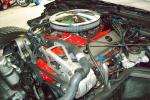



Crossfire fuel line

Thread Starter
Heel & Toe

Joined: Jun 2010
Posts: 19
Likes: 0
From: Bloomington Minnesota
 Crossfire fuel line
Okay, trying to figure out what the problem is with my 84 corvette and not starting/running. So far replaced old gas, had injectors serviced by FIC and replaced fuel filter.
Today I was going to remove the fuel line at the front throttle body to check pressure and flow. Pickup a 5/8" line wrench and went to work. The 5/8" nut is threaded into a 3/4"brass fitting that is then threaded into the TB. I cannot get the 5/8" fitting loose in face I started to flatten it out before stopping. At first I thought it was turning, wrong.
Any suggestions would be much appreciated.
Thanks, Al
Today I was going to remove the fuel line at the front throttle body to check pressure and flow. Pickup a 5/8" line wrench and went to work. The 5/8" nut is threaded into a 3/4"brass fitting that is then threaded into the TB. I cannot get the 5/8" fitting loose in face I started to flatten it out before stopping. At first I thought it was turning, wrong.
Any suggestions would be much appreciated.
Thanks, Al
Thread Starter
Heel & Toe
Joined: Jun 2010
Posts: 19
Likes: 0
From: Bloomington Minnesota

Team Owner


Joined: Aug 2004
Posts: 21,543
Likes: 3,216
From: Park City Utah
I think he already has a line wrench.
The guy that gave the "tapping w/hammer" advice was good advice...as was the vice grips on the line wrench. IMO, line wrenches are a joke. I've always had better luck w/a good open end than a good line wrench. I had MAC tools Line wrenches and they were garbage. Threw them away.
Another thing that works is a modest amount of heat from a propane torch. Use common sense and reason here; it's a fuel line. Heat quick, get flame away, break nut loose fast.
Next question I have is: Why are you trying to loosen that nut? I thought you were checking fuel pressure?
The guy that gave the "tapping w/hammer" advice was good advice...as was the vice grips on the line wrench. IMO, line wrenches are a joke. I've always had better luck w/a good open end than a good line wrench. I had MAC tools Line wrenches and they were garbage. Threw them away.
Another thing that works is a modest amount of heat from a propane torch. Use common sense and reason here; it's a fuel line. Heat quick, get flame away, break nut loose fast.
Next question I have is: Why are you trying to loosen that nut? I thought you were checking fuel pressure?
Last edited by Tom400CFI; Jul 8, 2010 at 09:23 PM.
Thread Starter
Heel & Toe
Joined: Jun 2010
Posts: 19
Likes: 0
From: Bloomington Minnesota
I think he already has a line wrench
Another thing that works is a modest amount of heat from a propane torch. Use common sense and reason here; it's a fuel line. Heat quick, get flame away, break nut loose fast.
Next question I have is: Why are you trying to loosen that nut? I thought you were checking fuel pressure?
Another thing that works is a modest amount of heat from a propane torch. Use common sense and reason here; it's a fuel line. Heat quick, get flame away, break nut loose fast.
Next question I have is: Why are you trying to loosen that nut? I thought you were checking fuel pressure?
So far I have drained the old gas, replaced the fuel filter and had the injectors service.
If the problem isn't fuel pump or sock. Next step will be tearing into the throttle bodies.
Did go out and tried the hammer trick, no joy. Maybe like someone said have to tap on it longer. Also thought about some anti-seize spray.
Al
Corvette Stories
The Best of Corvette for Corvette Enthusiasts

Top 10 Most Expensive Corvettes Ever Sold on Bring A Trailer
Brett Foote
10 Things Every Corvette Owner Needs (2026 Edition)
Michael S. Palmer
8 Most "Only Corvette Owners Understand" Quirks and Problems
Pouria Savadkouei
10 Reasons the C6 Z06 is Still A Performance Benchmark After 20 Years
Joe Kucinski
How Much Horsepower Every Corvette Engine "LOST" in 1972
Joe Kucinski
Top 10 DOs and DON'Ts for Protecting Your Convertible Top!
Michael S. Palmer
Top 10 Most Explosive Corvettes Ever Made: Power-to-Weight Ratio Ranked!
Joe Kucinski
150 hp to 1,250 hp: Every Corvette Generation Compared by the Specs That Matter
Joe Kucinski
8 Coolest Corvette Pace Cars (and Replicas) of All Time
Verdad Gallardo
Team Owner
Joined: Aug 2004
Posts: 21,543
Likes: 3,216
From: Park City Utah
Better yet, avoid taking it apart for now. Follow that hard line down to where it meets the black rubber hose. Un-clamp that hose, and "T" in to the fuel feed line at that point. Easy, quick and cheap.
Thread Starter
Heel & Toe
Joined: Jun 2010
Posts: 19
Likes: 0
From: Bloomington Minnesota
The whole heat thing on the gas line makes me nervous I must say

Al

Thread Starter
Heel & Toe
Joined: Jun 2010
Posts: 19
Likes: 0
From: Bloomington Minnesota
Al
Team Owner
Joined: Aug 2004
Posts: 21,543
Likes: 3,216
From: Park City Utah
A lot of them are...but that ain't true. As long as you are consistant in where you take your reading, and it's up stream of the FPR and down stream of the filter, it is sufficient.
