


VATs/Code question

- 1986 Original Owner -


Joined: Apr 1999
Posts: 3,193
Likes: 139
From: North Yorkshire, England
Cruise-In I Veteran
Cruise-In II Veteran
Cruise-In III Veteran
Cruise-In IV Veteran
Cruise-In VII Veteran

Burning Brakes

Joined: May 2011
Posts: 838
Likes: 2
From: Louisville Ky

That service was the repair and fix GM had for the VATs problems eairly on. Again it does not sound like you have a VATS problem. Gm found out that the lock cyl had enough play in it that at times the key did not get a good read. So the fix was to replace the lock cyc along with a longer key.. In over 30 years I have never seen a Vats mess up and still crank.....
Some have argued that VATS shut down a running engine -after the intitial 3 secs or so.
I believe that a healthy suspicion of computers is not a bad thing, but I notice that many people get hung up on one solution to every problem. The OP wondered about the VATS codes being set, more so than how to diagnose the no start.
In 4 yrs, I have had no vats codes, because I never armed the security system. One could still have issues with the PASS key, though.
From my observations, the vats was not well-conceived, nor was it well designed to make it useful and easy for the tech to figure out.
joe

Thread Starter
Melting Slicks


Joined: Feb 2011
Posts: 2,322
Likes: 6
From: Los Altos CA
That service was the repair and fix GM had for the VATs problems eairly on. Again it does not sound like you have a VATS problem. Gm found out that the lock cyl had enough play in it that at times the key did not get a good read. So the fix was to replace the lock cyc along with a longer key.. In over 30 years I have never seen a Vats mess up and still crank.....

But at this point I'm curious what's up with the old key. The car would pretty consistantly crank but not start with the old, worn, key (with a valid pellet resistance) but has started regularly with my other key and another new key I just had cut. It was bad enough a mechanic replaced the fuel pump trying to fix it. I'd like to know if I can reproduce that problem & see what it looks like from a code/scanner point of view.
Until the "real" problem goes from intermittent to a hard fault it's going to be tough to diagnose.
In the meantime, there's no harm in puttering with the old key and scanner for half an hour this weekend. Heck, I'm even thinking of disabling the resistor in one of my keys to intentionally trigger a true VATS violation just to see it for my own eyes. Tape would do it but I'm afraid some might get stuck in the lock so may just remove the pellet with a hammer.
Thanks for your comments. Rest assured I'm not clinging irrationally to a false conclusion---the symptom table is pretty clear.
Last edited by 3D87C4; Jul 26, 2011 at 01:07 PM. Reason: oops. post I was agreeing with was further up the thread than I realized
Thread Starter
Melting Slicks
Joined: Feb 2011
Posts: 2,322
Likes: 6
From: Los Altos CA
That TSB was superceded, by 88-292 if anyone is interested.
I double checked my VIN & my car is within the affected population (and I have the old, short, keys).
If this problem triggers a normal---no crank/no start, code 46 set---VATS violation then it likely doesn't apply.
One other reason I'm interested in this is it's one issue that might survive my proposed engine swap.
Thread Starter
Melting Slicks
Joined: Feb 2011
Posts: 2,322
Likes: 6
From: Los Altos CA
key experiment
So for grins I tried the following experiment this morning (see the datamaster screen shot below):
First I attempted to replicate the starting problem with the old key. Three tries, three starts. Clearly the old key isn't as bad as had been reported.
Next, I wrapped tape around the key covering both sides of the resistor pellet and tried to start the car. The starter cranked and the ignition caught briefly---see the RPM blip at about 11:04---but ultimately wouldn't start. No code saved.
Attempted to start again with the taped key: Crank but no start, no code.
Attempted to start again with the key I normally use: crank but no start, no code.
Waited 5 minutes. Pet cat as he hopped in the open back hatch and made a tour of the car. Car started with key I normally use.
I'm not sure what to make of this, as it seems to contradict the FSM diagnostic table.
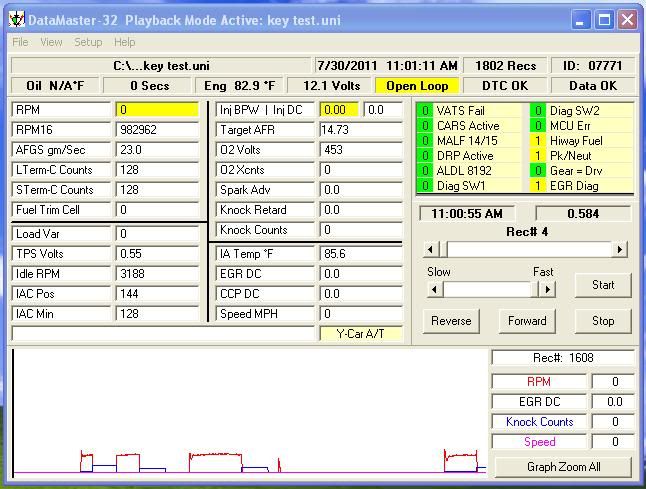
The dark blue line above is knock count. Is it normal for the knock sensor to be triggered when shutting down the engine?
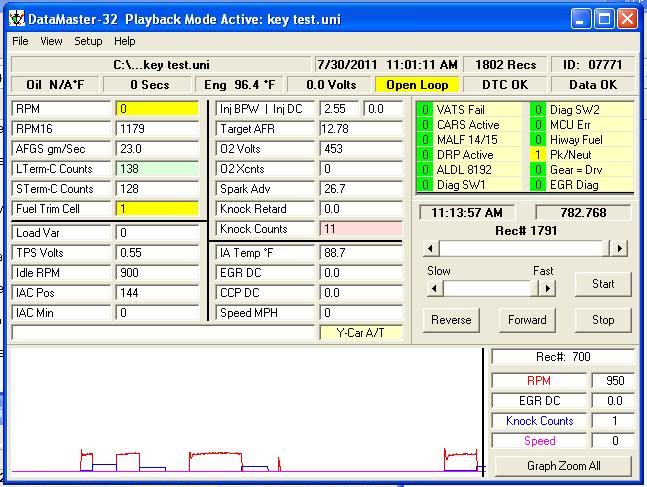
P.S. yes, the image above has the time marker at the beginning of the datalog, so doesn't show the final code status. I just re-opened the datamaster file and moved the time marker to the end and can assure you no codes are stored.
P.P.S. What the heck, here's a screen shot with the time mark at the end:
First I attempted to replicate the starting problem with the old key. Three tries, three starts. Clearly the old key isn't as bad as had been reported.
Next, I wrapped tape around the key covering both sides of the resistor pellet and tried to start the car. The starter cranked and the ignition caught briefly---see the RPM blip at about 11:04---but ultimately wouldn't start. No code saved.
Attempted to start again with the taped key: Crank but no start, no code.
Attempted to start again with the key I normally use: crank but no start, no code.
Waited 5 minutes. Pet cat as he hopped in the open back hatch and made a tour of the car. Car started with key I normally use.
I'm not sure what to make of this, as it seems to contradict the FSM diagnostic table.
The dark blue line above is knock count. Is it normal for the knock sensor to be triggered when shutting down the engine?
P.S. yes, the image above has the time marker at the beginning of the datalog, so doesn't show the final code status. I just re-opened the datamaster file and moved the time marker to the end and can assure you no codes are stored.
P.P.S. What the heck, here's a screen shot with the time mark at the end:
Last edited by 3D87C4; Jul 30, 2011 at 03:09 PM. Reason: added ps and pps

Instructor

Joined: Jun 2011
Posts: 182
Likes: 0
From: Bowling Green Ky
not sure what the hell this is! cranks with the resistors taped? not supposed to. you didn't tape all of them, or did you? don't recall if someone had attempted a bypass -I read so many I get lost- but that would explain it.
since you the man with the scanner, you can explain it.
since you the man with the scanner, you can explain it.
Thread Starter
Melting Slicks
Joined: Feb 2011
Posts: 2,322
Likes: 6
From: Los Altos CA
I can only speculate at this point. If I take the FSM literally, crank-but-no-start can't be VATS, but the time-out behavior suggests otherwise. My guess regarding the engine trying to start with the pellet taped is that maybe one of the relays or some other component is reacting slowly to the VATS violation allowing the engine to fire briefly. Or it could be a wiring or key-cylinder issue responding to some subtle variation in the way I was holding the key while it cranked.
It is highly unlikely VATS was disabled, though it might have been done without the PO's knowledge. I'll ask about that, I owe the folks a call anyway.
There might be a clue in the scan, but short of the code and VATS-fail fields I'm not sure what else to look for---I'm a new Datamaster user. Suggestions anyone?
It is highly unlikely VATS was disabled, though it might have been done without the PO's knowledge. I'll ask about that, I owe the folks a call anyway.
There might be a clue in the scan, but short of the code and VATS-fail fields I'm not sure what else to look for---I'm a new Datamaster user. Suggestions anyone?
Thread Starter
Melting Slicks
Joined: Feb 2011
Posts: 2,322
Likes: 6
From: Los Altos CA
repeat with scanner disconnected
While mulling over yesterday's little experiment I remembered something I'd read in the FSM:
So maybe having the scanner attached to the ALDL prevented any codes being stored?
To check this I repeated the experiment with nothing connected to the ALDL port, scanning after each start attempt to check for codes:
Field Service Mode
If the Diagnostic terminal is grounded with the engine running, the system will enter the Field Service mode.
.
.
.
While the system is in Field Service Mode, the ECM will be in the following mode:
1. New trouble codes cannote be stored in the ECM.
.
.
.
If the Diagnostic terminal is grounded with the engine running, the system will enter the Field Service mode.
.
.
.
While the system is in Field Service Mode, the ECM will be in the following mode:
1. New trouble codes cannote be stored in the ECM.
.
.
.
To check this I repeated the experiment with nothing connected to the ALDL port, scanning after each start attempt to check for codes:
- Two start attempts with the "bad" key yielded successful starts
- With scotch tape over the resistor pellet the engine cranked, fired briefly, but would not run---two times in a row. No codes were set.
- Attempting to start with a known good key less than a minute after the taped key try yielded the same thing---the engine cranked, fired briefly but would not run, no codes.
- After waiting 5 or 6 minutes it started normally using the known good key.
- The "bad" key probably isn't bad.
- The lack of codes does not appear to be caused by a scanner (actually Moates adaptor & Datamaster software) attached to the ALDL connector.
- I'm confused
Corvette Stories
The Best of Corvette for Corvette Enthusiasts

Every 2027 Corvette Engine Explained
Joe Kucinski
Designer Imagines A Corvette That Looks More Like a Corvette Than the Corvette
Verdad Gallardo
10 Ugly Corvettes That We Still Kinda Love
Joe Kucinski
Top 10 Most Expensive Corvettes Ever Sold on Bring A Trailer
Brett Foote
10 Things Every Corvette Owner Needs (2026 Edition)
Michael S. Palmer
8 Most "Only Corvette Owners Understand" Quirks and Problems
Pouria Savadkouei
10 Reasons the C6 Z06 is Still A Performance Benchmark After 20 Years
Joe Kucinski
How Much Horsepower Every Corvette Engine "LOST" in 1972
Joe Kucinski
Top 10 DOs and DON'Ts for Protecting Your Convertible Top!
Michael S. Palmer
Thread Starter
Melting Slicks
Joined: Feb 2011
Posts: 2,322
Likes: 6
From: Los Altos CA
Ok...spent the rest of the day doing sudoku's, laundry, practicing fiddle, napping & grocery shopping. About an hour ago I woke up and started looking through the electrical diagnosis suppliment and realized, once again, I was starting in the middle---I needed to do the System Check before going to the System Diagnosis table.
The System Check begins with trying to start the car. If it doesn't start then you go to the System Diagnosis table.
If it does start (and mine does) then you open the hush pannel under the steering column and disconnect connector C281 (surprisingly difficult to do) and try starting again---the engine shouldn't crank. If it does crank then go to the starter enable relay test.
Next you re-connect C281 and try to start within two minutes of previous attempt. The engine shouldn't crank & if it does replace the VATS decoder module.
So I pulled the connector and the engine cranks. I reconnected the connector and it still cranks. I stared at the schematic for a while and realised---that's exactly the same as taping the key!!!!! Grrrr...lesson: think first before futzing with hard to disconnect connectors.
So here's where things stand:
The system check & taped key experiment suggest either the starter enable relay has a problem, there's a short on circuit 965 (dark green wire) or a problem in the starter enable portion of the VATS decoder module.
The System Check says nothing about code 46 so, though it doesn't say this explicitely, I don't think a bad key pellet read alone will trigger a code. (Please correct me if I'm wrong.)
I believe that my occasional starting difficulties are exactly what I originally thought, misreads of the key resistor due to incorrect positioning of the key, or dirt, or who knows what, triggering the VATS system. The fact that my car cranks indicates a problem with the starter relay or VATS module but doesn't otherwise cause any trouble.
So I think I'm done for now. I'll persue it further if it becomes a hard fault. Otherwise, I have no desire to go digging into the dash to get at the starter relay and/or VATS module just to satisfy my curiosity.
Thank you for your attention.
The System Check begins with trying to start the car. If it doesn't start then you go to the System Diagnosis table.
If it does start (and mine does) then you open the hush pannel under the steering column and disconnect connector C281 (surprisingly difficult to do) and try starting again---the engine shouldn't crank. If it does crank then go to the starter enable relay test.
Next you re-connect C281 and try to start within two minutes of previous attempt. The engine shouldn't crank & if it does replace the VATS decoder module.
So I pulled the connector and the engine cranks. I reconnected the connector and it still cranks. I stared at the schematic for a while and realised---that's exactly the same as taping the key!!!!! Grrrr...lesson: think first before futzing with hard to disconnect connectors.
So here's where things stand:
The system check & taped key experiment suggest either the starter enable relay has a problem, there's a short on circuit 965 (dark green wire) or a problem in the starter enable portion of the VATS decoder module.
The System Check says nothing about code 46 so, though it doesn't say this explicitely, I don't think a bad key pellet read alone will trigger a code. (Please correct me if I'm wrong.)
I believe that my occasional starting difficulties are exactly what I originally thought, misreads of the key resistor due to incorrect positioning of the key, or dirt, or who knows what, triggering the VATS system. The fact that my car cranks indicates a problem with the starter relay or VATS module but doesn't otherwise cause any trouble.
So I think I'm done for now. I'll persue it further if it becomes a hard fault. Otherwise, I have no desire to go digging into the dash to get at the starter relay and/or VATS module just to satisfy my curiosity.
Thank you for your attention.

Race Director


Joined: Apr 2002
Posts: 10,036
Likes: 346
From: Anaheim CA
It sure sounds like your starter enable relay is bad or has been bypassed.
As you saw in the FSM, it shouldn't crank with a taped key.
I just checked the ECM program, and there are three ways to get a VATS error (Error 46). No pulses from the VATS module, VATS pulse frequency higher than 40 Hz, VATS pulse frequency lower than 20 Hz. It uses the same error code for all three problems, which means there is no way to tell which one caused the failure.
As you saw in the FSM, it shouldn't crank with a taped key.
I just checked the ECM program, and there are three ways to get a VATS error (Error 46). No pulses from the VATS module, VATS pulse frequency higher than 40 Hz, VATS pulse frequency lower than 20 Hz. It uses the same error code for all three problems, which means there is no way to tell which one caused the failure.
Thread Starter
Melting Slicks
Joined: Feb 2011
Posts: 2,322
Likes: 6
From: Los Altos CA
I agree the relay is the most likely fault. Since it has failed in the "starter enabled" state and the fuel control part of the VATS remains functional there's no compelling reason to fix it at this time (though I may ask my mechanic what he'd charge to do it when I get the oil changed this week).
So, since you can read the ECM program, am I correct in concluding a bad resistor read alone won't set a code? The lack of a code is what triggered this whole thread.
Thanks
So, since you can read the ECM program, am I correct in concluding a bad resistor read alone won't set a code? The lack of a code is what triggered this whole thread.
Thanks
Race Director
Joined: Apr 2002
Posts: 10,036
Likes: 346
From: Anaheim CA
The VATS module reads the resistor in the key. It doesn't really communicate with the ECM except to send a 30 Hz signal to tell it that it read the key correctly. The ECM checks for that signal when you turn on the ignition. If the signal is missing or the wrong frequency it sets Code 46.
