





Setting Timing by Ear

Race Director


Joined: Apr 2003
Posts: 17,700
Likes: 1,667
From: moraga ca

And if they do come off, first they make a big banging noise that makes you wear out your BVD's in a few seconds and when they hit the ground they can turn 90 degrees, accelerate past your car and it will be well in front of you, spinning wildly trying to get traction heading for the side of the road as you pass it. You will be confused and wonder what the heck it was for a few minutes. Go ahead, ask me how I know

Melting Slicks


Joined: Dec 2009
Posts: 2,244
Likes: 290
What they normally do (in street driving) is walk back & grind a hole in your timing cover, causing wierd noises & oil leaks. Look between the balancer & the crank pulley, if you see a gap (1/4" or more) then the balancer is slipping. These sbc have fairly heavy balancers & any quick engine deceleration, like hooking up hard, could make an old balancer slip.

Safety Car


Joined: Sep 2001
Posts: 4,163
Likes: 555
From: Glenbeulah Wi
Guys: I think i may have a slipping balancer. I am getting pinging when revving the engine after re-setting the timing. I had to do this recently when I put new plug wires on. The rotor was 180* off and the plug wires were a mess. Anyway, all is well with the wires and rotor, but I am struggling with timing. The car fired immediately and ran well just off my reference marks I made when pulling the distributor. Anyway, it runs more roughly/slowly as I advance it to 6 BTDC. It ran smoothly/faster at an indicated zero degrees on the timing mark. Due to the direction of balancer rotation, I assume the slipping (if that's what is happening) would produce a too-much advanced scenario even if it showed only a few degrees of advance.
So how do you time it by ear? (Yes I will replace the balancer!) Do you just get it to where it's smooth and happy? Ideas please!
So how do you time it by ear? (Yes I will replace the balancer!) Do you just get it to where it's smooth and happy? Ideas please!
If they are not the same you should replace the balancer because it will eventually fail causing all kinds of problems.

Drifting


Joined: Dec 2007
Posts: 1,647
Likes: 4
From: Argillite KY
[QUOTE]Now compare the marked zero position on the balancer to your scribed position on the balancer[QUOTE]
Almost. There is a dwell on TDC and BDC of several degrees where the piston is down. You can rotate the crank back and forth at BDC and the piston height will not change. This would be caused by clearances. That way will get you close but as far as knowing your balancer hasn't spun, no cigar.
Almost. There is a dwell on TDC and BDC of several degrees where the piston is down. You can rotate the crank back and forth at BDC and the piston height will not change. This would be caused by clearances. That way will get you close but as far as knowing your balancer hasn't spun, no cigar.
Safety Car
Joined: Sep 2001
Posts: 4,163
Likes: 555
From: Glenbeulah Wi
[QUOTE=1963SS;1578675177][QUOTE]Now compare the marked zero position on the balancer to your scribed position on the balancer
Almost. There is a dwell on TDC and BDC of several degrees where the piston is down. You can rotate the crank back and forth at BDC and the piston height will not change. This would be caused by clearances. That way will get you close but as far as knowing your balancer hasn't spun, no cigar.
I agree that there is some float but it is really close and can identify if you have any gross errors like a spun balancer. I have used this method many times expecially on LT1's to determine actual TDC since they have no timing pointer. The float around the bottom with 100 PSI is much tigher then you would expect, maybe 1 degree plus or minus.
Almost. There is a dwell on TDC and BDC of several degrees where the piston is down. You can rotate the crank back and forth at BDC and the piston height will not change. This would be caused by clearances. That way will get you close but as far as knowing your balancer hasn't spun, no cigar.

Le Mans Master

Joined: May 2004
Posts: 5,866
Likes: 60
From: Hellinois
Finalist 2020 C4 of the Year - Modified
[QUOTE=1963SS;1578675177][QUOTE]Now compare the marked zero position on the balancer to your scribed position on the balancer
Almost. There is a dwell on TDC and BDC of several degrees where the piston is down. You can rotate the crank back and forth at BDC and the piston height will not change. This would be caused by clearances. That way will get you close but as far as knowing your balancer hasn't spun, no cigar.
[QUOTE=bjankuski;1578675992][QUOTE=1963SS;1578675177]
This is why I said the op could get a "ballpark" idea of tdc. Once he gets a fair idea of tdc then he could look at where the timing marks are situated. If the ring has slipped so much that it causes the engine to run like he said when the timing is set at 6* then the amount of slippage would be very plain to see. Without being right there I would bet IF the ring has slipped it is at least 10* or more off. Since he has not posted back we are just farting into the wind.
Almost. There is a dwell on TDC and BDC of several degrees where the piston is down. You can rotate the crank back and forth at BDC and the piston height will not change. This would be caused by clearances. That way will get you close but as far as knowing your balancer hasn't spun, no cigar.
Now compare the marked zero position on the balancer to your scribed position on the balancer
I agree that there is some float but it is really close and can identify if you have any gross errors like a spun balancer. I have used this method many times expecially on LT1's to determine actual TDC since they have no timing pointer. The float around the bottom with 100 PSI is much tigher then you would expect, maybe 1 degree plus or minus.
I agree that there is some float but it is really close and can identify if you have any gross errors like a spun balancer. I have used this method many times expecially on LT1's to determine actual TDC since they have no timing pointer. The float around the bottom with 100 PSI is much tigher then you would expect, maybe 1 degree plus or minus.
Corvette Stories
The Best of Corvette for Corvette Enthusiasts

5 Best & 5 Worst Corvette Daily Drivers
Joe Kucinski
The Headlights of Every Corvette Generation Explained
Joe Kucinski
5 Best & 5 Most Overrated Corvette Track Packages of All Time!
Joe Kucinski
Every 2027 Corvette Engine Explained
Joe Kucinski
Designer Imagines A Corvette That Looks More Like a Corvette Than the Corvette
Verdad Gallardo
10 Ugly Corvettes That We Still Kinda Love
Joe Kucinski
Top 10 Most Expensive Corvettes Ever Sold on Bring A Trailer
Brett Foote
10 Things Every Corvette Owner Needs (2026 Edition)
Michael S. Palmer
8 Most "Only Corvette Owners Understand" Quirks and Problems
Pouria Savadkouei
Le Mans Master


Joined: Mar 2002
Posts: 5,889
Likes: 2
From: Castro Valley Calif.
St. Jude Donor '03 thru '26
Almost. There is a dwell on TDC and BDC of several degrees where the piston is down. You can rotate the crank back and forth at BDC and the piston height will not change. This would be caused by clearances. That way will get you close but as far as knowing your balancer hasn't spun, no cigar.

Safety Car
Joined: Apr 2011
Posts: 3,660
Likes: 22
I had a stock balancer sealing ring come apart on a previous C4 L98 that I had...
I kept hearing this weird dinging noise....what was so strange was that I heard it for several seconds AFTER shut down......
Finally having driven me near insane, I had the hood up, got someone else to start the car while I looked. Saw nothing but was sure I heard something..
Had my assistant shut it off and sure as hell theres the noise ! almost like the 2 stroke noise.. ring ding ding ding..!
I got lucky and happened to look at the balancer about 3 or 4 seconds after shut down and saw the outer ring spinning like mad...
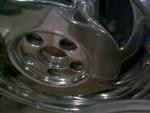
The rubber seal/binding ring had degraded and allowed the inner and outer rings to spin on what was left of the seal. Weirdest thing I ever had happen. If you look closely at the seal, you can see it cracking and uneven on the balancer ring. That shows that its trying to come apart, and it eventually WILL>
I kept hearing this weird dinging noise....what was so strange was that I heard it for several seconds AFTER shut down......
Finally having driven me near insane, I had the hood up, got someone else to start the car while I looked. Saw nothing but was sure I heard something..
Had my assistant shut it off and sure as hell theres the noise ! almost like the 2 stroke noise.. ring ding ding ding..!
I got lucky and happened to look at the balancer about 3 or 4 seconds after shut down and saw the outer ring spinning like mad...
The rubber seal/binding ring had degraded and allowed the inner and outer rings to spin on what was left of the seal. Weirdest thing I ever had happen. If you look closely at the seal, you can see it cracking and uneven on the balancer ring. That shows that its trying to come apart, and it eventually WILL>

Thread Starter
Instructor

Joined: May 2011
Posts: 103
Likes: 0
From: Lithia FL
You can get close by ear
Hold onto your hats... But I set the timing in the sweet spot without the light. I estimate that I retarded the timing back by about 6-8 degrees without the ignition wire connected and got a smooth idle with the engine warm. I suppose I was using a range of about 15-20 degrees back and forth total until I zeroed it in on the spot that sounded best. No detonation. I drove it and it behaved just like before I decided to reset the dist to get my wiring correct. It responded instantly to throttle input. I don't know if that smooth central spot is where you'd have some advance on the timing or right at zero. (my guess is that it's probably a few degrees of advance) I was hoping someone might take a stab at that along the way but I just got all kinds of screams not to do this without a light, etc. Yes..I plan to get a new balancer. Mine is off by apparently 6 degrees or so. There is some slight rubber bulging. It's flush with the center hub section and is not walking around. It looks pretty nice except for the rust. My pointer is perfectly straight and not part of the issue. I promise I won't drive it until I get a new balancer. But you CAN get close by ear.

Team Owner

Joined: Oct 2004
Posts: 81,241
Likes: 3,063
From: altered state
St. Jude Donor '05
Hate to put this out there in case someone tries it and has an issue but when its at the fact. timing it will seem a little retarded ie sounds like its idling lower/rougher than it should be. Try taking a little more out
Le Mans Master
Joined: May 2004
Posts: 5,866
Likes: 60
From: Hellinois
Finalist 2020 C4 of the Year - Modified
Yes, you can and I have, many times in my drag racing days but only as a bandaid until I could get a light on it to be sure. Once, when I was 16 and knew no better I found that when I advanced the timing without a light until I liked the way the engine ran I was rewarded for my stupidity with a dime sized hole melted through the top of the piston. With our cars having everything electronically controlled it's a lot more iffy. We had no idea you were not going to be driving the car as usual so we gave our advice accordingly. Glad you found for sure the ring has slipped, now you can get it replaced and get back to driving the car.

Team Owner
Joined: Sep 2003
Posts: 20,179
Likes: 673
From: Freedom is never more than one generation away from extinction.
St. Jude '03 thru '24
[QUOTE=1963SS;1578675177][QUOTE]Now compare the marked zero position on the balancer to your scribed position on the balancer
Almost. There is a dwell on TDC and BDC of several degrees where the piston is down. You can rotate the crank back and forth at BDC and the piston height will not change. This would be caused by clearances. That way will get you close but as far as knowing your balancer hasn't spun, no cigar.
If you use a TDC indicator/finder that "dwell" is not an issue.
Almost. There is a dwell on TDC and BDC of several degrees where the piston is down. You can rotate the crank back and forth at BDC and the piston height will not change. This would be caused by clearances. That way will get you close but as far as knowing your balancer hasn't spun, no cigar.
Drifting
Joined: Dec 2007
Posts: 1,647
Likes: 4
From: Argillite KY
If you use a TDC indicator/finder that "dwell" is not an issue
Of course I'm a little bit old school......at least.
Safety Car
Joined: Sep 2001
Posts: 4,163
Likes: 555
From: Glenbeulah Wi
[QUOTE=JrRifleCoach;1578687577][QUOTE=1963SS;1578675177]
Most SBC heads that I see do not have full thread spark plug holes so you cannot get the piston stop in to use it as intended. Another problem with the TDC inicator is it is very easy to bend if it does go in since it almost pependicular to the piston face.
Now compare the marked zero position on the balancer to your scribed position on the balancer
If you use a TDC indicator/finder that "dwell" is not an issue.
If you use a TDC indicator/finder that "dwell" is not an issue.


Drifting
Joined: May 2006
Posts: 1,428
Likes: 7
From: Chewelah Wa
Setting by ear was a lot easier in the old days without ESC for sure. You set it at "just before ping" at max load, and called it good. It was almost irrelevant as to where the timing ended up at idle. If this was a problem, you had to file out the slots in the advance plate (or make the slots shorter somehow). I guess it would be hard to see 6 degrees of slippage by a rough guestimate of TDC. Congrats OP on dialing it in to your satisfaction. We were trying to help you get there faster.
Safety Car
Joined: Sep 2001
Posts: 4,163
Likes: 555
From: Glenbeulah Wi
I am just pointing out that the piston stop does not work in all applications and if it does not work you can always use the compressed air method. I am not attempting to belittle your input.