



One small problem left...got any thoughts?
Thread Starter
Race Director


Joined: Nov 2003
Posts: 12,221
Likes: 446
From: Overland Park Kansas
2020 Corvette of the Year Finalist (appearance mods)
C4 of Year Winner (appearance mods) 2019
 One small problem left...got any thoughts?
People usually call it hunting or surging. At startup, mine will vary up/down about 1000-1500 rpms for 15-30 seconds. After that, perfect.
Really, it's not THAT bad or particularly noticeable...except to the perfectionists.
I'm very happy with my overall tune and have this single issue left. Doesn't seem likely there's a 15-sec vacuum leak at startup. Tried 2 IACs, flat timing in the 48, 64, and 96 "load" cells, and different timing values.
Maybe it's just "natural" for a cammed motor? Maybe I need a bit more fuel at startup? (Hate to do that though...who WANTS to burn more fuel?)
Almost everything was replaced with the 383 build.

Really, it's not THAT bad or particularly noticeable...except to the perfectionists.
I'm very happy with my overall tune and have this single issue left. Doesn't seem likely there's a 15-sec vacuum leak at startup. Tried 2 IACs, flat timing in the 48, 64, and 96 "load" cells, and different timing values.
Maybe it's just "natural" for a cammed motor? Maybe I need a bit more fuel at startup? (Hate to do that though...who WANTS to burn more fuel?)
Almost everything was replaced with the 383 build.
Thread Starter
Race Director
Joined: Nov 2003
Posts: 12,221
Likes: 446
From: Overland Park Kansas
2020 Corvette of the Year Finalist (appearance mods)
C4 of Year Winner (appearance mods) 2019

Race Director
Joined: Jun 2004
Posts: 13,953
Likes: 706
From: WI
I remember looking at your spark table in an earlier thread (pe maf) and thought to myself that it would cause idle fluctuation. The values were different around idle but it sounds like you tried that. Mine will hunt pretty bad if the low rpm/load cells are not even.
Another thought since it does it while warming up would be start up fuel.
Another thought since it does it while warming up would be start up fuel.
Burning Brakes

Joined: Mar 1999
Posts: 876
Likes: 9
From: Mooresville NC
A data log and tune file are worth a thousand forum posts

Thread Starter
Race Director
Joined: Nov 2003
Posts: 12,221
Likes: 446
From: Overland Park Kansas
2020 Corvette of the Year Finalist (appearance mods)
C4 of Year Winner (appearance mods) 2019
I remember looking at your spark table in an earlier thread (pe maf) and thought to myself that it would cause idle fluctuation. The values were different around idle but it sounds like you tried that. Mine will hunt pretty bad if the low rpm/load cells are not even.
Another thought since it does it while warming up would be start up fuel.
Another thought since it does it while warming up would be start up fuel.
I noticed the "stock" AYPY or ARAP bins have a pronounced difference/drop into the lower cells. If that's really indicative of the stock bin, then I wonder why it did not swing wildly from the factory?
Keep in mind, what I've got going on is subtle. I can't post logs because (as Andy knows) TunerPro won't let you do that. They're playable in sort-of-a "real-time" player -- as if you're driving the car around while viewing the logs. All the relevant parms/sensor feeds are available, where you pick any six to view simultaneously.
Not withholding anything intentionally.
Gotta wonder if anyone has an L98 that has a cold-start idle that's "rock-steady"?
Burning Brakes
Joined: Mar 1999
Posts: 876
Likes: 9
From: Mooresville NC
I got some other log viewing tools. I'm not real big on the playback thing.
I had my brothers 89 with a 422 idling solid on the stock ECU several years back before he switched to a standalone.
I had my brothers 89 with a 422 idling solid on the stock ECU several years back before he switched to a standalone.
Thread Starter
Race Director
Joined: Nov 2003
Posts: 12,221
Likes: 446
From: Overland Park Kansas
2020 Corvette of the Year Finalist (appearance mods)
C4 of Year Winner (appearance mods) 2019
Probably aren't too many things that would cause it...on an otherwise well-functioning bin.
One thing I notice with my other car(s) is how rich it smells on cold-start days. The vette doesn't smell as rich.
I've considered things like: Increasing crank fuel PW (vs. Temp), Rick/Lean Offset vs. Coolant, Open Loop AFR for temps below 90, Adding more start-up fuel with a slower delay, or decrease/increase spark correction in the sub-90-deg cells.
Not really that many choices....most of which I have tested in the past. Mostly, just programming for a higher cold rpm helped in the past...but I've lowered it again...to 1100 for the startup temps I'm talking about.
Actually, this is slower than my other "factory" cars but faster than the stock AYPY bin. (I have a stick)
BTW...My cam is similar to the LPE 219....with a couple degrees less duration and .015 less lift.
One thing I notice with my other car(s) is how rich it smells on cold-start days. The vette doesn't smell as rich.
I've considered things like: Increasing crank fuel PW (vs. Temp), Rick/Lean Offset vs. Coolant, Open Loop AFR for temps below 90, Adding more start-up fuel with a slower delay, or decrease/increase spark correction in the sub-90-deg cells.
Not really that many choices....most of which I have tested in the past. Mostly, just programming for a higher cold rpm helped in the past...but I've lowered it again...to 1100 for the startup temps I'm talking about.
Actually, this is slower than my other "factory" cars but faster than the stock AYPY bin. (I have a stick)
BTW...My cam is similar to the LPE 219....with a couple degrees less duration and .015 less lift.
Corvette Stories
The Best of Corvette for Corvette Enthusiasts

Top 10 Most Explosive Corvettes Ever Made: Power-to-Weight Ratio Ranked!
Joe Kucinski
150 hp to 1,250 hp: Every Corvette Generation Compared by the Specs That Matter
Joe Kucinski
8 Coolest Corvette Pace Cars (and Replicas) of All Time
Verdad Gallardo
Top 10 Corvette Engines RANKED by Peak Torque (70+ Years of Muscle!)
Joe Kucinski
Corvette ZR1X Will Be Pacing the Indy 500, And Could Probably Race, Too!
Verdad Gallardo
Top 10 Corvettes Coming to Mecum Indy 2026!
Brett Foote
Top 10 C9 Corvette MUST-HAVES to Fix These C8 Generation Flaws!
Michael S. Palmer
10 Revolutionary 'Corvette Firsts' Most People Don't Know
Joe Kucinski
5 Reasons to Upgrade to an LS6-Powered Corvette; 5 Reasons to Stay LT2
Michael S. Palmer
Safety Car


Joined: Sep 2001
Posts: 4,154
Likes: 553
From: Glenbeulah Wi
Play with your IAC speed, your IAC may be responding too fast or slow causing a surge, try to decrease the IAC stepper motor speed from the stock 16 rev's sec to less and see how it responds, then try more and see how it responds. It could also be too lean or rich or timing changes. Look at cold engine timing adders and AFR with a wideband.
Thread Starter
Race Director
Joined: Nov 2003
Posts: 12,221
Likes: 446
From: Overland Park Kansas
2020 Corvette of the Year Finalist (appearance mods)
C4 of Year Winner (appearance mods) 2019
Play with your IAC speed, your IAC may be responding too fast or slow causing a surge, try to decrease the IAC stepper motor speed from the stock 16 rev's sec to less and see how it responds, then try more and see how it responds. It could also be too lean or rich or timing changes. Look at cold engine timing adders and AFR with a wideband.
IIRC, that was measured in rpms/s. And, I increased it from 100rpms/s to 150rpms/s.
I don't remember any parm like you're describing above. But, I'll look again (especially at the extended mask).
Last edited by GREGGPENN; Oct 12, 2012 at 05:06 PM.


Thread Starter
Race Director
Joined: Nov 2003
Posts: 12,221
Likes: 446
From: Overland Park Kansas
2020 Corvette of the Year Finalist (appearance mods)
C4 of Year Winner (appearance mods) 2019
Timing tables are the real thing I want to (and should ask about).
As Andy pointed out, my spark table isn't (wasn't) flat across the 800rpm, 1000rpm, 1200rpm cells in the low-load columns. That's where it idles. Since I hadn't look at a tune for awhile, I forgot about the correction table (by coolant temp). It wasn't flat either.
I've made them both flat now and will install the new profile soon.
In the stock ARAP and AYPY (auto/stick) bins for an 89, timing rolls off to lower values in the lower load cells. I'm assuming there's a reason for that. (In another thread, I asked questions hoping to figure out the exact stock spark profile.)
I think it's interesting/informative to see regional table techniques. IOW, what did GM do in lower, mid, high, left, right, etc.. .values of each table. (spark or not). Most of that is straight forward. And, really not at issue now....except if timing was lowered (retarded) to keep the engine cooler at stop lights. (Or maybe to help parking lot trolling with a stick....or any other reason.)
Personally, I'd found higher-than-stock timing values seemed to work best for performance. (This is ONLY in the low, idle cells). In all other cells, less timing was the right solution -- after converting to much more efficient cylinder heads.
More timing in the low-load areas works similar to a bump in rpm speed. It makes the car easier to launch from an idle. It also makes less throttle necessary for the launches. (I have a ZF stick). Less throttle (revving) from a stop, makes driving seem more refined...not like driving a beast. Actually the same is true for my newer "throttled" back spark table. High/mid peformance is the same or better...while lower performance is a hair less snappy. Motor vibration is much less pronounced.
We've theorized the later is actually a product of the headers and power production in the lower rpms -- near resonance of the chassis. I'll also add that the side-pipe system I'm running more directly "connects" the motor to the frame. There are mounting points that are isolated with rubber bushings, but there ARE more contact points.
In lower rpms, it's almost like I was running solid motor mounts. These extra contact points -- combined with the secondard header pulse of Y-config headers -- create a bit more vibration. A bit more low-frequency "tuning-fork-like" rumble throughout my unique exhaust system.
The issue is esoteric...to say the least. It also has to do with my desire for maximum cooling at idle. I want the engine to create the least amount of heat and vibration at idle. I think less timing can accomplish that -- while more timing makes it easier to drive. That's why I'm "playing" with timing again.
I will go back to flat lower timing values and see what happens. Still, I'm left wondering why the General didn't code the low cells flat? Like the PE spark question I asked earlier this year, I'm curious if/what I'm missing? Doesn't mean I don't have a tune I won't be happy with...it's probably best described as I'm the "consummate" tinker-er....always trying to find something better.
(Did I mention I keep thinking about a FIRST or an HSR? )
)
As Andy pointed out, my spark table isn't (wasn't) flat across the 800rpm, 1000rpm, 1200rpm cells in the low-load columns. That's where it idles. Since I hadn't look at a tune for awhile, I forgot about the correction table (by coolant temp). It wasn't flat either.
I've made them both flat now and will install the new profile soon.
In the stock ARAP and AYPY (auto/stick) bins for an 89, timing rolls off to lower values in the lower load cells. I'm assuming there's a reason for that. (In another thread, I asked questions hoping to figure out the exact stock spark profile.)
I think it's interesting/informative to see regional table techniques. IOW, what did GM do in lower, mid, high, left, right, etc.. .values of each table. (spark or not). Most of that is straight forward. And, really not at issue now....except if timing was lowered (retarded) to keep the engine cooler at stop lights. (Or maybe to help parking lot trolling with a stick....or any other reason.)
Personally, I'd found higher-than-stock timing values seemed to work best for performance. (This is ONLY in the low, idle cells). In all other cells, less timing was the right solution -- after converting to much more efficient cylinder heads.
More timing in the low-load areas works similar to a bump in rpm speed. It makes the car easier to launch from an idle. It also makes less throttle necessary for the launches. (I have a ZF stick). Less throttle (revving) from a stop, makes driving seem more refined...not like driving a beast. Actually the same is true for my newer "throttled" back spark table. High/mid peformance is the same or better...while lower performance is a hair less snappy. Motor vibration is much less pronounced.
We've theorized the later is actually a product of the headers and power production in the lower rpms -- near resonance of the chassis. I'll also add that the side-pipe system I'm running more directly "connects" the motor to the frame. There are mounting points that are isolated with rubber bushings, but there ARE more contact points.
In lower rpms, it's almost like I was running solid motor mounts. These extra contact points -- combined with the secondard header pulse of Y-config headers -- create a bit more vibration. A bit more low-frequency "tuning-fork-like" rumble throughout my unique exhaust system.
The issue is esoteric...to say the least. It also has to do with my desire for maximum cooling at idle. I want the engine to create the least amount of heat and vibration at idle. I think less timing can accomplish that -- while more timing makes it easier to drive. That's why I'm "playing" with timing again.
I will go back to flat lower timing values and see what happens. Still, I'm left wondering why the General didn't code the low cells flat? Like the PE spark question I asked earlier this year, I'm curious if/what I'm missing? Doesn't mean I don't have a tune I won't be happy with...it's probably best described as I'm the "consummate" tinker-er....always trying to find something better.
(Did I mention I keep thinking about a FIRST or an HSR?
)

Race Director

Joined: Apr 2002
Posts: 10,036
Likes: 346
From: Anaheim CA
I've seen the surge at idle. In my case it was a small vacuum leak. I also saw a bog at tip-in.
It seems the ECM overshoots the target RPM and then corrects and then overshoots on the opposite side. I think it's adding and removing fuel but going too far. I think you would see IAC counts cycling high and low if this were the case. The injector pulse widths would also be doing the same.
I think maybe an O2 sensor (especially a wideband sensor) that was "preheated" to operating temperature before starting the engine might help zero in on what is happening if it's a mixture problem.
It seems the ECM overshoots the target RPM and then corrects and then overshoots on the opposite side. I think it's adding and removing fuel but going too far. I think you would see IAC counts cycling high and low if this were the case. The injector pulse widths would also be doing the same.
I think maybe an O2 sensor (especially a wideband sensor) that was "preheated" to operating temperature before starting the engine might help zero in on what is happening if it's a mixture problem.
Last edited by Cliff Harris; Oct 14, 2012 at 12:40 AM.
Thread Starter
Race Director
Joined: Nov 2003
Posts: 12,221
Likes: 446
From: Overland Park Kansas
2020 Corvette of the Year Finalist (appearance mods)
C4 of Year Winner (appearance mods) 2019
I think there can also be issues from too much timing on a "hot" cam. IOW, surging can be minimized with less timing (unless I'm mistaken). This point should also have been included in the "balance" of items being looked at from my prior post.
When cam profile is part (or all) of the problem, I'm betting a log won't help.
Even if I posted timing tables, I'm not sure that would help either...unless someone knows where/why timing is shaped in the lowest of load columns (e.g., from the factory). I've seen bins from tuners like PCM4Less that are high/flat to the bottom row. I gotta wonder if that runs hotter. Or has trouble "getting down" to the correct idle speed.
Idle "logic" has some very interesting considerations IMO.
Burning Brakes
Joined: Mar 1999
Posts: 876
Likes: 9
From: Mooresville NC
If your car was working fine and starts idling high or hunting it is often a vacuum issue, I am assuming all else is working correctly and you are trying to tune it, then the timing table is usually the cause of hunting and surging.
When working with a modified engine, what happens is the engine starts going through regions of the spark table that were not meant for idle, adds timing, the idle goes weak and it falls back in RPM again. If you watch in the data you will commonly see it follow a pattern of spark advance going up and down causing the surging. That is why you will commonly see tunes with the timing flattened out to keep it consistent in all idle areas.
You can also set up timing dips to hold the idle from going up into the higher RPM light load areas, thus giving you a much stronger idle.
Here is an example of a spark table on a setup that has no IAC:
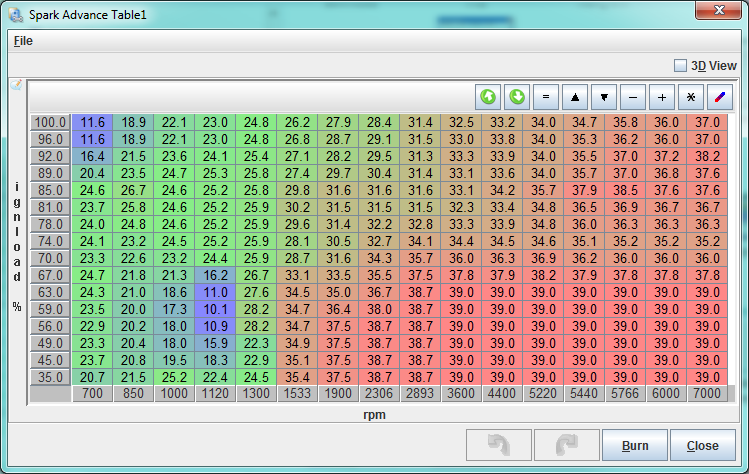
Notice the hole in the spark table at 1100 RPM, that basically boxes the idle in and holds the engine from wanting to go over that RPM at idle even if it has the throttle blade idle set higher than it would normally be set, thus gives a very solid idle even without an IAC, yet prevents surging.
This table is an extreme example as it is from a solid roller engine with no IAC and cam duration of 252/263, you wouldn't normally need to do something this extreme, but it serves as a good example of how you can manipulate the idle behaviors with the spark table.
When working with a modified engine, what happens is the engine starts going through regions of the spark table that were not meant for idle, adds timing, the idle goes weak and it falls back in RPM again. If you watch in the data you will commonly see it follow a pattern of spark advance going up and down causing the surging. That is why you will commonly see tunes with the timing flattened out to keep it consistent in all idle areas.
You can also set up timing dips to hold the idle from going up into the higher RPM light load areas, thus giving you a much stronger idle.
Here is an example of a spark table on a setup that has no IAC:
Notice the hole in the spark table at 1100 RPM, that basically boxes the idle in and holds the engine from wanting to go over that RPM at idle even if it has the throttle blade idle set higher than it would normally be set, thus gives a very solid idle even without an IAC, yet prevents surging.
This table is an extreme example as it is from a solid roller engine with no IAC and cam duration of 252/263, you wouldn't normally need to do something this extreme, but it serves as a good example of how you can manipulate the idle behaviors with the spark table.
Thread Starter
Race Director
Joined: Nov 2003
Posts: 12,221
Likes: 446
From: Overland Park Kansas
2020 Corvette of the Year Finalist (appearance mods)
C4 of Year Winner (appearance mods) 2019
Interesting. Having a "low" hole isn't something I would have considered..since the move (out of a low cell) to a higher surrounding cell would create a more pronounced jump in timing. And, presumably, a more pronounced change in engine speed/response.
If anything, I'd think having: more timing in [rpm] cells below, more timing is [load] cells below, less timing in [rpm] cells above, and less timing in [load] cells above the desired load/rpm cell [for idle] would create the effect you described. The result would be "flat" response [immediately] above idle with an artificial bump in timing in lower rpms/loads to boost idle back up to the desired plateau.
Another idea or two comes to mind, which I'll come back and post later....
If anything, I'd think having: more timing in [rpm] cells below, more timing is [load] cells below, less timing in [rpm] cells above, and less timing in [load] cells above the desired load/rpm cell [for idle] would create the effect you described. The result would be "flat" response [immediately] above idle with an artificial bump in timing in lower rpms/loads to boost idle back up to the desired plateau.
Another idea or two comes to mind, which I'll come back and post later....

Safety Car

Joined: Oct 2008
Posts: 4,022
Likes: 30
From: Los Angeles CA
vacuum hoses near and around the brake booster, and to the cruise servo, has little cracks on the ends, the aggregate of them will produce leak albeit small, cut off the ends and your braking power goes up.
Thread Starter
Race Director
Joined: Nov 2003
Posts: 12,221
Likes: 446
From: Overland Park Kansas
2020 Corvette of the Year Finalist (appearance mods)
C4 of Year Winner (appearance mods) 2019
Banged the drum of equal lower rpm cells for quite awhile (see date of my prior post). Finally, took the queue from the ARAP/AYPY bin and created cells where the "48" load column had lower timing than the "64" cells. Now it's pretty darn stable.
Everything I tried (before) involved moving cells in both those columns to the same lower/higher value. I also made sure the Startup timing table (vs coolant temp) was the same in both of these columns.
Don't know why they need to be different...but it works.
Everything I tried (before) involved moving cells in both those columns to the same lower/higher value. I also made sure the Startup timing table (vs coolant temp) was the same in both of these columns.
Don't know why they need to be different...but it works.

Le Mans Master


Joined: Sep 2000
Posts: 6,303
Likes: 714
From: Bartlett IL
Gregg,
Your def file should have a Closed Throttle SA. Are you running Closed Loop? Flattening both Fuel and Spark tables in the idle region really helps.
Smoothing in general makes a much better driving car.
Your def file should have a Closed Throttle SA. Are you running Closed Loop? Flattening both Fuel and Spark tables in the idle region really helps.
Smoothing in general makes a much better driving car.