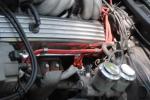





What would you do on a basic tune-up on a C4

Thread Starter
TheCorvetteBen


Joined: Feb 2007
Posts: 4,987
Likes: 144
From: Van Alstyne, TX
 What would you do on a basic tune-up on a C4
For Christmas this year, I have decided to do some needed maintenance on my brother-in-law's 1991 Corvette. He has had it for about two years and even though it has been driven, a good going through is in order. I was planning the following:
Spark Plugs
Spark Plug wires
Cap/Rotor
Set Timing
Air Filter
Oil Change
Brake Bleed
Basic Brake inspection.
Vacuum out the radiator
PVC Valve
Fuel Filter
Belt
Other than the above mentioned jobs, what else would you guys consider doing on this car?
Thanks!
Spark Plugs
Spark Plug wires
Cap/Rotor
Set Timing
Air Filter
Oil Change
Brake Bleed
Basic Brake inspection.
Vacuum out the radiator
PVC Valve
Fuel Filter
Belt
Other than the above mentioned jobs, what else would you guys consider doing on this car?
Thanks!
Last edited by chstitans42; Dec 15, 2013 at 12:31 PM.

Pro


Joined: Mar 2013
Posts: 628
Likes: 13
From: Indiana
Although it would be the most expensive of the list it would be one of the easiest. I would change out the injectors with remanufactured ones from FIC. The changes in throttle response and fuel mileage makes it worth the price. Between new plugs, wires, and injectors it will feel like a new car. Plugs, wires, fuel injectors, and PCV valves should be done every 50k miles as normal maintenance. Probably throw on a new belt also. 

Team Owner


Joined: Sep 2001
Posts: 62,160
Likes: 1,733
From: Athens AL
C7 of the Year - Unmodified Finalist 2021
C4 of Year Finalist (performance mods) 2019
Definite fuel filter. If the coolant is 2 years old then you may want to think about a full flush and replacement with new.
If you're feeling like finding something else, then change the brake fluid and tranny fluids.
If you're feeling like finding something else, then change the brake fluid and tranny fluids.
Corvette Stories
The Best of Corvette for Corvette Enthusiasts

Top 10 Most Expensive Corvettes Ever Sold on Bring A Trailer
Brett Foote
10 Things Every Corvette Owner Needs (2026 Edition)
Michael S. Palmer
8 Most "Only Corvette Owners Understand" Quirks and Problems
Pouria Savadkouei
10 Reasons the C6 Z06 is Still A Performance Benchmark After 20 Years
Joe Kucinski
How Much Horsepower Every Corvette Engine "LOST" in 1972
Joe Kucinski
Top 10 DOs and DON'Ts for Protecting Your Convertible Top!
Michael S. Palmer
Top 10 Most Explosive Corvettes Ever Made: Power-to-Weight Ratio Ranked!
Joe Kucinski
150 hp to 1,250 hp: Every Corvette Generation Compared by the Specs That Matter
Joe Kucinski
8 Coolest Corvette Pace Cars (and Replicas) of All Time
Verdad Gallardo
Melting Slicks

Joined: Jun 2013
Posts: 3,065
Likes: 39

Racer

Joined: Oct 2012
Posts: 350
Likes: 2
From: Huntsville AL
YES! Don't act on bad advice and replace good parts in the absence of any evidence of a problem. If there are no signs of external leakage from the injectors, gas mileage is good, and there's no leak down of fuel rail pressure when the engine is shut off, then starting a basic tuneup with such an expensive step would be less than prudent.
Racer
Joined: May 2007
Posts: 313
Likes: 0
From: DES MOINES IOWA
actually, there is a tune up kit for the c4 that contains most items on your list. i think it
cost around $130 i agree with just bob, if it ain't broke don't fix it
Also I think it's very nice for doing this for your bil. Happy holidays
cost around $130 i agree with just bob, if it ain't broke don't fix it
Also I think it's very nice for doing this for your bil. Happy holidays
Pro
Joined: Mar 2013
Posts: 628
Likes: 13
From: Indiana
I would not consider recommending replacing 23 year old injectors as bad advice. Injectors should be replaced on a regular schedule like filters and spark plugs. They recommend cleaning/replacing them every 50k miles. Thinking like that you could say the spark plugs still fire after 80k miles so don't bother changing them. Or air still flows through the filter so why bother buying a new one. Get the remanufactured Bosch III's from FIC for $189.00 for a complete set of eight. That's less than $24.00 each. It's a great deal and they make a world of difference. The original injectors are known to be kind of crappy and I'm sure after 23 years they haven't improved any. The newer technology in these injectors have a better spray pattern and quicker on/off cycling. Sure the old ones still fire, maybe, but they can not be as good as the newer tech stuff even if they are brand new old stock parts. The FIC ones have new seals that tolerate alcohol gas mix. The old ones do not so after 23 years, over half of which had alcohol added, I'm sure the seals have got to be shot and the firing valves have got to be damaged. I thought my 96' ran fine before I replaced them but wow what a difference they made.
Last edited by Klyde; Dec 15, 2013 at 02:34 PM.

Drifting


Joined: Mar 2012
Posts: 1,492
Likes: 61
From: New Jersey
If the fuel pressure regulator is original or at least 10 years old, I would change it along with the rest of the tune-up. When the regulator goes bad, the diaphragm usually tears allowing fuel into the vacuum line. Many engine fires have been caused by this problem.
As an extra regular maintenance item, the radiator shroud should be pulled and the radiator/ac condenser area cleaned out and any debris removed - helps keep the engine temps down.
As an extra regular maintenance item, the radiator shroud should be pulled and the radiator/ac condenser area cleaned out and any debris removed - helps keep the engine temps down.
Pro
Joined: Mar 2013
Posts: 628
Likes: 13
From: Indiana
On my 96' I removed both plastic covers over the fuel rail/valve covers. Next I bleed off the fuel rail pressure using the bleeder valve on the incoming fuel line. I placed several towels near the windshield. I then removed the wiring clips to each injector. Pull the vacuum line off of the regulator. Next I removed the four screws holding the fuel rail down and lifted it up and flipped it onto the towel. I cleaned all the manifold holes and pulled the retaining clips on each injector and took them out. Of course fuel runs out which is what the towels are for. I put the new O-rings on each new injector, lubed each with a little silicon grease, and without twisting pushed each one into the manifold making sure the wiring connector is where it should be. Do not twist just push straight in. Flip the fuel rail over and align each injector to its correct hole. Now push straight down until all injectors mate. Replace the four screws, the vacuum line, and the wiring connector. Turn the key on several times to build pressure but do not start the engine. Once you have pressure check for leaks. When your sure you have no leaks start the engine and once again check for leaks. Replace the plastic covers, close the hood, and drive. Takes twenty minutes.
Last edited by Klyde; Dec 15, 2013 at 05:47 PM.