



Brake Bleeding on a 1991 C4

Thread Starter
TheCorvetteBen


Joined: Feb 2007
Posts: 4,987
Likes: 144
From: Van Alstyne, TX
 Brake Bleeding on a 1991 C4
I have a few questions about some brake work on a 1991. The pedal has alot of travel before it starts stopping the car, so I am thinking a brake bleed is due. Since I am doing this by myself without a helper, I was planning on gravity bleeding the system by cracking open all four bleeders with rubber tubes on them with a catch can underneath, and then watching the MC making sure it does not run dry. My questions are, what kind of brake fluid should I use? Any other tips and tricks for this job?
Thanks!
Thanks!

Team Owner


Joined: Dec 1999
Posts: 34,873
Likes: 487
From: Lacey WA RVN 68-69
NCM Sinkhole Donor
For street use, a good quality DOT3 fluid will work fine. Castrol LMA, Valvoline SynPower or even the Ford Motorsports HD fluid will work.
I would suggest using a pressure bleeder and doing one wheel at a time. It sounds like a complete flush will be in order and it will certainly take less time to do. Figure on using about 3 pints. Before starting, use a turkey baster ($3 at grocery stores) to suck out as much of the old fluid as you can from the MC reservoir. Just don't go below the holes going into the MC.
Another suggestion is to get a set of Speed Bleeders for the calipers. These bleeders have a spring-loaded check ball in them. You install the bleeder so it's snug, then back off a 1/4 to 1/2 turn and then simply depress the brake pedal to force fluid past the check ball. As soon as you release the pedal, the check ball closes the bleeder. This makes it very easy for one person to do caliper bleeding or complete flushes.
If the flex hoses are original or something like 7-10 years old, I would recommend replacing all 4 hoses as part of the work.
I would suggest using a pressure bleeder and doing one wheel at a time. It sounds like a complete flush will be in order and it will certainly take less time to do. Figure on using about 3 pints. Before starting, use a turkey baster ($3 at grocery stores) to suck out as much of the old fluid as you can from the MC reservoir. Just don't go below the holes going into the MC.
Another suggestion is to get a set of Speed Bleeders for the calipers. These bleeders have a spring-loaded check ball in them. You install the bleeder so it's snug, then back off a 1/4 to 1/2 turn and then simply depress the brake pedal to force fluid past the check ball. As soon as you release the pedal, the check ball closes the bleeder. This makes it very easy for one person to do caliper bleeding or complete flushes.
If the flex hoses are original or something like 7-10 years old, I would recommend replacing all 4 hoses as part of the work.

Safety Car

Joined: Aug 2002
Posts: 3,842
Likes: 230
From: SANTA CRUZ CA
Your owner's manual will suggest the correct brake fluid to use......
probably, DOT 3.
Extensive pedal travel may be attributed to: worn brake pads, fluid loss, air in system, faulty master cylinder.
Changing fluid may not solve your problem
probably, DOT 3.
Extensive pedal travel may be attributed to: worn brake pads, fluid loss, air in system, faulty master cylinder.
Changing fluid may not solve your problem

Max G’s

Joined: Nov 2008
Posts: 2,751
Likes: 79
From: Monroe OH
NCM Sinkhole Donor
For street use and even autox with stock type brakes, the Valvoline DOT 4 Synthetic works great. And, gravity bleeding takes a while but is definitely the best way. Keep an eye on both left and right sides if opening both at the same time. Sometimes you have to close one side to get any flow. You won't have any problem doing the front and rear at the same time since we are fortunate to have a reservoir for the front and one for the rear. That is one nice thing you can check off about the 91.

Pro


Joined: Mar 2013
Posts: 628
Likes: 13
From: Indiana
I recommend the speed bleeders also. They make this job so much easier. I also agree about new brake hoses. The old ones get soft and when you press the brake they swell up which means less fluid gets to the brake cylinders. This relates to some of your peddle movement not making it to the brakes. If you have some extra cash the stainless wrapped brake hoses are a good move. They don't swell so all of your brake peddle movement goes to the brake cylinders. There is a pattern to the bleeding (which wheel first, second...) for each different model so do some research and follow the pattern for your year.

Race Director


Joined: Apr 2009
Posts: 19,294
Likes: 2,754
From: Charlotte NC
You "may" be successful...and I honestly hope so. But using a pressure bleeder is the one way to positively ensure that you get all the air out. It is the recommended tool from the factory. Due to the way the lines are run and bent...air can get trapped in the ABS unit and linger there when attempting to gravity bleed....which is why forcing the brake fluid under pressure (approx 20+psi)through the system is the way to get the air out. I service C2 to C6 brakes quite often and I could not live without my diaphragm brake pressure bleeder. I am not working on MY STUFF...I am doing it for others and I have to make sure that the brakes do not EVER FAIL due to my workmanship repair procedures.
But do as you wish.
DUB
But do as you wish.
DUB

Melting Slicks

Joined: May 2010
Posts: 2,082
Likes: 3
From: Conowingo Maryland
I have gravely bleed for over 30 yrs to each his own. But no matter what way you go do one wheel at a time. Your travel could be a lot of things like thouse listed the rod between the master cyc and booster could also be out of adj
Race Director
Joined: Apr 2009
Posts: 19,294
Likes: 2,754
From: Charlotte NC
With all due respect...Gravity bleeding may work just fine on a NON-ABS brake system. But I can assure you that it would not work if you got air into the ABS system. Pressure bleeding is a must....unless you believe that text written in the service manuals and the tools outlined for use to do it correctly are a completely incorrect and it is a conspiracy to make mechanics buy books and tools...because the engineers who developed the system are actually invested in the book and tool companies and want you to spend money so they can make money. Doubtful....don't you agree.
I personally would not adjust the rod...unless I have measured it carefully so I am not actuating the master cylinder due to the rod being adjusted out too far. The only time I usually adjust the rod is when a new booster is being installed and I carefully measure and adjust it....or if a master cylinder is being replaced and I check to make sure that the depth of the valving of the master cylinder is equal to the factory master cylinder that was on the car originally.
DUB
I personally would not adjust the rod...unless I have measured it carefully so I am not actuating the master cylinder due to the rod being adjusted out too far. The only time I usually adjust the rod is when a new booster is being installed and I carefully measure and adjust it....or if a master cylinder is being replaced and I check to make sure that the depth of the valving of the master cylinder is equal to the factory master cylinder that was on the car originally.
DUB
Corvette Stories
The Best of Corvette for Corvette Enthusiasts

Top 10 Most Expensive Corvettes Ever Sold on Bring A Trailer
Brett Foote
10 Things Every Corvette Owner Needs (2026 Edition)
Michael S. Palmer
8 Most "Only Corvette Owners Understand" Quirks and Problems
Pouria Savadkouei
10 Reasons the C6 Z06 is Still A Performance Benchmark After 20 Years
Joe Kucinski
How Much Horsepower Every Corvette Engine "LOST" in 1972
Joe Kucinski
Top 10 DOs and DON'Ts for Protecting Your Convertible Top!
Michael S. Palmer
Top 10 Most Explosive Corvettes Ever Made: Power-to-Weight Ratio Ranked!
Joe Kucinski
150 hp to 1,250 hp: Every Corvette Generation Compared by the Specs That Matter
Joe Kucinski
8 Coolest Corvette Pace Cars (and Replicas) of All Time
Verdad Gallardo
Melting Slicks
Joined: May 2010
Posts: 2,082
Likes: 3
From: Conowingo Maryland
Dub like I said to each his own. I have been a ase master tech for oevr 30 yrs. I wrote quite a bit of the quesstions for the tests. I have been an auto motive instructor for over 25 yrs. Non if you can loglity tell me how air can be traped if you are pushing it out from the higest spot to the lowest. Pressure belleding is much faster but it does not pick up defects like colasoing hoses ect. again like I said to each his own. As far as adjucting the rod it was a recommendation to check. they should be checked and adjusted durning the repacement of the master cyc or booster. It is adjustable for a reason to over look this would be wrong

Safety Car
Joined: Sep 2004
Posts: 3,953
Likes: 550
From: Mission Viejo CA
To check for the correct length push rod, look into the small ports in the botton of your m/c reservoir. You do have clean fluid, right? You should see the piston move as soon as you push on the brake pedal.
p.s. Worn brake pads will not cause excessive pedal travel. Disc brakes automatically adjust for brake pad wear. Another point: In any static hydraulic system, the fluid pressure will be the same at any point in the system. Soft brake hoses will not reduce the pressure in the calipers. They will only give you a spongy feel to the brake pedal. The brakes will stop the car the same with either the stainless braided lines or rubber lines.
p.s. Worn brake pads will not cause excessive pedal travel. Disc brakes automatically adjust for brake pad wear. Another point: In any static hydraulic system, the fluid pressure will be the same at any point in the system. Soft brake hoses will not reduce the pressure in the calipers. They will only give you a spongy feel to the brake pedal. The brakes will stop the car the same with either the stainless braided lines or rubber lines.
Last edited by Hot Rod Roy; Dec 17, 2013 at 06:35 AM.
Race Director
Joined: Apr 2009
Posts: 19,294
Likes: 2,754
From: Charlotte NC
Your philosophy on this issue "might be true" except for the fact IF the adjustment for the push rod is already out to far...or it was threaded out further... "just because" ...and this added length in the push rod actually begins actuating the master cylinder. Then the piston valving in the master cylinder would obviously move when you pressed the brake pedal because it is already contacting the piston valve.....which would be incorrectly adjusted by your description of "checking the correct length of the push rod".
Pre-loading or pre-actuation the master cylinder is dangerous and can cause issues that I have had to repair in the past due to parts replacements and adjustment to the push rod was not checked and verified by precise measuring equipment.
I measure this area so it is correct. Just watching the movement of the piston valving does not work in my scenario. I HAVE TO BE more precise than this due to the fact that I am liable of my work. And I am super picky when it comes to a person brakes on their car. And I have repaired brake systems that somebody else attempted and completely screwed it up by turning and changing things that they should not touch due to not knowing anything about it. I have repaired brakes systems where the owner has poured engine oil in the master cylinder....and finished one today where the owner poured DEX-COOL coolant in the master cylinder. Some people can buy a car...but still refuse to read the owners manual. Figure that.
Then I also install a brake pressure gauge so I can actually read the pressure at each wheel if needed. It takes the guess work out on how well the system is operating.
DUB
Race Director
Joined: Apr 2009
Posts: 19,294
Likes: 2,754
From: Charlotte NC
I agree to some extent...but when procedures have been developed and equipment has been manufactured to improve the service performance of a specific system. Why would you choose to use anything else...especially if it dealing with your brakes.
This is where I am having a problem. You evidently did not read what I wrote. Or you read only some parts of it and chose to comprehend it in a different way than how it was written. For someone with your credentials as you stated. I am shocked that you even dispute what I wrote because it is in factory service manuals. And you should know this if you are who you say you are and have done what you wrote you have done. it just does not make sense. Literally mind boggling.
You have to be joking because you must have not have worked on an ABS brake system in a Corvette. Install the ABS unit and bleed the brakes the way you prefer (gravity). Because if you had...and had the service manuals present...it would tell you WHY you need to pressure bleed the system.....and if you look at the brake lines....they do not all run "down hill". They actually can have significant high vertical runs in them that can trap air if you gravity bleed or perform the "brake pedal pump method" the results will be futile. Performing the "pump pedal" method can move air...but when you go and re-fill the master cylinder...you do not know where the air is in the system and that air bubble can migrate back to where it was initially. Because as you know....when performing the "pump pedal" method...you do have to re-fill the master cylinder at some time. AND seeing how you are talking about "gravity bleeding". I would not even attempt to gravity bleed because the internals of the ABS unit can be designed in a way where there are areas in it that can allow fluid to pass through but still have an air pocket at the top of this section of the ABS unit.
I do agree....it is FASTER...and it DOES pick up other issues if you know your equipment. And I do know that the diaphragm brake pressure bleeder is bleeding the system at a lower pressure than the "brake pedal pump method"...which is pointless in some circumstances. But "gravity bleeding" is under NO pressure and you can not tell if you have a collapsed hose that way....unless it is blocked off completely. And if you are gravity bleeding and getting dripping brake fluid from the bleeder...this is often times "good enough" for some people. And like you can tell you have a collapsed hose from dripping fluid from a bleeder...YEAH---RIGHT. OK..maybe you precisely open the bleeder exactly the same at each caliper and then count the number of drops in 10 seconds and check the volume of brake fluid collected and measure it so it can be compared from caliper to caliper. PLEASE---BE REAL. If you have a diaphragm brake pressure bleeder and use it enough...you can tell how the system flows fluid from a completely new system...versus that of an older system. I know I have and I can tell right away if there is something not quite right.
Then this is when I use my brake pressure tester to verify pressures at each caliper if needed or even at the master cylinder.
I AGREE 100%.
I wonder if it is really you writing this or you let someone in your family get on and reply under your screen name just to be "funny". Or your computer has been "hacked". This must be a joke...except for the last quoted comment from you. It just does not make sense. Let's see....you are 30 year ASE Master Mechanic...and instructor for 25 years...and you actually believe (and possibly instruct others) that your procedures are better than the procedures that the engineers that developed the brake systems in cars today and have developed service procedures that would allow a mechanic service it as it needs to be for safety and performance. Because we are talking about a Corvette that does have an ABS unit in this post. And if you have been a mechanic as long as you stated...then would it not seem that you would know how to spell the words correctly for the components/procedures in the system that you know about and teach???
Check your computer or stop allowing someone else respond for you. Because this can not really be you. Joke is over. Seriously.
DUB
Then this is when I use my brake pressure tester to verify pressures at each caliper if needed or even at the master cylinder.
I wonder if it is really you writing this or you let someone in your family get on and reply under your screen name just to be "funny". Or your computer has been "hacked". This must be a joke...except for the last quoted comment from you. It just does not make sense. Let's see....you are 30 year ASE Master Mechanic...and instructor for 25 years...and you actually believe (and possibly instruct others) that your procedures are better than the procedures that the engineers that developed the brake systems in cars today and have developed service procedures that would allow a mechanic service it as it needs to be for safety and performance. Because we are talking about a Corvette that does have an ABS unit in this post. And if you have been a mechanic as long as you stated...then would it not seem that you would know how to spell the words correctly for the components/procedures in the system that you know about and teach???
Check your computer or stop allowing someone else respond for you. Because this can not really be you. Joke is over. Seriously.
DUB
Pro
Joined: Mar 2013
Posts: 628
Likes: 13
From: Indiana
Hot Rod Roy:
"Soft brake hoses will not reduce the pressure in the calipers. They will only give you a spongy feel to the brake pedal. The brakes will stop the car the same with either the stainless braided lines or rubber lines."
This is true only to a point. Once the calipers push the pads against the disc pressure starts to build. Once the pressure reaches the point where the soft rubber hoses swell then the pressure stops building until the hoses quit swelling. Then it builds again. If the hoses are totally shot you could run out of pedal travel before the swelling stops. Therefore worn stock rubber hoses could not only make your pedal spongy but could in theory lower your braking power. Of course the soft rubber could swell till it ruptures leading to zero pressure in that caliper.
On my car over half of the pedal travel was going into swelling all four of my seventeen year old hoses. Once I changed them to stainless lines my braking was greatly improved. They do and did make a difference in braking power and are not the same as the old rubber lines. I'm sure that comparing new rubber lines with new stainless lines there would be little difference between the two.
"Soft brake hoses will not reduce the pressure in the calipers. They will only give you a spongy feel to the brake pedal. The brakes will stop the car the same with either the stainless braided lines or rubber lines."
This is true only to a point. Once the calipers push the pads against the disc pressure starts to build. Once the pressure reaches the point where the soft rubber hoses swell then the pressure stops building until the hoses quit swelling. Then it builds again. If the hoses are totally shot you could run out of pedal travel before the swelling stops. Therefore worn stock rubber hoses could not only make your pedal spongy but could in theory lower your braking power. Of course the soft rubber could swell till it ruptures leading to zero pressure in that caliper.
On my car over half of the pedal travel was going into swelling all four of my seventeen year old hoses. Once I changed them to stainless lines my braking was greatly improved. They do and did make a difference in braking power and are not the same as the old rubber lines. I'm sure that comparing new rubber lines with new stainless lines there would be little difference between the two.
Last edited by Klyde; Dec 18, 2013 at 09:14 PM.

Safety Car
Joined: Jan 2004
Posts: 3,783
Likes: 15
From: Northern California
I use Earl's Solo Bleeds on my 91 Vette.
They are very easy to use!...
These bleeders have a better design than the Russel Speed Bleeder brand IMO...
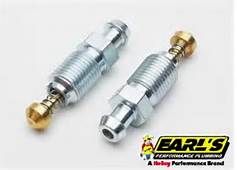
They are very easy to use!...
These bleeders have a better design than the Russel Speed Bleeder brand IMO...
Last edited by GKK; Dec 18, 2013 at 09:18 PM.
Melting Slicks
Joined: May 2010
Posts: 2,082
Likes: 3
From: Conowingo Maryland
Dub you are an a?? I dare you question who I am or what I have done. Please show me where GM Ford or Dodge say you must pressure bleed?? The fact is I am lone retired but just checked 3 fsm from 86 -89 and the give you both options and explain how to do both. I know several service centers and know of none that use a pressure bleeder as a general means. Get a life get over your self people come one here for information on how do to things. There is no reason to purchase pressure break bleader when there are more just as efficeant ways of doing it. And please show me in a fsm on the op cars where it says you must pressure bleed. If you can read like I said it tells you how to do it both ways. also tell me how air can be traped if you are bleeding at the lowest point. please tell me how if flluid is running it can get traped. I will correct myself on that there are som IH trucks and buses and Isure other that you must must activate the abs systems course there were a couple of gm and fors you had to activaate the abs to bleed also but even then you did not have to pressure bleed. People like you are why people think damn I cannot do this. And giving them wrong information really messes them up. Get a life get off your high horse.


Race Director
Joined: Apr 2009
Posts: 19,294
Likes: 2,754
From: Charlotte NC
Yeah...but sometimes it gets somewhat insane.
Once people allow their emotions to override their intellect...and it becomes vulgar....that is when I kinda have to "bow-out" because it just is pointless. I can not communicate with people who are....
DUB
Once people allow their emotions to override their intellect...and it becomes vulgar....that is when I kinda have to "bow-out" because it just is pointless. I can not communicate with people who are....
DUB
Race Director
Joined: Apr 2009
Posts: 19,294
Likes: 2,754
From: Charlotte NC
NO WHERE in the GM Corvette Service Manuals I have looked in from 1986 to 1996 does it state anywhere that "gravity Bleeding" is an approved method for an ABS brake system.
I am quite aware that MANUAL BLEEDING by pressing on the brake pedal is an approved method. The main issue when manually bleeding is to make sure all of the air is out of the master cylinder and then follow the procedures outlined. Also it can be time consuming due to the process...and from my experiences a very long time ago. Having a question if the system was air free was something that I did not like to ask myself. So I bought the diaphragm pressure bleeder and have not looked back.
I feel it all has to do with INTEGRITY. Just because you know this or that or do this or that or even have a tool that can do this or that. It is the obligation of a professional mechanic to have integrity and not settle in to practices that often times may question that integrity. I have turned away more work due to customers want me to do a "half-baked" repair and I just won't do it. I am not implying anyone here on the Forum does that...I am just stating what I DO.
DUB
I am quite aware that MANUAL BLEEDING by pressing on the brake pedal is an approved method. The main issue when manually bleeding is to make sure all of the air is out of the master cylinder and then follow the procedures outlined. Also it can be time consuming due to the process...and from my experiences a very long time ago. Having a question if the system was air free was something that I did not like to ask myself. So I bought the diaphragm pressure bleeder and have not looked back.
I feel it all has to do with INTEGRITY. Just because you know this or that or do this or that or even have a tool that can do this or that. It is the obligation of a professional mechanic to have integrity and not settle in to practices that often times may question that integrity. I have turned away more work due to customers want me to do a "half-baked" repair and I just won't do it. I am not implying anyone here on the Forum does that...I am just stating what I DO.
DUB
Last edited by DUB; Dec 19, 2013 at 11:41 PM.