



383 Stroker - On a Budget?

Team Owner


Joined: Aug 2004
Posts: 21,543
Likes: 3,216
From: Park City Utah

 and that is what I'm working on for mine.
 I only mentioned rods b/c someone above had suggested getting better rods. Being a budget build, and knowing that stock rods aren't bad, especially with better hardware, I suggested reusing your stock rods. If you found a kit, or a short block that meets your budget and happens to have better/aftermarket rods...bonus. Not necessary though. All you need to stroke is crank, pistons and a harmonic damper. The rest is PM since you have a 160k engine.
Last time I had a flywheel balanced in the manner that I described, it cost me $80. That was 20 years ago....I'd budget $150 today.

Thread Starter
Drifting

Joined: Jul 2014
Posts: 1,426
Likes: 46
From: Lynchburg, VA
and that is what I'm working on for mine. I only mentioned rods b/c someone above had suggested getting better rods. Being a budget build, and knowing that stock rods aren't bad, especially with better hardware, I suggested reusing your stock rods. If you found a kit, or a short block that meets your budget and happens to have better/aftermarket rods...bonus. Not necessary though. All you need to stroke is crank, pistons and a harmonic damper. The rest is PM since you have a 160k engine.
Last time I had a flywheel balanced in the manner that I described, it cost me $80. That was 20 years ago....I'd budget $150 today.
What you're saying is I just have to buy a 400 crank, new pistons, a harmonic damper, and pay to have the machinework done on my block? If so, that would make budgeting a lot easier.
Team Owner
Joined: Aug 2004
Posts: 21,543
Likes: 3,216
From: Park City Utah
For example: If you know you'll get your FIRST intake and some cylinder heads in a year....why bother dumping any $$$ into any of your top end? It will be a hoot to drive b/c of the displacement for a while, then you can do your top end "in a year" and realize another huge gain.
But if you know that it may be 5 years until you get to it...probably a good idea to PM the heads/valve train while it's apart.
Know what I mean?
Last edited by Tom400CFI; Jul 29, 2014 at 11:27 PM.

Instructor


Joined: Feb 2014
Posts: 181
Likes: 2
From: Omaha Nebraska
For 89 octane? Provided you have good quench and run aluminum heads, anything under 10:1 would probably work just fine.
If you have a new main cat it's probably just fine. Newer cats flow better than the old ones, even if they're not high-flow cats. You don't need to buy pre cats. You already have them, they are integrated into the front Y pipe and cannot be removed. You have three options for the pre cats: leave them as they are, gut them and bolt the Y pipe back on, or replace the entire front Y with a new one that has higher flow pre cats (expensive). Buying new precats and gutting them would make no sense, and you would probably not pass visual inspection without at least looking like you have precats.
When choosing a cam, you should take everything into consideration, including CR. You can get away with longer duration on an engine with more displacement too, so that's another benefit to a 400 (or 383 for that matter).
400s are not necessarily hard to find or all that expensive. They're just not as plentiful as 350 blocks. There are 3 for sale pretty cheap in my city right now.
If you have a new main cat it's probably just fine. Newer cats flow better than the old ones, even if they're not high-flow cats. You don't need to buy pre cats. You already have them, they are integrated into the front Y pipe and cannot be removed. You have three options for the pre cats: leave them as they are, gut them and bolt the Y pipe back on, or replace the entire front Y with a new one that has higher flow pre cats (expensive). Buying new precats and gutting them would make no sense, and you would probably not pass visual inspection without at least looking like you have precats.
When choosing a cam, you should take everything into consideration, including CR. You can get away with longer duration on an engine with more displacement too, so that's another benefit to a 400 (or 383 for that matter).
400s are not necessarily hard to find or all that expensive. They're just not as plentiful as 350 blocks. There are 3 for sale pretty cheap in my city right now.
Thread Starter
Drifting
Joined: Jul 2014
Posts: 1,426
Likes: 46
From: Lynchburg, VA
Technically, yes. It would run with a new crank pistons and damper (and balanced FW), but obviously you'd also use all new bearings, seals, rings, etc. And since you're in there, you'd install a new timing chain and and other PM items....since you have 160k. You don't NEED a cam, valve springs, or anything else to make it run and "fell fun"....the decision to do more work either preventative (valve guides/seals/springs etc) or for performance (porting, cam, etc) is a personal decision that should be heavily "steered" by futer plans/budget.
For example: If you know you'll get your FIRST intake and some cylinder heads in a year....why bother dumping any $$$ into any of your top end? It will be a hoot to drive b/c of the displacement for a while, then you can do your tope end "in a year" and realize another huge gain.
But if you know that it may be 5 years until you get to it...probably a good ideal to PM the heads/valve train while it's apart.
Know what I mean?
For example: If you know you'll get your FIRST intake and some cylinder heads in a year....why bother dumping any $$$ into any of your top end? It will be a hoot to drive b/c of the displacement for a while, then you can do your tope end "in a year" and realize another huge gain.
But if you know that it may be 5 years until you get to it...probably a good ideal to PM the heads/valve train while it's apart.
Know what I mean?
Real quick, what's PM mean? Preventative maintenance?
I'd like to swap in a new cam when I do this; would that entail any other replacements? I seem to recall hearing you have to replace valve springs when you replace your cam?
Thread Starter
Drifting
Joined: Jul 2014
Posts: 1,426
Likes: 46
From: Lynchburg, VA
For 89 octane? Provided you have good quench and run aluminum heads, anything under 10:1 would probably work just fine.
If you have a new main cat it's probably just fine. Newer cats flow better than the old ones, even if they're not high-flow cats. You don't need to buy pre cats. You already have them, they are integrated into the front Y pipe and cannot be removed. You have three options for the pre cats: leave them as they are, gut them and bolt the Y pipe back on, or replace the entire front Y with a new one that has higher flow pre cats (expensive). Buying new precats and gutting them would make no sense, and you would probably not pass visual inspection without at least looking like you have precats.
When choosing a cam, you should take everything into consideration, including CR. You can get away with longer duration on an engine with more displacement too, so that's another benefit to a 400 (or 383 for that matter).
400s are not necessarily hard to find or all that expensive. They're just not as plentiful as 350 blocks. There are 3 for sale pretty cheap in my city right now.
If you have a new main cat it's probably just fine. Newer cats flow better than the old ones, even if they're not high-flow cats. You don't need to buy pre cats. You already have them, they are integrated into the front Y pipe and cannot be removed. You have three options for the pre cats: leave them as they are, gut them and bolt the Y pipe back on, or replace the entire front Y with a new one that has higher flow pre cats (expensive). Buying new precats and gutting them would make no sense, and you would probably not pass visual inspection without at least looking like you have precats.
When choosing a cam, you should take everything into consideration, including CR. You can get away with longer duration on an engine with more displacement too, so that's another benefit to a 400 (or 383 for that matter).
400s are not necessarily hard to find or all that expensive. They're just not as plentiful as 350 blocks. There are 3 for sale pretty cheap in my city right now.
The precats are visible if you look down the side of the engine, right? If so, they're not there. There was a note in a receipt for work the previous owner had done where it was noted that there were no precats. I'm guessing someone removed them for performance.
CR means...? I read a big explanation of camshaft terminology but I just can't recall. What cam would you recommend for a 6-speed 383 running 89 octane? I'm looking for low to mid-range power, not screaming high RPMs.
I probably won't go with the 400 right now, but just so I know my options how much would a 400 block cost?
Team Owner
Joined: Aug 2004
Posts: 21,543
Likes: 3,216
From: Park City Utah

[QUOTE=C4ProjectCar;1I'd like to swap in a new cam when I do this; would that entail any other replacements? I seem to recall hearing you have to replace valve springs when you replace your cam?[/QUOTE]
Any new cam is going to have more lift than your stock cam, and more than likely, a much more aggressive "ramp rate". Meaning it will open and close the valve further and more quickly. So the stock springs will not be able to control the valve movement at higher RPM....you'd need to change valve springs. If you have springs off...might as well change the seals. Don't look too close at the guides though, if you're not going to do them!

Thread Starter
Drifting
Joined: Jul 2014
Posts: 1,426
Likes: 46
From: Lynchburg, VA
Any new cam is going to have more lift than your stock cam, and more than likely, a much more aggressive "ramp rate". Meaning it will open and close the valve further and more quickly. So the stock springs will not be able to control the valve movement at higher RPM....you'd need to change valve springs. If you have springs off...might as well change the seals. Don't look too close at the guides though, if you're not going to do them!
And about what should I expect to pay for some decent valve guides?
EDIT: Googled it. Looks like 100 bucks or so?
Last edited by C4ProjectCar; Jul 29, 2014 at 11:43 PM.
Corvette Stories
The Best of Corvette for Corvette Enthusiasts

Top 10 Most Expensive Corvettes Ever Sold on Bring A Trailer
Brett Foote
10 Things Every Corvette Owner Needs (2026 Edition)
Michael S. Palmer
8 Most "Only Corvette Owners Understand" Quirks and Problems
Pouria Savadkouei
10 Reasons the C6 Z06 is Still A Performance Benchmark After 20 Years
Joe Kucinski
How Much Horsepower Every Corvette Engine "LOST" in 1972
Joe Kucinski
Top 10 DOs and DON'Ts for Protecting Your Convertible Top!
Michael S. Palmer
Top 10 Most Explosive Corvettes Ever Made: Power-to-Weight Ratio Ranked!
Joe Kucinski
150 hp to 1,250 hp: Every Corvette Generation Compared by the Specs That Matter
Joe Kucinski
8 Coolest Corvette Pace Cars (and Replicas) of All Time
Verdad Gallardo
Team Owner
Joined: Aug 2004
Posts: 21,543
Likes: 3,216
From: Park City Utah
May not be a 400?
Doesn't know how to spell...
Full Short block...
Thread Starter
Drifting
Joined: Jul 2014
Posts: 1,426
Likes: 46
From: Lynchburg, VA
Found several w/a quick search ranging in price from $80 (bare block) to $1250 (full short block)
May not be a 400?
Doesn't know how to spell...
Full Short block...
May not be a 400?
Doesn't know how to spell...
Full Short block...
 Your link titles are hilarious!
What would I have to buy to do the 400 that I wouldn't to do the 383?
EDIT: Also, blocks are different for roller cams than for flat tappet cams, right? How do you tell the difference on a Craigslist post etc?
Last edited by C4ProjectCar; Jul 29, 2014 at 11:53 PM.
Team Owner
Joined: Aug 2004
Posts: 21,543
Likes: 3,216
From: Park City Utah
1. Maybe a flywheel, and maybe roller lifters. No 400 ever had a roller cam, so to get a roller cam you'd have to buy "retrofit roller lifters" OR retrofit/DIY your old lifters and "spider plate" (retainer) to make it a roller cam engine.
Also, no 400 ever had a one piece rear main seal, so you'd have to either
A. redrill and bore your stock flywheel flange for the 2 piece crank, then balance appropriately, or
B. Buy a "single mass" flywheel for that application
2. If you can see a pic of the rear of the engine, you can tell if it's a 2 piece rear main seal engine and that would mean it came (originally) with a flat tappet cam. Look at the crank flange:

Here is the later 1 piece rear main seal. Note the lack of a "counterweight", and the crank flange doesn't protrude (much) beyond the seal:

^This could have been flat tappet OR roller, and the split was probably about 50/50. so hard to tell by looking at pics. Best just to ask the seller.
Otherwise, differences between a 350 block and a 400 block are limited to the aforementioned steam holes required in the heads, and the bore size.
Last edited by Tom400CFI; Jul 30, 2014 at 12:24 AM.
Thread Starter
Drifting
Joined: Jul 2014
Posts: 1,426
Likes: 46
From: Lynchburg, VA
My thoughts exactly concerning proofreading. It's one thing for a short block, but it's worse when it's for a $5k+ Corvette.
The 400 seems like more than I want to bite off right now, but I'll keep it in mind.
Wait - you said both pictures are 1 piece. They look different.
The 400 seems like more than I want to bite off right now, but I'll keep it in mind.
Wait - you said both pictures are 1 piece. They look different.
Team Owner
Joined: Aug 2004
Posts: 21,543
Likes: 3,216
From: Park City Utah
Guess I need to take my own advice and check! I just edited above, but the first pic was an older 2 piece engine (like all 400's) and the second pic is a later 1 piece like what you currently have in your car now.
Thread Starter
Drifting
Joined: Jul 2014
Posts: 1,426
Likes: 46
From: Lynchburg, VA
I'm trying to nail down my plans for my stroker. What cam would you suggest?
I spotted this one on Craigslist for cheap:
http://stockton.craigslist.org/pts/4570636766.html
It's a CC XR270HR
Instructor
Joined: Feb 2014
Posts: 181
Likes: 2
From: Omaha Nebraska
If I were you, I'd just shop around locally for a while. Maybe you'll find a really good deal on a 383, maybe a 400, who knows maybe even a 377.
On craigslist you'll often see folks selling expensive setups that just haven't been assembled yet.
Once you have a short block (or the parts to build one), you can start to think about what cam you should use. Not every block is set up to use a roller cam with your oem roller lifters, and going aftermarket roller is expensive.
The best policy for cams is to use the lifters and springs specifically recommended for the that particular cam by the manufacturer. If you call one of these places they can help to guide your cam selection based on the engine displacement, heads, intake, intended use, and a host of other things.
Most of all: read Vizard's book (or a similar one). It will answer all of these questions plus hundreds of others you'll never think to ask. When doing your own thing with an engine you need to know lots of stuff! There's also a SBC parts interchange book that can be very helpful if you're pulling together parts on a tight budget.
Whatever happens, don't get carried away with cost, and make sure you know all of the costs for a build up front, as much as possible. A brand new Blue Print 450 hp/tq 383 crate engine, complete (even with stuff you don't need and could sell, like the intake manifold and HEI distributor) and ready to run with a 50k mile warranty can be purchased from Speedway for $3500. You might even find you can buy one like it locally, with very few miles, for half that price. Lot's of people spend big bucks on engines and then change their minds, or get in over their heads with the car project. Their stuff sells at a steep discount. You don't want to be the guy who makes that mistake, you want to be the guy who steps in and takes advantage of it.
On craigslist you'll often see folks selling expensive setups that just haven't been assembled yet.
Once you have a short block (or the parts to build one), you can start to think about what cam you should use. Not every block is set up to use a roller cam with your oem roller lifters, and going aftermarket roller is expensive.
The best policy for cams is to use the lifters and springs specifically recommended for the that particular cam by the manufacturer. If you call one of these places they can help to guide your cam selection based on the engine displacement, heads, intake, intended use, and a host of other things.
Most of all: read Vizard's book (or a similar one). It will answer all of these questions plus hundreds of others you'll never think to ask. When doing your own thing with an engine you need to know lots of stuff! There's also a SBC parts interchange book that can be very helpful if you're pulling together parts on a tight budget.
Whatever happens, don't get carried away with cost, and make sure you know all of the costs for a build up front, as much as possible. A brand new Blue Print 450 hp/tq 383 crate engine, complete (even with stuff you don't need and could sell, like the intake manifold and HEI distributor) and ready to run with a 50k mile warranty can be purchased from Speedway for $3500. You might even find you can buy one like it locally, with very few miles, for half that price. Lot's of people spend big bucks on engines and then change their minds, or get in over their heads with the car project. Their stuff sells at a steep discount. You don't want to be the guy who makes that mistake, you want to be the guy who steps in and takes advantage of it.
Team Owner
Joined: Aug 2004
Posts: 21,543
Likes: 3,216
From: Park City Utah
If you do pursue the 400 here are your two roller lifter options;
1. is to buy the "retrofit lifter kit". Lifters look like this, using a "link bar" to keep them aligned.
.jpg)
2. DIY using junk yard parts or the parts from your current engine. LIKE THIS GUY DID It ends up looking and working like a factory set up b/c it's all factory parts, using "dog bones" to align the lifters, and a "spider plate" to hold them down. This is what your car has in it now....
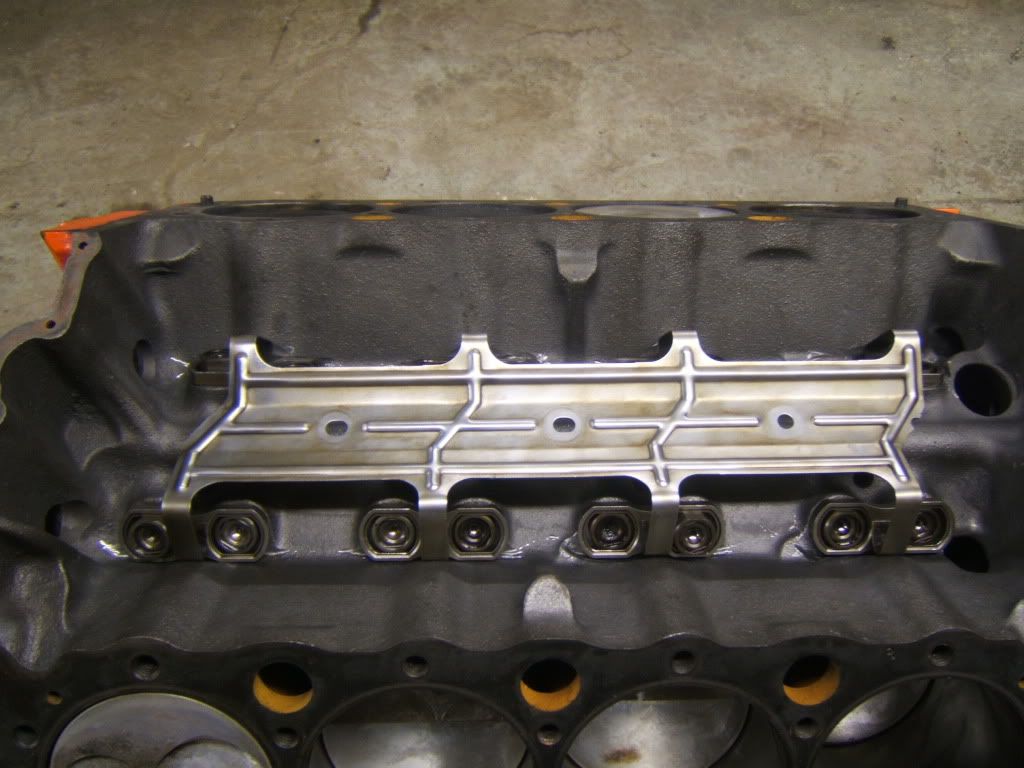
1. is to buy the "retrofit lifter kit". Lifters look like this, using a "link bar" to keep them aligned.
2. DIY using junk yard parts or the parts from your current engine. LIKE THIS GUY DID It ends up looking and working like a factory set up b/c it's all factory parts, using "dog bones" to align the lifters, and a "spider plate" to hold them down. This is what your car has in it now....
Team Owner
Joined: Aug 2004
Posts: 21,543
Likes: 3,216
From: Park City Utah
If I were you, I'd just shop around locally for a while. Maybe you'll find a really good deal on a 383, maybe a 400, who knows maybe even a 377.
Lot's of people spend big bucks on engines and then change their minds, or get in over their heads with the car project. Their stuff sells at a steep discount. You don't want to be the guy who makes that mistake, you want to be the guy who steps in and takes advantage of it.
Lot's of people spend big bucks on engines and then change their minds, or get in over their heads with the car project. Their stuff sells at a steep discount. You don't want to be the guy who makes that mistake, you want to be the guy who steps in and takes advantage of it.
Thread Starter
Drifting
Joined: Jul 2014
Posts: 1,426
Likes: 46
From: Lynchburg, VA
Okay, thanks.
I was planning to stick with a roller block, because I heard they performed better. Is this not the case?
Huh, I didn't know about matching rollers and springs to cams. Is that for both types of cams or just flat tappet? I'd heard that for roller cams the LS7 lifters are nearly always the best way to go.
I plan on getting his book and reading it, I just haven't gotten it quite yet.
That cheap for a crate engine? Wow.
I was planning to stick with a roller block, because I heard they performed better. Is this not the case?
Huh, I didn't know about matching rollers and springs to cams. Is that for both types of cams or just flat tappet? I'd heard that for roller cams the LS7 lifters are nearly always the best way to go.
I plan on getting his book and reading it, I just haven't gotten it quite yet.
That cheap for a crate engine? Wow.
Team Owner
Joined: Aug 2004
Posts: 21,543
Likes: 3,216
From: Park City Utah
You bet!
Roller blocks only "perform better" b/c they have roller CAMS inside. There is nothing different/special/better about the block itself and how it works or makes power. Only advantage is the 1 pc rear seal, and the fact that it's already configured to accept a roller cam. Functionally they're the same.
You can use any hydraulic roller lifter on any hydraulic roller cam. And that is what you'd be in the market for. You are correct, flat tappet cams, once run the lifter needs to stay w/the same cam, and even the same lobe.
I'm an hour ahead of you....gotta go to bed.
There is nothing different/special/better about the block itself and how it works or makes power. Only advantage is the 1 pc rear seal, and the fact that it's already configured to accept a roller cam. Functionally they're the same. I'm an hour ahead of you....gotta go to bed.