


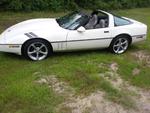
1985 Corvette ECM
Thread Starter
Racer

Joined: Jan 2015
Posts: 314
Likes: 20
From: Wareham, MA
 1985 Corvette ECM
I want to purchase a back up ECM for my 1985. I have a 4+3 do I need to find one that is specifically programmed for a MT? Are the numbers on the ECU different for a MT vs AT.
Thanks
Thanks
Thread Starter
Racer
Joined: Jan 2015
Posts: 314
Likes: 20
From: Wareham, MA

Melting Slicks


Joined: Sep 2010
Posts: 2,422
Likes: 202
It's actually fun. I have a 94 parts car. I upgraded my fuel pump wire gauge from OE 18g to 14g & 14g to 12g at the fuse block. Gained over 1 volt. experimented on the parts harness 1st. The funny thing is GM had larger connectors to accommodate this gauge wire. But used $$$ saving thin gauge wire.
Last edited by THE 383 admiral; Oct 20, 2015 at 02:40 PM.
Melting Slicks
Joined: Sep 2010
Posts: 2,422
Likes: 202
OTOH. The drop in voltage using the Skinnier "wire" is not so good on the brush motor FP. In this case more Voltage is better!!!! and actually adds more volume to your GPH & pressure. Resulting in a small HP gain. And much less stress on the FP.
Last edited by THE 383 admiral; Oct 21, 2015 at 11:20 AM.

Melting Slicks
Joined: Jan 2008
Posts: 2,054
Likes: 120
From: AZ
I think you mean is more current, amperage, which does the work in those devices. Small point, yes.
Melting Slicks
Joined: Sep 2010
Posts: 2,422
Likes: 202
DC Motors are generally used in lower voltage applications where portability is the primary goal. Most DC Motors have brushes to switch the magnetic alignment to cause rotation. DC Motors operate over a wide range of voltages. A 12V DC Motor will operate down below 6V or up to over 15 or more. What is lost at low voltage is speed & torque. At a lower voltage, both friction and load will drop motor speed. Thus a DC Motor rated 1200RPM at 12V at no load will drop to near ½ Speed at 6V and torque will be much lower. At a high voltage the speed & torque will be higher but the DC Motor upper voltage range is limited by rotational force & heat. The best way to lower a DC Motor speed is through the use of Pulse Width Modulation (PWM) where full voltage is applied (therefore full torque available) but only for a adjustable period of time. The load will cause the DC Motor to slow to an average lower speed. Without increasing voltage above rated; the max speed & torque with PWM is the rated value. A DC Motor with Gearhead is another method to increase or decrease speed range and resultant torque.
Corvette Stories
The Best of Corvette for Corvette Enthusiasts

Corvette ZR1X Will Be Pacing the Indy 500, And Could Probably Race, Too!
Verdad Gallardo
Top 10 Corvettes Coming to Mecum Indy 2026!
Brett Foote
Top 10 C9 Corvette MUST-HAVES to Fix These C8 Generation Flaws!
Michael S. Palmer
10 Revolutionary 'Corvette Firsts' Most People Don't Know
Joe Kucinski
5 Reasons to Upgrade to an LS6-Powered Corvette; 5 Reasons to Stay LT2
Michael S. Palmer
2027 Corvette vs The World: Every C8 vs Its Closest Competitor
Joe Kucinski
10 Most Common Corvette Problems of the Last 20 Years!
Joe Kucinski
5 MOST and 5 LEAST Popular Corvette Model Years in History!
Joe Kucinski