


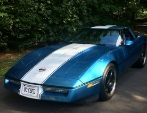


Another 383 stroker build...

Thread Starter
Heel & Toe

Joined: Feb 2017
Posts: 18
Likes: 0
From: MI
 Another 383 stroker build...
So, I'm considering (eventually) doing a 383 stroker build on my '87 coupe. Just doing research for now, but here's the list of parts I'm looking at, based on what I've been reading here and on the "third gen" forum:
FAST ez-EFI 2.0 retro system
FIRST fuel injections TPI style manifold
FAST dual sync distributor
SCAT forged 383 rotating assembly
AFR 195cc SBC Eliminator Street Heads 1041
Comp cams Xtreme Fuel Injection 268XFI HR13 OR Thumpr™ 283THR7
Comp 1.52:1 rollers
Melrose headers
Looking for 450 - 500 HP at the crank. Think this will get me there?
Also, thinking I'll be spreading this out over a 3-4 year span for the sake of my budget, and hoping to do most of the work myself while I'm storing it for the winter. With that in mind, I'm thinking about doing it in stages:
1)Computer and distributor
2)Intake and exhaust
3)Heads and rockers
4)Short-block and cam
Would that make sense (besides having to remove things repeatedly like the exhaust...)?
Thanks in advance!
FAST ez-EFI 2.0 retro system
FIRST fuel injections TPI style manifold
FAST dual sync distributor
SCAT forged 383 rotating assembly
AFR 195cc SBC Eliminator Street Heads 1041
Comp cams Xtreme Fuel Injection 268XFI HR13 OR Thumpr™ 283THR7
Comp 1.52:1 rollers
Melrose headers
Looking for 450 - 500 HP at the crank. Think this will get me there?
Also, thinking I'll be spreading this out over a 3-4 year span for the sake of my budget, and hoping to do most of the work myself while I'm storing it for the winter. With that in mind, I'm thinking about doing it in stages:
1)Computer and distributor
2)Intake and exhaust
3)Heads and rockers
4)Short-block and cam
Would that make sense (besides having to remove things repeatedly like the exhaust...)?
Thanks in advance!
Thread Starter
Heel & Toe
Joined: Feb 2017
Posts: 18
Likes: 0
From: MI
Haven't looked into them that much yet. Because the manifold needs a different fuel rail, it comes with the rail and up to 30 lb injectors at no additional cost, but I've seen several builds with 36's , and even one with 42's. 
I'm leaning toward 36's, but wonder if the 30's would be enough?
I'm leaning toward 36's, but wonder if the 30's would be enough?

Melting Slicks


Joined: Jan 2009
Posts: 3,482
Likes: 196
From: folsom california
personally, I'd do it in reverse order (more or less); get a bare block and do the short block build up first...then maybe heads and have at least a short block, or better yet a long block ready to drop in.
a lot of the stuff is gonna be repeated if you build it according to your plan...more time, duplicated effort, costs, etc.
if you do the engine (and as much of it that can bolt up to it), first, your car stays running with minimum downtime.
also the engine will be the most expensive part, but the engine build can be accomplished over time in discrete incremental steps with the least damage to your short term finances.
One thing missing from your plan, anytime you start mixing and matching aftermarket parts, the lower end should be balanced as a unit: flywheel (or flex plate), crank, rods, pistons, rings, bearings, harmonic balancer
a lot of the stuff is gonna be repeated if you build it according to your plan...more time, duplicated effort, costs, etc.
if you do the engine (and as much of it that can bolt up to it), first, your car stays running with minimum downtime.
also the engine will be the most expensive part, but the engine build can be accomplished over time in discrete incremental steps with the least damage to your short term finances.
One thing missing from your plan, anytime you start mixing and matching aftermarket parts, the lower end should be balanced as a unit: flywheel (or flex plate), crank, rods, pistons, rings, bearings, harmonic balancer
Last edited by mtwoolford; Feb 22, 2017 at 10:12 PM.
Thread Starter
Heel & Toe
Joined: Feb 2017
Posts: 18
Likes: 0
From: MI
personally, I'd do it in reverse order (more or less); get a bare block and do the short block build up first...then maybe heads and have at least a short block, or better yet a long block ready to drop in.
a lot of the stuff is gonna be repeated if you build it according to your plan...more time, duplicated effort, costs, etc.
if you do the engine (and as much of it that can bolt up to it), first, your car stays running with minimum downtime.
also the engine will be the most expensive part, but the engine build can be accomplished over time in discrete incremental steps with the least damage to your short term finances.
One thing missing from your plan, anytime you start mixing and matching aftermarket parts, the lower end should be balanced as a unit: flywheel (or flex plate), crank, rods, pistons, rings, bearings, harmonic balancer
a lot of the stuff is gonna be repeated if you build it according to your plan...more time, duplicated effort, costs, etc.
if you do the engine (and as much of it that can bolt up to it), first, your car stays running with minimum downtime.
also the engine will be the most expensive part, but the engine build can be accomplished over time in discrete incremental steps with the least damage to your short term finances.
One thing missing from your plan, anytime you start mixing and matching aftermarket parts, the lower end should be balanced as a unit: flywheel (or flex plate), crank, rods, pistons, rings, bearings, harmonic balancer

Curious as to what I'd be looking at in repeat costs though?
As far as downtime goes, I have automatic downtime in the form of Michigan winters, so 3-4 months per year of not driving it is a part of life anyway... :/
Perhaps you could fill in some of the blanks for me on the lower end balancing you described? Like I said, very new to this, so the more details I can wrap my head around on the front end, the better...
Thread Starter
Heel & Toe
Joined: Feb 2017
Posts: 18
Likes: 0
From: MI
Just did a quick look on TPIS' website, and they recommend 30 lb/hr injectors for the power range I'm looking to make. Is there a reason I'm seeing a lot of people going with 36’s instead? Durability, future upgrades, etc?

Melting Slicks
Joined: Apr 2007
Posts: 2,616
Likes: 111
Too many folks get the biggest injectors they can find thinking it will make more power. Not always a wise choice.
There are charts out there giving you a guide based on Cubic inch and other factors.

Team Owner


Joined: Sep 2001
Posts: 62,154
Likes: 1,731
From: Athens AL
C7 of the Year - Unmodified Finalist 2021
C4 of Year Finalist (performance mods) 2019
Really need to talk to a fuel injector specialist before you finally decide, if youre doing the tuning yourself. Otherwise I'd recommend you speak to your tuner as well.
Last edited by vader86; Feb 23, 2017 at 11:22 AM.
Corvette Stories
The Best of Corvette for Corvette Enthusiasts

Top 10 Most Expensive Corvettes Ever Sold on Bring A Trailer
Brett Foote
10 Things Every Corvette Owner Needs (2026 Edition)
Michael S. Palmer
8 Most "Only Corvette Owners Understand" Quirks and Problems
Pouria Savadkouei
10 Reasons the C6 Z06 is Still A Performance Benchmark After 20 Years
Joe Kucinski
How Much Horsepower Every Corvette Engine "LOST" in 1972
Joe Kucinski
Top 10 DOs and DON'Ts for Protecting Your Convertible Top!
Michael S. Palmer
Top 10 Most Explosive Corvettes Ever Made: Power-to-Weight Ratio Ranked!
Joe Kucinski
150 hp to 1,250 hp: Every Corvette Generation Compared by the Specs That Matter
Joe Kucinski
8 Coolest Corvette Pace Cars (and Replicas) of All Time
Verdad Gallardo
Instructor

Joined: Sep 2007
Posts: 127
Likes: 13
From: Apollo Beach. Fla
[QUOTE=87c4z52;1594150979]So, I'm considering (eventually) doing a 383 stroker build on my '87 coupe. Just doing research for now, but here's the list of parts I'm looking at, based on what I've been reading here and on the "third gen" forum:
FAST ez-EFI 2.0 retro system
FIRST fuel injections TPI style manifold
FAST dual sync distributor
SCAT forged 383 rotating assembly
AFR 195cc SBC Eliminator Street Heads 1041
Comp cams Xtreme Fuel Injection 268XFI HR13 OR Thumpr™ 283THR7
Comp 1.52:1 rollers
Melrose headers
Looking for 450 - 500 HP at the crank. Think this will get me there?
Also, thinking I'll be spreading this out over a 3-4 year span for the sake of my budget, and hoping to do most of the work myself while I'm storing it for the winter. With that in mind, I'm thinking about doing it in stages:
1)Computer and distributor
2)Intake and exhaust
3)Heads and rockers
4)Short-block and cam
Would that make sense (besides having to remove things repeatedly like the exhaust...)?
Thanks in advance
Le Mans Master


Joined: Aug 2015
Posts: 6,103
Likes: 1,985
From: St. Charles MO
If you are going to purchase and install a new intake, I would recommend against a TPI style intake. The long runners of the TPI style will limit your useful powerband to 5000rpm and below, no matter how large the runners' cross section is. You'd have a much wider powerband and make a lot more power with a short-runner LTx-style intake. Otherwise, you will give away a minimum of 30hp and probably more like 50hp with that TPI intake. This is especially true if you build the engine with a short-runner intake in mind from the get-go, as you'd be able to use significantly more compression ratio and more cam overlap without inviting knock at the TPI's resonance-induced peak cylinder pressure.
Le Mans Master
Joined: Aug 2015
Posts: 6,103
Likes: 1,985
From: St. Charles MO
Sigh...Two responses to this:
1) You don't actually lose torque; the 1990 L98 was rated at 350lb/ft and the 1995 LT1 was rated at 340lb/ft, so there is no significant difference in peak torque. But you do get to shift up higher and get a much flatter torque curve. That's why you get a much wider usable power band and way more power.
2) Torque at the crankshaft is irrelevant to how fast your car accelerates. Power is the one and only measure that predicts the performance of your car. If you want to accelerate faster you always opt for higher power. And if you can get more power and a wider, more usable power band, it's a no-brainer.
1) You don't actually lose torque; the 1990 L98 was rated at 350lb/ft and the 1995 LT1 was rated at 340lb/ft, so there is no significant difference in peak torque. But you do get to shift up higher and get a much flatter torque curve. That's why you get a much wider usable power band and way more power.
2) Torque at the crankshaft is irrelevant to how fast your car accelerates. Power is the one and only measure that predicts the performance of your car. If you want to accelerate faster you always opt for higher power. And if you can get more power and a wider, more usable power band, it's a no-brainer.
Thread Starter
Heel & Toe
Joined: Feb 2017
Posts: 18
Likes: 0
From: MI
If you are going to purchase and install a new intake, I would recommend against a TPI style intake. The long runners of the TPI style will limit your useful powerband to 5000rpm and below, no matter how large the runners' cross section is. You'd have a much wider powerband and make a lot more power with a short-runner LTx-style intake. Otherwise, you will give away a minimum of 30hp and probably more like 50hp with that TPI intake. This is especially true if you build the engine with a short-runner intake in mind from the get-go, as you'd be able to use significantly more compression ratio and more cam overlap without inviting knock at the TPI's resonance-induced peak cylinder pressure.
http://www.superchevy.com/how-to/eng...tpi-induction/
450-ish CHP, and it carried out all the way to 6000 RPM. Sounds pretty good to me. Also, they used the stock upper and lower portions of the manifold, with big runners, and ported everything out, flowing up to 260 cfm, whereas the FIRST manifold flows 300+ cfm out of the box, and can be ported farther still...
For what it's worth, I like the look of the engine with the TPI, and I like the way the power band feels. I just want more of it...
Melting Slicks
Joined: Apr 2007
Posts: 2,616
Likes: 111

Melting Slicks
Joined: Apr 2007
Posts: 2,616
Likes: 111
Sigh...Two responses to this:
1) You don't actually lose torque; the 1990 L98 was rated at 350lb/ft and the 1995 LT1 was rated at 340lb/ft, so there is no significant difference in peak torque. But you do get to shift up higher and get a much flatter torque curve. That's why you get a much wider usable power band and way more power.
2) Torque at the crankshaft is irrelevant to how fast your car accelerates. Power is the one and only measure that predicts the performance of your car. If you want to accelerate faster you always opt for higher power. And if you can get more power and a wider, more usable power band, it's a no-brainer.
1) You don't actually lose torque; the 1990 L98 was rated at 350lb/ft and the 1995 LT1 was rated at 340lb/ft, so there is no significant difference in peak torque. But you do get to shift up higher and get a much flatter torque curve. That's why you get a much wider usable power band and way more power.
2) Torque at the crankshaft is irrelevant to how fast your car accelerates. Power is the one and only measure that predicts the performance of your car. If you want to accelerate faster you always opt for higher power. And if you can get more power and a wider, more usable power band, it's a no-brainer.
Dont even bother my friend. The torque monster theory that prevails out there with these outdated TPI systems is here to stay. I with others have posted graphs showing the torque and power gains of aftermarket intakes with shorter runners but it doesn't matter to some.