



Crankcase Vacuum Leak

Thread Starter
Drifting

Joined: Jul 2014
Posts: 1,426
Likes: 46
From: Lynchburg, VA
 Crankcase Vacuum Leak
Once my engine warms up, it develops a pulsating whistle that sounds like a bad accessory bearing or squeaky fan belt. This began occurring immediately after I reinstalled the engine in January. Recently, I finally figured out the cause - a vacuum leak in the crankcase. The second I pull the PCV hose or the breather line on the other side, the whistle subsides, and it immediately resumes when I reattach said fitting. It's pretty embarrassing, especially when I shut off the engine, and the remaining vacuum bleeds off in a several-second-long wail that sounds something like an elk bugle.
I was hoping it was just a leak around the pan gasket, so I put it on the ramps and tightened the pan bolts to spec with a torque wrench. Unfortunately, that didn't fix it. As far as I can tell, this leaves a couple possibilities: the timing cover, either china wall, or the valve cover gaskets. It doesn't sound like it's coming from the valve cover gaskets, and snugging down the bolts didn't help. (The valve covers are quality machined units, and I took care not to overtighten, so warping is not an issue there.)
Of course that narrows it down to the two most difficult fixes. I really don't feel like tearing the whole top end off the engine to reseal everything in hopes of fixing this (especially because The Right Stuff is a PITA to chisel off the china walls), so do you guys have any suggestions of what I can do to pinpoint and/or fix it? It's not like an intake leak where you can spray carb cleaner around and listen to the engine idle - I don't think enough airflow goes through the crankcase for that to have an immediate effect, and I also just don't wanna have solvent sucked into my crankcase.
It's worth mentioning that I slightly bent up the timing cover in the process of replacing the crank seal. I carefully straightened it out, and I laid it on something flat to make sure it would seal. Any remaining imperfections should have been sealed by the RTV I put on the gasket, but who knows.
Edit:
Car is a 1990 base model. The engine has heads, cam, SuperRam, and headers, though the problem began before I installed the headers.
I was hoping it was just a leak around the pan gasket, so I put it on the ramps and tightened the pan bolts to spec with a torque wrench. Unfortunately, that didn't fix it. As far as I can tell, this leaves a couple possibilities: the timing cover, either china wall, or the valve cover gaskets. It doesn't sound like it's coming from the valve cover gaskets, and snugging down the bolts didn't help. (The valve covers are quality machined units, and I took care not to overtighten, so warping is not an issue there.)
Of course that narrows it down to the two most difficult fixes. I really don't feel like tearing the whole top end off the engine to reseal everything in hopes of fixing this (especially because The Right Stuff is a PITA to chisel off the china walls), so do you guys have any suggestions of what I can do to pinpoint and/or fix it? It's not like an intake leak where you can spray carb cleaner around and listen to the engine idle - I don't think enough airflow goes through the crankcase for that to have an immediate effect, and I also just don't wanna have solvent sucked into my crankcase.
It's worth mentioning that I slightly bent up the timing cover in the process of replacing the crank seal. I carefully straightened it out, and I laid it on something flat to make sure it would seal. Any remaining imperfections should have been sealed by the RTV I put on the gasket, but who knows.
Edit:
Car is a 1990 base model. The engine has heads, cam, SuperRam, and headers, though the problem began before I installed the headers.
Last edited by C4ProjectCar; Aug 28, 2018 at 11:24 AM.

Race Director


Joined: Apr 2003
Posts: 17,699
Likes: 1,667
From: moraga ca
Normally a leak in the areas you mentioned would be accompanied with a loss of oil. Why don't you do a smoke test with the engine off and the source of the leak should be easily detected?

Team Owner


Joined: Aug 2004
Posts: 21,543
Likes: 3,216
From: Park City Utah

Thread Starter
Drifting
Joined: Jul 2014
Posts: 1,426
Likes: 46
From: Lynchburg, VA
Smoke test? As in pump a bunch of smoke into the crankcase? I do have a fog machine; not sure if that could react with my oil or something.
I meant to mention it, but I gave that a shot. (As an aside, I was amazed how well that let me pick up on the tiniest engine noises!) I couldn't pinpoint it, although it seemed like it was coming from the front/bottom of the engine. If I'm feeling brave this weekend, I might try listening from underneath.
Thread Starter
Drifting
Joined: Jul 2014
Posts: 1,426
Likes: 46
From: Lynchburg, VA
I removed and replaced the intake manifold in the hopes that the leak was occurring at the front or rear china wall, but unfortunately the leak is still apparent. I put my car up on ramps and got under it with the engine running, and it sounds like the whistle is coming from the front bottom of the engine - as I feared, the timing cover.
Not only is the leak annoying because of the sound it makes, it seems to be causing other issues. While coasting, the car's idle swings greatly (approximately 500 - 1400 RPM, IIRC), which I am almost certain is from the vacuum leak. Also, my car has been burning a significant amount of oil: about a quart every 1500 miles. Initially I chalked this up to leaky valve cover gaskets and/or china walls, but I've sorted that out, so I'm guessing the leak is causing too much PCV flow which is sucking oil mist into the intake manifold.
I tried reaching up the front of the engine and smearing some Permatex around, in the hopes I'd cover the leak, but that didn't help. Can you guys think of any solution other than replacing the timing cover gasket?
Not only is the leak annoying because of the sound it makes, it seems to be causing other issues. While coasting, the car's idle swings greatly (approximately 500 - 1400 RPM, IIRC), which I am almost certain is from the vacuum leak. Also, my car has been burning a significant amount of oil: about a quart every 1500 miles. Initially I chalked this up to leaky valve cover gaskets and/or china walls, but I've sorted that out, so I'm guessing the leak is causing too much PCV flow which is sucking oil mist into the intake manifold.
I tried reaching up the front of the engine and smearing some Permatex around, in the hopes I'd cover the leak, but that didn't help. Can you guys think of any solution other than replacing the timing cover gasket?
Team Owner
Joined: Aug 2004
Posts: 21,543
Likes: 3,216
From: Park City Utah
I want to know why a leak to your "oiled areas"/crank case, would have any effect to idle? Or why you're drawing so much air into your crank case that you've got a whistle/hiss that you can hear?
First; your crank case vacuum should be limited to ~9 CFM, by the PCV valve...which ain't enough to cause hissing/whistling that you could hear.
Second, by FAR, the easiest path for make-up air to enter the crank case should be through the nearly 1/2" hole in the ducting that runs from the air TB (air filter, essentially) to the passenger's side valve cover.
If it takes several seconds for your crank case vacuum to subside after shut down....I'd be having a close look at your PCV valve and then the fresh air intake and/or the oil separator on that side.
.
First; your crank case vacuum should be limited to ~9 CFM, by the PCV valve...which ain't enough to cause hissing/whistling that you could hear.
Second, by FAR, the easiest path for make-up air to enter the crank case should be through the nearly 1/2" hole in the ducting that runs from the air TB (air filter, essentially) to the passenger's side valve cover.
If it takes several seconds for your crank case vacuum to subside after shut down....I'd be having a close look at your PCV valve and then the fresh air intake and/or the oil separator on that side.
.
Last edited by Tom400CFI; Aug 27, 2018 at 10:36 PM.

Le Mans Master

Joined: Feb 2005
Posts: 6,478
Likes: 565
From: Clearwater Florida
….. As Tom suggested … The way the PCV system is "supposed" to work is to draw fresh air through the engine via the PCV valve on one valve cover (drivers side) and a hose on the other valve cover (passenger side) that goes to the throttle body … if that second hose is MIA or plugged it could cause the vacuum scenario that you are describing … PCV air is a non-metered , but known (to the ECM) quantity and impeding it will affect your idle operation …..
Last edited by C409; Aug 28, 2018 at 07:59 AM.

Safety Car


Joined: Sep 2001
Posts: 4,155
Likes: 553
From: Glenbeulah Wi
….. As Tom suggested … The way the PCV system is "supposed" to work is to draw fresh air through the engine via the PCV valve on one valve cover (drivers side) and a hose on the other valve cover (passenger side) that goes to the throttle body … if that second hose is MIA or plugged it could cause the vacuum scenario that you are describing … PCV air is a non-metered , but known (to the ECM) quantity and impeding it will affect your idle operation …..
Check the breathe on the opposite valve cover, it sould be open and attached to the throttle body on the port that is ahead of the throttle blades but still filtered. You are getting a vacuum in the crankcase from the PCV and the whistle is air leaking in around the crank seals when the engine is running. This problem will not happen if the breather is hooked up correctly.
Corvette Stories
The Best of Corvette for Corvette Enthusiasts

Top 10 Most Explosive Corvettes Ever Made: Power-to-Weight Ratio Ranked!
Joe Kucinski
150 hp to 1,250 hp: Every Corvette Generation Compared by the Specs That Matter
Joe Kucinski
8 Coolest Corvette Pace Cars (and Replicas) of All Time
Verdad Gallardo
Top 10 Corvette Engines RANKED by Peak Torque (70+ Years of Muscle!)
Joe Kucinski
Corvette ZR1X Will Be Pacing the Indy 500, And Could Probably Race, Too!
Verdad Gallardo
Top 10 Corvettes Coming to Mecum Indy 2026!
Brett Foote
Top 10 C9 Corvette MUST-HAVES to Fix These C8 Generation Flaws!
Michael S. Palmer
10 Revolutionary 'Corvette Firsts' Most People Don't Know
Joe Kucinski
5 Reasons to Upgrade to an LS6-Powered Corvette; 5 Reasons to Stay LT2
Michael S. Palmer

Team Owner
Joined: Aug 2004
Posts: 21,543
Likes: 3,216
From: Park City Utah
Thread Starter
Drifting
Joined: Jul 2014
Posts: 1,426
Likes: 46
From: Lynchburg, VA
Hey guys, thanks for the responses.
Tom, as I understand it, a vacuum leak can cause a hunting idle. Is that incorrect? I've done my best to understand the PCV system, but honestly I'm a little stumped. It seems like both valve cover lines run to the manifold, where vacuum should be consistent, so I don't get what causes flow. My only thought is that perhaps I missed something, and the passenger side line runs to the throttle body in *front* of the throttle blades?
Also, I'm not sure that it would take that much air to make a whistle. You can place a blade of grass between your two thumbs and cause a pretty loud shriek without blowing too hard.
I've checked the PCV valve, and it seems to be functioning properly: when I blow on it, it allows air through, and sucking on it closes the valve (i.e., it allows air to leave the crankcase but not to enter).
I'm not sure what the fresh air intake and oil separater are; are these possibly equipment found on a different-year car? Mine is a 1990.
C409, both hoses are present. However, I'll have to check, but I'm nearly positive the PCV valve is found on the passenger's side with just a regular hose connector on the driver's side. Is this backward?
Tom, as I understand it, a vacuum leak can cause a hunting idle. Is that incorrect? I've done my best to understand the PCV system, but honestly I'm a little stumped. It seems like both valve cover lines run to the manifold, where vacuum should be consistent, so I don't get what causes flow. My only thought is that perhaps I missed something, and the passenger side line runs to the throttle body in *front* of the throttle blades?
Also, I'm not sure that it would take that much air to make a whistle. You can place a blade of grass between your two thumbs and cause a pretty loud shriek without blowing too hard.
I've checked the PCV valve, and it seems to be functioning properly: when I blow on it, it allows air through, and sucking on it closes the valve (i.e., it allows air to leave the crankcase but not to enter).
I'm not sure what the fresh air intake and oil separater are; are these possibly equipment found on a different-year car? Mine is a 1990.
C409, both hoses are present. However, I'll have to check, but I'm nearly positive the PCV valve is found on the passenger's side with just a regular hose connector on the driver's side. Is this backward?
Team Owner
Joined: Aug 2004
Posts: 21,543
Likes: 3,216
From: Park City Utah
I've done my best to understand the PCV system, but honestly I'm a little stumped. It seems like both valve cover lines run to the manifold, where vacuum should be consistent, so I don't get what causes flow. My only thought is that perhaps I missed something, and the passenger side line runs to the throttle body in *front* of the throttle blades?
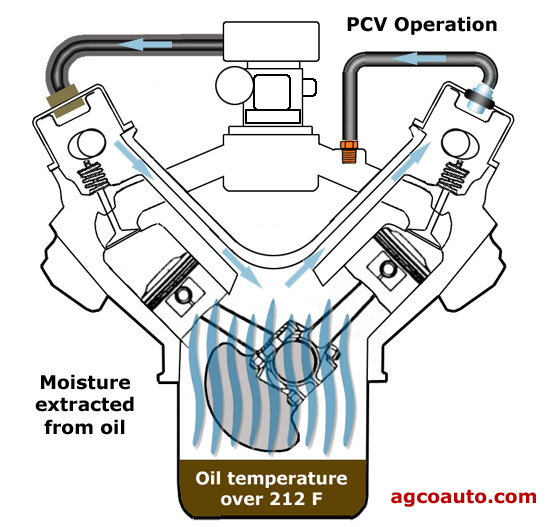
Air filter >MAF >TB housing>Hose to passenger's side VC>through "crank case" > PCV valve >Hose to plenum > Plenum/runners/cylinders to get burned...with any crank case contaminates.
Le Mans Master
Joined: Oct 2002
Posts: 7,098
Likes: 378
From: Las Vegas - Just stop perpetuating myths please.
Just curious C4, do have excessive fuel tank pressure when you remove the gas cap? More than a small puff but enough to make your hand wet from the fuel vapor gusting out?
Thread Starter
Drifting
Joined: Jul 2014
Posts: 1,426
Likes: 46
From: Lynchburg, VA
Hmm. I'll have to run out and check, but I'm almost positive my system is set up so that it would be impossible for air to flow that direction. I swear, if the problem has just been that my PCV system is backwards...
You wouldn't believe the amount of stupid problems like that I've had on this car from the PO's mechanic. When I first got it, I had problems overheating, and a new serpentine belt I put on got instantly chewed up. Found out the PO's mechanic put a V-belt style water pump on, which has a different pulley alignment and is designed to spin the opposite direction!
Can't say I've noticed that. I'll double-check when I run out in a minute, but I'm almost sure I've never noticed anything more than a little hiss.
Edit:
Alright, PCV is on the passenger side, and it allows me to blow, but not suck. (On another note, anyone got a good way to wash motor oil residue out of your mouth? Swished some diluted dish soap and I can't say I prefer the taste.)
That would mean air is attempting to flow out of the lower intake manifold, down into the crankcase through the driver's side valve cover, back up through the passenger's side valve cover, and into the throttle body. That's the opposite of the above diagram. So I guess I need to switch the PCV valve to the driver's side?
You wouldn't believe the amount of stupid problems like that I've had on this car from the PO's mechanic. When I first got it, I had problems overheating, and a new serpentine belt I put on got instantly chewed up. Found out the PO's mechanic put a V-belt style water pump on, which has a different pulley alignment and is designed to spin the opposite direction!
Edit:
Alright, PCV is on the passenger side, and it allows me to blow, but not suck. (On another note, anyone got a good way to wash motor oil residue out of your mouth? Swished some diluted dish soap and I can't say I prefer the taste.)
That would mean air is attempting to flow out of the lower intake manifold, down into the crankcase through the driver's side valve cover, back up through the passenger's side valve cover, and into the throttle body. That's the opposite of the above diagram. So I guess I need to switch the PCV valve to the driver's side?
Last edited by C4ProjectCar; Aug 28, 2018 at 06:28 PM.


Thread Starter
Drifting
Joined: Jul 2014
Posts: 1,426
Likes: 46
From: Lynchburg, VA
Thanks for the pics, cdm. I went back and looked at pics from shortly after I got the car, and mine was wrong even then, so I guess I've been operating without a proper PCV system for 4 years.
I'll be darned. Swapped the elbow and the valve, and the squeak seems to be gone. Granted, sometimes it takes a little while to show up, but since I determined it's vacuum-related I am certain that fixed it. Might just be me, but driveability feels a bit better too. Seems like the stumble that made starting from a dead stop difficult has disappeared, but maybe I'm just imagining that. I hope I don't see an oil leak from where the vacuum sucked a gap in the timing cover gasket.
As mad as I am at whichever of the PO's mechanics screwed that up, I'm just as grateful to you guys for helping me sort this out. You have no idea how annoying this noise was, and it was also a bit embarassing to have a car I put so much work into sound so ill-maintained. Just wish I would have caught this before I drove 3000 miles across the country.
I'll be darned. Swapped the elbow and the valve, and the squeak seems to be gone. Granted, sometimes it takes a little while to show up, but since I determined it's vacuum-related I am certain that fixed it. Might just be me, but driveability feels a bit better too. Seems like the stumble that made starting from a dead stop difficult has disappeared, but maybe I'm just imagining that. I hope I don't see an oil leak from where the vacuum sucked a gap in the timing cover gasket.
As mad as I am at whichever of the PO's mechanics screwed that up, I'm just as grateful to you guys for helping me sort this out. You have no idea how annoying this noise was, and it was also a bit embarassing to have a car I put so much work into sound so ill-maintained. Just wish I would have caught this before I drove 3000 miles across the country.