When you click on links to various merchants on this site and make a purchase, this can result in this site earning a commission. Affiliate programs and affiliations include, but are not limited to, the eBay Partner Network.
Indmar Conversion
1 extermanl fuel pump (PSI is 38 steady even when it dies)
2 the opti spark has been removed and replaced with Cadillac north-star ignition, which also added 2 crank sensors
3 No O2 sensors
4 No MAF sensor
5 it uses a MEFI port for data which is Marine Electronic Fuel Injection the scanner is actually my laptop with scanner pro on it
No pop or backfire just the sound of air rushing in,
I cleaned the tank changed the fuel water separator (couldn't really tell how dirty it was) and the high PSI filter also cant tell how dirty it was.The fuel looked good that i pumped out.
i put new plugs in and checked compression around 190 on all 8
i have changed MAP sensor,IAC and TPS
I ran a professional injector cleaner that i borrowed through it NO change
Where are the screens located
The device called the MAT is your Boats "Intake Air Temp". For any engine to properly calculate the fuel ratios it must use the engines Temperature in that calculation to compensate for cold weather or extreme heat.
There are three things connected to the MAT on the software that are puzzling me. 255 Raw MAT This is probably the default max limit -40 RAW MAT This is likely the bottom minimum limit 5.0 MAT Sensor Voltage This suggest the sensor is getting the five volt reference signal. I am looking for a temperature reading that makes some sense. You might not be using a MAT but there has to be a way for the computer to see the intake air temp.
Is this boat equipped with a cooling system? Which type is it? are you using the water from the lake to cool your engine or are you using a large Heat Exchanger with a closed loop engine system? I saw mention of RAW
What the heck is a Throttle Follower and the Throttle follow bias? Is there somebody who can enlighten us out there.
I am not a boat expert nor a LT1 expert and I am limited in my knowledge of how to follow some of these software packages. I do know that on land in a Corvette the engine would have an ECM which would check engine operating temperature and the intake air temp coming in to precisely control the fuel mixture. Do boats have an open loop and closed loops? Again in a Corvette it runs on stored maps and uses basic controls in open loop mode. After warm up the engine will then use the Engine Coolant Temperature, MAP and Oxygen sensor to primarily control the engine. I don't understand how your engine is controlling the air fuel mixture without the entire Oxygen sensor circuit.
We WILL Figure this thing out!!
P.S. When you changed your IAC did you verify that it was the same as your engine had? There are more than a couple pintle designs. Some won't work properly in our throttle bodies.
Last edited by ctmccloskey; Jan 12, 2020 at 05:55 PM.
I have an indmar lt1 in a 95 mastercraft. I have checked several thing too many to list. But I think I have found that the BPW is not going up as the throttle and rpms go up. It idles fine and starts back up after it dies. In the driveway I can get it to rev if I am very easy raising the throttle but if you rev it normal it will die if you don’t let off the throttle. In the water in gear (under load) I wont get over 900 no matter how slow you raise the throttle. I have scanerpro software and noticed the BPW is at 2ms and barley goes up to 4ms but really does seem to go up at all until it dies. Could this be a ECU problem. It has MEFI-1. If I understand correctly the BPM is controlled by engine load but I cant figure out which reading In the software is the calculated engine load.
Also on my scanpro software it shows the MAT which I assume is mass air temp to be 0. I don’t think it has one does it?
Thanks Quintin
You are correct, there is no MAT sensor.
The ECM adjusts the injector pulse width based on information from the Coolant Temperature Sensor, The Manifold Absolute Pressure sensor and the Throttle Position Sensor.
MAP and TPS reading don't look right. What is source voltage to sensors both sensors?automotive would be 5v. You haven't responded concerning service information. There should be a intake air temperature or manifold air temperature sensor but unable to Google it.
Larry from Indmar said they do not have mat sensors
The ECM adjusts the injector pulse width based on information from the Coolant Temperature Sensor, The Manifold Absolute Pressure sensor and the Throttle Position Sensor.
Doing some Googling the marine PCM operation and defaults are very different than cars. I suggest trying Mastercraft forum Team Talk for help. It appears there are knowledgeable folks over there to the querks of the marine LT1.
Very cool reading about the LT1 in mastercrafts. Uses a 4-coil dis; i wonder if anyone has ever adopted this into their street car.
OP this is harder to diagnose without O2 sensors. How do the sparkplugs look? Everybody says check "spark, fuel, air" but we should really say check for the correct amount of spark fuel and air at the right time. Your condition sounds like the wrong amount of spark or fuel, or delivered at the wrong time. Your spark plug condition will give you clues.
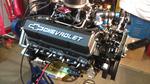
It seems the boating community loves this engine. Enjoy some photos!
I have 5 volts on the grey wire at the MAP with it unplugged. my next check i will check it with the sensor plugged in
I am going to toss this out there. I read multiple times that your FP was at 38psi even when it is stalling. That is low if the pump is still running. I am assuming on the boat you are still running the same fuel rails as our cars do. The no vacuum fuel pressure on an LT1 should be higher than 43PSI. As your engine dies, vacuum is reduced, pressure should be going up to near 0 vacuum setting. I do not think this would make your engine die, but it doesn't seem right.
The three sensors that your Buddy Larry from Indmar your ECM needs to see the "Coolant Temperature Sensor, The Manifold Absolute Pressure sensor and the Throttle Position Sensor."
This is very similar to what your Corvette Engine does but with the oxygen sensor to make even more precise fuel air mixtures. Since you are only using the TPS, MAP and CTS for the information needed to make this engine run that narrows down where to look.
My first guess will be that it is associated with your MAP system. Your software shows a MAP Voltage at .41 to .43, you also have several MAP sensors responding.
Why are there so many MAP sensors: Raw Map Sensor,1 atmosphere MAP Sensor, 2 atmosphere MAP sensor and the Bosch MAP sensor?
If the engine is not able to measure the air being ingested into the Combustion chambers then it will not rev properly. Check the MAP twice and even three times over to be sure it is working properly. Which MAP Sensor does it use for the calculations for the A/F mixture?
If it is not the MAP then it has to be one of the other two critical sensors. The TPS has to be "set" on some engines so it knows the range of the throttle movement. Verify it once more please..
The CTS should be the easiest one to check and verify it is operating properly. This is the less likely culprit as it should allow the engine to rev normally.
This sounds like a problem with one of the three primary components and I will bet MAP. When a MAP fails you are stuck with an inability to rev freely. The problem with that is that your engine is "shutting off" like the key was turned. That sounds like a control system doing it, especially as you mentioned that you still have a spark after the shutdown.
After seeing those beautiful pictures of a Corvette engine in a Boat it makes me appreciate my 165HP Mercury setup I have in my old Mach-One Power boat. That is a lot of engine in that engine compartment. I will stick with my Four banger Mercruiser as it gets me up to 50 mph on the water. On the water that is fast enough for me.... I went 1500 miles at 10 knots getting to Virginia from Southwest Florida. I like going slow and not spending a lot on fuel.
The three sensors that your Buddy Larry from Indmar your ECM needs to see the "Coolant Temperature Sensor, The Manifold Absolute Pressure sensor and the Throttle Position Sensor."
This is very similar to what your Corvette Engine does but with the oxygen sensor to make even more precise fuel air mixtures. Since you are only using the TPS, MAP and CTS for the information needed to make this engine run that narrows down where to look.
My first guess will be that it is associated with your MAP system. Your software shows a MAP Voltage at .41 to .43, you also have several MAP sensors responding.
Why are there so many MAP sensors: Raw Map Sensor,1 atmosphere MAP Sensor, 2 atmosphere MAP sensor and the Bosch MAP sensor?
If the engine is not able to measure the air being ingested into the Combustion chambers then it will not rev properly. Check the MAP twice and even three times over to be sure it is working properly. Which MAP Sensor does it use for the calculations for the A/F mixture?
If it is not the MAP then it has to be one of the other two critical sensors. The TPS has to be "set" on some engines so it knows the range of the throttle movement. Verify it once more please..
The CTS should be the easiest one to check and verify it is operating properly. This is the less likely culprit as it should allow the engine to rev normally.
This sounds like a problem with one of the three primary components and I will bet MAP. When a MAP fails you are stuck with an inability to rev freely. The problem with that is that your engine is "shutting off" like the key was turned. That sounds like a control system doing it, especially as you mentioned that you still have a spark after the shutdown.
After seeing those beautiful pictures of a Corvette engine in a Boat it makes me appreciate my 165HP Mercury setup I have in my old Mach-One Power boat. That is a lot of engine in that engine compartment. I will stick with my Four banger Mercruiser as it gets me up to 50 mph on the water. On the water that is fast enough for me.... I went 1500 miles at 10 knots getting to Virginia from Southwest Florida. I like going slow and not spending a lot on fuel.
This is definitely not my area of expertise, but doesn't it matter if the system is in closed-loop vs open? Or is that only for O2 sensor trimming? OP does the engine behave the same cold vs hot?
This is definitely not my area of expertise, but doesn't it matter if the system is in closed-loop vs open? Or is that only for O2 sensor trimming? OP does the engine behave the same cold vs hot?
Closed/Open is based on using 02 Feedback or not. Open is not, closed is.
Along with your fuel system... how does a boat use the CTS? the system is constantly pulling in cool lake water... it is an open system. They have to compensate for this in some manner. Where is the CTS located on your engine?
I agree with the new parts not meaning anything. I would suggest finding someone with a LT1 in their good running car ... and see if you can borrow their MAP sensor for an evening. A part that has been on a well functioning engine for 6 months is way more trustworthy than a new in box part, especially electrical.
Ill try to help ya. Boat tech of 25 years...Let me go re-read everything and see whats going on..
1st...Did the prop get changed, or replaced? .Did you do a comp test? Easy as hell on an inboard engine.
Someone said about 5 volts...It IS the same as automotive. 5 volt reference across the board.
IAC wouldnt change anything. PSI fuel seems ok (would at least allow close to WOT)
Ill be back
Saw you did a comp test...good....
Im leaning towards restricted fuel flow, and or plugged injectors. Do you have an anti-syphon valve in tank? Its right at the tank/hose to engine. These are prone as hell to sticking (there is a ball and spring in there. Over time it gets slowly gummed up).... You as a consumer can replace it with a brass barb. Or get a new one (but you should just ditch it) This goes for a fuel shut off valve. Dont remember Indmar using one, but check. The fuel should go from tank right to engine.
Take out injectors and have them cleaned or Do it yourself. Fuel flows though the injector, so no cleaner will reverse the flow to clean them out( Screens on injectors) If you take them out you can run voltage to them to open while blowing air backwards. This 90% of the time works. Fuel cleaners however, 10% maybe...
If the fuel line is older then 2008ish - replace it. Use 3/8 marine hose. The old stuff dosent hold up at all to the ethanol. The insides collapse, expand, flake apart (look for black speks in the fuel filter) and other issues.
These are all easy as hell to do to your boat.
I can tell you damn near all problems on boats are fuel related. And your numbers look good on the info you gave.
Last edited by FostersPerformance; Jan 16, 2020 at 04:28 PM.
And the engine still has a thermostat, btw..Engine temp should always be 175...Even though its non-closed system, the thermostat keeps pressure then opens. Just about ALL inboards run 175 degrees temp. Just so you know...
I would imagine it would be tough to keep the engine operating at 175* in some of the upstate New York lakes even in Mid-August. How do they use lake water and have a thermostat? I used a good size heat exchanger and a closed loop cooling system with coolant and all
How does this engine operate without the Oxygen sensor? Different emissions laws for Boats?
Where do they hide the Coolant temperature sensor?
Why multiple MAP sensors? 1 atmosphere, 2 atmosphere and then a Bosch MAP? The idea of the 1 MAP versus 2 makes sense as they probably turbocharge/Supercharge some of these Engines. Where does the engine read when you have different signals coming in.
The way it just dies seems to have something to do with it. It shuts off like the key was turned "off" where the power just shut down. I agree, I think it has something to do with the fuel system but in the controls just turning off. I have seen such systems on inboards that protects the engine in case of oil loss or some other failure. I welcome you to this discussion as it needs more specific "Marine Knowledge" to move on. He has told us he replaced all the filters and has fuel pressure, I was also asking about the fuel flow being impeded potentially.
Thanks for helping us figure out to run an modern engine without the O2 sensor! I am very interested in learning more!