When you click on links to various merchants on this site and make a purchase, this can result in this site earning a commission. Affiliate programs and affiliations include, but are not limited to, the eBay Partner Network.
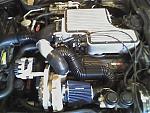
MAT - Manifold Air Temperature sensor. Helps the ECM fine tune mixture ratios. It has a connector pigtail coming from the firewall area near the distributor and it runs forward / under the plenum to connect.
That is the Manifold Air Temperature sensor all right. I have been (mistakenly?) calling this sensor the Intake Air Temperature . Either way they do the same thing which is measure the temperature of the air on it's way through the intake manifold and into the Combustion Chamber.
But when you See where the sensor is mounted on this engine doesn't it seem odd to be threaded into an aluminum plenum part? The sensor gets heated up by absorbing the surrounding heat mostly the hot metal around it. Your engine would prefer the "coolest" air you can get into it, even the L98. Re-locating this sensor to a location where it can read the actual intake air temperature without effects of hot brackets and plenums is a very good thing to do.This would help the L98 see correct data and adjust based on accurate sensor readings.
The Manifold Air Temperature/Intake Air Temperature sensor has a Thermistor (a Thermal Transistor). Through the computer, the MAT sensor causes modification of Spark Advance and Fuel Enrichment during acceleration. It is also a prime player in Open loop operation as well as Closed loop. I have been telling people to check their Coolant Temperature Sensor as it is a "critical" component to the ECM the CTS sensor needs to be accurate for the car to run right. Well, guess what I am going to pay more attention to the MAT/IAT sensor to be sure it is "accurate" as well as it too is a very important player in the world of ECM Calculations. This is why I strongly recommend you re-locate the sensor to a cooler location if you seek the most out of your Corvette.... If you need more convincing take a measurement of the air temp and see what your car "sees" on a scanner. On some cars the heat is substantial and that robs the engine of power.
Corvette Central has the kits in stock to relocate your MAT/IATfor $57 and it says the following on the sales page: "1985-1991 MAT Sensor's stock location is near a great deal of heat, causing loss of performance. This Relocating Kit moves the sensor to allow cooler ambient temperature readings. Requires drilling a 7/8" hole in the air filter base, simple plug-in installation."
"This kit relocates the IAT Sensor away from the hot engine compartment so the computer can receive accurate reading of ambient air temperature, thus increasing performance."
Corvette Central has the kits in stock to relocate your MAT/IATfor $57 and it says the following on the sales page: "1985-1991 MAT Sensor's stock location is near a great deal of heat, causing loss of performance. This Relocating Kit moves the sensor to allow cooler ambient temperature readings. Requires drilling a 7/8" hole in the air filter base, simple plug-in installation."
"This kit relocates the IAT Sensor away from the hot engine compartment so the computer can receive accurate reading of ambient air temperature, thus increasing performance."
Good luck
That 'mentioned package' can be fabricated for probably less than 1/2 the $$ ($25 likely or less) and all components purchased 'locally'. That IS NOT an economical solution!
Originally Posted by johnfin
Is the harness part of the ECM harness and is it the same for 85/86
There's a short jumper from the sensor to the harness, your wiring diagram and FSM should have all the information you need to accomplish the connection and use of the sensor. The jumper is the same for most TPI that have that sensor location.
Can you please cite your sources for this information?
In a recent thread, tequillaboy told us that the MAT sensor is used ONLY for EGR enable. The ECM DOES NOT USE MAT FOR FUELING CALCULATIONS.
So it doesn't matter where it is located, or if it is even hooked up for fueling. It does have DTCs associated with it, and the SES comes on when the car is stopped, so to avoid the annoyance, the MAT has to be hooked up. But "fueling" is unaffected by the MAT.
I trust tequillaboy has forgotten more about how these calibrations function than most people on this board know. (Other than bankuski, who also knows his chit.)
EDIT/ADD: I just reviewed the MAT Codes 23 and 25. The Service Engine Soon light is only illuminated after 2 minutes engine run time, No VSS, and the voltage is out of range for 4 seconds. The SES will only stay on when all three conditions are met. So MAT is not important, it doesn't even leave the SES on once the car is moving. There is also no description telling what the MAT signal is used for. None. On the contrary, the CTS codes set after 4 seconds out of range and the SES stays on for the remainder of the key cycle. There are NINE calculations which uses CTS. We all know CTS is important, and the FSM treats it as such. MAT? Not at all important.
When I was working on figuring out my setup, I recall that same info posted as well. I believe it is specific to MAF based cars. There wouldn't be a reason for it to effect fueling on one.
I apologize for not having this reference posted in the post. My error.
The source I should have put on the post is the following book that I mention every so often. It is called: How To Understand, Service and Modify Corvette Fuel Injection & Electronic Engine Management and it was written by Charles O. Probst with Bentley Publishers
My cover says it covers "1982 through 2001 years models as well as the following engines L83, L98, LT1, LT4, LS1, LS6 and ZR-1".
This book is useful because they explain the various parts and explain how they interact. It is a good easy book to read and the tricks are all over the place. I keep my copy with my C4 stuff and read it often.
I personally had been ignoring the importance the MAT/IAT sensor when the whole time we should have been checking them and keeping them are working the best they can. They do have an affect on the L98 in Open Loop and Closed Loop and is not an insignificant component in the realm of the L98 EFI system.
Yes, with $0.50 worth of wire I could make my own extension but not everybody likes doing that or has the tools readily available. I am not suggesting anybody buy anything without shopping around. For even $5 worth of wire, solder and heat shrink I would think this is one of the cheapest performance upgrades on any L98 with it's MAT/IAT still mounted in the factory spot.
The 1985 Corvette FSM (see pages below) says that the MAT sensor is used to delay EGR until the MAT temp reaches 40 F.
The wiring diagram from the FSM shows that the MAT sensor is wired to the MAF sensor, but does not describe how/if it controls anything here.
The FSM also shows an "EGR Temperature Switch", but does not describe its function (it does describe how to troubleshoot it though). I used to think this EGR Temperature switch performed the task that the FSM says the MAT sensor does.
I am not taking any side here, but I want to understand what the MAT and EGR temp switches really do.
What is the function of the EGR Temp Switch if the MAT controls the EGR temp delay?
MAT/ EGR Temp Switch Wiring Page 6E-10 of FSM MAT Sensor Description Page 6E-74 of FSM EGR System Page 6E3-120 of FSM
The 1985 Corvette FSM (see pages below) says that the MAT sensor is used to delay EGR until the MAT temp reaches 40 F.
The wiring diagram from the FSM shows that the MAT sensor is wired to the MAF sensor, but does not describe how/if it controls anything here.
The FSM also shows an "EGR Temperature Switch", but does not describe its function (it does describe how to troubleshoot it though). I used to think this EGR Temperature switch performed the task that the FSM says the MAT sensor does.
I am not taking any side here, but I want to understand what the MAT and EGR temp switches really do.
What is the function of the EGR Temp Switch if the MAT controls the EGR temp delay?
MAT/ EGR Temp Switch Wiring Page 6E-10 of FSM MAT Sensor Description Page 6E-74 of FSM EGR System Page 6E3-120 of FSM
The MAF and MAT in that diagram are simply sharing a 5v reference/power source. It has no bearing on one and other as it's measuring the resistance on A11 for the MAT sensor and whatever other pin for the MAF.
As for the EGR switch, I am unsure. Being it appears to be a simple on off temp switch, perhaps it serves as function test of the egr valve? It would seem it provides feedback by simple thermal switch to the ecm that the egr has gasses flowing? I'd have to read through an 85 manual to confirm that but based on the diagram, it appears to be something of that nature.
You can only remove the EGR completely and correctly by having a new code written for your Corvette to eliminate it in the software. Disabling the EGR on the engine will hurt the performance of the engine and cause the emissions will start having more NOX in it. My car failed the emissions test because the EGR was bad and my NOX was really high. When the EGR is bad the engine will run higher combustion chamber temperatures and potentially detonate as well. It will require the engine be fed higher octane fuel to keep it from detonating.
Well I am sorry you feel that way ihatebarkingdogs. I think of Clymers as a generic "How-to" Book and this book by Charles Probst is anything but that.
Here is a piece about the book: "The engine is the heart of the Corvette and the heart of the Corvette engine is its electronic management system. Corvette Fuel Injection Electronic Engine Control is the book that explains that system. Chuck Probst, author of the authoritative Bentley books on Bosch and Ford fuel injection systems, has worked with GM and aftermarket engineers, trainers, and technicians to bring the same sort of inside information to an authoritative understanding of Corvette engine controls. The comprehensive troubleshooting tips and service procedures presented here are a great aid in mastering Corvette engine control systems. The book begins with a survey of the different fuel injection systems used in these cars: Throttle Body Injection (TBI), Multiport Fuel Injection (MFI), and Sequential Fuel Injection (SFI). Probst covers the reasons behind J1930 terminology (electrical/electronic systems diagnostic terms, definitions, abbreviations and acronyms) and the engine management concept of Open Loop and Closed Loop Operation. In addition, oxygen sensor and heated oxygen sensor operation, traction control, Exhaust Gas Recirculation (EGR), Air Injection (AIR), catalytic converters, evaporative controls, octane and fuel volatility are among the many thoroughly covered topics. Probst's treatment of On-Board Diagnostics (OBD and OBD II) involves topics such as misfire detection, crankshaft position sensor operation, Mass Air Flow (MAF) sensor design, Electronic Spark Control (ESC), and Central Processing Unit (CPU). No other book comes close in providing this much detailed, proven information, with 380 pages including 112 pages of model-specific wiring diagrams, trouble codes, and test specifications along with hundreds of photos and illustrations. Get it and go faster!"
I would strongly suggest you take a look at the book and judge for yourself. I know of tequilaboy and Bankuski and have lots of respect for their knowledge of the C4's. This book is a true resource and I believe you will find lots of great information in it.
We have a Mass Air Flow or MAP to calculate the volume of air passing thru into the combustion chambers. How does the engine know the density of the air passing thru, by measuring the intake air's temperature. Colder air is more dense as opposed to hot air. Without this sensor the computer could not make the proper fuel adjustments and it would not run properly. The MAT is used in both Open Loop and Closed Loop. Every time you go to wide open throttle the MAT is helping get the right fuel mixture for the best acceleration possible.
The EGR "Diagnostic Temp Switch" is an on-off switch installed in the base of the EGR valve, or in the pipe on aluminum head engines. When EGR is enabled, the base or the pipe gets hot, and the switch closes. The ECM uses this input for the Code 32 Diagnostic. Nothing else. If the ECM is commanding EGR, and the conditions are met that the switch should be closed, but it isn't, Code 32 sets. Hence the term "diagnostic" in it's description. Code 32 will also be set if the switch is detected closed upon engine start, because it obviously shouldn't be.
I want to thank the peeps here that put up the descriptions of the MAT and EGR from the FSMs. Those both clearly show that the MAT is used for EGR enable, and nothing else. Chris needs to compare the descriptions of what MAT does with the same for CTS.
So, the EGR Temp Switch just confirms EGR flow (when EGR is called for) via a temp switch and not a flow reading. Makes sense. I wish the FSM explained this, because I can't find where it does.
The beauty of the maf system is that it is mass based. The maf sensor directly measures the mass air flow rate in grams/second. More accurately put, a lookup table is used to convert the sensor voltage to a flow rate. All the ecm has to do is calculate the injector pw to deliver the appropriate fuel mass for a given target AFR and mass airflow rate, since the number of injectors and injector flow rate is already known. Volume and temperature are not considered, since the sensor automatically accounts for variation in charge air temperature, and does it quite well.
In this log, you can see a dramatic increase in the maf air temperature which is of course interesting, but it has no bearing whatsoever on the fueling. Note the WBO2 and target afr signals along with mass airflow and maf air temp. You can see that the fuel control is quite accurate under significantly different conditions, all because of the capability of the maf sensor and the quality of the calibration.
Note: This is one of my custom blower tunes. This car is equipped with a Blowerworks slot-style maf. The IAT signal from the MAF sensor is being used instead of the factory MAT signal, since it is very slow to respond. This new signal is labelled "maf air temp" in the log. 383, miniram (no egr), D1 blower, 48 lb/hr injectors.
This car is about out of injector with 10+ ms pulse widths at 5500 rpm. It will reach 100% duty cycle at 6,000 rpm. I wanted to also show pw vs load, but the load signal is already pegged at its maximum as soon as the throttle is opened to WOT despite the increased load range (150%), so the pw vs load relationship is not as linear as it would otherwise be. This is not an issue since the maf flow range has been increased to 300% and the pw is being calculated (not looked-up from the load table). It is also worth noting that the 3500 kg/hr meter is nearly pegging at 5.12 volts (not shown in this log). This car made more power than expected. For any more power, lager injectors and an upgrade to a 5,000 kg/hr meter would be recommended.
2nd Note: Hot air temperatures like this will kill a Bosch style maf in very short order. Remember the heat-sinks that everybody would remove to increase flow, ha-ha.
My apologies for going off topic, but wanted to clarify a few points regarding the maf and fueling.
Last edited by tequilaboy; Jan 19, 2022 at 03:43 PM.