




Cam suggestions
Le Mans Master


Joined: Aug 2015
Posts: 6,090
Likes: 1,972
From: St. Charles MO

LOL, this is an entertaining thread! So again, that Super Ram should be a good match for your heads. Neither the heads nor intake flow a ton at high RPM, but that intake will get rid of the TPI "brick wall" above 4000rpm and has bigger runners. It's a great intake upgrade on a stock or near-stock 350. So focus on a cam that's good from idle~5500rpm. This can be a nice street engine with real gains over the stock L98.
PS - Find out the rear axle gear ratio on your C4. If it's 2.59:1, you would really benefit from looking at going to 3.07. Those are ubiquitous and so should be cheap to obtain and easy to swap, and it would really help this power train come alive.
PS - Find out the rear axle gear ratio on your C4. If it's 2.59:1, you would really benefit from looking at going to 3.07. Those are ubiquitous and so should be cheap to obtain and easy to swap, and it would really help this power train come alive.
Last edited by MatthewMiller; Feb 20, 2022 at 10:21 AM.

Instructor

Joined: Mar 2021
Posts: 189
Likes: 73
From: Christiansburg Va
For the cam take a look at the old LT4 hot cam or something in that duration range. I think the hot cam with 1.5 rockers combined total lift will work without interference but should be checked anyway.
As mentioned above, a gear change would sure help out too.
As mentioned above, a gear change would sure help out too.

Team Owner


Joined: Sep 2001
Posts: 62,139
Likes: 1,728
From: Athens AL
C7 of the Year - Unmodified Finalist 2021
C4 of Year Finalist (performance mods) 2019
I would go with the tried and true Accel 219/219@050 cam for the combo, but anything in that 220ish range is fine. It will need a custom tune after the cam is in.
I would ask the tuner about sticking with 24lb injectors, it may want more fuel than that.
I would ask the tuner about sticking with 24lb injectors, it may want more fuel than that.
Melting Slicks

Joined: Aug 2003
Posts: 3,394
Likes: 393
From: Lakeville MI
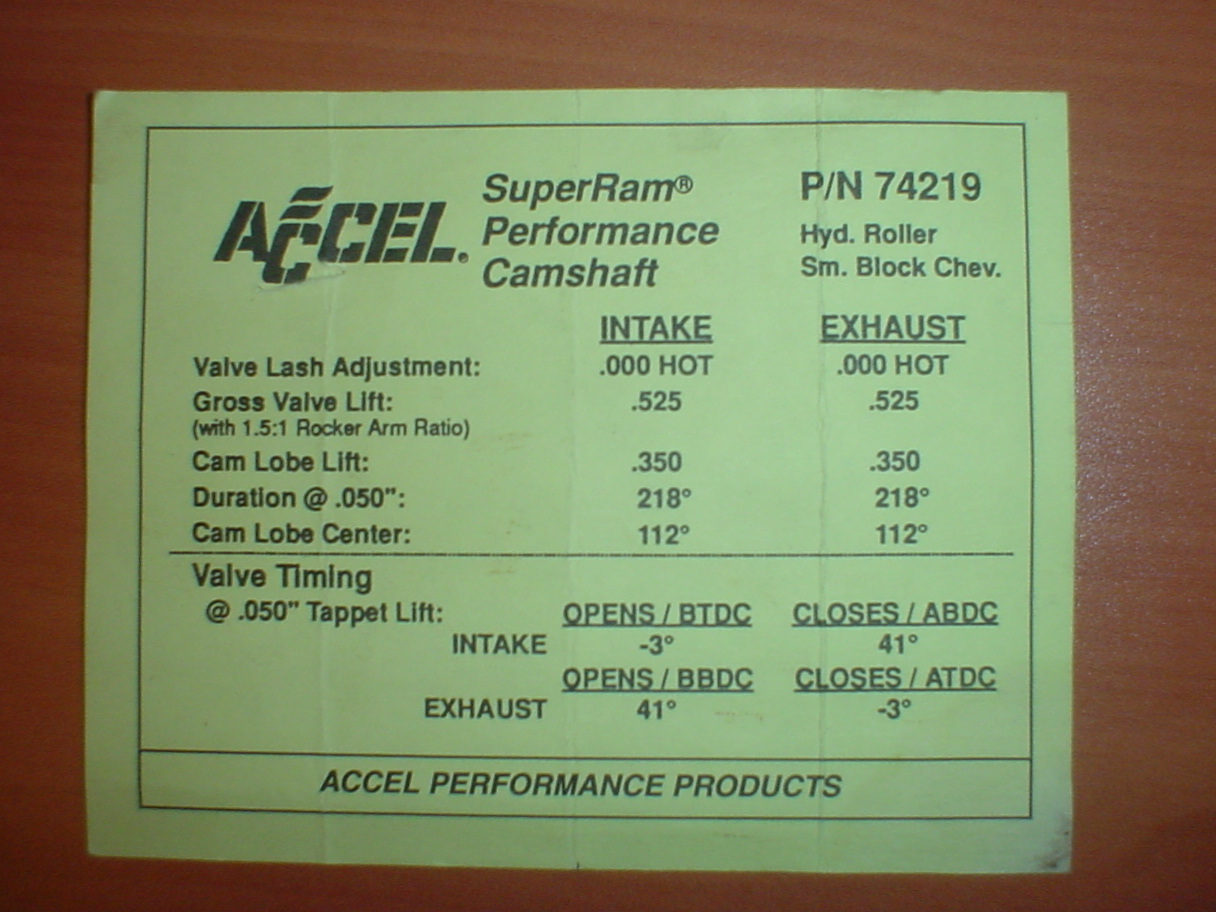
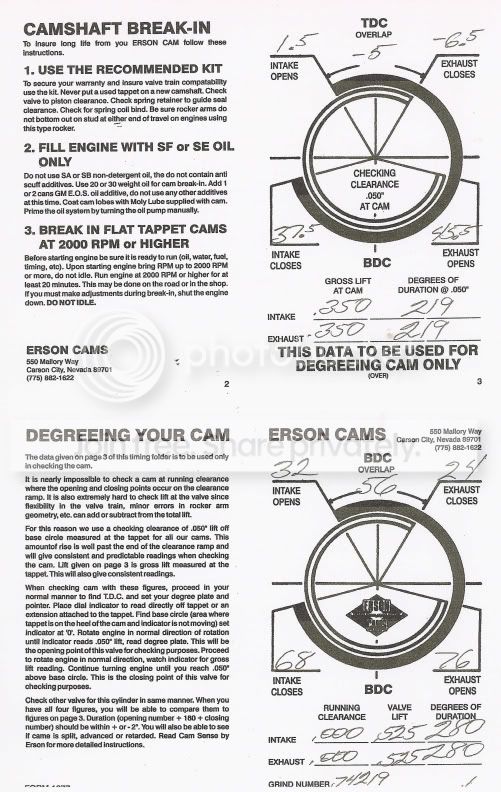
If the published specs can be trusted, the 219 has pretty lazy ramps. 280 advertised duration with only 218-219 at 0.050". 56 degrees of overlap. It should have all the negative qualities of a bigger cam, but without the benefit of longer 0.50" duration. I think you can do better.
From a couple of different CF sources:
SBC 350-420
SuperRam
219/219 Duration @ .050" w/1.5 ratio rockers
.525"/.525" Gross Valve Lift w/1.5 ratio rockers
.560"/.560" Gross Valve Lift w/1.6 ratio rockers
280deg. / 280deg. Duration@ .006" w/ 1.5 ratio rockers
108 deg. Intake Center Line w/ 1.5 ratio rockers
112 deg. Cam Lobe Center
.350"/ .350" Lobe Lift w/ 1.5 ratio rockers
1.5 RR 1.6RR
intake/exhaust intake/ exhaust
Valve Timing@ .050" open/BTDC close/ABDC
INTAKE 1.5 deg. 37.5 deg.
open/BBDC close/ATDC
EXHAUST 45.5 deg. -6.5 deg.
74219
PART NUMBER 74219 GROSS VALVE LIFT INT. 0.525
GRIND GROSS VALVE LIFT EXH. 0.525
ENGINE SBC INTAKE OPEN 32
ROCKER RATIO 1.50 INTAKE CLOSE 68
ROCKER RATIO 1.50 EXHAUST OPEN 76
CAM LIFT INTAKE .350 EXHAUST CLOSE 24
CAM LIFT EXHAUST .350 OVERLAP@ LASH 56
LOBE SEPARATION 112 INTAKE PHASE 108
ADV. OR RET. DEG. 4 ANGLE or CENTERLINE
INTAKE "LASH" DUR. 280
EXHAUST "LASH" DUR. 280 EXHAUST PHASE 116
INTAKE DUR @ .050" 219 ANGLE or CENTERLINE
EXHAUST DUR @ .050" 219
Erson version:
Its even lazier than an old comp magnum 224-224 which has a bit more overlap (60 degrees): https://www.compcams.com/magnum-224-...oller-sbc.html
The 224-224 has the same lift, but earlier intake closing (increased dcr), later exhaust opening (longer power stroke), increased overlap (better scavenging), and increased 0.050" duration. What's not to like? Vacuum and idle quality may suffer a bit.
If your willing to try a 219, might as well try a more modern cam up to 230-230 or something a bit smaller on a tighter LSA (like the magnum example above) in order to achieve similar overlap but with improved flow potential due to the increased 0.050" duration.
From a couple of different CF sources:
SBC 350-420
SuperRam
219/219 Duration @ .050" w/1.5 ratio rockers
.525"/.525" Gross Valve Lift w/1.5 ratio rockers
.560"/.560" Gross Valve Lift w/1.6 ratio rockers
280deg. / 280deg. Duration@ .006" w/ 1.5 ratio rockers
108 deg. Intake Center Line w/ 1.5 ratio rockers
112 deg. Cam Lobe Center
.350"/ .350" Lobe Lift w/ 1.5 ratio rockers
1.5 RR 1.6RR
intake/exhaust intake/ exhaust
Valve Timing@ .050" open/BTDC close/ABDC
INTAKE 1.5 deg. 37.5 deg.
open/BBDC close/ATDC
EXHAUST 45.5 deg. -6.5 deg.
74219
PART NUMBER 74219 GROSS VALVE LIFT INT. 0.525
GRIND GROSS VALVE LIFT EXH. 0.525
ENGINE SBC INTAKE OPEN 32
ROCKER RATIO 1.50 INTAKE CLOSE 68
ROCKER RATIO 1.50 EXHAUST OPEN 76
CAM LIFT INTAKE .350 EXHAUST CLOSE 24
CAM LIFT EXHAUST .350 OVERLAP@ LASH 56
LOBE SEPARATION 112 INTAKE PHASE 108
ADV. OR RET. DEG. 4 ANGLE or CENTERLINE
INTAKE "LASH" DUR. 280
EXHAUST "LASH" DUR. 280 EXHAUST PHASE 116
INTAKE DUR @ .050" 219 ANGLE or CENTERLINE
EXHAUST DUR @ .050" 219
Erson version:
Its even lazier than an old comp magnum 224-224 which has a bit more overlap (60 degrees): https://www.compcams.com/magnum-224-...oller-sbc.html
The 224-224 has the same lift, but earlier intake closing (increased dcr), later exhaust opening (longer power stroke), increased overlap (better scavenging), and increased 0.050" duration. What's not to like? Vacuum and idle quality may suffer a bit.
If your willing to try a 219, might as well try a more modern cam up to 230-230 or something a bit smaller on a tighter LSA (like the magnum example above) in order to achieve similar overlap but with improved flow potential due to the increased 0.050" duration.
Last edited by tequilaboy; Feb 23, 2022 at 05:12 AM.

Thread Starter
Instructor
Joined: Aug 2016
Posts: 143
Likes: 16
From: Calgary alberta
Gears
Tuning will have a huge impact on horsepower. Guess is your probably around 285-290 hp.
Stock automatic has either 2.59 or 3.07 axle ratio. If you have the 2.59,IMO gear change to 3.07-3.73 is required before cam change. Used D36 3.07 assemblies are thrifty and easy swap. Cam selection will depend on how you will use car, highway, stoplight grand prix, auto X. New cam will also require new tune.
Stock automatic has either 2.59 or 3.07 axle ratio. If you have the 2.59,IMO gear change to 3.07-3.73 is required before cam change. Used D36 3.07 assemblies are thrifty and easy swap. Cam selection will depend on how you will use car, highway, stoplight grand prix, auto X. New cam will also require new tune.

Race Director

Joined: Nov 2003
Posts: 12,221
Likes: 446
From: Overland Park Kansas
2020 Corvette of the Year Finalist (appearance mods)
C4 of Year Winner (appearance mods) 2019
Less "lazy" than Lingenfelter 219/219, about the same lift, a little more duration to help with exhaust
Comp Cams 218/224 XFI? adv=268/276 (.050=218/224 .57 lift with 1.6 rockers LSA 113) ICL not listed on CC website
Might require different valve covers though. Also have to check Patriot heads max lift.
Comp Cams 218/224 XFI? adv=268/276 (.050=218/224 .57 lift with 1.6 rockers LSA 113) ICL not listed on CC website
Might require different valve covers though. Also have to check Patriot heads max lift.

Safety Car


Joined: Oct 2007
Posts: 4,204
Likes: 1,074
From: South Florida
For reliability and longevity (if this is a goal) you want the lowest lift and slowest ramp camshaft.
-The rate of lift needs to be slow to set the valve down gently and open it gently for complete control.
-The overall lift total needs to be low as possible to minimize valvetrain wear and tear.
-Valve spring should be as 'light' (as little pressure) as possible/feasible.
-Duration is where you can design strategy a perfect camshaft power range, any duration is fine as you desire
For example the camshaft in my 5.3L is TFS-30602001
Very low lift as aftermarket cams go, very slow ramp rate of lift.
Works with PAC1218 Valve springs which are fairly light as springs go.
This cam is useful for valve stability, high RPM valve control, and long term durability / longevity of the valvetrain.
It also happens to support 600-800 rear wheel horsepower via turbocharging. No reason to use a large cam for big power these days.
But I choose reliability over power any day. The choice to turbocharge and use a small cam while still having 600 or 800hp is a longevity/durability choice for the setup. This is why I recommend you leave the cam alone and pursue knowledge of how to make power first. Once you understand how to make the power using the most basic/lowest "gentle" parts which work well together you can maintain a high reliability in lieu of high output.
-The rate of lift needs to be slow to set the valve down gently and open it gently for complete control.
-The overall lift total needs to be low as possible to minimize valvetrain wear and tear.
-Valve spring should be as 'light' (as little pressure) as possible/feasible.
-Duration is where you can design strategy a perfect camshaft power range, any duration is fine as you desire
For example the camshaft in my 5.3L is TFS-30602001
Very low lift as aftermarket cams go, very slow ramp rate of lift.
Works with PAC1218 Valve springs which are fairly light as springs go.
This cam is useful for valve stability, high RPM valve control, and long term durability / longevity of the valvetrain.
It also happens to support 600-800 rear wheel horsepower via turbocharging. No reason to use a large cam for big power these days.
But I choose reliability over power any day. The choice to turbocharge and use a small cam while still having 600 or 800hp is a longevity/durability choice for the setup. This is why I recommend you leave the cam alone and pursue knowledge of how to make power first. Once you understand how to make the power using the most basic/lowest "gentle" parts which work well together you can maintain a high reliability in lieu of high output.
Corvette Stories
The Best of Corvette for Corvette Enthusiasts

150 hp to 1,250 hp: Every Corvette Generation Compared by the Specs That Matter
Joe Kucinski
8 Coolest Corvette Pace Cars (and Replicas) of All Time
Verdad Gallardo
Top 10 Corvette Engines RANKED by Peak Torque (70+ Years of Muscle!)
Joe Kucinski
Corvette ZR1X Will Be Pacing the Indy 500, And Could Probably Race, Too!
Verdad Gallardo
Top 10 Corvettes Coming to Mecum Indy 2026!
Brett Foote
Top 10 C9 Corvette MUST-HAVES to Fix These C8 Generation Flaws!
Michael S. Palmer
10 Revolutionary 'Corvette Firsts' Most People Don't Know
Joe Kucinski
5 Reasons to Upgrade to an LS6-Powered Corvette; 5 Reasons to Stay LT2
Michael S. Palmer
2027 Corvette vs The World: Every C8 vs Its Closest Competitor
Joe Kucinski
Thread Starter
Instructor
Joined: Aug 2016
Posts: 143
Likes: 16
From: Calgary alberta
Cam
For reliability and longevity (if this is a goal) you want the lowest lift and slowest ramp camshaft.
-The rate of lift needs to be slow to set the valve down gently and open it gently for complete control.
-The overall lift total needs to be low as possible to minimize valvetrain wear and tear.
-Valve spring should be as 'light' (as little pressure) as possible/feasible.
-Duration is where you can design strategy a perfect camshaft power range, any duration is fine as you desire
For example the camshaft in my 5.3L is TFS-30602001
Very low lift as aftermarket cams go, very slow ramp rate of lift.
Works with PAC1218 Valve springs which are fairly light as springs go.
This cam is useful for valve stability, high RPM valve control, and long term durability / longevity of the valvetrain.
It also happens to support 600-800 rear wheel horsepower via turbocharging. No reason to use a large cam for big power these days.
But I choose reliability over power any day. The choice to turbocharge and use a small cam while still having 600 or 800hp is a longevity/durability choice for the setup. This is why I recommend you leave the cam alone and pursue knowledge of how to make power first. Once you understand how to make the power using the most basic/lowest "gentle" parts which work well together you can maintain a high reliability in lieu of high output.
-The rate of lift needs to be slow to set the valve down gently and open it gently for complete control.
-The overall lift total needs to be low as possible to minimize valvetrain wear and tear.
-Valve spring should be as 'light' (as little pressure) as possible/feasible.
-Duration is where you can design strategy a perfect camshaft power range, any duration is fine as you desire
For example the camshaft in my 5.3L is TFS-30602001
Very low lift as aftermarket cams go, very slow ramp rate of lift.
Works with PAC1218 Valve springs which are fairly light as springs go.
This cam is useful for valve stability, high RPM valve control, and long term durability / longevity of the valvetrain.
It also happens to support 600-800 rear wheel horsepower via turbocharging. No reason to use a large cam for big power these days.
But I choose reliability over power any day. The choice to turbocharge and use a small cam while still having 600 or 800hp is a longevity/durability choice for the setup. This is why I recommend you leave the cam alone and pursue knowledge of how to make power first. Once you understand how to make the power using the most basic/lowest "gentle" parts which work well together you can maintain a high reliability in lieu of high output.
Race Director
Joined: Nov 2003
Posts: 12,221
Likes: 446
From: Overland Park Kansas
2020 Corvette of the Year Finalist (appearance mods)
C4 of Year Winner (appearance mods) 2019
It's been too long for me (over 10 years). I'm having trouble remembering the limitations of stock heads -- for lift? More specifically, if/what has to be altered to get higher lift. I'm thinking machining is required for part of the issue? Grinding under the valve covers is another part? Someone else should confirm this issue. I didn't see anything about new heads....which means my prior suggestion was a bad one ESPECIALLY when you are looking for longevity.
The Lingenfelter Superram cam sounds like a decent choice IF 1990 "113" alum heads can tolerate .525 lift? Of course GM sped'd the hotcam as a factory/longevity option. With 1.5 rockers, lift is only .490 which should clear -- for sure. It might only require valve cover "work" to get 1.6 rockers under there. If Lingenfelter had stock heads in mind (which I thought he did), I'd have to think his superram cam (listed by KingtalOn) might be THE quintessential choice? Plus, I'd think it would put you in the ballpark of your power goal....at least the low end of it. (Actually, I hadn't noticed it's fairly "lazy".)
You could also call Bullet cams and see what they say. I had longevity as an option and ended up being directed to their second-most "aggressive" [hydraulic lifter] ramp. It hits .544 lift with 1.6 rockers. I believe they offer it in a couple of durations around 220. (Mine is 214/214). There's a difference because I have AFR heads with double springs...possibly making mine "overkill" for caution. With single/factory springs, it might be advisable to stay below .500 lift? Again, someone should confirm/deny -- for an owner particularly concerned about longevity.
Long story short, I'm not an expert. Just thought I'd add some thoughts to get this discussion going again (for you).
The Lingenfelter Superram cam sounds like a decent choice IF 1990 "113" alum heads can tolerate .525 lift? Of course GM sped'd the hotcam as a factory/longevity option. With 1.5 rockers, lift is only .490 which should clear -- for sure. It might only require valve cover "work" to get 1.6 rockers under there. If Lingenfelter had stock heads in mind (which I thought he did), I'd have to think his superram cam (listed by KingtalOn) might be THE quintessential choice? Plus, I'd think it would put you in the ballpark of your power goal....at least the low end of it. (Actually, I hadn't noticed it's fairly "lazy".)
You could also call Bullet cams and see what they say. I had longevity as an option and ended up being directed to their second-most "aggressive" [hydraulic lifter] ramp. It hits .544 lift with 1.6 rockers. I believe they offer it in a couple of durations around 220. (Mine is 214/214). There's a difference because I have AFR heads with double springs...possibly making mine "overkill" for caution. With single/factory springs, it might be advisable to stay below .500 lift? Again, someone should confirm/deny -- for an owner particularly concerned about longevity.
Long story short, I'm not an expert. Just thought I'd add some thoughts to get this discussion going again (for you).
Thread Starter
Instructor
Joined: Aug 2016
Posts: 143
Likes: 16
From: Calgary alberta
Head
It's been too long for me (over 10 years). I'm having trouble remembering the limitations of stock heads -- for lift? More specifically, if/what has to be altered to get higher lift. I'm thinking machining is required for part of the issue? Grinding under the valve covers is another part? Someone else should confirm this issue. I didn't see anything about new heads....which means my prior suggestion was a bad one ESPECIALLY when you are looking for longevity.
The Lingenfelter Superram cam sounds like a decent choice IF 1990 "113" alum heads can tolerate .525 lift? Of course GM sped'd the hotcam as a factory/longevity option. With 1.5 rockers, lift is only .490 which should clear -- for sure. It might only require valve cover "work" to get 1.6 rockers under there. If Lingenfelter had stock heads in mind (which I thought he did), I'd have to think his superram cam (listed by KingtalOn) might be THE quintessential choice? Plus, I'd think it would put you in the ballpark of your power goal....at least the low end of it. (Actually, I hadn't noticed it's fairly "lazy".)
You could also call Bullet cams and see what they say. I had longevity as an option and ended up being directed to their second-most "aggressive" [hydraulic lifter] ramp. It hits .544 lift with 1.6 rockers. I believe they offer it in a couple of durations around 220. (Mine is 214/214). There's a difference because I have AFR heads with double springs...possibly making mine "overkill" for caution. With single/factory springs, it might be advisable to stay below .500 lift? Again, someone should confirm/deny -- for an owner particularly concerned about longevity.
Long story short, I'm not an expert. Just thought I'd add some thoughts to get this discussion going again (for you).
The Lingenfelter Superram cam sounds like a decent choice IF 1990 "113" alum heads can tolerate .525 lift? Of course GM sped'd the hotcam as a factory/longevity option. With 1.5 rockers, lift is only .490 which should clear -- for sure. It might only require valve cover "work" to get 1.6 rockers under there. If Lingenfelter had stock heads in mind (which I thought he did), I'd have to think his superram cam (listed by KingtalOn) might be THE quintessential choice? Plus, I'd think it would put you in the ballpark of your power goal....at least the low end of it. (Actually, I hadn't noticed it's fairly "lazy".)
You could also call Bullet cams and see what they say. I had longevity as an option and ended up being directed to their second-most "aggressive" [hydraulic lifter] ramp. It hits .544 lift with 1.6 rockers. I believe they offer it in a couple of durations around 220. (Mine is 214/214). There's a difference because I have AFR heads with double springs...possibly making mine "overkill" for caution. With single/factory springs, it might be advisable to stay below .500 lift? Again, someone should confirm/deny -- for an owner particularly concerned about longevity.
Long story short, I'm not an expert. Just thought I'd add some thoughts to get this discussion going again (for you).

s
Safety Car
Joined: Oct 2007
Posts: 4,204
Likes: 1,074
From: South Florida
1. Engines need to be kept clean inside like a human body during surgery. There are very few if any mechanics that understand that. Open the engine = risk of inclusion filthy fingers and airbourne debris.
2. Wrong spring / cam / lifters / rocker arms combinations = early demise
3. To make more power using a larger cam means giving up low end torque. Generally this means modifying the entire vehicle;
A. higher stall converter
B. Larger injectors
C. New tuning
D. Updated/improved air intake and exhaust pathways
You take all that risk and change all those parts and in the end even if you are lucky and everything goes smoothly that was alot of money and time and effort for like 20 or 40hp or whatever. And if you start talking 80hp+ then you are also looking at transmission rebuild/upgrades and drivetrain improvements to go with it. And theres a good chance that 1 of those 99 mods goes slightly wrong and the engine fails before its time anyways. Sorry.
This is just my natural skepticism after 23 years of building high power cars as daily drivers. It really comes down to who does the work, who chooses the parts and how they combine everything. And in the case of used parts, how they were treated and maintained and inspected since the past. I learned to always choose parts with NO modifications, old engines with 200,000 miles that have been left alone for 20 years is far superior to anything that has a single mod, even just an aftermarket air filter, can make the engine turn to trash in the long run.
Melting Slicks
Joined: Aug 2003
Posts: 3,394
Likes: 393
From: Lakeville MI
Is the car in running condition now? If so, you can conduct a few experiments to help give you an idea of what you have (assuming the car is running reasonably well). You've listed and shown some photos, but its not exactly clear how the car is actually equipped. I get the impression that some of the listed parts are still in boxes.
What is the idle rpm (in gear) with hot coolant?
What is the manifold vacuum at idle?
What is the ignition timing at idle?
How much vacuum can be achieved by advancing ignition timing? How much timing required to maximize vacuum?
What has been done (ecm) tuning-wise? If unknown, you can read the eprom with a programmer and compare to stock to see what has been done (if anything). An s/d car won't run very well with (almost) any mods without tuning.
Are you able to record aldl scan data? The CCM can make this tricky, but hopefully resolved by now as the tools should have evolved.
A dyno pull baseline might not be a bad idea.
What is the idle rpm (in gear) with hot coolant?
What is the manifold vacuum at idle?
What is the ignition timing at idle?
How much vacuum can be achieved by advancing ignition timing? How much timing required to maximize vacuum?
What has been done (ecm) tuning-wise? If unknown, you can read the eprom with a programmer and compare to stock to see what has been done (if anything). An s/d car won't run very well with (almost) any mods without tuning.
Are you able to record aldl scan data? The CCM can make this tricky, but hopefully resolved by now as the tools should have evolved.
A dyno pull baseline might not be a bad idea.