When you click on links to various merchants on this site and make a purchase, this can result in this site earning a commission. Affiliate programs and affiliations include, but are not limited to, the eBay Partner Network.
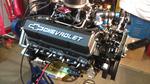
I think I’ve done something wrong. The engine is a 383 stroker with afr heads aggressive cam, miniram ii etc.
Just thinking of my original setup back when I ran a stock engine, the pcv was in one valve cover and then basically went to the bottom vacuum line on the passenger side of the throttle body. Just above the IAC valve.
as much as I know at this point I have to admit when I do something stupid. So when I got all my new setup I obviously had 2 valve covers with holes for breathers/pcv valves. I thought, why not put two pcv valves instead of an ugly breather and t them together and connect to the same vacuum line at the throttle body. I started seeing a light coating of oil in my intake so I also thought I’ll put a catch can in between the pcv valves and the throttle body.
well the catch can doesn’t really get much but I started having what looks like oil pushing out the dipstick at heavy throttle. That makes a ton of smoke burning off the headers. The engine passes a leak down and compression test, but I think I’m getting blowby at load and high rpm’s. I don’t think the pcv can handle it so it’s pushing out the dip stick.
The more I read it sounds like I could have failed to get rings to seat properly. But I’d like to get the pcv situated first before I go down that road. When I tried just 2 breathers and no pcv I got a bit of mist that came out at heavy throttle and a bit of track duty. I had to remove baffles in the valve covers because of my stud griddles so that might be why misting.
my thought is to pcv passenger side to the catch can, to the TB. Then driver side take tubing from the valve cover and run it to a small breather filter out of the way somewhere else.
The pcv sucks out crankcase fumes with vacuum from the engine. It does this from one valve cover. The other valve cover allows clean, filtered air back into the engine. Put a breather on this side or plumb it back to stock.
Agreed with 383vette.
My 383 is carbed. PCV on drivers side (tall covers, baffle in place) ran to carb base, and breather on passenger side with a hose to airbox/air cleaner base. I had started to make a catch can/filter from a bronze air compressor filter, but I am getting zero mist or blowby what so ever. I was kinnda surprised at that. Been seeing a few people here lately with blowby issues and or dipstick pressure issues.
Okay, but why does the stock setup not require a breather for “fresh air”? Or is it banking on the fact there would be zero blowby?
It does:
Originally Posted by 383vett
The other valve cover allows clean, filtered air back into the engine.
The stock set up behaves exactly like a breather. It IS a breather. When you open the throttle, yes, you'll have blow by, no doubt about it. You'll also have low or no manifold vacuum, so at that point, the PCV isn't working anyway. At heavy throttle, the blow by gasses will exit the engine through the passenger's side tube, just as though it were a breather....only diff is that instead of venting those gasses to atmosphere -as a breather does, it vents it to the intake duct, which is also "atmosphere", where it is then sucked into the intake, and burned.
At light throttle, when the PCV is working, then the passenger side vc is drawing fresh air into the engine, FROM the intake ducting...just like a breather would...only the air the stock system is pulling is filtered by the stock (large) air filter and not a dinky "filter" on your valve cover, and that air is "seen" and metered by the MAF, where with a vc mounted breather, it's not.
The OEM system functions the same as a breather, it just manages the crank case gasses rather than venting them to the air (and leaving oily residue on the breather/valve cover), and it measures ALL of the air, through the MAF.
Thank you for the clarification. When I took my old 48mm tb and blew through the two vacuum holes it made a lot of sense.
Let me preface my next statement with, I don’t want to sound like a “but I want to do it this way” and which I normally in your shoes would say fine dip ****, do whatever the hell you want. However….
I run a MAP sensor not a MAF. Since I track the car 80% of the time (don’t know why my account says “drifting” don’t know how to change that stupid label”. I drive road courses and instruct HPDE with NASA and SCCA) I’m concerned with coating the inside of the manifold with oil. Even with minimal blowby it’s still making its way to the intake and it’s hard for me to troubleshoot and figure out if I’ve sucked the edge of an intake gasket bordering the lifter valley or it’s just normal blowby oil mist.
from what I understand the oil catch can I want to run should go between the valve cover and the top 1/2” vacuum line on the TB. The Pcv can go to the bottom 3/8 vacuum line bottom passenger of the TB because it’s only pulling vacuum at low rpm where there should not be any misting oil or blowby…. ? I was thinking originally to put the catch can after pcv but sounds like the main sorce of oil mist I’m trying to capture is where the “breather” would go.
The "drifting" name is just based on your activity here. Someone posted how it works before.
Can you relocate the MAP ? Or even make a catch can between the MAP and manifold? What about a small bronze inline filter between MAP and manifold? Just a thought.
I don't think that there is any need to isolate the MAP. I don't think it "cares" what goes into it's orifice....it just measures pressure.
OP you're right that w/a MAP, your mass air measurement doesn't matter, so you can slap a breather on there....whatever. You're still going to draw oil vapor into the intake through the PCV though, so you need a catch can there, too, if you care. You'd need two catch cans. The car already has two "catch cans"....if you have the stock valve covers, each one has an oil separating device; one where the PCV valve plugs in and one where the breather does. Now, they're too small for "competition use", IMO, and they'll likely pass more vapor in that kind of use, but GM tried to address "catch canS" on both the PCV and the breather.
I think worrying about oil in the intake (normal amounts of oil residue) is "Worryin' about **** that ain't worth worryin' about", as I like to say. It's similar to worrying about carbon build up on pistons, when we know it will always build, then maintain a certain amount as more accumulates and the same amount burns off and goes away. Same w/the intake. You're going to get some oily residue in the intake no matter what, but it doesn't accrue....it just sort of "maintains". Now....if it's a personal "thing" and you just don't "like it"....then by all means, throw oil separators in the PCV, and breather tubes. Or eliminate them both and use two breathers/filters on the valve covers....then wipe off your valve covers after every drive. Either will likely work fine. If you're concerned about an intake leak, I'd try to diagnose that a different way.
FYI, PCV function isn't RPM dependent; it's vacuum dependent. So end of straights, cornering w/maintenance throttle, etc, any time the throttle is less than probably 1/2 open, you're pulling crank gasses through the PCV. In fact, if you chop the throttle at 6000 RPM for corner 1, that's about the highest intake vacuum the car could ever make....PCV will be pulling gasses like a som-bee (Utah "swearing" right there! )
.
Last edited by Tom400CFI; Jun 24, 2023 at 11:55 AM.
On the C3 forum, several members are having similar PCV issues and there was some really good discussion between them in their threads.
The two specific threads were posted by CorvettePassion with his 408 sbc and Rescue Rogers with his 427 bbc.
The threads are long build threads but their PCV issues were recent so look at postings during the last couple of months.
There was good data posted by leigh1322.
I just built a 496 for my 73 and I don’t plan to run a PCV.
I will have two Moroso filtered catch cans mounted on my firewall.
One for the drivers side and one for the passenger side valve covers.
I’ve seen where some people have run a hose from the passenger side catch can to the header collector and used the engine exhaust to pull any mist and help vent the crankcase gasses.
I appreciate the constructive feedback and indulgence. I feel I really understand things now. My map sensor is actually in my ECU with a separate vacuum line running to it so that’s not an issue. I see your point on the two catch cans and was my original thought. Just didn’t know I would have so much crank case pressure going the other direction.
now my friggin issue is finding a darn 90* elbow for my valve covers. I can’t use stock valve covers because my stud girdles are way too high. I’m using a Holley gm licensed pair.
for the life of me I can’t find a 1/2” elbow to slide into the grommets I already have. I emailed doorman to see if they could get me a part number because advanced and orileys are never any help “what year and make is it?”. So stupid.
all I need is something like this. This one is listed as a 92-96 but I think it might work but don’t have measurements listed.
I have had my fare share of PCV and Oil issues over on the C3 side of the forum myself. What I learned over there was to use Factory Valve covers with there breathers that don't suck Oil. When I built my C4 Motor I made sure I stuck with the Mag L98 covers just for this problem. If you used valve cover risers you might be able to use stockers.
If you care about the engine you need PCV. A breather is not PCV. Positive crankcase ventilation means two things
1. Streamlines which remove combustion blow-by gas before they can interact with engine oil
2. A pressure below atmospheric at all times
Breathers allow blow-by to mix with engine oil which will cause deposits, carbon conglomerates, oil leaks, dilute engine oil, leads to eventual wear and failure.
The pressure between the air filter and throttle valve is what drives WOT PCV on a natural aspirated engine, it will be less than atmospheric depending how much pressure drop provided by the air filter. OEM targets 0.5" to 1.5"Hg of vacuum.
The PCV valve opens more at WOT if the crankcase pressure rises because of a insufficient WOT PCV pressure drop and this causes oil to wash into intake manifold.
In other words people that modify their air filters without measuring the crankcase pressure, and people who use breathers, will find oil filling the baffles and intake manifold, then they think they need a catch can. But the true problem is lack of sufficient pressure drop on the crankcase at WOT.
Wow, that is some high level stuff. Now Im getting more questions from a theoretical standpoint not a fictional.
As for the original valve covers? My valvetrain is way too high for those. Talking maybe an inch of clearance missing.
I am trying to recreate the original setup, but I need that elbow to do it. What I’ll do is test it without the catch can with the stock setup and see if I’m still getting a film inside the intake.
I glossed over it before but I had real problems getting the manifold gasket to hold on the lifter side of things. I was sucking in oil from the lifter valley and that was the cause of the oil. If I can eliminate oil misting into it through the pcv then I can be sure to identify if that problem rears it’s head again, I’m a bit paranoid with detonation on this engine because I actually blasted a piston when my fuel pump overheated on track. It was a Chinese copy that made it into summit’s/Wolbro supply chain. I bit off more than I could chew thinking I could kill two birds with one stone upgrading the ecu to a MS3 and rebuilding the engine. It’s a long story, but I’m well warranted in my paranoia.
oil in the mixture will lower my octane rating technically and I’d rather avoid it.
so where can I get the elbow to make the stock system?
and thank you for elaborating. I’ve really learned something new.
To help with the fuel pump issue particularly in an NA application
1. IF the fuel pressure is constant (the 58psi type without a reference) you can add a fuel pressure safety switch to cut the engine if pressure drops
2. Add a wideband gauge big enough and placed well enough you can monitor at a glance for safety
3. Add a fuel pressure gauge with a setting that has a warning or light flashing at specific pressures
4. Use a fuel pump and injectors that can flow adequate fuel volume with reduced pressure, so you can reduce the fuel system to around 38-42psi baseline and this will keep fuel cooler. I always do this in forced induction applications.
5. Consider a PWM fuel pump controller which can reduce fuel pump heating and volume when off throttle
6. Make sure fuel pump is getting a full 14~ volts during Natural Aspirated operation for minimum heating. Consider a fuel pump voltage controller. Hard Wire pump to the battery. Low voltage causes over heating.
7. Worst case scenario is a fuel cooler but I do not recommend.
Wow, that is some high level stuff. Now Im getting more questions from a theoretical standpoint not a fictional.
As for the original valve covers? My valvetrain is way too high for those. Talking maybe an inch of clearance missing.
I am trying to recreate the original setup, but I need that elbow to do it. What I’ll do is test it without the catch can with the stock setup and see if I’m still getting a film inside the intake.
I glossed over it before but I had real problems getting the manifold gasket to hold on the lifter side of things. I was sucking in oil from the lifter valley and that was the cause of the oil. If I can eliminate oil misting into it through the pcv then I can be sure to identify if that problem rears it’s head again, I’m a bit paranoid with detonation on this engine because I actually blasted a piston when my fuel pump overheated on track. It was a Chinese copy that made it into summit’s/Wolbro supply chain. I bit off more than I could chew thinking I could kill two birds with one stone upgrading the ecu to a MS3 and rebuilding the engine. It’s a long story, but I’m well warranted in my paranoia.
oil in the mixture will lower my octane rating technically and I’d rather avoid it.
so where can I get the elbow to make the stock system?
and thank you for elaborating. I’ve really learned something new.
To help with understanding oil droplets and PCV:
1. Oil droplets form large diameter drops and high density mist when the crankcase pressure is high. By monitoring and maintaining low crankcase pressure you will prevent large droplets and high density oil from being pulled out of the crankcase.
2. OEM Baffle systems are designed to separate oil droplets of a specific size range and they depend on a minimum kinetic energy of fluid flow to operate effectively. Kinetic energy is a velocity component of fluid flow and lines add friction which will reduce the kinetic energy of flow. The best PCV hoses are short with no interruptions, which can maintain kinetic energy of fluids. Smaller diameter hoses help maintain velocity but also adds friction so a balance must be struck between diameter and velocity. A good guideline is the length and size of OEM PCV hoses.
3. Crankcase volume includes PCV lines volume, which adds up to total system mass of fluid (air is a fluid). The more volume of fluid the more energy it will take to pull a vacuum on the crankcase. This is why catch cans will work against your crankcase PCV- they add fluid mass to the PCV system which then requires more energy to drive molecules into a necessary kinetic energy of fluid flow without turbulence. The catch can also adds friction and turbulence which works against the pressure differential between two points in the PCV system.
4. Piston ring function is strongly influenced by crankcase pressure. At the end of power stroke crankcase pressure applies force to the piston rings which will increase blow-by, increase oil flow to the rings, and over time the combustion chamber and ring pack will consume oil and the rings will stick with hard carbon deposits causing excessive wear of the cylinder.
While it is possible to simply catch a bucket (can) to the crankcase and catch all the oil that wants to spray out, the engine will be in mortal peril as crankcase gas dissolves into engine oil, distributes carbon deposits throughout the engine, oil enters ring packs and light hydrocarbon chains leave promoting hard carbon deposits on the rings, and crankcase pressure of course will force oil out of every oil engine seal as well.
If you'd like some clarification on any of this I have some documentation from research over the decades I've been doing this to share i Just dont want to clog up the thread with huge pics
More great clarification. I just finished making essentially all 3 setups of pcv configuration.
Setup 1: basically stock. 3/8” tube coming out a pcv valve to the bottom port of the TB (feeding air for idle), then 1/2” line going from other valve cover to top line of TB feeding/pulling air from the main engine intake tube.
setup 2: pcv and breather both have their own catch can mounted on the ac condenser housing. Lots of lines.
setup 3: K&N breather in one valve cover, pcv in other straight to the TB.
I was pretty surprised by the results blowing into the system. I first blew into the pcv hose and it took me over 9 seconds to empty my lungs! No way that can handle any amount of blow by, so define only working and pulling vacuum at driving around town speeds. Taking the catch cans out of the equation took that time down to 5 seconds. Substantial, but still pretty low amount of air. As for the breather side of things, it took me an entire 3 seconds to empty my lungs with catch cans and 2.5 without. Then I tried with setup 3. There was no restriction at all.
I guess it all comes down to if I have problems once I get it back on track. I would have thought there would be more air moving on the stock setup, but I also blew directly into the valve cover where the pcv goes and I pressurized the case very easily where it blew back in my face after releasing.
I definitely see how a catch can could cause problems if I wasn’t using a breather. I’m going to attempt the stock setup first and see what type of oil shows up in the manifold.
as for the fuel problem, that was solved. I have a fuel pressure gauge in the center where the ac controls use to be and then two wideband sensors on either side. My MS3 unit I can trip cylinders so sometimes I’ll run one on a bank and one in a single cylinder and sometimes just one per side. It was purely a knock off fuel pump that couldn’t handle the mid day heat at road Atlanta. It was sneaky because at night time after i tore into the entire fuel system and reassembled it was fine and great in the morning when it was cooler. It was the after lunch session that got me.







 Correct pcv setup for aftermarket engine?








 Either will likely work fine. If you're concerned about an intake leak, I'd try to diagnose that a different way.