



Water bypass for throttle body

Thread Starter
Burning Brakes


Joined: Nov 2004
Posts: 834
Likes: 1
From: Keller Texas
 Water bypass for throttle body
I have seen a post about the bypass and was wondering what was the best way to do it? There was a post about blocking off the water hoses, can some one tell me what hoses and where?

Melting Slicks

Joined: May 2002
Posts: 2,670
Likes: 4
From: Severna Park MD
Read through this post. The replies to my question indicate alternate ways to bypass the TB other than to join the two hoses that attach to the TB itself.
http://forums.corvetteforum.com/showthread.php?t=966123
http://forums.corvetteforum.com/showthread.php?t=966123
Thread Starter
Burning Brakes
Joined: Nov 2004
Posts: 834
Likes: 1
From: Keller Texas
Originally Posted by FELNGR8
Read through this post. The replies to my question indicate alternate ways to bypass the TB other than to join the two hoses that attach to the TB itself.
http://forums.corvetteforum.com/showthread.php?t=966123
http://forums.corvetteforum.com/showthread.php?t=966123

Race Director


Joined: Sep 2004
Posts: 13,793
Likes: 0
From: St. Peters MO Sometimes you have to prove yourself by doing alot of killing or alot of dying...
the design of the routing send hot coolant through the TB for cold weather applications. if you trace the hose, you can get a single hose that will attach the two ends and not have to worry about a splice. Or a forum member has an add in the marketplace as a "one time sale" that has polished pieces that just look briliant!!!

Race Director
Joined: Apr 2000
Posts: 15,344
Likes: 4,009
From: Texas
Originally Posted by RED LT4
Yes I saw that and do thank you. I have a LT4 motor and the bypass looks a little different. Do you block it at where the hose ties into the radiator? Help......
- Disconnect the small hose between the passenger side of the throttle body and the hard line that runs along the passenger side valve cover.
- Connect the hose you just disconnected from the driver's side of the throttle body to the hard line.
You're done.
Thread Starter
Burning Brakes
Joined: Nov 2004
Posts: 834
Likes: 1
From: Keller Texas
This may not be true but I read a post that the lines could be removed. Now is that from a different year C-4 or something? Is it best just to bypass the TB like you said? Thanks
Race Director
Joined: Sep 2004
Posts: 13,793
Likes: 0
From: St. Peters MO Sometimes you have to prove yourself by doing alot of killing or alot of dying...
Originally Posted by 96GS#007
- Disconnect the hose from the driver's side of the throttle body.
- Disconnect the small hose between the passenger side of the throttle body and the hard line that runs along the passenger side valve cover.
- Connect the hose you just disconnected from the driver's side of the throttle body to the hard line.
You're done.
- Disconnect the small hose between the passenger side of the throttle body and the hard line that runs along the passenger side valve cover.
- Connect the hose you just disconnected from the driver's side of the throttle body to the hard line.
You're done.
 yeah what he said. that was a simple way of explaining what i was saying above. Thanks Jim!!!
Melting Slicks
Joined: May 2002
Posts: 2,670
Likes: 4
From: Severna Park MD
Originally Posted by RED LT4
Yes I saw that and do thank you. I have a LT4 motor and the bypass looks a little different. Do you block it at where the hose ties into the radiator? Help......
The water goes in to the TB on the driver side, and comes out on the passenger side. You just pull the hoses off the sides of the Throttle Body and join them, letting the joint lie hidden under the TB.
Over the years there have been various size hoses, and the two sides are different sizes. Mine is 1/2" in and 5/8" out. That is where the problem comes in. The kit they all sell is just a "hose splice" packaged with two hose clamps, but smaller than what I needed. For the earlier cars that match the packaged kit it is much less hassle.
I had to go to a hardware store to get the correct size splice, then it was shorter than the one in the kit, so I had to replace the 5/8" hose to stretch it to meet the 1/2" hose.
This is a lot of hassle for a simple fix. Some suggest new hoses to get rid of the joints altogether, and to look neater. You have to know the size and lengths of the hoses "you have" on "your car". To get them off to measure and what not you have to dump a lot of coolant.
Have a garage and don't mind downtime?
Corvette Stories
The Best of Corvette for Corvette Enthusiasts

Top 10 Most Expensive Corvettes Ever Sold on Bring A Trailer
Brett Foote
10 Things Every Corvette Owner Needs (2026 Edition)
Michael S. Palmer
8 Most "Only Corvette Owners Understand" Quirks and Problems
Pouria Savadkouei
10 Reasons the C6 Z06 is Still A Performance Benchmark After 20 Years
Joe Kucinski
How Much Horsepower Every Corvette Engine "LOST" in 1972
Joe Kucinski
Top 10 DOs and DON'Ts for Protecting Your Convertible Top!
Michael S. Palmer
Top 10 Most Explosive Corvettes Ever Made: Power-to-Weight Ratio Ranked!
Joe Kucinski
150 hp to 1,250 hp: Every Corvette Generation Compared by the Specs That Matter
Joe Kucinski
8 Coolest Corvette Pace Cars (and Replicas) of All Time
Verdad Gallardo
Race Director
Joined: Aug 2003
Posts: 11,043
Likes: 3
From: San Jose Pat Tillman - American Hero
Originally Posted by 96GS#007
- Disconnect the hose from the driver's side of the throttle body.
- Disconnect the small hose between the passenger side of the throttle body and the hard line that runs along the passenger side valve cover.
- Connect the hose you just disconnected from the driver's side of the throttle body to the hard line.
You're done.
- Disconnect the small hose between the passenger side of the throttle body and the hard line that runs along the passenger side valve cover.
- Connect the hose you just disconnected from the driver's side of the throttle body to the hard line.
You're done.
Race Director
Joined: Apr 2000
Posts: 15,344
Likes: 4,009
From: Texas
Originally Posted by RED LT4
This may not be true but I read a post that the lines could be removed. Now is that from a different year C-4 or something? Is it best just to bypass the TB like you said? Thanks

 I have an LT4 like you (see my sig) and I did mine nearly 7 years ago. My advice is accurate.
Race Director


Joined: Feb 2003
Posts: 11,672
Likes: 20
From: Lake Wylie SC
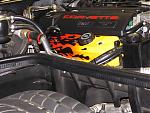
My 92 is probably a little different from your 96, but this is how I did it. I have a "T" that comes off the top radiator hose. The smaller hose that comes off the "T" goes to the TB. I think this hose is 5/8" I bought a longer piece of that hose and covered it with S/S braiding and ran it across the top of the radiator (after rotating the "T") and down to meet the hose that was on the other side of the TB, which I think is 1/2". I used the kit (yes too much $$ for what you get) which had the coupler for joining 1/2" and 5/8" hoses. This picture will show the routing across the top of the radiator.

This picture shows the connection of the 2 hoses:

I finished this off with rubber plugs that cover the TB nipples.
This picture shows the connection of the 2 hoses:
I finished this off with rubber plugs that cover the TB nipples.
Thread Starter
Burning Brakes
Joined: Nov 2004
Posts: 834
Likes: 1
From: Keller Texas
Originally Posted by 96GS#007
I have an LT4 like you (see my sig) and I did mine nearly 7 years ago. My advice is accurate.
Advanced

Joined: Apr 2004
Posts: 74
Likes: 0
From: Miami Florida
I have a 94 and I went to the local autoparts and found the right hoses to completely eliminate all of the factory stuff(metal T's and hosing). If you just get rid of the throttle body hose by plugging up where it comes from you could run into problems, because the plugs have been known to crack or pop off(even when correctly clamped)
Race Director
Joined: Apr 2000
Posts: 15,344
Likes: 4,009
From: Texas
Originally Posted by RED LT4
I may be makng a simple job diffucult.....but is there any way the line not used can be removed? Just to make it cleaner and neater?

Melting Slicks
Joined: Oct 2004
Posts: 2,510
Likes: 4
From: Austin Texas
Originally Posted by 96GS#007
- Disconnect the hose from the driver's side of the throttle body.
- Disconnect the small hose between the passenger side of the throttle body and the hard line that runs along the passenger side valve cover.
- Connect the hose you just disconnected from the driver's side of the throttle body to the hard line.
You're done.
- Disconnect the small hose between the passenger side of the throttle body and the hard line that runs along the passenger side valve cover.
- Connect the hose you just disconnected from the driver's side of the throttle body to the hard line.
You're done.


Intermediate
Joined: Sep 2002
Posts: 49
Likes: 1
Any reason not to do it?
I'm sure GM had a good reason for spending the $ to route the hot coolant through the TB. I assume it's to prevent icing in the TB venturi. (I'm a pilot, and most small airplanes use exhaust to heat the carburetor to prevent TB icing. It can occur over a wide range of temperatures and relative humidity, but it's most typical during cool and/or humid weather.)
So, those who have disconnected the lines from the TB, any adverse effects?
Thanks.
So, those who have disconnected the lines from the TB, any adverse effects?
Thanks.

Melting Slicks
Joined: Dec 2001
Posts: 2,049
Likes: 0
From: Texas
Sorry, I assume it's been answered with numerous replies as these guys are always on top of everything, but I'll go ahead and post real quick without reading...
Remove the hose completely that connects passenger side of tb to piping.
Remove end nearest tb of hose on driver's side, and install to piping where previous hose was placed.
Done.
Remove the hose completely that connects passenger side of tb to piping.
Remove end nearest tb of hose on driver's side, and install to piping where previous hose was placed.
Done.
Race Director
Joined: Apr 2000
Posts: 15,344
Likes: 4,009
From: Texas
Originally Posted by DRE69L46
I'm sure GM had a good reason for spending the $ to route the hot coolant through the TB. I assume it's to prevent icing in the TB venturi. (I'm a pilot, and most small airplanes use exhaust to heat the carburetor to prevent TB icing. It can occur over a wide range of temperatures and relative humidity, but it's most typical during cool and/or humid weather.)
So, those who have disconnected the lines from the TB, any adverse effects?
Thanks.
So, those who have disconnected the lines from the TB, any adverse effects?
Thanks.
I've driven mine in temps that ranged from below 0* and little humidity to 100*+ and 90% humidity, to just about everything in between...i.e. where the problem can actually occur like you stated
 I've never had a problem nor am I aware of anyone having a problem.
I think this is one of those things that end up on a car to correct an issue that "one half of 1%" may actually see. Remember, the basic tb architecture has been in use since 1985 on everything from Vettes and F-Bodies, to Impala SSs, to taxi's, to police cars.

Safety Car


Joined: Sep 2000
Posts: 3,524
Likes: 4
From: Hinckley Ohio
Originally Posted by 96GS#007
- Disconnect the hose from the driver's side of the throttle body.
- Disconnect the small hose between the passenger side of the throttle body and the hard line that runs along the passenger side valve cover.
- Connect the hose you just disconnected from the driver's side of the throttle body to the hard line.
You're done.
- Disconnect the small hose between the passenger side of the throttle body and the hard line that runs along the passenger side valve cover.
- Connect the hose you just disconnected from the driver's side of the throttle body to the hard line.
You're done.
That is how I did my LT4.....