








New 3 Valve head for LT1?>>>>

Thread Starter
Safety Car


Joined: Jun 1999
Posts: 3,641
Likes: 2
From: Southern California
 New 3 Valve head for LT1?>>>>
http://www.barrygrant.com/pages/news...ticleid=sema04
It says pre '86 LT1 engines in this ad. Which is a typo. But in the magazine I read it said pre '96 LT1 motors. So we might have a new head for our cars.
It says pre '86 LT1 engines in this ad. Which is a typo. But in the magazine I read it said pre '96 LT1 motors. So we might have a new head for our cars.
Last edited by Raysur; Jan 4, 2005 at 11:13 PM.
Thread Starter
Safety Car
Joined: Jun 1999
Posts: 3,641
Likes: 2
From: Southern California
http://www.barrygrant.com/pages/imag...Introsheet.pdf
Towards the middle. But it says pre '86 LT1 instead of pre '96 LT1
Towards the middle. But it says pre '86 LT1 instead of pre '96 LT1
Last edited by Raysur; Jan 4, 2005 at 11:39 PM.

Race Director


Joined: Sep 2004
Posts: 13,793
Likes: 0
From: St. Peters MO Sometimes you have to prove yourself by doing alot of killing or alot of dying...
The new stock Ford heads on the new 05 Mustang are 3 valve heads. It is an interesting idea. Ford was able to generate as much power out of a smaller motor than we got out of 350ci. There are also several bolt ons coming that will boost the stang up to 400hp... this is going to get interesting!!!
What I'd like to know is how is the third valve operated. We have standard pushrod motors... so in order to move the valve... you'd need a different cam... different valve train all together... and where is the extra pushrod going to go? The block doesn't have provisions for it. Am I wrong? I'd like someone to explain this one to me...
What I'd like to know is how is the third valve operated. We have standard pushrod motors... so in order to move the valve... you'd need a different cam... different valve train all together... and where is the extra pushrod going to go? The block doesn't have provisions for it. Am I wrong? I'd like someone to explain this one to me...

Drifting

Joined: Oct 2001
Posts: 1,759
Likes: 0
From: Round Rock,Austin, Texas

Le Mans Master


Joined: Feb 2002
Posts: 5,970
Likes: 20
From: San Marcos Texas
here is a pic, dont think its for reverse flow LT1's. note the "standard" small block chevys engines, vortec and pre-86'(meaning early LT1's, late 60's-early70's)

Last edited by chriswtx; Jan 5, 2005 at 12:53 AM.
Corvette Stories
The Best of Corvette for Corvette Enthusiasts

Top 10 Most Expensive Corvettes Ever Sold on Bring A Trailer
Brett Foote
10 Things Every Corvette Owner Needs (2026 Edition)
Michael S. Palmer
8 Most "Only Corvette Owners Understand" Quirks and Problems
Pouria Savadkouei
10 Reasons the C6 Z06 is Still A Performance Benchmark After 20 Years
Joe Kucinski
How Much Horsepower Every Corvette Engine "LOST" in 1972
Joe Kucinski
Top 10 DOs and DON'Ts for Protecting Your Convertible Top!
Michael S. Palmer
Top 10 Most Explosive Corvettes Ever Made: Power-to-Weight Ratio Ranked!
Joe Kucinski
150 hp to 1,250 hp: Every Corvette Generation Compared by the Specs That Matter
Joe Kucinski
8 Coolest Corvette Pace Cars (and Replicas) of All Time
Verdad Gallardo
Melting Slicks


Joined: May 2001
Posts: 3,270
Likes: 26
From: Winchester VA
Cruise-In V Veteran
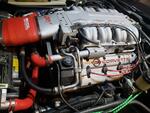
There is a company that has done a 4 valve head. I've never heard of anyone that has them. I think the valve actuation of the addt'l valve is similar, one pushrod and one special rocker that actuates two valves. The pic shows a typical 8 rocker per head setup (unless I'm missing something)
This raises an eyebrow for me. While each spring may be lighter, the pushrod/lifter/cam lobe is seeing two of them.
I would like to know for sure how the valve is actuated.
PS. The 4 valve heads go for 5 large.
This raises an eyebrow for me. While each spring may be lighter, the pushrod/lifter/cam lobe is seeing two of them.
I would like to know for sure how the valve is actuated.
PS. The 4 valve heads go for 5 large.
Race Director


Joined: Jul 1999
Posts: 16,292
Likes: 104
From: Sun city CA
Originally Posted by RadPolo96
BTW... 3 valve motors have been around a long time... In 1984 Honda had 750 cc 3 valve V twin motors...
Not only that... they are still the only manufacturer that I know of that produced an oval cylinder design with 8 valves... 4 in and 4 out... that motor is a race motor placed in a NSR 750 cc bike... it actually had 2 cylinders... Iam not a Honda car fan... but they make some awesome motorcycles... and Indy motors... If only some of this technology would go into mass production... the hp per inch could take a big leap imho...
What else is out there ?


Team Owner

Joined: Oct 2004
Posts: 81,241
Likes: 3,063
From: altered state
St. Jude Donor '05
[
www.araoengineering.com
I think this is what you're looking for. These guys are right up the street from me. Interesting piece. Used to be called Dominion heads, a marketing company used years ago. Link should work now!
www.araoengineering.com
I think this is what you're looking for. These guys are right up the street from me. Interesting piece. Used to be called Dominion heads, a marketing company used years ago. Link should work now!
Last edited by cv67; Jan 5, 2005 at 06:39 PM. Reason: bad link

Drifting
Joined: Jul 2002
Posts: 1,488
Likes: 4
From: Frostburg MD
GM has been talking about 3 valve heads for several years now, here's some brief info I found on their site http://www.gm.com/automotive/gmpower...OHV_3valve.pdf
Race Director
Joined: Feb 2003
Posts: 11,672
Likes: 20
From: Lake Wylie SC
I wonder how the electro controlled valves are doing? No cam, rockers, pushrods or lifters, just a computer to activate the opening and closing of the valves. Heat buildup seems to be the biggest problem of the solenoids that move the valves.

Team Owner
Joined: Aug 2000
Posts: 40,156
Likes: 45
From: San Pedro CA
Originally Posted by Strick
I wonder how the electro controlled valves are doing? No cam, rockers, pushrods or lifters, just a computer to activate the opening and closing of the valves. Heat buildup seems to be the biggest problem of the solenoids that move the valves.


Pro

Joined: Aug 2004
Posts: 544
Likes: 0
Originally Posted by Strick
I wonder how the electro controlled valves are doing? No cam, rockers, pushrods or lifters, just a computer to activate the opening and closing of the valves. Heat buildup seems to be the biggest problem of the solenoids that move the valves.

Instructor

Joined: Dec 2004
Posts: 142
Likes: 0

Instructor
Joined: Dec 2004
Posts: 176
Likes: 0
From: Oakland CA
Originally Posted by Bigvmaxx
Not only that... they are still the only manufacturer that I know of that produced an oval cylinder design with 8 valves... 4 in and 4 out... that motor is a race motor placed in a NSR 750 cc bike... it actually had 2 cylinders... ?
The Coates rotary valve setup is the one that looks very interesting. No valve stem to impede airflow and no risk of valve float.
