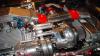


GM_96LT4's new engine

Thread Starter
Le Mans Master


Joined: Jan 2003
Posts: 8,596
Likes: 19
From: Portland Oregon
 GM_96LT4's new engine
Here are a few pictures of Glens new heart for his baby: 
CNC ported 210 LT4 AFR heads (We checked them all out so don't ask )
)

CNC ported intake ports

CNC ported exhaust ports

The bottom end, note the splayed billet main caps at all five locations. Also check out the billet rear main cap that is a work of art, all of which are supplied by Program Engineering. We opted for a Callies crankshaft on Glens engine due to no available cranks for Lunati. I felt that it was of equal quality. Also the rods are 4340 billet steel forgings from Lunati which are attached to custom Ross slugs which used a 2618 alloy to take a bit of boost

Another shot of the crankshaft and LT4 Extreme chain

This is the assembled short block ready for final assembly. Its almost there Glen!
This engine is a 383 with 8.7:1 compression. It will see between 12 and 14 pounds of boost. The cam is a custom ground cam using a Crane 8620 billet core, the cam profile was from Comp Cams. But seeing how they don't offer a billet steel cam with a cast gear, we opted to go to a local cam grinder who ground us the cams using Cranes billet cores.
CNC ported 210 LT4 AFR heads (We checked them all out so don't ask
) CNC ported intake ports
CNC ported exhaust ports
The bottom end, note the splayed billet main caps at all five locations. Also check out the billet rear main cap that is a work of art, all of which are supplied by Program Engineering. We opted for a Callies crankshaft on Glens engine due to no available cranks for Lunati. I felt that it was of equal quality. Also the rods are 4340 billet steel forgings from Lunati which are attached to custom Ross slugs which used a 2618 alloy to take a bit of boost
Another shot of the crankshaft and LT4 Extreme chain
This is the assembled short block ready for final assembly. Its almost there Glen!
This engine is a 383 with 8.7:1 compression. It will see between 12 and 14 pounds of boost. The cam is a custom ground cam using a Crane 8620 billet core, the cam profile was from Comp Cams. But seeing how they don't offer a billet steel cam with a cast gear, we opted to go to a local cam grinder who ground us the cams using Cranes billet cores.
Last edited by tjwong; Jan 27, 2005 at 12:59 AM.

Safety Car


Joined: Apr 2004
Posts: 4,532
Likes: 7
From: Lahaina Hi
I have the same thing with a cola crank .
Where did you get the snout for the crank and balancer cola has been jerking me for 2 mths.
Timing chain also cola says my Lt4 timing chain won't work .
I was tring to make the stock opti and water pump work on it.
I would love some info.
Thanks in advance!!
Where did you get the snout for the crank and balancer cola has been jerking me for 2 mths.
Timing chain also cola says my Lt4 timing chain won't work .
I was tring to make the stock opti and water pump work on it.
I would love some info.
Thanks in advance!!
Corvette Stories
The Best of Corvette for Corvette Enthusiasts

150 hp to 1,250 hp: Every Corvette Generation Compared by the Specs That Matter
Joe Kucinski
8 Coolest Corvette Pace Cars (and Replicas) of All Time
Verdad Gallardo
Top 10 Corvette Engines RANKED by Peak Torque (70+ Years of Muscle!)
Joe Kucinski
Corvette ZR1X Will Be Pacing the Indy 500, And Could Probably Race, Too!
Verdad Gallardo
Top 10 Corvettes Coming to Mecum Indy 2026!
Brett Foote
Top 10 C9 Corvette MUST-HAVES to Fix These C8 Generation Flaws!
Michael S. Palmer
10 Revolutionary 'Corvette Firsts' Most People Don't Know
Joe Kucinski
5 Reasons to Upgrade to an LS6-Powered Corvette; 5 Reasons to Stay LT2
Michael S. Palmer
2027 Corvette vs The World: Every C8 vs Its Closest Competitor
Joe Kucinski
Thread Starter
Le Mans Master
Joined: Jan 2003
Posts: 8,596
Likes: 19
From: Portland Oregon
Originally Posted by REDC4CORVETTE
I have the same thing with a cola crank .
Where did you get the snout for the crank and balancer cola has been jerking me for 2 mths.
Timing chain also cola says my Lt4 timing chain won't work .
I was tring to make the stock opti and water pump work on it.
I would love some info.
Thanks in advance!!
Where did you get the snout for the crank and balancer cola has been jerking me for 2 mths.
Timing chain also cola says my Lt4 timing chain won't work .
I was tring to make the stock opti and water pump work on it.
I would love some info.
Thanks in advance!!
 .
.

Pro


Joined: Jan 2001
Posts: 526
Likes: 0
From: Sierra Madre
Hey TJ,
Thanks for posting the pictures, I was surprised to see them.
I went out of town for awhile and when I came back, my internet was down. In fact it will be down until Feb. (Changed ISP's) and the only time I can hop on is after work.
Anyway, you guys already probably know this but I wanted to give credit to TJ. He is all around top knotch and I would definitely have him build my next engine.
Anyway, can't wait to put it in.
On the other note, sent my inlet & discharge tube to Greg Carrol for him to modify my intake and to weld in the nozzles for his injection kit.
Wish everyone a Happy New Year.
Thanks again guys,
Glenn
Thanks for posting the pictures, I was surprised to see them.
I went out of town for awhile and when I came back, my internet was down. In fact it will be down until Feb. (Changed ISP's) and the only time I can hop on is after work.
Anyway, you guys already probably know this but I wanted to give credit to TJ. He is all around top knotch and I would definitely have him build my next engine.
Anyway, can't wait to put it in.
On the other note, sent my inlet & discharge tube to Greg Carrol for him to modify my intake and to weld in the nozzles for his injection kit.
Wish everyone a Happy New Year.
Thanks again guys,
Glenn
Thread Starter
Le Mans Master
Joined: Jan 2003
Posts: 8,596
Likes: 19
From: Portland Oregon
Originally Posted by cprgmr
TJ - great looking engine for GM_96LT4!
Is there any reason why you guys didn't opt to go to a 396 instead of a 383?
Is there any reason why you guys didn't opt to go to a 396 instead of a 383?
Melting Slicks

Joined: Sep 2000
Posts: 2,710
Likes: 1
From: Green Bay WI
Originally Posted by tjwong
Personal preference and some design preferences. I prefered a shorter stroke to give me a little more compression height so that I can move the rings around on the pistons. For these pistons I had the top ring relocated a bit lower from the top of the piston, this shields it from heat as this is going to see boost. With a longer stroke the compression height is shorter, I guess I could have gone with a shorted rod, but then the rod to stroke ratio is not as desirable. I felt this was a better design and it will live long and provide many hours of fun for Glen.
Thanks for your valuable information, I really appreciate it.
Thread Starter
Le Mans Master
Joined: Jan 2003
Posts: 8,596
Likes: 19
From: Portland Oregon
Originally Posted by cprgmr
That makes sense. I'm just wondering because I'd like to eventually do a blown 396 but I don't want to make any mistakes when it comes to component selection. And I don't want to blow up the engine by making a foolish mistake in the planning process.
Thanks for your valuable information, I really appreciate it.
Thanks for your valuable information, I really appreciate it.
 ) but they make for poor street manners for an every day driver, they usually stink because of the high HC count associated with lots of overlap, all this not to mention the problems with tuning issues.
 Plus if you are going to put boost on it, one doesn't need a lot of cam, thats what the blower is for. There is a practical limit of course, I don't think I would go much over a GM 847 grind that is ground on a looser LSA to get rid of some overlap. I think if its ground on a 114 and add 5 degrees of advance to it, that cam would make a decent blower grind for someone making 12 to 14 pounds of boost. Thats about max anyways for the street on pump gas.