




backpressure problem

Thread Starter
jobberone


Joined: Aug 2003
Posts: 2,062
Likes: 8
From: Kailua Kona HI

And you're right. The smallish exhaust flange could be causing part of the problem. The downpipe is 3".
Thread Starter
jobberone
Joined: Aug 2003
Posts: 2,062
Likes: 8
From: Kailua Kona HI
I was going to use Mast double valve springs on a set of their large bore LS3 heads. The machine shop (that my tuner used to assembly my heads) tested them and said that even if they shimmed the crap out of them they would barley work on my motor N/A. I ended up going with PRC springs and ate the $375 I paid for the Mast springs.

Le Mans Master

Joined: Jan 2006
Posts: 6,831
Likes: 4
From: Vacaville Ca
St. Jude Donor '13
We're measuring back pressure right at the turbo.
The cam is mediocre IMO. The lift is just less than 600. Duration is 230/234 which isn't pushing it that much. Or am I wrong? We've talked with Comp Cams as it's a custom grind and they see nothing wrong with it. In fact they suggested we go to a 236 on the exhaust side to try to relieve the back pressure. Are we missing something here?
I'll have to ask about the timing and knock. To my knowledge we're getting no knock at all. But we're running half race gas to keep it safe until the final tune on pump gas and meth. I'm afraid this is all at the limits of my knowledge. In fact while I understand the basic concept of back pressure I don't fully conceptualize it in my mind. I do understand the banana in the tailpipe concept though.
I didn't build the car. I would have used larger air to air intercoolers and would not have a wet to dry on the car. I do understand why they did it. Apparently the car was run to race on 116 and they put dry ice in the well to lower the IATs significantly.
The cam is mediocre IMO. The lift is just less than 600. Duration is 230/234 which isn't pushing it that much. Or am I wrong? We've talked with Comp Cams as it's a custom grind and they see nothing wrong with it. In fact they suggested we go to a 236 on the exhaust side to try to relieve the back pressure. Are we missing something here?
I'll have to ask about the timing and knock. To my knowledge we're getting no knock at all. But we're running half race gas to keep it safe until the final tune on pump gas and meth. I'm afraid this is all at the limits of my knowledge. In fact while I understand the basic concept of back pressure I don't fully conceptualize it in my mind. I do understand the banana in the tailpipe concept though.
I didn't build the car. I would have used larger air to air intercoolers and would not have a wet to dry on the car. I do understand why they did it. Apparently the car was run to race on 116 and they put dry ice in the well to lower the IATs significantly.
Before you go too far, I would disconnect/remove and inspect the intercoolers, i think they may have debri or jus not flow well.
Good luck, we are all just throwing out ideas because we are not there to systematically eliminate the possibilities and get to the root of the problem. If your exhaust is not plugged, I would not worry about the size, it is not your problem.
Steve

Melting Slicks


Joined: May 2003
Posts: 2,851
Likes: 1
From: San Bruno Ca
I don't expect to get 200 HP from the fact of changing the exhausts. The problem is the car is running into a brick wall. Remove the problem or restriction and the car should make some decent power. There is something wrong with a car that stops making power at 4000rpm at 15lbs of boost. The fact we're getting to roughly 600HP (it's slightly less) at 5900 on 10 lbs of boost is just somewhat of a break. The car should make more power at 10 lbs as it should be able to reach 7000 easily with the parts on the car.
It's the backpressure that's killing the power. It's not a lack of parts on the car to reach a goal of roughly 800 HP. GT35Rs should support 500-600 HP each. A 346 with the parts that car has should make 800+HP pretty easily.
It's the backpressure that's killing the power. It's not a lack of parts on the car to reach a goal of roughly 800 HP. GT35Rs should support 500-600 HP each. A 346 with the parts that car has should make 800+HP pretty easily.

Instructor


Joined: May 2010
Posts: 173
Likes: 1
From: Chesterfield, MO
turbo back

May even want to consider porting or clipping turbos to eliminate back pressure the engine sees... Turbos must breathe AND NOT CONSTRICT! I admit I'm only pulling around 510 HP, but again, its only 182CI, and of course going to AWD!!

Corvette Stories
The Best of Corvette for Corvette Enthusiasts

Top 10 Most Expensive Corvettes Ever Sold on Bring A Trailer
Brett Foote
10 Things Every Corvette Owner Needs (2026 Edition)
Michael S. Palmer
8 Most "Only Corvette Owners Understand" Quirks and Problems
Pouria Savadkouei
10 Reasons the C6 Z06 is Still A Performance Benchmark After 20 Years
Joe Kucinski
How Much Horsepower Every Corvette Engine "LOST" in 1972
Joe Kucinski
Top 10 DOs and DON'Ts for Protecting Your Convertible Top!
Michael S. Palmer
Top 10 Most Explosive Corvettes Ever Made: Power-to-Weight Ratio Ranked!
Joe Kucinski
150 hp to 1,250 hp: Every Corvette Generation Compared by the Specs That Matter
Joe Kucinski
8 Coolest Corvette Pace Cars (and Replicas) of All Time
Verdad Gallardo
Advanced
Joined: Jul 2009
Posts: 81
Likes: 0
From: Cleveland Ohio
Yes, going with larger diameter piping will help but there is something other than the downpipe and catback causing the issues. I still think its the housings if these are T25 based turbos because nothing else really explains why the power doesnt increase with boost. A restriction on the cold side doesnt really explain it because power will still increase with boost and even with a boost leak power will increase with boost.
corvettesforfun: Can you confirm if these turbos have the t2 flange with a picture or by contacting the builder or previous owner? If the turbos are T25 based like i suspect you will be very limited on the turbine side. I am not sure if there is a option for a larger ar ratio so unless you are willing to change the flange on the manifold to a T3 flange, replace the housings and modify the downpipe there may not be any other options go get you to or near 800hp on the same setup.
I would be willing to bet this is why tti and lingenfelter stopped using the T25 based turbos with their setups.
Carl
corvettesforfun: Can you confirm if these turbos have the t2 flange with a picture or by contacting the builder or previous owner? If the turbos are T25 based like i suspect you will be very limited on the turbine side. I am not sure if there is a option for a larger ar ratio so unless you are willing to change the flange on the manifold to a T3 flange, replace the housings and modify the downpipe there may not be any other options go get you to or near 800hp on the same setup.
I would be willing to bet this is why tti and lingenfelter stopped using the T25 based turbos with their setups.
Carl

Advanced
Joined: Dec 2010
Posts: 68
Likes: 0
dont change the turbos , i did 664whp on a 347ci with mildly ported heads stock cam and a 2.5inch exhaust, start working outside on the piping on your blow off valve and manifold gaskets and then after you have eliminated all those then think about changing major components.
Thread Starter
jobberone
Joined: Aug 2003
Posts: 2,062
Likes: 8
From: Kailua Kona HI
Most of you were right. Dropped the exhaust at the downpipes and car picked up some HP but not substantial and still fell on its face at 6000 at 10psi.
Next step remove the wet to dry intercooler and back to the dyno.
I have gotten over the hurdle of having to drop the engine again.
Next step remove the wet to dry intercooler and back to the dyno.
I have gotten over the hurdle of having to drop the engine again.

Burning Brakes

Joined: Mar 2010
Posts: 1,012
Likes: 7
From: Moore OK
I'm with Arun. I think its in the tune. I've seen a couple cars do the same thing, even more so when their boosted. I would make sure your tuner knows what they are doing in regards to the tables he mentioned before chasing these hard parts. That and put two good intercoolers in it and ditch the 3rd.

Racer

Joined: Apr 2002
Posts: 275
Likes: 1
From: Romeo MI
You said backpressure is 4.4:1. Are you refering to the turbine expansion ratio? So you are measuring exhaust pressure before and after the turbo? If so what are the measurements?
You also said they hogged out the inside of the turbo. This scares me. What did they do? The way you worded this makes it sound like they increased the internal volume of the housings. I hope this is not the case. The volute geometry is critical for aero performance and should never be modified.
One more question: what kind of coupler do you have running between the filters and the compressor inlet? If they are relatively flimsy silcone type you may want to try going with a more rigid pipe as the ones you have now may be collapsing due to the high negative pressure at the compressor inlet. I work for Garrett on the OE side and have seen this before on some production applications.
Are you running internal or external wastegates? Some other things to check: BOV, WG spring stiffness, intake manifold temp (would give you an indication of inefficiency of your cooler setup), intercooler delta P, and ignition retard (are you sure it's not pulling timing?). It would also be good to know the exact turbo you are running (i.e. wheel size, trim, etc.).
Good Luck,
You also said they hogged out the inside of the turbo. This scares me. What did they do? The way you worded this makes it sound like they increased the internal volume of the housings. I hope this is not the case. The volute geometry is critical for aero performance and should never be modified.
One more question: what kind of coupler do you have running between the filters and the compressor inlet? If they are relatively flimsy silcone type you may want to try going with a more rigid pipe as the ones you have now may be collapsing due to the high negative pressure at the compressor inlet. I work for Garrett on the OE side and have seen this before on some production applications.
Are you running internal or external wastegates? Some other things to check: BOV, WG spring stiffness, intake manifold temp (would give you an indication of inefficiency of your cooler setup), intercooler delta P, and ignition retard (are you sure it's not pulling timing?). It would also be good to know the exact turbo you are running (i.e. wheel size, trim, etc.).
Good Luck,
Thread Starter
jobberone
Joined: Aug 2003
Posts: 2,062
Likes: 8
From: Kailua Kona HI
You said backpressure is 4.4:1. Are you refering to the turbine expansion ratio? So you are measuring exhaust pressure before and after the turbo? If so what are the measurements?
You also said they hogged out the inside of the turbo. This scares me. What did they do? The way you worded this makes it sound like they increased the internal volume of the housings. I hope this is not the case. The volute geometry is critical for aero performance and should never be modified.
One more question: what kind of coupler do you have running between the filters and the compressor inlet? If they are relatively flimsy silcone type you may want to try going with a more rigid pipe as the ones you have now may be collapsing due to the high negative pressure at the compressor inlet. I work for Garrett on the OE side and have seen this before on some production applications.
Are you running internal or external wastegates? Some other things to check: BOV, WG spring stiffness, intake manifold temp (would give you an indication of inefficiency of your cooler setup), intercooler delta P, and ignition retard (are you sure it's not pulling timing?). It would also be good to know the exact turbo you are running (i.e. wheel size, trim, etc.).
Good Luck,
You also said they hogged out the inside of the turbo. This scares me. What did they do? The way you worded this makes it sound like they increased the internal volume of the housings. I hope this is not the case. The volute geometry is critical for aero performance and should never be modified.
One more question: what kind of coupler do you have running between the filters and the compressor inlet? If they are relatively flimsy silcone type you may want to try going with a more rigid pipe as the ones you have now may be collapsing due to the high negative pressure at the compressor inlet. I work for Garrett on the OE side and have seen this before on some production applications.
Are you running internal or external wastegates? Some other things to check: BOV, WG spring stiffness, intake manifold temp (would give you an indication of inefficiency of your cooler setup), intercooler delta P, and ignition retard (are you sure it's not pulling timing?). It would also be good to know the exact turbo you are running (i.e. wheel size, trim, etc.).
Good Luck,
Wet to dry intercooler has been pulled. Dyno again Friday.
Thread Starter
jobberone
Joined: Aug 2003
Posts: 2,062
Likes: 8
From: Kailua Kona HI
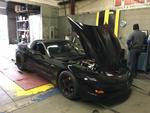
Pulled wet to dry intercooler and made a trip back to the dyno. Only modest gains though. At 10lbs on meth at 19 degrees timing at 6300 RPM the car made 700HP. The car again was very strong up to the 'wall' then abruptly fell off power wise. I have a video and graph coming I'll try to post. At 15lbs the power fell off at 5300rpm.
I'm convinced the flanges are too small and perhaps even a T2 instead of a T3. We'll have the turbos out of the car next week. And we'll see.
They are Garrett. Who do you recommend rebuild them and make the recommendations for changes?
I'm convinced the flanges are too small and perhaps even a T2 instead of a T3. We'll have the turbos out of the car next week. And we'll see.
They are Garrett. Who do you recommend rebuild them and make the recommendations for changes?
Thread Starter
jobberone
Joined: Aug 2003
Posts: 2,062
Likes: 8
From: Kailua Kona HI
I'm still confused. It seems that normally GT35s come with a T3 flange. I still don't know what to make of things. I'm getting a lot of conflicting advice still.
Backpressure is 4.4 to 1.

Safety Car


Joined: Jan 2008
Posts: 4,797
Likes: 52
From: Boise
The T3 flange is not the restriction. Imports can make more power than you are making with only 1 turbo on a motor with 1/3 the displacement.
I would suspect that those intercoolers you have are causing restriction.
Also where are the dump tubes from your waste gates going?
I would suspect that those intercoolers you have are causing restriction.
Also where are the dump tubes from your waste gates going?
Racer
Joined: Apr 2002
Posts: 275
Likes: 1
From: Romeo MI
I am still not sure what you mean by this. If you are talking about the expansion ratio (which is turbine inlet pressure divided by turbine outlet pressure - we measure this as a total / static ratio) then that is very high and could be an indication that your turbine stage is too small. You could be choking the **** out of your engine. Increase turbine trim (or most likely increase A/R) and that could help it breath easier. It doesn't seem like twin GT35s should be choked at your power level but if the 4.4:1 you are talking about is the expansion ratio, then I would be suspicious of what you really have. Measure the turbine wheel inducer (larger diameter) and exducer (smaller diameter) and let me know what it is.
Last edited by 87GN&98VET; Apr 7, 2011 at 02:49 PM.