




Jack stands
Thread Starter
Pro

Joined: Sep 2007
Posts: 661
Likes: 2
From: Centerville IA
 Jack stands
If you are jacking up one corner of the car at a time, where is the best place to put the jack stand? At the front? At the back? I recently saw a diagram but am still unsure where to put the jack stand. Thanks for the assistance!

Racer

Joined: Dec 2005
Posts: 263
Likes: 0
From: Tucson Arizona
Actually, if Ron MN Blue doesn't mind me adding to the post. Would someone mind posting up the proper procedure for jacking the car up period. Location of jack, jack stands etc. I haev yet to do this but need to get the chrping birds out of my trunk (busings need greasing) so I need to get the rear end up in the air myself. Thanks!!!

Race Director

Joined: Jul 2007
Posts: 18,681
Likes: 47
From: Reno is so close to Hell you can see Sparks , State Of Confusion
St. Jude Donor '12-'13-'14
Well I would think if you are jacking up 1 corner of the car you would want the stand in that corner. I find it a lot easyler to jack up the front or the rear, Not just one corner. I use the front cradle or the a arms

Drifting


Joined: Aug 2007
Posts: 1,495
Likes: 0
From: Homer Glen IL

Le Mans Master


Joined: Oct 2007
Posts: 6,867
Likes: 769
From: Kelso Washington
St. Jude Donor '09, '13, '15
Corvette Stories
The Best of Corvette for Corvette Enthusiasts

8 Coolest Corvette Pace Cars (and Replicas) of All Time
Verdad Gallardo
Top 10 Corvette Engines RANKED by Peak Torque (70+ Years of Muscle!)
Joe Kucinski
Corvette ZR1X Will Be Pacing the Indy 500, And Could Probably Race, Too!
Verdad Gallardo
Top 10 Corvettes Coming to Mecum Indy 2026!
Brett Foote
Top 10 C9 Corvette MUST-HAVES to Fix These C8 Generation Flaws!
Michael S. Palmer
10 Revolutionary 'Corvette Firsts' Most People Don't Know
Joe Kucinski
5 Reasons to Upgrade to an LS6-Powered Corvette; 5 Reasons to Stay LT2
Michael S. Palmer
2027 Corvette vs The World: Every C8 vs Its Closest Competitor
Joe Kucinski
10 Most Common Corvette Problems of the Last 20 Years!
Joe Kucinski
Tech Contributor


Joined: Dec 2003
Posts: 19,384
Likes: 87
From: Horncastle Lincolnshire, England
2023 C5 of the Year Finalist - Unmodified
Thats a good link from futuretech
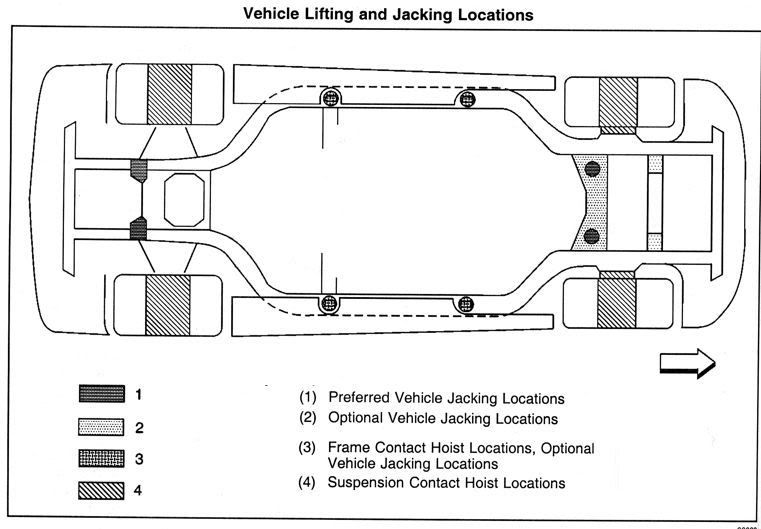
Here's a diagram of the jacking points:
theadmiral94 posted this How To a while ago
http://forums.corvetteforum.com/show...1&forum_id=103
In Other Words -- how to lift and support your C5 per the GM Manual
This article will translate and document the GM Manual’s procedures for lifting and supporting a C5 (based on a 2000) and clearly define the distinction between a ‘hydraulic jack’ and where it can be placed -- versus -- ‘jack stands’ and where they can be placed.
This is not to say other suggested procedures would not work without damage.
However, after struggling through so many different suggested procedures and the manual, I decided to put this together to help the next 'new to them' owner of a C5.
The goal of this write-up is to accurately convey the GM Manual’s information so anyone can determine if a suggested procedure deviates from GM recommendations.
This information is taken from GM’s 2000 Service Manual, Volume 1 of 3, General Information, pages 0-33.
I should also credit two other websites for their information, upon which some of this article is based :
The Idaho Corvette Page and Z06vette.com
First, to identify some large differences between many suggested procedures and what the GM’s manual recommends. The GM Manual states or implies:
1. ‘Jack Stands’ should NOT be placed under the ‘frame rails’ (regardless of whether ‘hockey pucks’ are used or not).
2. A ‘hydraulic jack’ should NOT be placed directly under the CENTER of the ‘OPTIONAL’ front cross-member. The ‘Optional’ Front cross-member is FORWARD of the front fiberglass transverse spring and is the ‘optional’ front location for a ‘hydraulic jack’. By contrast, the ‘PREFERRED’ front location is to the REAR of the fiberglass transverse spring, immediately forward of the oil pan. This 'PREFERRED' cross-member can have a 'hydraulic Jack' placed directly under the center, however, doing so will most likely contact and may damage the oil pan/oil drain plug, so it is NOT advisable either.
3. A ‘hydraulic jack’ should NOT be placed directly under the CENTER of the rear cross-member to raise the rear of the car.
4. ‘Hockey Pucks’ should NOT be used at the FRONT Frame Rail location when lifting the car with a ‘service lift’. The presumably larger flat rectangular ‘service lift’ ‘pad’ is to be placed with its long side parallel with and at or immediately forward of the front ‘hockey puck’ AREA (note: this also assures a slightly higher rear end for proper oil draining from the oil pan).
Now on to what can be done.
First of all, here is the Service Manual’s vehicle diagram of the “Vehicle Lifting and Jacking Locations” (note: Jacking is NOT ‘Jack Stands’):
personal home page Lifting & Jacking Locations
The Service Manual has 3 sections within the ‘Lifting and Jacking the Vehicle section’. These sections can be easily switched and thereby confusing.
The FIRST SECTION is ‘Vehicle Lifting – Frame Contact Hoist’ (i.e. a ‘service lift’). This section clarifies the use of the ‘hockey pucks’ (special part # J43625) ONLY for the REAR, to be installed in the ‘rear frame rail shipping slots’. The presumably larger flat rectangular ‘service lift’ ‘pad’ is to be placed with its long side parallel with and at or immediately forward of the front ‘hockey puck’ AREA (without a ‘hockey puck’) AND not touching the body panels.
The SECOND SECTION ‘Vehicle Jacking’ (‘Hydraulic Jack’, not to be confused with ‘Jack Stands’ or a ‘service lift’) implies the use of ‘hockey pucks’ front and rear by specifying the use of “2 ½ inch or smaller diameter lifting pads when ‘jacking’ the car via the ‘frame rails’.
For the FRONT, this ‘Vehicle Jacking’ section continues to specify the ‘Preferred’ Front Suspension cross-member as the one behind the fiberglass transverse spring, immediately forward of the oil pan. This cross-member can be lifted anywhere along its width (center to 13” off-center), with the preferred location at the outer 7 ½ inches (and in the middle of that outer 7 ½ inches). Note, the usage of the ‘Preferred’ cross-member may make oil changes difficult as the cross member is more narrow at the center where it comes very close to the oil drain plug.
Further specified in this ‘Vehicle Jacking’ section is that the Front ‘Optional’ front cross-member should only be lifted at the outer 5 ½ inches of the overall 26 inch cross-member’s length and NOT in the center (when you look at the cross-member, you will understand why).
For the REAR, Similarly specified is that a ‘hydraulic Jack’ should NOT be placed in the center, it should only be placed at the outer and rearward sweeping 5 ½ inches (of the overall 26 inch length cross-member) (again, when you look at the cross-member and how it supports the body, you will understand why).
The THIRD SECTION ‘Supporting the Vehicle with Jack Stands’ first notes “Important: Do not place jack stands under the frame rails”.
It further specifies that ‘Jack Stands’ should only be placed under the outer areas of the three previously mentioned cross-members. Also, a ‘block or pad’ should be placed between the jack stands and the vehicle. Lastly, make sure the ‘jack stands’ ‘block or pad’ span at least 2 cross-member ribs (i.e. side to side thin aluminum ridge).
Some Personal notes/thoughts:
The cast aluminum cross-members should only be lifted with specially constructed wood ‘pads’ to prevent damage and possible cracking.
The car’s underbody is very low. There is only approximately 3½ inches clearance below the front air dam, and only about 5 inches below most of the underbody, cross-members and side rails.
This low clearance creates a requirement for front and rear drive-on ramps with a minimum of 3” of lift to gain clearance to the cross-members for ‘jacking’ with specially constructed wood ‘pads’ and a low-profile hydraulic jack (e.g. #0950240 from Sears with 3¾” to 18½” lifting range). Always first lift the front, otherwise there will not be enough clearance to do so after lifting the rear.
Now on to what you can make out of wood to comply with the GM Service Manual.
Here's a link to pictures of the home-made items:
Wood Ramps and Hydraulic Lifting Pads
Home Made Wood Ramps:
§ Two 12 foot 2” x 12”
§ One 8 foot 2” x 3”
§ One box of #10 x 3” wood screws
Front: cut off 1’ from the worse end of the first 2” x 12” and set aside. Then cut two 3 ½’ and two 2’ sections.
Rear: cut off 1’ from both ends of the other 2” x 12”, then cut two 3’ and two 2’ sections.
Both: cut eight 12” lengths for stop-blocks from the 2” x 3”. Four are for placing behind the tires after driving onto the ramps.
Cut a 30 degree angle on one end of each of the ten 2” x 12” sections. This can be done with a table-saw set at 30 degrees and each board held vertical (standing up) while passing between the guide and another guide/piece of wood (I used the first 1’ section set aside, clamped to the table).
Otherwise, if you only have a hand-held electric circular saw (which cannot cut the proper 30 degree angle on a vertical end as when set flat on the board, its 30 degree setting will actually cut a 60 degree ramp instead), then instead just cut a 45 degree angle on one end of each of the ten 2” x 12” sections.
Assemble front ramps: 12” 2”x3” stop-block on square end of 2’ 2”x12” on top of 3 ½’ 2” x 12”. Pre-drill and screw together (2 screws for stop-block, 4 screws for 2’ to 3½‘).
Assemble rear ramps: 12” 2”x3” stop-block on square end of 2’ 2”x12” on top of 3’ 2” x 12”. Pre-drill and screw together. The two additional 1’ 2” x 12” sections are for placing under the tires after jacking to elevate the rear for proper oil draining. However, there may not be sufficient clearance to driver all the way off of the 3 levels, so you could roll off the 3rd level, then remove the 3rd level board before continuing down off the rest of the rear ramps.
Usage: Place the FRONT ramps with the stop block where you want the front tires to end up. Pull car just up to the ramp incline. Push the ramps up against the front tires and align the front ramps. Place the REAR ramps 6” in front of the rear tires and align (I use a 6” piece of wood as a spacer against the tire). Back car up without hitting any front mud flaps on rear ramps and accelerate smoothly. The car should hit the front ramp’s 1st level, then the rear ramp’s 1st level, then front and rear ramp’s 2nd levels almost simultaneously. Be sure the car is against the stop-blocks and set parking brake. Then set the four additional stop blocks behind each tire.
NOTE: The front ramps are only 3 ½‘ long to be clear of the ‘hockey puck’ area, in case it is needed for ‘hydraulic Jacking’. The rear ramps are only 3’ and set 6” forward of the rear tire to prevent hitting both ramps at the same time thereby reducing the chance of their movement and insufficient speed to achieve making the 2nd level of both ramps.
Home Made Wood Hydraulic Jack Lifting Pads
Here's a link to pictures of the home-made items:
Wood Ramps and Hydraulic Lifting Pads
§ One 8 foot 2” x 6”
§ One 8 foot 2” x 8”
§ #10 3 inch wood screws
For FRONT ‘Optional’ cross-member: cut two 6” sections, and one 26” section from the 2” x 6”. Assemble each 6” section on top, flush with the ends and parallel with the 26” section. Pre-drill and screw together.
When used on the ‘Optional’ front cross-member (area forward of the fiberglass transverse leaf spring), center the wood (side to side and front to back) with the 6” sections on top against the cross-member and contacting both front and rear ‘RIB’ with the hydraulic jack centered underneath the 26” section. Pre-drill and screw together. This way lifting pressure will NOT be applied under the center of the cross-member, only the ends, as specified by the GM Manual.
For FRONT ‘Recommended’ cross-member: cut two 8” sections and one 26” section from the 2” x 8”. Assemble each 8” section on top, flush with the ends and parallel with the 26” section. Pre-drill and screw together.
When used on the ‘Recommended’ front cross-member (area behind the fiberglass transverse leaf spring and immediately forward of the oil pan), center the wood (side to side and front to back) with the 8” sections on top against the cross-member and contacting both front and rear ‘RIB’, with the hydraulic jack centered underneath the 26” section. This way lifting pressure will NOT be applied to the middle of the cross-member where the wood would overlap the oil pan and oil drain plug. This could also allow still doing the oil change while the wood is in place.
‘Jack Stands’ should only be used with these wood lifting pads, placed underneath the ends of the 26” section on either side of the hydraulic jack (‘Jack Stands’ should NOT be placed under the ‘hockey pucks’ on the frame rails).
For REAR cross-member: Cut two 10” sections and one 26” section from the 2” x 6”. Assemble each 10” section on top, at each end, but perpendicular to the 26” section, somewhat centered, except that 3” should extending rearward of the 26” section, and 1½“ should extending forward of the 26” section (looks like a ‘U’ with downward legs when assembled).
When used on REAR cross-member, center (side to side and front to back) the 26” section on the center of the rear cross-member directly under both ‘ribs’, with the 10” sections upward and against the cross member and pointing rearward so as to ALSO be underneath the cross-member ends which are more rearward (tie-rod ends). Place the hydraulic jack centered underneath the middle of the 26” section. This way lifting pressure will NOT be applied under the center of the cross-member, only the ends, as specified by the GM Service Manual.
‘Jack Stands’ should only be used with this wood lifting pad, placed underneath the ends of the 26” section and centered below the 10” sections on both sides of the hydraulic jack (‘Jack Stands’ should NOT be placed under the ‘hockey pucks’ on the frame rails).
Set the rear ‘jack stands’ one (1) notch higher than the front ‘jack stands’ for a level car.
Set the rear ‘jack stands’ two (2) notches higher than the front ‘jack stands’ when performing an oil change (will level/slightly tip the oil pan to fully drain the oil).
Here's a diagram of the jacking points:
theadmiral94 posted this How To a while ago
http://forums.corvetteforum.com/show...1&forum_id=103
In Other Words -- how to lift and support your C5 per the GM Manual
This article will translate and document the GM Manual’s procedures for lifting and supporting a C5 (based on a 2000) and clearly define the distinction between a ‘hydraulic jack’ and where it can be placed -- versus -- ‘jack stands’ and where they can be placed.
This is not to say other suggested procedures would not work without damage.
However, after struggling through so many different suggested procedures and the manual, I decided to put this together to help the next 'new to them' owner of a C5.
The goal of this write-up is to accurately convey the GM Manual’s information so anyone can determine if a suggested procedure deviates from GM recommendations.
This information is taken from GM’s 2000 Service Manual, Volume 1 of 3, General Information, pages 0-33.
I should also credit two other websites for their information, upon which some of this article is based :
The Idaho Corvette Page and Z06vette.com
First, to identify some large differences between many suggested procedures and what the GM’s manual recommends. The GM Manual states or implies:
1. ‘Jack Stands’ should NOT be placed under the ‘frame rails’ (regardless of whether ‘hockey pucks’ are used or not).
2. A ‘hydraulic jack’ should NOT be placed directly under the CENTER of the ‘OPTIONAL’ front cross-member. The ‘Optional’ Front cross-member is FORWARD of the front fiberglass transverse spring and is the ‘optional’ front location for a ‘hydraulic jack’. By contrast, the ‘PREFERRED’ front location is to the REAR of the fiberglass transverse spring, immediately forward of the oil pan. This 'PREFERRED' cross-member can have a 'hydraulic Jack' placed directly under the center, however, doing so will most likely contact and may damage the oil pan/oil drain plug, so it is NOT advisable either.
3. A ‘hydraulic jack’ should NOT be placed directly under the CENTER of the rear cross-member to raise the rear of the car.
4. ‘Hockey Pucks’ should NOT be used at the FRONT Frame Rail location when lifting the car with a ‘service lift’. The presumably larger flat rectangular ‘service lift’ ‘pad’ is to be placed with its long side parallel with and at or immediately forward of the front ‘hockey puck’ AREA (note: this also assures a slightly higher rear end for proper oil draining from the oil pan).
Now on to what can be done.
First of all, here is the Service Manual’s vehicle diagram of the “Vehicle Lifting and Jacking Locations” (note: Jacking is NOT ‘Jack Stands’):
personal home page Lifting & Jacking Locations
The Service Manual has 3 sections within the ‘Lifting and Jacking the Vehicle section’. These sections can be easily switched and thereby confusing.
The FIRST SECTION is ‘Vehicle Lifting – Frame Contact Hoist’ (i.e. a ‘service lift’). This section clarifies the use of the ‘hockey pucks’ (special part # J43625) ONLY for the REAR, to be installed in the ‘rear frame rail shipping slots’. The presumably larger flat rectangular ‘service lift’ ‘pad’ is to be placed with its long side parallel with and at or immediately forward of the front ‘hockey puck’ AREA (without a ‘hockey puck’) AND not touching the body panels.
The SECOND SECTION ‘Vehicle Jacking’ (‘Hydraulic Jack’, not to be confused with ‘Jack Stands’ or a ‘service lift’) implies the use of ‘hockey pucks’ front and rear by specifying the use of “2 ½ inch or smaller diameter lifting pads when ‘jacking’ the car via the ‘frame rails’.
For the FRONT, this ‘Vehicle Jacking’ section continues to specify the ‘Preferred’ Front Suspension cross-member as the one behind the fiberglass transverse spring, immediately forward of the oil pan. This cross-member can be lifted anywhere along its width (center to 13” off-center), with the preferred location at the outer 7 ½ inches (and in the middle of that outer 7 ½ inches). Note, the usage of the ‘Preferred’ cross-member may make oil changes difficult as the cross member is more narrow at the center where it comes very close to the oil drain plug.
Further specified in this ‘Vehicle Jacking’ section is that the Front ‘Optional’ front cross-member should only be lifted at the outer 5 ½ inches of the overall 26 inch cross-member’s length and NOT in the center (when you look at the cross-member, you will understand why).
For the REAR, Similarly specified is that a ‘hydraulic Jack’ should NOT be placed in the center, it should only be placed at the outer and rearward sweeping 5 ½ inches (of the overall 26 inch length cross-member) (again, when you look at the cross-member and how it supports the body, you will understand why).
The THIRD SECTION ‘Supporting the Vehicle with Jack Stands’ first notes “Important: Do not place jack stands under the frame rails”.
It further specifies that ‘Jack Stands’ should only be placed under the outer areas of the three previously mentioned cross-members. Also, a ‘block or pad’ should be placed between the jack stands and the vehicle. Lastly, make sure the ‘jack stands’ ‘block or pad’ span at least 2 cross-member ribs (i.e. side to side thin aluminum ridge).
Some Personal notes/thoughts:
The cast aluminum cross-members should only be lifted with specially constructed wood ‘pads’ to prevent damage and possible cracking.
The car’s underbody is very low. There is only approximately 3½ inches clearance below the front air dam, and only about 5 inches below most of the underbody, cross-members and side rails.
This low clearance creates a requirement for front and rear drive-on ramps with a minimum of 3” of lift to gain clearance to the cross-members for ‘jacking’ with specially constructed wood ‘pads’ and a low-profile hydraulic jack (e.g. #0950240 from Sears with 3¾” to 18½” lifting range). Always first lift the front, otherwise there will not be enough clearance to do so after lifting the rear.
Now on to what you can make out of wood to comply with the GM Service Manual.
Here's a link to pictures of the home-made items:
Wood Ramps and Hydraulic Lifting Pads
Home Made Wood Ramps:
§ Two 12 foot 2” x 12”
§ One 8 foot 2” x 3”
§ One box of #10 x 3” wood screws
Front: cut off 1’ from the worse end of the first 2” x 12” and set aside. Then cut two 3 ½’ and two 2’ sections.
Rear: cut off 1’ from both ends of the other 2” x 12”, then cut two 3’ and two 2’ sections.
Both: cut eight 12” lengths for stop-blocks from the 2” x 3”. Four are for placing behind the tires after driving onto the ramps.
Cut a 30 degree angle on one end of each of the ten 2” x 12” sections. This can be done with a table-saw set at 30 degrees and each board held vertical (standing up) while passing between the guide and another guide/piece of wood (I used the first 1’ section set aside, clamped to the table).
Otherwise, if you only have a hand-held electric circular saw (which cannot cut the proper 30 degree angle on a vertical end as when set flat on the board, its 30 degree setting will actually cut a 60 degree ramp instead), then instead just cut a 45 degree angle on one end of each of the ten 2” x 12” sections.
Assemble front ramps: 12” 2”x3” stop-block on square end of 2’ 2”x12” on top of 3 ½’ 2” x 12”. Pre-drill and screw together (2 screws for stop-block, 4 screws for 2’ to 3½‘).
Assemble rear ramps: 12” 2”x3” stop-block on square end of 2’ 2”x12” on top of 3’ 2” x 12”. Pre-drill and screw together. The two additional 1’ 2” x 12” sections are for placing under the tires after jacking to elevate the rear for proper oil draining. However, there may not be sufficient clearance to driver all the way off of the 3 levels, so you could roll off the 3rd level, then remove the 3rd level board before continuing down off the rest of the rear ramps.
Usage: Place the FRONT ramps with the stop block where you want the front tires to end up. Pull car just up to the ramp incline. Push the ramps up against the front tires and align the front ramps. Place the REAR ramps 6” in front of the rear tires and align (I use a 6” piece of wood as a spacer against the tire). Back car up without hitting any front mud flaps on rear ramps and accelerate smoothly. The car should hit the front ramp’s 1st level, then the rear ramp’s 1st level, then front and rear ramp’s 2nd levels almost simultaneously. Be sure the car is against the stop-blocks and set parking brake. Then set the four additional stop blocks behind each tire.
NOTE: The front ramps are only 3 ½‘ long to be clear of the ‘hockey puck’ area, in case it is needed for ‘hydraulic Jacking’. The rear ramps are only 3’ and set 6” forward of the rear tire to prevent hitting both ramps at the same time thereby reducing the chance of their movement and insufficient speed to achieve making the 2nd level of both ramps.
Home Made Wood Hydraulic Jack Lifting Pads
Here's a link to pictures of the home-made items:
Wood Ramps and Hydraulic Lifting Pads
§ One 8 foot 2” x 6”
§ One 8 foot 2” x 8”
§ #10 3 inch wood screws
For FRONT ‘Optional’ cross-member: cut two 6” sections, and one 26” section from the 2” x 6”. Assemble each 6” section on top, flush with the ends and parallel with the 26” section. Pre-drill and screw together.
When used on the ‘Optional’ front cross-member (area forward of the fiberglass transverse leaf spring), center the wood (side to side and front to back) with the 6” sections on top against the cross-member and contacting both front and rear ‘RIB’ with the hydraulic jack centered underneath the 26” section. Pre-drill and screw together. This way lifting pressure will NOT be applied under the center of the cross-member, only the ends, as specified by the GM Manual.
For FRONT ‘Recommended’ cross-member: cut two 8” sections and one 26” section from the 2” x 8”. Assemble each 8” section on top, flush with the ends and parallel with the 26” section. Pre-drill and screw together.
When used on the ‘Recommended’ front cross-member (area behind the fiberglass transverse leaf spring and immediately forward of the oil pan), center the wood (side to side and front to back) with the 8” sections on top against the cross-member and contacting both front and rear ‘RIB’, with the hydraulic jack centered underneath the 26” section. This way lifting pressure will NOT be applied to the middle of the cross-member where the wood would overlap the oil pan and oil drain plug. This could also allow still doing the oil change while the wood is in place.
‘Jack Stands’ should only be used with these wood lifting pads, placed underneath the ends of the 26” section on either side of the hydraulic jack (‘Jack Stands’ should NOT be placed under the ‘hockey pucks’ on the frame rails).
For REAR cross-member: Cut two 10” sections and one 26” section from the 2” x 6”. Assemble each 10” section on top, at each end, but perpendicular to the 26” section, somewhat centered, except that 3” should extending rearward of the 26” section, and 1½“ should extending forward of the 26” section (looks like a ‘U’ with downward legs when assembled).
When used on REAR cross-member, center (side to side and front to back) the 26” section on the center of the rear cross-member directly under both ‘ribs’, with the 10” sections upward and against the cross member and pointing rearward so as to ALSO be underneath the cross-member ends which are more rearward (tie-rod ends). Place the hydraulic jack centered underneath the middle of the 26” section. This way lifting pressure will NOT be applied under the center of the cross-member, only the ends, as specified by the GM Service Manual.
‘Jack Stands’ should only be used with this wood lifting pad, placed underneath the ends of the 26” section and centered below the 10” sections on both sides of the hydraulic jack (‘Jack Stands’ should NOT be placed under the ‘hockey pucks’ on the frame rails).
Set the rear ‘jack stands’ one (1) notch higher than the front ‘jack stands’ for a level car.
Set the rear ‘jack stands’ two (2) notches higher than the front ‘jack stands’ when performing an oil change (will level/slightly tip the oil pan to fully drain the oil).
Last edited by DeeGee; Jun 4, 2008 at 12:52 AM.


Le Mans Master

Joined: Nov 2004
Posts: 7,050
Likes: 7
From: Canadian Rockies
This is the procedure I use :
http://www.z06vette.com/forums/f117/...-pucks-107706/
The only times I use my jacking pucks is when I'm removing one wheel and/or working on one set of brakes at a time.
http://www.z06vette.com/forums/f117/...-pucks-107706/
The only times I use my jacking pucks is when I'm removing one wheel and/or working on one set of brakes at a time.