


Piston Slap

Thread Starter
Melting Slicks


Joined: Sep 2007
Posts: 2,599
Likes: 1
From: Long Island, Nassau County New York
 Piston Slap
I have piston slap till the engine warms up. Just out of curiosity, what would you guys guess would be the percentage of c5's that have this?

Instructor

Joined: Aug 2010
Posts: 124
Likes: 0
From: Bowling Green Kentucky
What exactly is piston slap? I mean the name hints the piston "slapping" something...but it seems with the "slapping" of metals that would've been addressed or would cause major problems, like a piston and valve meeting or something catastrophic like that.

Race Director


Joined: Aug 2003
Posts: 13,421
Likes: 8
From: Lake Mary Florida
From Service Bulletin>
Some of the above vehicles may exhibit an engine knock noise that begins in the first several thousand miles/kilometers of use. The knock noise is most often noticed during initial start-up and typically disappears as the engine warms up. The noise is usually more noticeable when tenperature is below 10 degrees C (50 degrees F) or if the vehicle has not been used for several days.
This noise may be caused by an interaction between the piston and the cylinder wall. GM Powertrain engineering, and an analysis of engines returned with this condition, has confirmed that the noise is not detrimental to the performance, reliability or durability of the engine. The noise does not have any effect on the longevity of any of the engine components.
Important At this time, replacing the engine assembly or pistons will not eliminate this noise. Please share the information found in this bulletin with customers who inquire about this condition. In the event they have additional questions or concerns, please advise them to contact Customer Assistance.
Some of the above vehicles may exhibit an engine knock noise that begins in the first several thousand miles/kilometers of use. The knock noise is most often noticed during initial start-up and typically disappears as the engine warms up. The noise is usually more noticeable when tenperature is below 10 degrees C (50 degrees F) or if the vehicle has not been used for several days.
This noise may be caused by an interaction between the piston and the cylinder wall. GM Powertrain engineering, and an analysis of engines returned with this condition, has confirmed that the noise is not detrimental to the performance, reliability or durability of the engine. The noise does not have any effect on the longevity of any of the engine components.
Important At this time, replacing the engine assembly or pistons will not eliminate this noise. Please share the information found in this bulletin with customers who inquire about this condition. In the event they have additional questions or concerns, please advise them to contact Customer Assistance.
Corvette Stories
The Best of Corvette for Corvette Enthusiasts

Every 2027 Corvette Engine Explained
Joe Kucinski
Designer Imagines A Corvette That Looks More Like a Corvette Than the Corvette
Verdad Gallardo
10 Ugly Corvettes That We Still Kinda Love
Joe Kucinski
Top 10 Most Expensive Corvettes Ever Sold on Bring A Trailer
Brett Foote
10 Things Every Corvette Owner Needs (2026 Edition)
Michael S. Palmer
8 Most "Only Corvette Owners Understand" Quirks and Problems
Pouria Savadkouei
10 Reasons the C6 Z06 is Still A Performance Benchmark After 20 Years
Joe Kucinski
How Much Horsepower Every Corvette Engine "LOST" in 1972
Joe Kucinski
Top 10 DOs and DON'Ts for Protecting Your Convertible Top!
Michael S. Palmer
Le Mans Master


Joined: Aug 2009
Posts: 5,482
Likes: 1,071
From: Chester County Pennsylvania
2025 C5 of the Year Finalist - Unmodified
2025 Corvette of the Year Finalist - Modified
2024 C6 of the Year Winner - Modified
2020 C5 of the Year Finalist - Unmodified
Mine doesn't have it yet....



Le Mans Master

Joined: Feb 2003
Posts: 6,683
Likes: 144
From: Memphis Tennessee
I have noticed it just a bit with my 03 AE, but it was a real issue on my 94 LT1 in my Trans Am.
Pretty scary when you hear it for the first time. I found that after a short warm-up it went away and did not reappear until the next cold(er) startup.
Pretty scary when you hear it for the first time. I found that after a short warm-up it went away and did not reappear until the next cold(er) startup.

Le Mans Master

Joined: Nov 2009
Posts: 6,882
Likes: 235
From: Bangkok, Thailand
Piston slap sounds like rattling a coffee can full of marbles and is common on engines like ours that have a short-skirt piston design. This is a "typical" long-skirt piston:
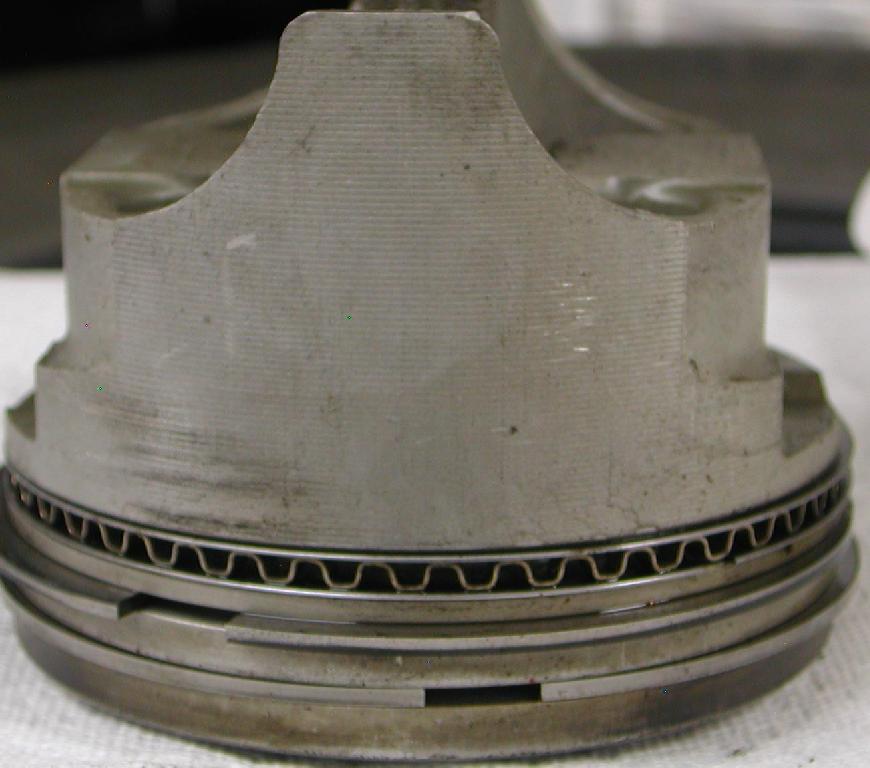
And here is a short-skirt style piston:

Notice on the first piston that there is a long "skirt" extending well below the piston pin - unlike the second picture. The longer skirts produce more drag and friction in the engine, which is part of the reason they don't use them in our engines.
The "slap" is the sound of the piston skirts hitting the cylinders walls as thrust direction changes. You only hear it when the eninge is cold because the pistons heat up as the engine gets hot, the clearance betweem the pistons and the cylinder walls reduces and the sound becimes inaudible.
As many of these engines as we've seen go 250K miles and more, I doubt it's anything to worry about. It may sound disconcerting, but it's just the nature of the beast.
And here is a short-skirt style piston:
Notice on the first piston that there is a long "skirt" extending well below the piston pin - unlike the second picture. The longer skirts produce more drag and friction in the engine, which is part of the reason they don't use them in our engines.
The "slap" is the sound of the piston skirts hitting the cylinders walls as thrust direction changes. You only hear it when the eninge is cold because the pistons heat up as the engine gets hot, the clearance betweem the pistons and the cylinder walls reduces and the sound becimes inaudible.
As many of these engines as we've seen go 250K miles and more, I doubt it's anything to worry about. It may sound disconcerting, but it's just the nature of the beast.

 (OR OUTSIDE)LOL