






[Z06] Heat extraction hoods.

Thread Starter
Intermediate

Joined: Oct 2009
Posts: 47
Likes: 0
From: San Antonio Texas
 Heat extraction hoods.
What is your take on heat extraction hoods? I drove around the other day with my hood popped open, thinking that it would increase airflow and cool the engine down. It actually had the opposite effect. Maybe the hot air was swirling around inside the engine compartment. What do you guys think?

Drifting


Joined: Jan 2008
Posts: 1,722
Likes: 138
From: Florida
St. Jude Donor '09
What is your take on heat extraction hoods? I drove around the other day with my hood popped open, thinking that it would increase airflow and cool the engine down. It actually had the opposite effect. Maybe the hot air was swirling around inside the engine compartment. What do you guys think?

Melting Slicks


Joined: Nov 2009
Posts: 2,536
Likes: 15
If you drive your vette "spiritedly" then you will notice an advantage to the vented hoods. Is it absolutly necessary, no but either is all the other stuff we bolt on these cars.
And about the faux racer look...these cars will hang with most of the higher end production cars so....psuedo..I think not.
There is an added down force advantage but the speed required to see this would need to be on a closed circuit.
Thanks....now..if you do not like the look thats one thing.
Last edited by LSOHOLIC; Sep 28, 2011 at 12:54 AM.

Safety Car


Joined: Jul 2004
Posts: 3,904
Likes: 29
From: Vancouver Washington
Corvette Stories
The Best of Corvette for Corvette Enthusiasts

Top 10 Most Expensive Corvettes Ever Sold on Bring A Trailer
Brett Foote
10 Things Every Corvette Owner Needs (2026 Edition)
Michael S. Palmer
8 Most "Only Corvette Owners Understand" Quirks and Problems
Pouria Savadkouei
10 Reasons the C6 Z06 is Still A Performance Benchmark After 20 Years
Joe Kucinski
How Much Horsepower Every Corvette Engine "LOST" in 1972
Joe Kucinski
Top 10 DOs and DON'Ts for Protecting Your Convertible Top!
Michael S. Palmer
Top 10 Most Explosive Corvettes Ever Made: Power-to-Weight Ratio Ranked!
Joe Kucinski
150 hp to 1,250 hp: Every Corvette Generation Compared by the Specs That Matter
Joe Kucinski
8 Coolest Corvette Pace Cars (and Replicas) of All Time
Verdad Gallardo


Drifting

Joined: Apr 2006
Posts: 1,876
Likes: 0
From: Edmond OK

Burning Brakes


Joined: Sep 2010
Posts: 1,137
Likes: 4
From: Indianapolis Indiana
St. Jude Donor '13, '15, ‘18, '21
Melting Slicks
Joined: Nov 2009
Posts: 2,536
Likes: 15


This is hard to explain in text...but here it goes. As you get to speed the air that enters the rad. has trouble exiting the engine compartment as fast as it is coming in. This results in the front end lifting, as in the front end of the car becoming less stable, commonly refered to as front end float, because the air is trapped in the engine compartment. And also as the air "builds up", the cooling system becomes less efficient because the air moving across the rad. is slowing down.
Now enter in the heat extractor style hoods....by allowing the heat and high pressure air to escape the engine compartment you reduce the air pressure build up and allow the cooling system to operate at a higher efficience.
As the air begins to escape from the hood vent, especially the center mid mounted vent it is being "sucked" by the air rushing past the vent from the laminar and boundary layer air traveling over the hood (externally). This can be measured by a manometer, imagine a straw..when you apply suction the fluid rises toward the source of suction. The same applies to the vented hood and the air racing past the vent..aka, drawing the air out from under the hood via the vent, thus causing more air to be pulled through the rad. And the cycle continues as the speed increases, thus causing down force via the air leaving the vent at a high rated of speed and as the air leaves the vent..remember its sucking more air through the rad.
Picture it happening, it literaly pushes the front of the car down and helps stick it to the track. ASE test reveiled that and 170 mph the C5R hood provided 300lb-ft of down force on the nose of the car (IIRC). All this is commonly known as Bernoulli's principle.
Thanks...
Safety Car
Joined: Jul 2004
Posts: 3,904
Likes: 29
From: Vancouver Washington
Technically it does add down force and reduces lift. Take a look at the C5R pics below.


This is hard to explain in text...but here it goes. As you get to speed the air that enters the rad. has trouble exiting the engine compartment as fast as it is coming in. This results in the front end lifting, as in the front end of the car becoming less stable, commonly refered to as front end float, because the air is trapped in the engine compartment. And also as the air "builds up", the cooling system becomes less efficient because the air moving across the rad. is slowing down.
Now enter in the heat extractor style hoods....by allowing the heat and high pressure air to escape the engine compartment you reduce the air pressure build up and allow the cooling system to operate at a higher efficience.
As the air begins to escape from the hood vent, especially the center mid mounted vent it is being "sucked" by the air rushing past the vent from the laminar and boundary layer air traveling over the hood (externally). This can be measured by a manometer, imagine a straw..when you apply suction the fluid rises toward the source of suction. The same applies to the vented hood and the air racing past the vent..aka, drawing the air out from under the hood via the vent, thus causing more air to be pulled through the rad. And the cycle continues as the speed increases, thus causing down force via the air leaving the vent at a high rated of speed and as the air leaves the vent..remember its sucking more air through the rad.
Picture it happening, it literaly pushes the front of the car down and helps stick it to the track. ASE test reveiled that and 170 mph the C5R hood provided 300lb-ft of down force on the nose of the car (IIRC). All this is commonly known as Bernoulli's principle.
Thanks...
This is hard to explain in text...but here it goes. As you get to speed the air that enters the rad. has trouble exiting the engine compartment as fast as it is coming in. This results in the front end lifting, as in the front end of the car becoming less stable, commonly refered to as front end float, because the air is trapped in the engine compartment. And also as the air "builds up", the cooling system becomes less efficient because the air moving across the rad. is slowing down.
Now enter in the heat extractor style hoods....by allowing the heat and high pressure air to escape the engine compartment you reduce the air pressure build up and allow the cooling system to operate at a higher efficience.
As the air begins to escape from the hood vent, especially the center mid mounted vent it is being "sucked" by the air rushing past the vent from the laminar and boundary layer air traveling over the hood (externally). This can be measured by a manometer, imagine a straw..when you apply suction the fluid rises toward the source of suction. The same applies to the vented hood and the air racing past the vent..aka, drawing the air out from under the hood via the vent, thus causing more air to be pulled through the rad. And the cycle continues as the speed increases, thus causing down force via the air leaving the vent at a high rated of speed and as the air leaves the vent..remember its sucking more air through the rad.
Picture it happening, it literaly pushes the front of the car down and helps stick it to the track. ASE test reveiled that and 170 mph the C5R hood provided 300lb-ft of down force on the nose of the car (IIRC). All this is commonly known as Bernoulli's principle.
Thanks...
 Explained far better than I could have. Thanks!
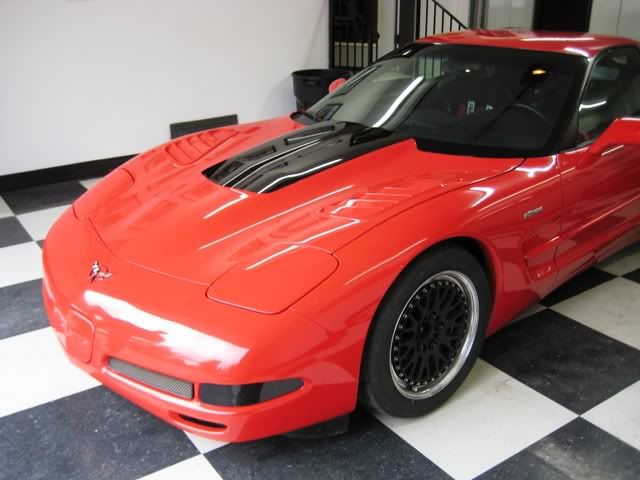
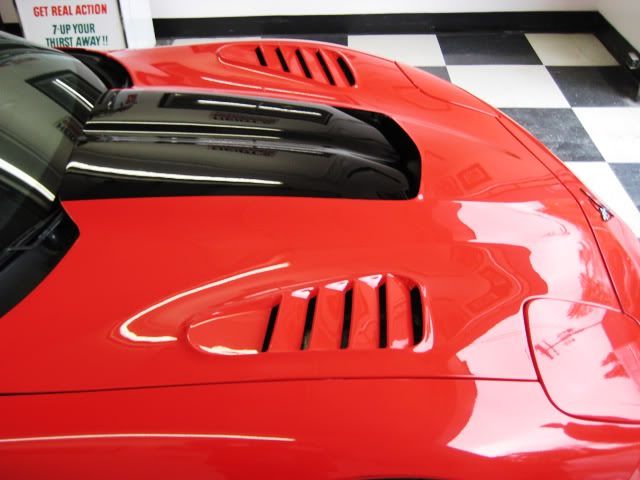
  The hood is made by ACP, the same people that made the C5R hood, and it's available in fiberglass or carbon fiber. The reduction is heat is just a side benefit, it was the downforce I was looking for.
Drifting
Joined: Jan 2008
Posts: 1,722
Likes: 138
From: Florida
St. Jude Donor '09
Technically it does add down force and reduces lift. Take a look at the C5R pics below.
Now enter in the heat extractor style hoods....by allowing the heat and high pressure air to escape the engine compartment you reduce the air pressure build up and allow the cooling system to operate at a higher efficience.
Picture it happening, it literaly pushes the front of the car down and helps stick it to the track. ASE test reveiled that and 170 mph the C5R hood provided 300lb-ft of down force on the nose of the car (IIRC). All this is commonly known as Bernoulli's principle.
Thanks...
Now enter in the heat extractor style hoods....by allowing the heat and high pressure air to escape the engine compartment you reduce the air pressure build up and allow the cooling system to operate at a higher efficience.
Picture it happening, it literaly pushes the front of the car down and helps stick it to the track. ASE test reveiled that and 170 mph the C5R hood provided 300lb-ft of down force on the nose of the car (IIRC). All this is commonly known as Bernoulli's principle.
Thanks...
The C5R's hood is a completely different configuration which also encompasses the top of the front wheel fenders. The vents on the outer edged are located directly above the wheels, not the engine compartment. The center opening on the C5-R hood is located directly behind the radiator, which by the way is mounted in a different location and positioned very differently from the production car. The center opening creates a cooling air flow path for the radiator, not under hood air.
If you choose to believe that this somewhat lookalike hood is providing you the same aerodynamic and cooling benefits as the one on the race car, you are fooling yourself.
Melting Slicks
Joined: Nov 2009
Posts: 2,536
Likes: 15
The C5R's hood is a completely different configuration which also encompasses the top of the front wheel fenders. The vents on the outer edged are located directly above the wheels, not the engine compartment. The center opening on the C5-R hood is located directly behind the radiator, which by the way is mounted in a different location and positioned very differently from the production car. The center opening creates a cooling air flow path for the radiator, not under hood air.
If you choose to believe that this somewhat lookalike hood is providing you the same aerodynamic and cooling benefits as the one on the race car, you are fooling yourself.
If you choose to believe that this somewhat lookalike hood is providing you the same aerodynamic and cooling benefits as the one on the race car, you are fooling yourself.
And you don't see an advantage ?? I'll steal a line from you since you said it so well....if you choose NOT to believe this somewhat look a like hood is providing you the SAME aerodynamic and cooling benefits as the one on the race car, you are fooling yourself.
Most of the heat extractor hoods for the c5 on the market today we derived from the World Challenge hood. As in the C5 World Challenge race cars..that had the same rad. configuration as the stock C5. Call ACP products (who make the World Challenge hood) and tell them it does nothing for the car.
I would hope to believe that we all understand that our C5's are not R's. That being said no one expects the same results but they do expect the hood to be a functioning piece, which it is. If it does 25% of what the C5R hood accomplished then I'm happy...because thats 25% more than a stock hood will allow.
Again, you never stated the down side of using the heat extractor style hood...please elaborate......
Thanks......sorry for any typos...this was typed from my phone.
Drifting
Joined: Apr 2006
Posts: 1,876
Likes: 0
From: Edmond OK
As I said before, a vented hood does not create downforce...it reduces lift. The same net effect, but not the same thing.
I think it's much simpler to say that the pressure of air decreases with velocity, meaning the airflow over the hood has a lower pressure that the air in the engine compartment...creating lift. Since air moves from high to low pressure, the effect can be neutralized by venting the hood and roughly equalizing the pressure.
Downforce would mean that the pressure above the hood would have to be greater than the pressure under it. This is true of surfaces like splitters, spoilers, and inverted airfoils.
I think it's much simpler to say that the pressure of air decreases with velocity, meaning the airflow over the hood has a lower pressure that the air in the engine compartment...creating lift. Since air moves from high to low pressure, the effect can be neutralized by venting the hood and roughly equalizing the pressure.
Downforce would mean that the pressure above the hood would have to be greater than the pressure under it. This is true of surfaces like splitters, spoilers, and inverted airfoils.
Melting Slicks
Joined: Nov 2009
Posts: 2,536
Likes: 15
As I said before, a vented hood does not create downforce...it reduces lift. The same net effect, but not the same thing.
I think it's much simpler to say that the pressure of air decreases with velocity, meaning the airflow over the hood has a lower pressure that the air in the engine compartment...creating lift. Since air moves from high to low pressure, the effect can be neutralized by venting the hood and roughly equalizing the pressure.
Downforce would mean that the pressure above the hood would have to be greater than the pressure under it. This is true of surfaces like splitters, spoilers, and inverted airfoils.
I think it's much simpler to say that the pressure of air decreases with velocity, meaning the airflow over the hood has a lower pressure that the air in the engine compartment...creating lift. Since air moves from high to low pressure, the effect can be neutralized by venting the hood and roughly equalizing the pressure.
Downforce would mean that the pressure above the hood would have to be greater than the pressure under it. This is true of surfaces like splitters, spoilers, and inverted airfoils.
Thanks......I was refering to the air exiting the vent....at a high rate of speed the air is leaving the vent at such a force that it is action down on the nose of the car. There was a big article on this in Engine Technology magazine where they tested the ALMs Caddy in a tunnel.
Last edited by LSOHOLIC; Sep 29, 2011 at 10:58 AM.
Melting Slicks
Joined: Nov 2009
Posts: 2,536
Likes: 15
I understand the number are a little misleading....they take the "known" lift at a given speed and basically add it to the downforce (lack of lift) with the new "aero" package. Example...@ 85 mph there is 50lb-ft of lift and with the aero package (hood) the test reveiled 50lb-ft down down force equalling 100lb-fts of down force at 85 mph.
At least that is the way I understand it.
Thanks...and down force or lift is a function of velocity squared.
At least that is the way I understand it.
Thanks...and down force or lift is a function of velocity squared.