



Question about fuel tanks
Thread Starter
Drifting


Joined: Jun 2013
Posts: 1,965
Likes: 343
From: Shell Point (Crawfordville) Florida
 Question about fuel tanks
I know we have 2 fuel tanks, one on each side. My question is, does fuel drain/pump from both sides equally, or from one tank onto the other, then to the engine? From a practical point of view, if you dump a bottle of Techron into a quarter of tank of fuel (as measured on the gauge), does it get into both tanks, does it mix, or not until you fill up the car?

Pro

Joined: Jul 2010
Posts: 666
Likes: 2
From: western springs illinois
I know we have 2 fuel tanks, one on each side. My question is, does fuel drain/pump from both sides equally, or from one tank onto the other, then to the engine? From a practical point of view, if you dump a bottle of Techron into a quarter of tank of fuel (as measured on the gauge), does it get into both tanks, does it mix, or not until you fill up the car?

Pro
Joined: Jul 2010
Posts: 666
Likes: 2
From: western springs illinois
I know we have 2 fuel tanks, one on each side. My question is, does fuel drain/pump from both sides equally, or from one tank onto the other, then to the engine? From a practical point of view, if you dump a bottle of Techron into a quarter of tank of fuel (as measured on the gauge), does it get into both tanks, does it mix, or not until you fill up the car?

Team Owner


Joined: May 2001
Posts: 36,836
Likes: 244
From: Dear Karma, I have a list of people you missed.
St. Jude Donor '08-'09-'10-'11-'12-'13-'14-'15-'16
I know we have 2 fuel tanks, one on each side. My question is, does fuel drain/pump from both sides equally, or from one tank onto the other, then to the engine? From a practical point of view, if you dump a bottle of Techron into a quarter of tank of fuel (as measured on the gauge), does it get into both tanks, does it mix, or not until you fill up the car?
Pour it in when level is low(er) (1/4 is good), then fill up completely and you're good.
HTH
Last edited by LoneStarFRC; May 9, 2014 at 03:33 PM. Reason: Typo correction

Administrator


Joined: Mar 2001
Posts: 368,390
Likes: 24,791
From: In a parallel universe. Currently own 2014 Stingray Coupe.
C7 of the Year - Modified Finalist 2021
MO Events Coordinator
St. Jude Co-Organizer
St. Jude Donor '03 thru '26
NCM Sinkhole Donor
CI 5, 8 & 11 Veteran

Tech Contributor

Joined: Dec 2003
Posts: 19,384
Likes: 87
From: Horncastle Lincolnshire, England
2023 C5 of the Year Finalist - Unmodified
The fuel system is slightly different on the 04 but for my 02 this describes what goes on and answers your question:
02 Fuel System Description
Two fuel tanks containing 9 gals each store the fuel supply. An electric fuel pump attaches to the fuel sender assembly inside the left fuel tank. The fuel pump pumps fuel through the fuel feed pipe (6) and an in-line fuel filter (9) to the fuel rail. The rear fuel feed pipe (6) has an integral check valve (4) in order to maintain the fuel system pressure in the feed pipe. The pump provides the fuel at a pressure greater than what is needed by the fuel injectors. The fuel pressure regulator, part of the fuel filter (9), keeps the fuel available to the injectors at a regulated pressure. A fuel return pipe (7) returns the unused fuel to the left fuel tank. The fuel pump also feeds the fuel through a tee (5) with an orifice in the fuel feed rear pipe (6) and through the auxiliary fuel feed rear pipe (2) in order to supply the siphon jet pump inside the right fuel tank. The siphon jet pump transfers the fuel from the right fuel tank to the left fuel tank through the auxiliary fuel return rear pipe (3, 8).:
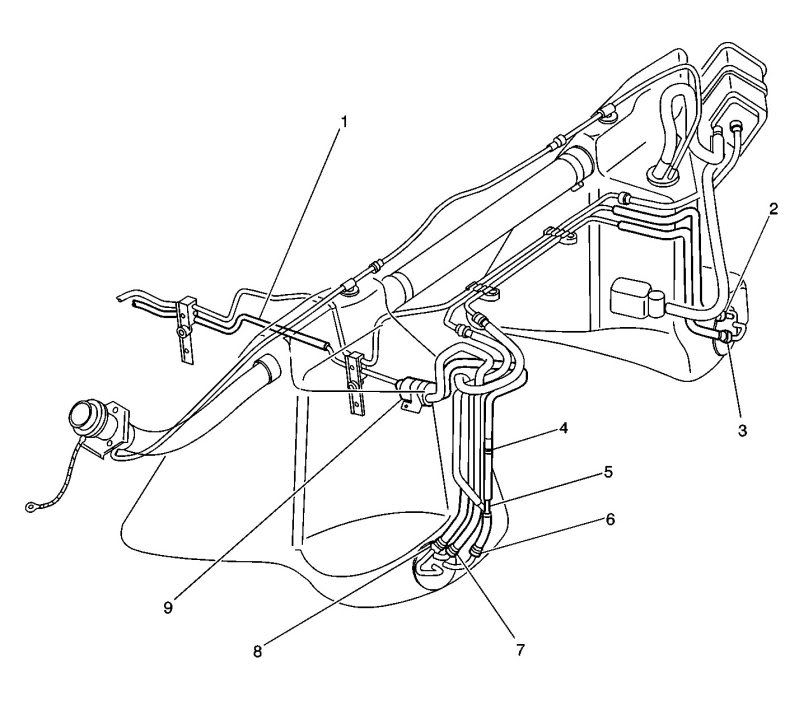
(1)Fuel Feed Pipe (2)Auxiliary Fuel Feed Rear Pipe (left tank to jet pump) (3)Auxiliary Fuel Return Rear Pipe (jet pump to left tank) (4)Fuel Feed Pipe Check Valve (5)Fuel Feed Pipe Tee with Orifice (6)Fuel Feed Rear Pipe (to fuel filter/fuel pressure regulator and siphon jet pump) (7)Fuel Return Rear Pipe (8)Auxiliary Fuel Return Rear Pipe (jet pump to left tank) (9)Fuel Filter/Fuel Pressure Regulator
02 Fuel System Description
Two fuel tanks containing 9 gals each store the fuel supply. An electric fuel pump attaches to the fuel sender assembly inside the left fuel tank. The fuel pump pumps fuel through the fuel feed pipe (6) and an in-line fuel filter (9) to the fuel rail. The rear fuel feed pipe (6) has an integral check valve (4) in order to maintain the fuel system pressure in the feed pipe. The pump provides the fuel at a pressure greater than what is needed by the fuel injectors. The fuel pressure regulator, part of the fuel filter (9), keeps the fuel available to the injectors at a regulated pressure. A fuel return pipe (7) returns the unused fuel to the left fuel tank. The fuel pump also feeds the fuel through a tee (5) with an orifice in the fuel feed rear pipe (6) and through the auxiliary fuel feed rear pipe (2) in order to supply the siphon jet pump inside the right fuel tank. The siphon jet pump transfers the fuel from the right fuel tank to the left fuel tank through the auxiliary fuel return rear pipe (3, 8).:
(1)Fuel Feed Pipe (2)Auxiliary Fuel Feed Rear Pipe (left tank to jet pump) (3)Auxiliary Fuel Return Rear Pipe (jet pump to left tank) (4)Fuel Feed Pipe Check Valve (5)Fuel Feed Pipe Tee with Orifice (6)Fuel Feed Rear Pipe (to fuel filter/fuel pressure regulator and siphon jet pump) (7)Fuel Return Rear Pipe (8)Auxiliary Fuel Return Rear Pipe (jet pump to left tank) (9)Fuel Filter/Fuel Pressure Regulator
Thread Starter
Drifting
Joined: Jun 2013
Posts: 1,965
Likes: 343
From: Shell Point (Crawfordville) Florida
Amazingly complicated system, and it's probably pretty much the same up to the C7's.
I used to have a Lotus Esprit that had 2 tanks that were filled separately on each side but were connected by a simple crossover pipe underneath eliminating all that extra hardware, pumps, pipes and sensors as well as the fancy computer. Why do you have to make something so complicated? And that also gives it more chance to fail. Some engineer had to justify his salary. Now that I know how this works, I'm almost sorry I asked.

I used to have a Lotus Esprit that had 2 tanks that were filled separately on each side but were connected by a simple crossover pipe underneath eliminating all that extra hardware, pumps, pipes and sensors as well as the fancy computer. Why do you have to make something so complicated? And that also gives it more chance to fail. Some engineer had to justify his salary. Now that I know how this works, I'm almost sorry I asked.

Pro
Joined: Jan 2010
Posts: 669
Likes: 13
Amazingly complicated system, and it's probably pretty much the same up to the C7's.
I used to have a Lotus Esprit that had 2 tanks that were filled separately on each side but were connected by a simple crossover pipe underneath eliminating all that extra hardware, pumps, pipes and sensors as well as the fancy computer. Why do you have to make something so complicated? And that also gives it more chance to fail. Some engineer had to justify his salary. Now that I know how this works, I'm almost sorry I asked.
I used to have a Lotus Esprit that had 2 tanks that were filled separately on each side but were connected by a simple crossover pipe underneath eliminating all that extra hardware, pumps, pipes and sensors as well as the fancy computer. Why do you have to make something so complicated? And that also gives it more chance to fail. Some engineer had to justify his salary. Now that I know how this works, I'm almost sorry I asked.
This system is a beautiful part of the C5-up Vette, it's nearly starvation-proof which is a big deal on a car that performs like this one. On cars with single tanks, or even separate tanks with nothing more than a crossover tube, pump starvation during high-G cornering is a very real issue that can be dangerous and also difficult to remedy. With this system, it really never happens, the fuel system is basically race-ready out of the gate.
Waxers could probably care less, fuel pumps never starve at car shows, but people who drive the Vette how it's meant to be driven tend to have more appreciation of the fact that this system works, and works well

Corvette Stories
The Best of Corvette for Corvette Enthusiasts

Top 10 Most Expensive Corvettes Ever Sold on Bring A Trailer
Brett Foote
10 Things Every Corvette Owner Needs (2026 Edition)
Michael S. Palmer
8 Most "Only Corvette Owners Understand" Quirks and Problems
Pouria Savadkouei
10 Reasons the C6 Z06 is Still A Performance Benchmark After 20 Years
Joe Kucinski
How Much Horsepower Every Corvette Engine "LOST" in 1972
Joe Kucinski
Top 10 DOs and DON'Ts for Protecting Your Convertible Top!
Michael S. Palmer
Top 10 Most Explosive Corvettes Ever Made: Power-to-Weight Ratio Ranked!
Joe Kucinski
150 hp to 1,250 hp: Every Corvette Generation Compared by the Specs That Matter
Joe Kucinski
8 Coolest Corvette Pace Cars (and Replicas) of All Time
Verdad Gallardo
Thread Starter
Drifting
Joined: Jun 2013
Posts: 1,965
Likes: 343
From: Shell Point (Crawfordville) Florida
OK, so maybe now I can understand the why behind this system, but my Lotus Esprit pulled at least as many lateral G's, if not more, than my C5, and never starved for fuel taking really fast corners. And there was equal weight on both sides. There is more than one way to solve a problem, and in my mind, the least complicated, the better. Maybe for the overall design of this car and all it's mechanicals, this had to be the solution. I'm glad it works, it's just got a lot of parts to it and computers needed just to read the fuel gauge. (And reading the link posted in #3 above, I now know where the Check Gauges Low Fuel warning comes from, even when it's not low.)
Thanks for all the replies and the new knowledge I've gained.

Thanks for all the replies and the new knowledge I've gained.