When you click on links to various merchants on this site and make a purchase, this can result in this site earning a commission. Affiliate programs and affiliations include, but are not limited to, the eBay Partner Network.
AFR Head Preparation – Setting the Rocker Wipe Pattern
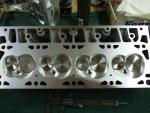
I have had several people e-mail and ask how to do this so I thought I would post this for discussion and information. I just finished setting up the wipe pattern of my Yella Terra roller rockers on my new AFR heads. The Yella Terra rockers are fixed fulcrum rockers (as opposed to a fully adjustable rocker like the Crane I set up on my current configuration) and are furnished with a rocker pedestal and a single shim that is 0.048” thick, which when placed under the pedestal, will raise the fulcrum of the rocker and move the roller location towards the exhaust side of the valve stem. The goal is to center the wipe pattern on the valve stem and minimize the width of the pattern. When the width is reduced over the course of rocker motion, then the side loading into the valve guides is also reduced. This not only provides faster valve motions but also minimizes valve guide wear. Below is a photo of how the Yella Terra setup is installed with the pedestal and shim (if used) under the rocker shaft and the bolt passing through the assembly and into the threaded hole in the head.
I am doing this on the workbench but this can also be done on the car. The workbench has the advantage that there is more time to set things up and if parts are needed the car won’t be down as it would if you were in the middle of the head installation. Plus, it’s easier on the back.
The first step is to remove two valve springs and replace them with checking springs. I have two sets of checking springs and I used the stiffer set since they provide more force against the rocker to help in wiping off the ink that is applied to obtain the final wipe pattern.
Once the check springs are installed, set the cylinder head in the air such that the valves can be manually operated without contacting the workbench surface. Using a dial indicator allows you to manually operate the rocker arm to the required valve lift. Since the final wipe pattern is lift sensitive, you have to ensure that the motion you are moving the rocker through imitates that which will be driven by the cam.
The next step in the operation is to setup your rockers and snug the bolts. There is no need to fully torque the bolts and load the threads in the aluminum head. Hand snug is fine and will eliminate thread wear as the bolts are taken in and out several times during the process. Once the rockers are in place with the shims that are being checked, and your measurement method is setup to determine how much the valve is being moved, use a Sharpie to spread black ink on the upper surface of the valve stem. I have found it best to not allow the ink to dry too long as with checking springs it doesn’t wipe off as well. Instead, I use a cotton swap and pull off most of the cotton then soak it with ink from the Sharpie. Then I simply rotate the rocker back off of the valve stem and apply the ink. After it is just dry, then the wipe test is conducted by rotating the rocker arm by hand in the same manner as the pushrod and cam would if the head were on the motor. This process is repeated until a satisfactory wipe pattern is found by adjusting the height of the shim. A thicker shim should push the wipe pattern towards the exhaust side of the valve stem. This will be critical later as the pushrod length changes approximately 0.016” in length for every 0.010” of shim you add to the rocker pedestal so that the wipe pattern needs to be established first followed by the pushrod length.
I started the process with no shim in place under the pedestal and then added shims until I got the desired wipe pattern. Washers can be used and stacked for this process but once a thickness is found you need to find a single piece shim of the correct thickness. In the photo below (sorry for the crappy photography), three of the patterns are shown. On the left is the wipe pattern without a shim. Notice that the wipe pattern is towards the intake side of the valve stem and barely gets to the valve stem center over the course of travel of the roller on the rocker. In the middle photo, shimming has now moved the wipe pattern towards the center of the valve stem. It is still biased to the intake side and a little wide. The final wipe pattern on the right is the shim setup I will use for final installation, as I am very pleased with the final wipe pattern obtained. Note that the shim value can be different for any given setup, the point being that simply bolting on the rockers from the box would have yielded the pattern on the left and likely resulted in not only disappointing results but higher than necessary valve guide wear for my installation. I bought my final shims (11/32" ID, 13/16" OD from McMaster-Carr, which are available in a lot of thicknesses. These were pretty much a perfect fit under the pedestal if you need a thickness that differs than the one provided by Yella Terra for any reason.
Last edited by vettenuts; Jul 19, 2017 at 07:35 AM.
You noted the included shims were .048" thick...what final thickness did you end up using? (I know it might differ for mine, but curious how much more shim you needed).
I have a set of these rockers sitting here, and I plan to take the time to set them up proper as you did. This was a a good read for me, thanks.
With non adjustable rockers that would be a lot to add to pushrod length to keep lifter preload in check. Anybody doing this in the car? It's hard to do with a hyd cam.
With non adjustable rockers that would be a lot to add to pushrod length to keep lifter preload in check. Anybody doing this in the car? It's hard to do with a hyd cam.
Are you asking if anyone has checked wipe in the car?
Are you asking if anyone has checked wipe in the car?
Well I'm sure it's possible, but how easy? I'd like to do mine without installing check springs, etc. I suppose you could do it turning over the engine, but you won't get full valve lift with the lifters not pumped up.
Nice job Bob. Have you used a similar method on the Crane's?
Yes, but rather than shim I used the adjuster nut. Then as a reference I measured the depth of the stud to the top of the adjustment nut that provided the best wipe so when you measure for your pushrod you set the nut to the correct height and then use the adjustable pushrod to measure for pushrod length. Did it that way on my current Crane setup and it worked quite well as the Crane supplied 7.250" pushrods wouldn't work with the Morel lifters due to the lifter height difference and the different preload requirement. The only hard part is the Cranes don't have anything to prevent them from moving side to side since there is no pushrod so the wipe patterns aren't quite as clean.
Last edited by vettenuts; Feb 8, 2008 at 05:26 AM.
Well I'm sure it's possible, but how easy? I'd like to do mine without installing check springs, etc. I suppose you could do it turning over the engine, but you won't get full valve lift with the lifters not pumped up.
Installing the check springs on the heads in the car is easy (assuming you have the valve spring tool, which you should if you are running aftermarket parts). Once the springs are in you rotate the piston down out of the way, set up the dial indicator as I did and then figure out the required shim height. Did it this way last summer on a friends car.
Bob, one thing to watch for now that the rockers are .125" higher is valve cover clearance. There are more than a few places under there that can interfere. There's not much room to begin with.
Bob, one thing to watch for now that the rockers are .125" higher is valve cover clearance. There are more than a few places under there that can interfere. There's not much room to begin with.
Fortunately I planned ahead. I am going to the 04 valley cover and 04 valve covers. Picked them up off of someone last fall that removed them from a crate motor. Baffles have been removed, and I have opened them up internally and smoothed them out. I am hoping to clay them this weekend with the rocker closed and rocker in full valve open position. Initial attempt with be with no valve cover gasket, if they fit that way I should be good. I'm sure something will come up though.
The advantage to these rockers (or a roller rocker in general) is not additional hp but the better wipe pattern and lower guide wear. A better wipe pattern can result in better power though. I don't believe I could have achieved any where near this good of a wipe pattern with the stock rockers, shimmed or otherwise.
For some....for others it's just part of the process of building an optimized combination...LOL
A stock rocker wont even come close to that wipe pattern....its night and day. A stock rocker "scrubs" over the valvestem tip (it doesnt roll), and leaves a wipe pattern that literally covers 60% of the valve tip (which places alot more sideloading on the valve guides increasing the rate of wear).
Benefits to a roller tip design dialed in for the proper geometry and wipe pattern are:
-Less friction
-Typically more net lift at the valve
-Less rocker arm flex (netting more lift at the valve as well)
-Reduced side loading and guide wear (extending the life of your guides and the oil consumption issues that can creep up due to loose guides).
-Slightly more power due to all the perks mentioned above (about 5 RWHP typically).
Great write-up Bob (as usual)....its something I would have liked to do myself for the folks out there but can simply never find the time.
Cheers,
Tony
Last edited by Tony Mamo @ AFR; Feb 8, 2008 at 01:45 PM.
Is is safe to assume that all AFRs would be the same?
Rob
It's "likely" to assume that all AFR's are the same (or certainly 205's), but the reality is stacking of tolerances can change and effect things (valves a few thou longer or shorter, valvejob depth slightly different (we have a certain tolerance we try to hold but they can vary), and even the height of the rocker pads can vary from machine to machine.
So in a nutshell, you must check to be sure but I would certainly start with a shim close to Bob's thickness to save some time. To be honest I have set up a few of our heads with only the shim thickness Yella Terra provides with their kit and have gotten good results (its half the thickness of Bob's), so IMO that would be probably a better place to start. Plus not checking is making assumptions that the height of the rockerstand and other issues related to the rocker kit istelf is also exactly the same (assumptions of any kind related to engine building are a bad thing.....LOL)
The real bottom line here is there are no short cuts building a quality engine the right way. Things must be double and triple checked to ensure everything is right. If you arent up to the task, pay someone qualified and detail oriented that is....its money well spent in the long run and usually results in more power and additional reliability.
I have been beating my 383 to death for almost three years (August will be three years since the first round of testing on the engine dyno)....it has seen countless blasts to the 7400 rev limiter and I have never had to do anything to it besides adjust the solid valvetrain from time to time (and change oil and plugs). Investing the proper time in assembly usually pays off in spades....it doesnt guarantee you wont have a problem or be down on power, but it certainly gives you a much better chance the results will be just the opposite of that.
Sorry for the long winded reply but I find the Internet leads some people to believe anyone can build an engine....while most people can bolt the parts together (its not rocket science), to build one properly requires certain tools, certain procedures, and alot of patience.
Cheers,
Tony
Last edited by Tony Mamo @ AFR; Feb 8, 2008 at 05:24 PM.













 AFR Head Preparation – Setting the Rocker Wipe Pattern