




Help!

Thread Starter
Pro


Joined: Apr 2007
Posts: 585
Likes: 2
 Rear Sway Bar and Alignment - Help Needed
OK ... I was finally fed up with the rear sway bar bushings squeaking, so I read some information on this forum on how to remove, clean, and grease them. It seemed easy enough. However, I've noticed that the lower A-arms have now moved into a more outward position (creating what would be more toe-in on the car). I only removed the nuts (not the bolts through the arms). I did this on the ground as I've always read that sway bars should be mounted in their resting position (not with the suspension hanging).
Help! Why did the A-arms move, and how do I get them back so my recently done alignment doesn't change?
LO PHAT
Update: As there were no replies while I was bolting everything back together, I lifted the rear of the car and torqued the nuts back to spec. I just took the car for a short drive, and, while there was no longer any squeaking, I am still worried about the alignment....
Help! Why did the A-arms move, and how do I get them back so my recently done alignment doesn't change?
LO PHAT
Update: As there were no replies while I was bolting everything back together, I lifted the rear of the car and torqued the nuts back to spec. I just took the car for a short drive, and, while there was no longer any squeaking, I am still worried about the alignment....
Last edited by LO PHAT; Apr 12, 2008 at 02:46 PM.

Team Owner


Joined: Sep 2001
Posts: 23,283
Likes: 906
From: Lake Elsinore, CA
Removing and replacing the sway bar will not change your alignment settings. The sway bar does connect the two wheels together to resist body roll during cornering but you will not change the alignment simply by loosening and tightening the brackets and/or end links as you've just described.
Thread Starter
Pro
Joined: Apr 2007
Posts: 585
Likes: 2
Removing and replacing the sway bar will not change your alignment settings. The sway bar does connect the two wheels together to resist body roll during cornering but you will not change the alignment simply by loosening and tightening the brackets and/or end links as you've just described.
I completely agree with you, of course. I consider myself to be very mechanically inclined, and removing the upper bracket bolts and lower bracket nuts certainly should not have adjusted anything on the rear alignment. That said, I am quite certain of what I watched happen and visually measured. The rear A-arm bushings (at the rear of the lower arms) moved in an outward direction by about 2 mm each. When I tightened things back up on the ground they remained in that position. When I then loosened them back up, lifted the car (tires off the ground), and retightened the nuts, they wound up perhaps only 1 mm off of their original position.
Clearly this shouldn't have happened, but it did. My question is, "Why did it happen, and will the A-arms settle back to where they were after some more driving?"
LO PHAT
Last edited by LO PHAT; Apr 12, 2008 at 07:05 PM.

Instructor

Joined: Nov 2007
Posts: 108
Likes: 0
From: Waukesha WI
I completely agree with you, of course. I consider myself to be very mechanically inclined, and removing the upper bracket bolts and lower bracket nuts certainly should not have adjusted anything on the rear alignment. That said, I am quite certain of what I watched happen and visually measured. The rear A-arm bushings (at the rear of the lower arms) moved in an outward direction by about 2 mm each. When I tightened things back up on the ground they remained in that position. When I then loosened them back up, lifted the car (tires off the ground), and retightened the nuts, they wound up perhaps only 1 mm off of their original position.
Clearly this shouldn't have happened, but it did. My question is, "Why did it happen, and will the A-arms settle back to where they were after some more driving?"
LO PHAT
Clearly this shouldn't have happened, but it did. My question is, "Why did it happen, and will the A-arms settle back to where they were after some more driving?"
LO PHAT
Thread Starter
Pro
Joined: Apr 2007
Posts: 585
Likes: 2
The alignment was technically done a year ago, but the car has only seen about 6,000 miles since that time. I seriously doubt that anything was left loose, but anything is possible at this point. Still, what could have been left loose that would allow the rear of the lower arms to move the way they did?
What I am fearful of is that the A-arm bushings may be wearing out. Even worse, it could be that the bolt holes in the aluminum cradle are slightly worn.
It is also possible (more like very certain) that I am more **** than most, and many people would simply miss observing this ever so slight change in the position of the bushings.
Maybe it is a little of all of the above....
Instructor
Joined: Nov 2007
Posts: 108
Likes: 0
From: Waukesha WI
Well, comming from experience working on alignments, i'm pretty sure that a 2mm movement would be 1.) VERY hard to notice with the naked eye, and 2.) probably would not affect the alignment of the car that significantly. Possibly moving the rear toe from say 2 degrees to 2.10 degrees, which would make a difference if it was a race car, but none on a street car.
Thread Starter
Pro
Joined: Apr 2007
Posts: 585
Likes: 2
Well, comming from experience working on alignments, i'm pretty sure that a 2mm movement would be 1.) VERY hard to notice with the naked eye, and 2.) probably would not affect the alignment of the car that significantly. Possibly moving the rear toe from say 2 degrees to 2.10 degrees, which would make a difference if it was a race car, but none on a street car.
Let me explain a little better so you don't think I'm crazy.

On the outter rear of the rubber bushings in the lower A-arms, there are flat spots on the bushings where they previously rested/rubbed inside of the aluminum cradle. When I was first removing the nuts, I noticed on each side that the flat spot would become visible and then continue to grow outward until it was exposed about 2 mm in length from the edge of the aluminum cradle that created it. As stated above, tightening the nuts back up did nothing to bring the bushings back inward to their original resting position while the car was on the ground. Tightening the nuts with the tires in the air brought the bushings back inward about 1 mm each.
So ... I am at a loss. I know it happened, and it was quite visible to my detail oriented eyes. I just want to know why it happened. Also, do you really think that shifting the rear of each A-arm outward by 1 mm would only create .10 degree difference in toe?
Thank you for the replies,
LO PHAT

Le Mans Master


Joined: Dec 2001
Posts: 7,788
Likes: 6
From: Winchester TN
Cruise-In III Veteran
Cruise-In IV Veteran
Cruise-In V Veteran
St. Jude Donor '03-'04-'05-'06-'07-'11
Hi LO PHAT -
The only way you could get that kind of lateral movement unintentionally would be from wear in the control arm bushings.
The only bolt that you loosened was the one that runs through the lower rear control arm bushing, and the attachment points on the suspension cradle.
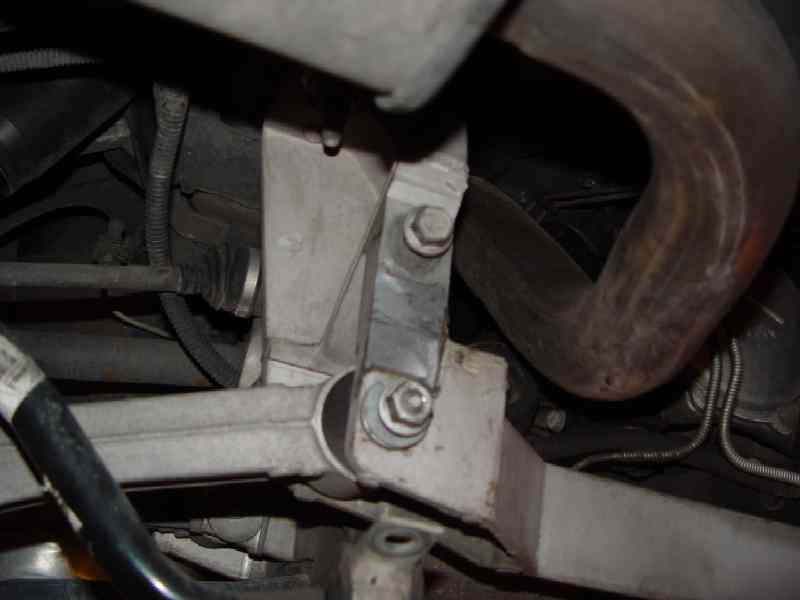
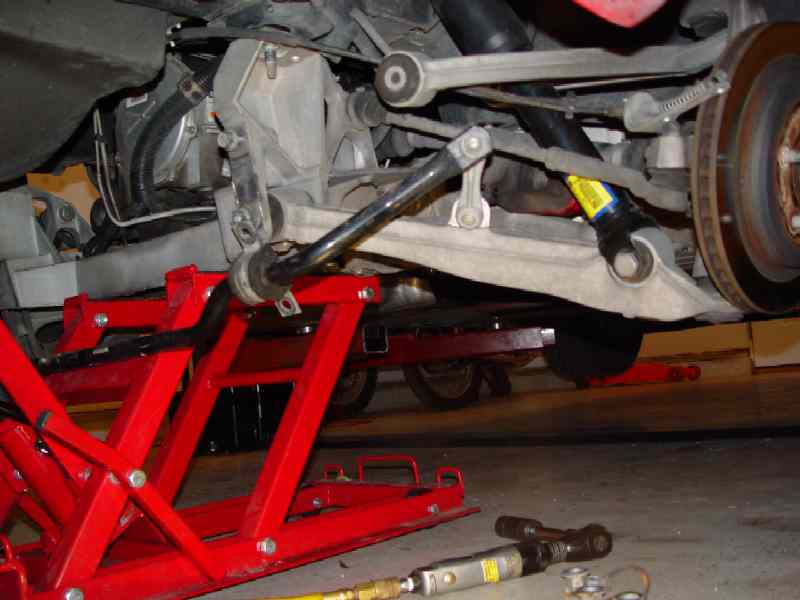
These are wear items, and not unreasonable to think that they could get a little sloppy with wear.
I would add that a year is a long time, and I am finding that these cars seem to get beat out of alignment - maybe it is the stiff suspension and the huge tires - but with tires so costly, I would suggest having the alignment checked to protect your tires from undue wear.
best regards -
mqqn
The only way you could get that kind of lateral movement unintentionally would be from wear in the control arm bushings.
The only bolt that you loosened was the one that runs through the lower rear control arm bushing, and the attachment points on the suspension cradle.
These are wear items, and not unreasonable to think that they could get a little sloppy with wear.
I would add that a year is a long time, and I am finding that these cars seem to get beat out of alignment - maybe it is the stiff suspension and the huge tires - but with tires so costly, I would suggest having the alignment checked to protect your tires from undue wear.
best regards -
mqqn
Corvette Stories
The Best of Corvette for Corvette Enthusiasts

Top 10 Most Explosive Corvettes Ever Made: Power-to-Weight Ratio Ranked!
Joe Kucinski
150 hp to 1,250 hp: Every Corvette Generation Compared by the Specs That Matter
Joe Kucinski
8 Coolest Corvette Pace Cars (and Replicas) of All Time
Verdad Gallardo
Top 10 Corvette Engines RANKED by Peak Torque (70+ Years of Muscle!)
Joe Kucinski
Corvette ZR1X Will Be Pacing the Indy 500, And Could Probably Race, Too!
Verdad Gallardo
Top 10 Corvettes Coming to Mecum Indy 2026!
Brett Foote
Top 10 C9 Corvette MUST-HAVES to Fix These C8 Generation Flaws!
Michael S. Palmer
10 Revolutionary 'Corvette Firsts' Most People Don't Know
Joe Kucinski
5 Reasons to Upgrade to an LS6-Powered Corvette; 5 Reasons to Stay LT2
Michael S. Palmer
Instructor
Joined: Nov 2007
Posts: 108
Likes: 0
From: Waukesha WI
Hi LO PHAT -
The only way you could get that kind of lateral movement unintentionally would be from wear in the control arm bushings.
The only bolt that you loosened was the one that runs through the lower rear control arm bushing, and the attachment points on the suspension cradle.
These are wear items, and not unreasonable to think that they could get a little sloppy with wear.
I would add that a year is a long time, and I am finding that these cars seem to get beat out of alignment - maybe it is the stiff suspension and the huge tires - but with tires so costly, I would suggest having the alignment checked to protect your tires from undue wear.
best regards -
mqqn
The only way you could get that kind of lateral movement unintentionally would be from wear in the control arm bushings.
The only bolt that you loosened was the one that runs through the lower rear control arm bushing, and the attachment points on the suspension cradle.
These are wear items, and not unreasonable to think that they could get a little sloppy with wear.
I would add that a year is a long time, and I am finding that these cars seem to get beat out of alignment - maybe it is the stiff suspension and the huge tires - but with tires so costly, I would suggest having the alignment checked to protect your tires from undue wear.
best regards -
mqqn
Thread Starter
Pro
Joined: Apr 2007
Posts: 585
Likes: 2
Good information there, guys. I'm leaning toward worn bushings too.
In studying those pictures, I am curious about two things: 1) Is the toe setting primarily controlled by the adjustable rod rather than the A-arm mounting points? 2) It appears that there are washers on the car pictured (behind the lower A-arm nuts) that are not on my car.
I'll drive the car without worry for now. If the bushings still haven't settled back into their old positions in a week or so, I'll likely get the whole car aligned again.
LO PHAT
In studying those pictures, I am curious about two things: 1) Is the toe setting primarily controlled by the adjustable rod rather than the A-arm mounting points? 2) It appears that there are washers on the car pictured (behind the lower A-arm nuts) that are not on my car.
I'll drive the car without worry for now. If the bushings still haven't settled back into their old positions in a week or so, I'll likely get the whole car aligned again.
LO PHAT
Le Mans Master
Joined: Dec 2001
Posts: 7,788
Likes: 6
From: Winchester TN
Cruise-In III Veteran
Cruise-In IV Veteran
Cruise-In V Veteran
St. Jude Donor '03-'04-'05-'06-'07-'11
Good information there, guys. I'm leaning toward worn bushings too.
In studying those pictures, I am curious about two things: 1) Is the toe setting primarily controlled by the adjustable rod rather than the A-arm mounting points? 2) It appears that there are washers on the car pictured (behind the lower A-arm nuts) that are not on my car.
I'll drive the car without worry for now. If the bushings still haven't settled back into their old positions in a week or so, I'll likely get the whole car aligned again.
LO PHAT
In studying those pictures, I am curious about two things: 1) Is the toe setting primarily controlled by the adjustable rod rather than the A-arm mounting points? 2) It appears that there are washers on the car pictured (behind the lower A-arm nuts) that are not on my car.
I'll drive the car without worry for now. If the bushings still haven't settled back into their old positions in a week or so, I'll likely get the whole car aligned again.
LO PHAT
Good eye! lol
That car has an aftermarket catback on it, and the owner had used stacks of washers on those bolts to align his catback.
best regards -
mqqn