



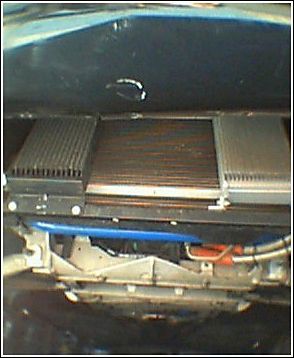

Trans cooler mounting position - HELP!

Thread Starter
Burning Brakes

Joined: Jun 2006
Posts: 933
Likes: 0
From: St. Paul MN
 Trans cooler mounting position - HELP!
I'm currently in the process of mounting a b&m 70264 supercooler. The instructions are worthless, can somebody help me out:
1)Is there a designated inlet and outlet for this cooler?
2)Does the cooler have to be mounted with the two fittings facing upwards?
3)Is it a bad idea to use the zip ties to mount the cooler?
4)The bottom line coming off of the radiator is the return line correct?
Thanks!
1)Is there a designated inlet and outlet for this cooler?
2)Does the cooler have to be mounted with the two fittings facing upwards?
3)Is it a bad idea to use the zip ties to mount the cooler?
4)The bottom line coming off of the radiator is the return line correct?
Thanks!

Pro

Joined: Sep 2003
Posts: 731
Likes: 0
From: Calgary Alberta
I'm currently in the process of mounting a b&m 70264 supercooler. The instructions are worthless, can somebody help me out:
1)Is there a designated inlet and outlet for this cooler?
2)Does the cooler have to be mounted with the two fittings facing upwards?
3)Is it a bad idea to use the zip ties to mount the cooler?
4)The bottom line coming off of the radiator is the return line correct?
Thanks!
1)Is there a designated inlet and outlet for this cooler?
2)Does the cooler have to be mounted with the two fittings facing upwards?
3)Is it a bad idea to use the zip ties to mount the cooler?
4)The bottom line coming off of the radiator is the return line correct?
Thanks!
2)One fitting should be above the other fitting; and the fitting to use as the inlet should be one you place at the bottom.
3) there is a B&M (or any other brand) cooler mounting kit that you can buy with proper cooler attachment ties.
4) if you live in a hot climate state you're better off to bypass the radiator altogether.
Thread Starter
Burning Brakes
Joined: Jun 2006
Posts: 933
Likes: 0
From: St. Paul MN
1) it doesn't matter which one you use as inlet or outlet
2)One fitting should be above the other fitting; and the fitting to use as the inlet should be one you place at the bottom.
3) there is a B&M (or any other brand) cooler mounting kit that you can buy with proper cooler attachment ties.
4) if you live in a hot climate state you're better off to bypass the radiator altogether.
2)One fitting should be above the other fitting; and the fitting to use as the inlet should be one you place at the bottom.
3) there is a B&M (or any other brand) cooler mounting kit that you can buy with proper cooler attachment ties.
4) if you live in a hot climate state you're better off to bypass the radiator altogether.
The cooler came with the mounting kit, is this what you're referring to? I was concerned running anything through the condenser. Has anyone developed leaks doing this?
I live in MinneSNOWta
 . The bottom line is the return correct?
Burning Brakes
Joined: Aug 2006
Posts: 1,217
Likes: 5
From: Stark County Ohio
Heat rises. On most cars, the car radiator has its inlet at the top while cooled water exits at the bottom of the radiator.
Personally, I mount the trans oil cooler with the inlet at the top with the outlet flow at the bottom, just like most radiators. Whether it makes a significant difference or a slight difference I cannot say.
Accessibility is also a factor in how one mounts the cooler.
Personally, I mount the trans oil cooler with the inlet at the top with the outlet flow at the bottom, just like most radiators. Whether it makes a significant difference or a slight difference I cannot say.
Accessibility is also a factor in how one mounts the cooler.

Melting Slicks


Joined: Feb 2006
Posts: 2,172
Likes: 104
From: Des Moines Iowa
Heat rises. On most cars, the car radiator has its inlet at the top while cooled water exits at the bottom of the radiator.
Personally, I mount the trans oil cooler with the inlet at the top with the outlet flow at the bottom, just like most radiators. Whether it makes a significant difference or a slight difference I cannot say.
Accessibility is also a factor in how one mounts the cooler.
Personally, I mount the trans oil cooler with the inlet at the top with the outlet flow at the bottom, just like most radiators. Whether it makes a significant difference or a slight difference I cannot say.
Accessibility is also a factor in how one mounts the cooler.

Corvette Stories
The Best of Corvette for Corvette Enthusiasts

Top 10 Most Expensive Corvettes Ever Sold on Bring A Trailer
Brett Foote
10 Things Every Corvette Owner Needs (2026 Edition)
Michael S. Palmer
8 Most "Only Corvette Owners Understand" Quirks and Problems
Pouria Savadkouei
10 Reasons the C6 Z06 is Still A Performance Benchmark After 20 Years
Joe Kucinski
How Much Horsepower Every Corvette Engine "LOST" in 1972
Joe Kucinski
Top 10 DOs and DON'Ts for Protecting Your Convertible Top!
Michael S. Palmer
Top 10 Most Explosive Corvettes Ever Made: Power-to-Weight Ratio Ranked!
Joe Kucinski
150 hp to 1,250 hp: Every Corvette Generation Compared by the Specs That Matter
Joe Kucinski
8 Coolest Corvette Pace Cars (and Replicas) of All Time
Verdad Gallardo


Thread Starter
Burning Brakes
Joined: Jun 2006
Posts: 933
Likes: 0
From: St. Paul MN
I don't mean to beat this to death but:
1)The botton line coming out of the radiator is the return line correct?
2)I've mounted the tube and fin style coolers in many different ways as it really doesn't matter as the fluid must follow the same path regardless if its right-side-up, side-ways, upside-down....
With the plate style cooler 100% of the photos I've seen have the fittings facing up....which always seems to be the most inconvenient position. I'm assuming that with the plate-style coolers the fitting MUST face up? Again, B&M makes no mention of the correct orientation...I'll never buy another B&M product.
1)The botton line coming out of the radiator is the return line correct?
2)I've mounted the tube and fin style coolers in many different ways as it really doesn't matter as the fluid must follow the same path regardless if its right-side-up, side-ways, upside-down....
With the plate style cooler 100% of the photos I've seen have the fittings facing up....which always seems to be the most inconvenient position. I'm assuming that with the plate-style coolers the fitting MUST face up? Again, B&M makes no mention of the correct orientation...I'll never buy another B&M product.

Burning Brakes
Joined: Feb 2005
Posts: 752
Likes: 1
From: Tulsa OK
I don't mean to beat this to death but:
1)The botton line coming out of the radiator is the return line correct?
2)I've mounted the tube and fin style coolers in many different ways as it really doesn't matter as the fluid must follow the same path regardless if its right-side-up, side-ways, upside-down....
With the plate style cooler 100% of the photos I've seen have the fittings facing up....which always seems to be the most inconvenient position. I'm assuming that with the plate-style coolers the fitting MUST face up? Again, B&M makes no mention of the correct orientation...I'll never buy another B&M product.
1)The botton line coming out of the radiator is the return line correct?
2)I've mounted the tube and fin style coolers in many different ways as it really doesn't matter as the fluid must follow the same path regardless if its right-side-up, side-ways, upside-down....
With the plate style cooler 100% of the photos I've seen have the fittings facing up....which always seems to be the most inconvenient position. I'm assuming that with the plate-style coolers the fitting MUST face up? Again, B&M makes no mention of the correct orientation...I'll never buy another B&M product.
I don't think it matters how the cooler is oriented - I mounted mine in front of the condensor with the inlets facing up - this made it easier to bring the line around the side of the radiator to the return line.
The kit should have come with long zip tie type fasteners that you push through the radiator & condensor fins and finally through the cooler bracket hole before to install the retainer. Cut off any excess fastener that sticks out after the retainer is slid on. The hardest part is getting them pushed through the radiator/ condensor fins so they will align with the holes in the cooler bracket.
The fittings I received with my kit did not fit the radiator inlet so I just cut the return line from the radiator and attached the cooler hoses to it.
Last edited by EStreeter; Jun 18, 2008 at 03:47 PM.
Burning Brakes
Joined: Feb 2005
Posts: 752
Likes: 1
From: Tulsa OK
With the inlets of the cooler facing up, you can poor trans fluid into the one of the hoses until it tops off in the other. This would probably work just as well with inlets facing to the side. If the inlets face down you won't be able to get the air out. Then connect the hoses to the trans return line and you won't lose the cooler fluid volume of your trans fluid level.
Burning Brakes
Joined: Feb 2005
Posts: 752
Likes: 1
From: Tulsa OK
I owned a chrylser product that had a bleeder fitting on top of the thermostat housing to let trapped air out or the cooling system would get a vapor lock after a coolant change and over heat - ask me how I know this.
